PLC vs SCADA: What's the Difference and Do You Need Both?
What is a PLC? (Plain English)
A PLC (Programmable Logic Controller) is a rugged industrial computer designed to control machines and processes in factories. Think of it as the brain that tells a machine:
- When to start and stop
- How fast to run
- What to do when something goes wrong
- How to coordinate with other machines
PLCs replaced hardwired relay systems in the 1960s. Today, every automated factory in the world runs on PLCs. From the conveyor belt that moves packages at Amazon to the bottling line that fills your Coca-Cola, PLCs control it all.
Popular PLC brands: Siemens, Allen Bradley (Rockwell), Mitsubishi, ABB, Delta, Schneider Electric, Omron
What is SCADA? (Plain English)
SCADA (Supervisory Control and Data Acquisition) is the software system that lets operators monitor and control an entire factory or plant from a central location. If a PLC is the brain of a single machine, SCADA is the nervous system of the whole facility.
SCADA provides:
- Real-time monitoring, See every sensor, valve, and motor on screen
- Alarm management, Get alerts when something goes wrong
- Data logging, Record process data for analysis
- Remote control, Operate equipment from the control room
- Historical trends, Track performance over time
Popular SCADA software: Siemens WinCC, Rockwell FactoryTalk View, Inductive Automation Ignition
How PLC and SCADA Work Together
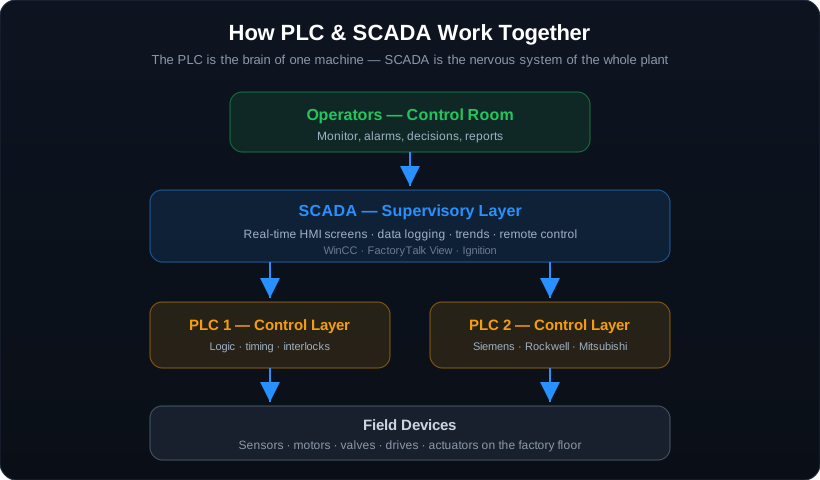
PLC and SCADA are not competing technologies, they work together:
- PLCs sit on the factory floor, directly connected to sensors, motors, and valves
- SCADA sits in the control room, communicating with PLCs over industrial networks
- PLCs send real-time data to SCADA (temperatures, pressures, speeds)
- SCADA displays this data on screens and stores it in databases
- Operators use SCADA to send commands back to PLCs
It's like a pilot (SCADA) and an autopilot system (PLC). The autopilot flies the plane, but the pilot monitors everything and can override when needed.
Career Paths: PLC Engineer vs SCADA Engineer
| PLC Engineer | SCADA Engineer | |
|---|---|---|
| Focus | Hardware + programming | Software + data |
| Daily work | Wiring, programming, commissioning | Configuration, HMI design, networking |
| Location | Factory floor | Control room + office |
| Tools | TIA Portal, Studio 5000, multimeter | WinCC, FactoryTalk, SQL |
| Salary range | 4-22 LPA | 4-20 LPA |
Why Learning Both Makes You More Employable
Engineers who know BOTH PLC and SCADA are significantly more valuable because:
- Most real projects require both skills
- Troubleshooting often spans PLC logic and SCADA communication
- You can handle projects end-to-end without dependency on others
- Companies prefer hiring one versatile engineer over two specialists
At EDWartens, the AEP program covers both PLC programming (20 brands) and SCADA systems (WinCC, FactoryTalk View, Ignition). This dual competency is what gives graduates their competitive edge.
Ready to Learn Both?
Explore the AEP, Automation Engineer Program or book a consultation.
Learn this, free
The courses that teach this
Every lesson, the written notes and the practice are free with an account. Only the certificate is optional and paid.