Alarm Management with ISA-18.2: How to Design Alarms an Operator Can Actually Use

The problem the standard exists for
Every major process incident report of the last thirty years has an alarm chapter. At Texas City in 2005 the operators had a flood of alarms and no way to see the one that mattered. At Buncefield the high-level alarm that should have stopped the overfill never reached anyone. The pattern is the same: it is easy to add an alarm and nobody ever removes one, so the list grows until it is noise.
ISA-18.2 (also published as IEC 62682) is the standard for Management of Alarm Systems for the Process Industries. It does not tell you which alarms to have. It tells you how to decide, how to document, how to measure, and how to keep the system healthy for the life of the plant.
What an alarm is, by the standard
An alarm is an audible or visible means of indicating an equipment malfunction, process deviation or abnormal condition requiring a timely response. Three tests hide in that sentence:
- It must indicate something abnormal.
- It must require a response from the operator.
- The response must be needed in time to matter.
A status change that needs no action is a notification, not an alarm, and belongs on a screen, not in the alarm list. This one distinction removes a third of most alarm lists on its own.
The alarm management lifecycle
ISA-18.2 is organised as a lifecycle, and the stages are the outline of any alarm project:
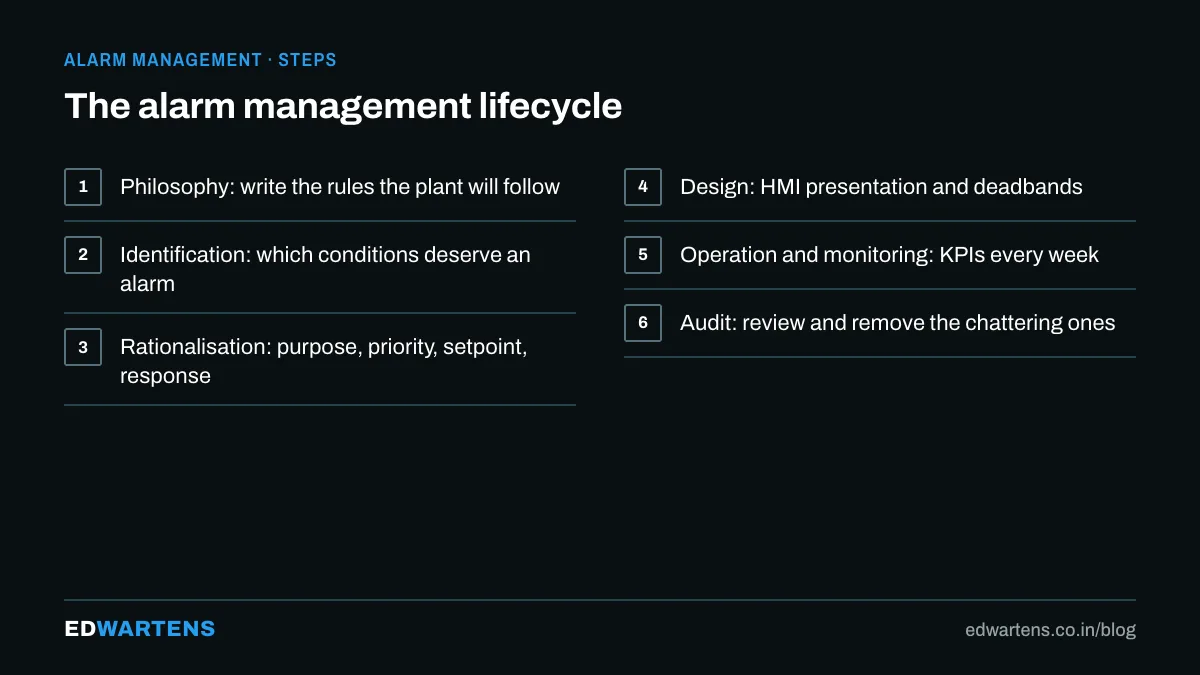
- Philosophy. A site document that says how alarms are classified, prioritised, presented and reviewed. Written once, applied to every alarm.
- Identification. Where alarms come from: HAZOPs, P&IDs, operating procedures, incident reviews.
- Rationalisation. Each candidate alarm is tested against the philosophy: consequence, time to respond, the operator's action. Priority is set from consequence and time, not from how loud somebody argued.
- Detailed design. Setpoints, deadbands, delays, suppression rules, display.
- Implementation. Configuring the SCADA, testing and training.
- Operation and maintenance. The alarms are used, shelved, and kept working.
- Monitoring and assessment. Measuring performance against targets.
- Management of change and audit wrap around all of it.
The numbers that define a healthy system
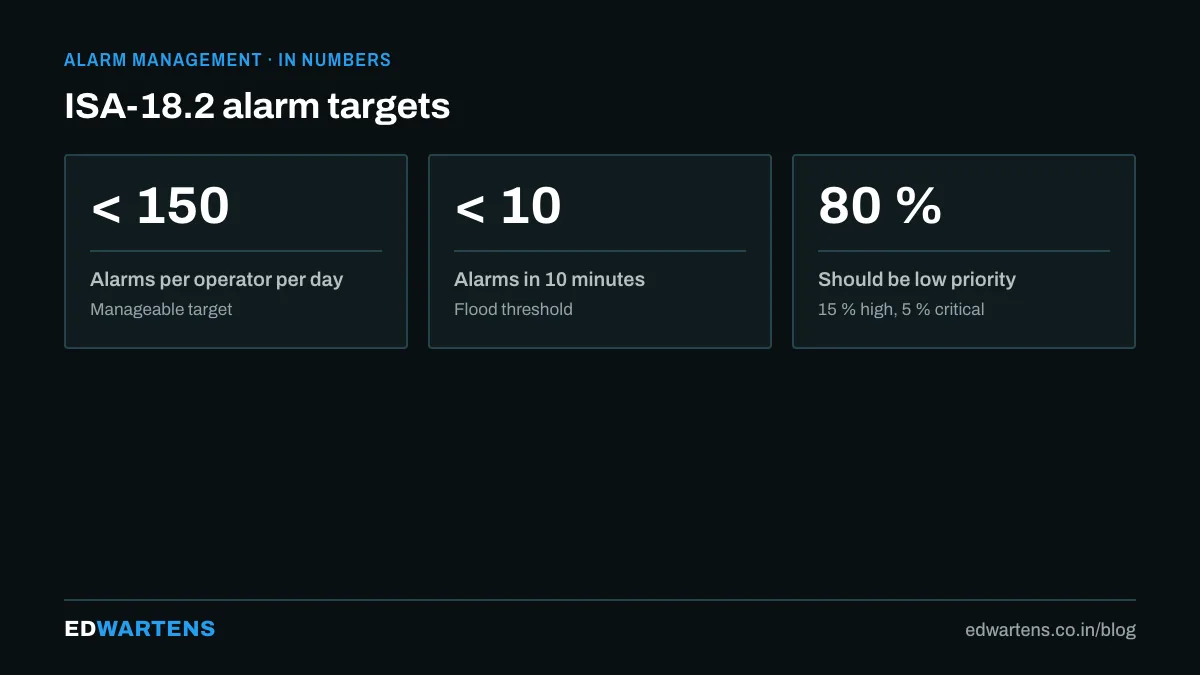
The standard gives target metrics per operator console, and they are the quickest way to judge any SCADA you walk up to:
Metric | Target | Maximum acceptable |
|---|---|---|
Average alarms per hour | about 6 | 12 |
Average alarms per 10 minutes | 1 | 2 |
Peak alarms per 10 minutes | under 10 | |
Time in flood (more than 10 per 10 minutes) | under 1 percent | |
Share from the top 10 most frequent alarms | under 5 percent | |
Stale alarms (standing more than 24 hours) | under 5 on any day | |
Priority split (high, medium, low) | about 5, 15, 80 percent |
If you have never measured these on your plant, export a week of the alarm journal and count. Most systems are far outside them, and the top ten most frequent alarms usually account for a third of everything.
Rationalising an existing alarm list
The practical method, which works in a workshop with an operator, a process engineer and a controls engineer:
- Export the alarm configuration and a month of the alarm journal.
- Sort by frequency. Deal with the top ten first: each is usually a bad setpoint, a chattering discrete input or a nuisance that needs a delay or deadband.
- For every remaining alarm ask the three questions: what is abnormal, what does the operator do, how long do they have. If there is no action, it is not an alarm.
- Assign priority from a consequence and time matrix, the same matrix for every alarm.
- Write the response into the alarm's help text so the operator sees it when the alarm appears.
- Record everything in a master alarm database, because the SCADA configuration will drift and the database is the truth.
Configuring it in the SCADA
Deadband, on-delay and off-delay are the tools that remove chattering. State-based alarming (different limits when the unit is starting, running or shut down) removes the floods at every start-up. Shelving lets an operator silence a known nuisance for a fixed time with a record, which is what stops people disabling alarms permanently. Our article on HMI alarm configuration shows these settings screen by screen, and the Wonderware InTouch and Ignition free courses configure them in practice.
For how PLC, SCADA and DCS differ and what you build in our classroom, see PLC vs SCADA vs DCS in Bangalore.
Frequently asked questions
Is ISA-18.2 mandatory in India? Not by law, but pharma and oil and gas clients specify it, and it is referenced by IEC 62682, which is the international equivalent.
How many priorities should we use? Three or four. More than that and operators cannot tell them apart in the moment.
What is the single biggest improvement? Deleting alarms with no operator action, then fixing the top ten most frequent. Those two steps usually halve the alarm rate.
Learn this, free
The courses that teach this
Every lesson, the written notes and the practice are free with an account. Only the certificate is optional and paid.


