Automation Engineering in Pharma: GAMP 5, 21 CFR Part 11 and What Validation Means for Your PLC Code

Why pharma is different
On a packaging line, a wrong PLC change costs a shift. On a sterile filling line it can cost a batch, a recall, and the plant's licence. Indian pharma, the world's largest supplier of generics, runs under US FDA, EU and CDSCO inspection, and every automated system that touches product quality must be validated: proven, with documents, to do what it is specified to do. The automation engineer who understands this is paid for it.
GAMP 5 in plain terms
GAMP 5 (Good Automated Manufacturing Practice, from ISPE) is the guide for validating computerised systems. Its ideas:
- Risk-based: validate in proportion to the risk to patient safety, product quality and data integrity.
- Software categories: Category 1 infrastructure, Category 3 non-configured (a standard instrument), Category 4 configured (a SCADA, a PLC using standard blocks configured for the plant), Category 5 custom (bespoke code). Most PLC programs are Category 4 with Category 5 elements, and the custom parts get the most testing.
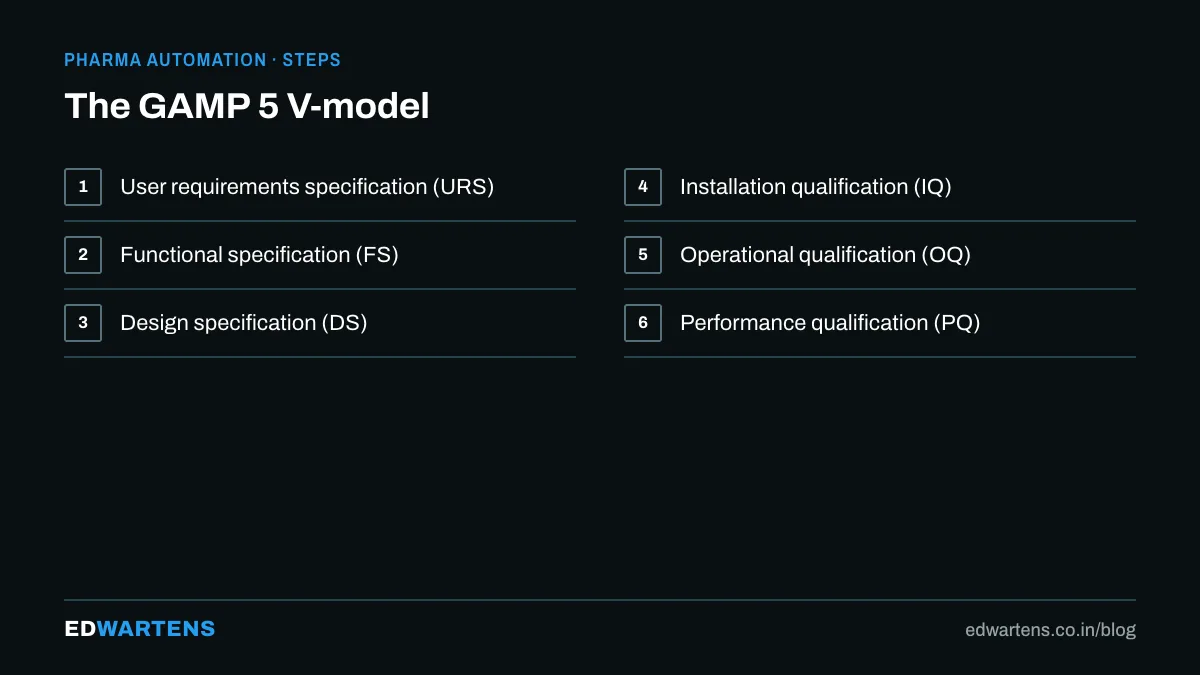
- The V-model: user requirements specification (URS), functional specification (FS), design specification (DS) on the way down; installation, operational and performance qualification (IQ, OQ, PQ) on the way up, each test tracing to a requirement.
- Supplier assessment: how much you can lean on the vendor's own testing.
21 CFR Part 11 and Annex 11
21 CFR Part 11 is the US FDA rule for electronic records and electronic signatures; EU Annex 11 is the equivalent. For the systems you build:
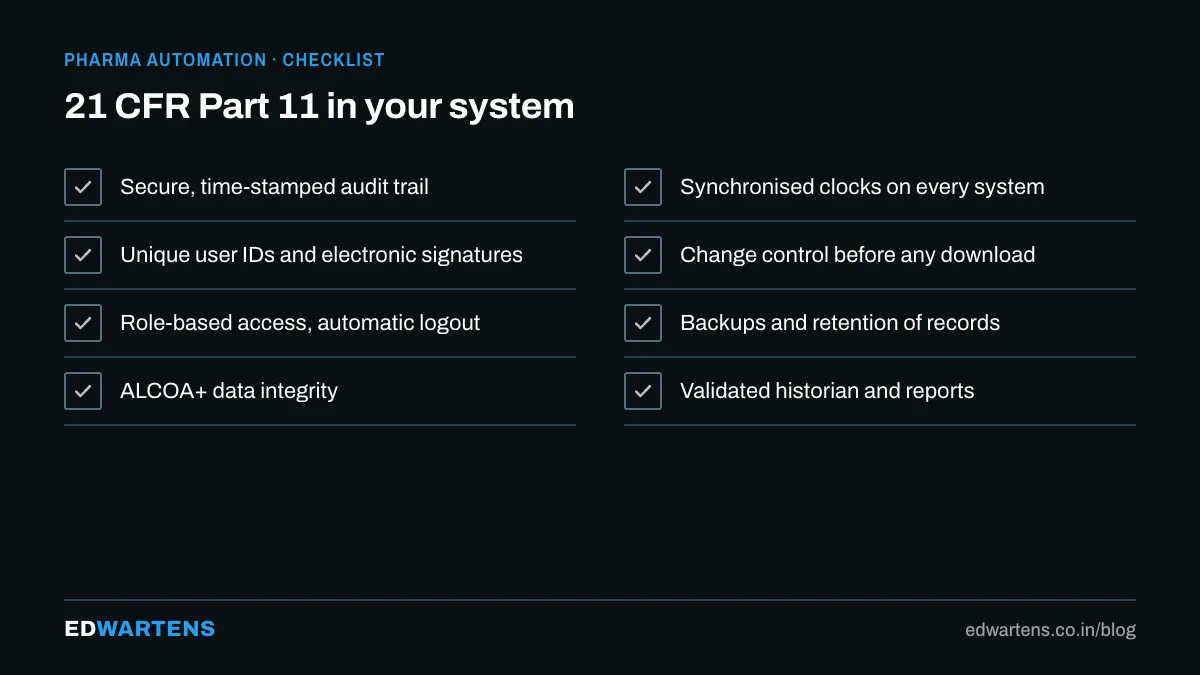
- Audit trail: who changed what, when and why, secure, time-stamped, not editable, reviewed. The SCADA and the historian must provide it; PLC parameter changes through the HMI must be logged.
- Electronic signatures: unique user IDs, passwords, meaning of the signature, linked to the record.
- Access control: named users, roles, no shared logins, automatic logout.
- Data integrity (ALCOA+): attributable, legible, contemporaneous, original, accurate, plus complete, consistent, enduring, available.
- Time synchronisation: every record with the same clock.
What changes for your PLC work
- Change control. No download without an approved change request, an impact assessment, and re-testing of what the change touches.
- Documented testing. Every interlock and alarm tested against a written protocol, witnessed and signed.
- Program protection. Checksums, version records, access levels on the controller and the engineering station.
- Configuration over code. Standard, tested blocks configured per loop beat clever custom logic nobody can validate.
- The historian is a GxP record. Its retention, backup and audit trail matter, as in historians and trend data.
Careers and pay
Pharma automation engineers in Hyderabad, Ahmedabad, Baddi, Goa and Bangalore earn a premium over discrete manufacturing at every level, and validation engineers who can also program are rarer still. Titles: automation engineer, CSV engineer, validation engineer, MES engineer. The Gulf, Ireland and Singapore recruit from India for these roles.
Learning it
The PLC and SCADA fundamentals come from the free TIA Portal, WinCC and DeltaV courses; GAMP 5 itself from ISPE training; and the habits from the first validated project you work on, which is why a pharma integrator is a good first employer.
For classroom practice, our PLC course in Bangalore: syllabus and duration sets out what is taught and for how long.
Frequently asked questions
Is validation a separate department? Usually, but the automation engineer writes the FS and DS and executes the OQ, so it is your work too.
Does a free course need to be validated? No. Validation applies to systems in the plant. A course teaches you the method.
What is the single habit to build now? Write down what you changed and why, every time. That is an audit trail, and you will need it.
Learn this, free
The courses that teach this
Every lesson, the written notes and the practice are free with an account. Only the certificate is optional and paid.


