Electrical · Free online course
NEC 2026 for Engineers and Electricians
The 2026 National Electrical Code (NFPA 70) for people who design and install: how the code is arranged, Article 110 working space and terminations, branch circuits and services, the new Article 120 load calculations for dwellings and commercial buildings, ampacity and voltage drop, overcurrent protection and taps, grounding and bonding, raceway and box fill, motors, transformers, hazardous locations, and PV, energy storage and EV charging.
- 15 modules
- 13h 35m of video
- Intermediate
- English
- ₹0, free
₹0Free for good
Worth ₹7,999 by length and depth against classroom training. It has always been free; that is not a former price.
No card. Checkout takes a minute and gives you a receipt.
Overview
About NEC 2026 for Engineers and Electricians
The 2026 National Electrical Code (NFPA 70) for people who design and install: how the code is arranged, Article 110 working space and terminations, branch circuits and services, the new Article 120 load calculations for dwellings and commercial buildings, ampacity and voltage drop, overcurrent protection and taps, grounding and bonding, raceway and box fill, motors, transformers, hazardous locations, and PV, energy storage and EV charging.
NEC 2026 for Engineers and Electricians is a free, self-paced online course from EDWartens for electrical engineers, designers, electricians, apprentices, inspectors and estimators working to the NEC in the USA, the Philippines, Latin America and on US-specified projects worldwide. It has 15 modules and 13h 35m of video lessons by Ryan Jackson, Electrical 101, MikeHoltNEC and others, with written notes and worked problems, a practical project with a document pack and a 15-question final assessment (pass mark 60%). Learning is free with an account; an optional certificate with a public verification code is issued when you pass. Last updated 27 September 2026.
Who it is for: Electrical engineers, designers, electricians, apprentices, inspectors and estimators working to the NEC in the USA, the Philippines, Latin America and on US-specified projects worldwide
This course includes
- 13h 35m of video lessons
- 15 modules with written notes and diagrams
- One final assessment: 15 questions, pass mark 60%
- Ask-an-engineer support from practising engineers
- Lifetime access, the course does not expire
- Optional verifiable certificate when you finish
- Step 1 of 3
Learn the 15 modules
13h 35m of video lessons, written notes and a practice task per module, at your own pace.
- Step 2 of 3
Pass the final assessment
15 questions drawn from every module, pass mark 60%, 3 attempts.
- Step 3 of 3
Take the certificate, if you want it
Optional, paid once, only if you choose it. The course stays free either way.
See the certificate and its price
A look inside
From the lessons

How the NEC works: Article 90, Article 100, adoption and finding answers fast
by Electrical 101

Branch circuits, feeders and services: Articles 210, 215 and 230
by Ryan Jackson

Commercial and industrial feeder and service load calculations
by Electrical 101

Overcurrent protection: Article 240, taps and short-circuit ratings
by Dave Gordon

Bonding and equipment grounding conductors: the effective fault path
by MikeHoltNEC
![Motor Branch Circuit Conductor Sizing [430.22(A)] (14min:30sec)](https://i.ytimg.com/vi/_7FmwY442dQ/mqdefault.jpg)
Motors, motor control and industrial machinery: Articles 430, 409 and 670
by MikeHoltNEC
Lesson frames belong to the creators named in the Credits and are shown from YouTube.
What you learn
What you will be able to do
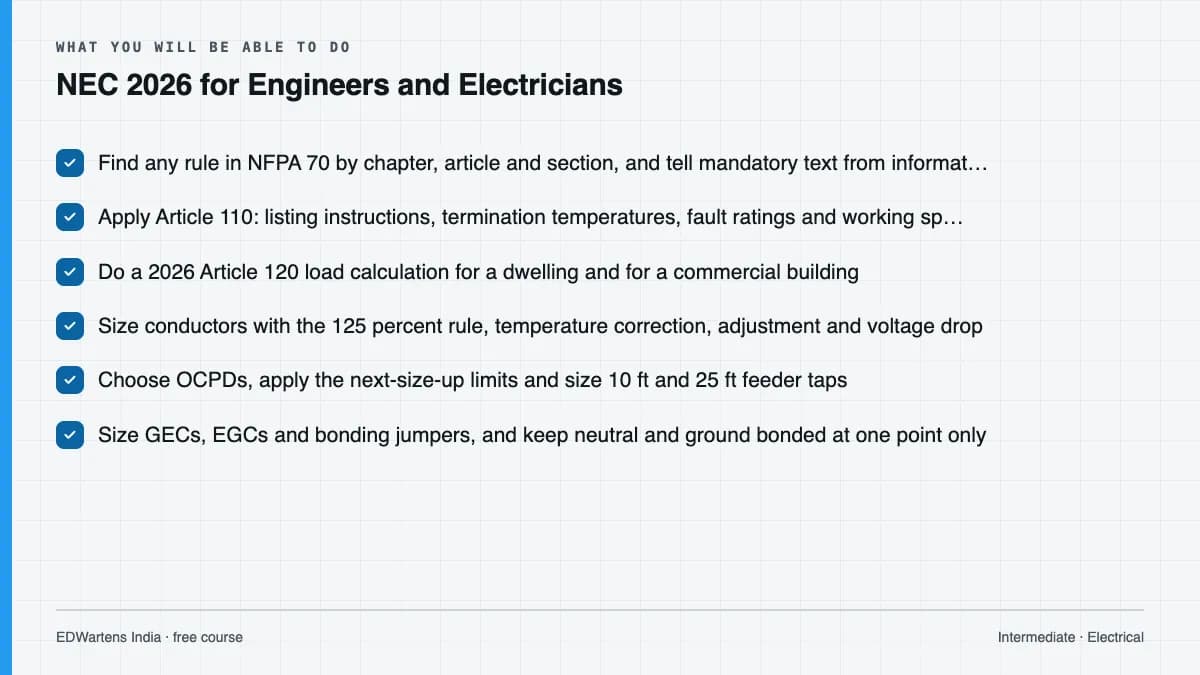
Find any rule in NFPA 70 by article and section; apply Article 110 approval, termination, fault-rating and working-space rules; size branch circuits, feeders and services with the 125 percent continuous rule; perform 2026 Article 120 load calculations for a dwelling and a commercial building; size conductors with temperature correction, adjustment and voltage drop; select OCPDs and apply the tap rules; size GECs, EGCs and bonding jumpers; calculate raceway and box fill; size motor and transformer circuits; classify hazardous locations; and apply the PV, ESS and EV rules and the main 2026 changes.
- Find any rule in NFPA 70 by chapter, article and section, and tell mandatory text from informational notes
- Apply Article 110: listing instructions, termination temperatures, fault ratings and working space
- Do a 2026 Article 120 load calculation for a dwelling and for a commercial building
- Size conductors with the 125 percent rule, temperature correction, adjustment and voltage drop
- Choose OCPDs, apply the next-size-up limits and size 10 ft and 25 ft feeder taps
- Size GECs, EGCs and bonding jumpers, and keep neutral and ground bonded at one point only
- Size motor, transformer and EV charger circuits, and calculate raceway and box fill
- Classify hazardous locations and apply the PV, energy storage and 2026 change rules
Syllabus
Course content, module by module
In order, at whatever pace suits you. Each module ends with a practice task that builds on the last.
- Modules
- 15
- Video lessons
- 57
- Of video
- 13h 35m
- Final questions
- 15
- 01
How the NEC works: Article 90, Article 100, adoption and finding answers fast
3 lessons · 40m - 02
Article 110: approval, terminations, working space and arc-flash labels
3 lessons · 1h 20m - 03
Branch circuits, feeders and services: Articles 210, 215 and 230
4 lessons · 53m - 04
Dwelling load calculations under the new Article 120
4 lessons · 55m - 05
Commercial and industrial feeder and service load calculations
4 lessons · 45m - 06
Conductors and ampacity: Article 310, correction, adjustment and voltage drop
5 lessons · 1h 28m - 07
Overcurrent protection: Article 240, taps and short-circuit ratings
5 lessons · 1h 8m - 08
Grounding: system grounding, electrodes and the grounding electrode conductor
3 lessons · 59m Final assessment · 15 questions, pass mark 60%
Project
The course project
Optional practice that ends in the kind of job the course prepares you for, with the documents that go with it.
About 12 hours
Service and feeder design for a mixed-use commercial building to the 2026 NEC: load calculation, feeders, grounding and EV charging
Design the electrical service and feeders for a two-storey retail and office building with EV charging: build the load list and the Article 120 calculation, size the service, feeders, transformer and motor circuits with their OCPDs, EGCs and voltage drop, ground and bond the service and the separately derived system, and record the code checks. The sample pack shows each document for a building near Austin, Texas.
Sample document pack, 5 documents, filled in for the scenario
- Load listLoad list and Article 120 calculation: Ridgeview Commons
- ReportService and grounding calculation report
- Motor listMotor and HVAC equipment list
- Cable scheduleFeeder and branch-circuit schedule
- RegisterCode compliance checklist
Read inside the course and download as a workbook. The project is optional practice, marked when you submit it; the certificate needs only the modules and the final assessment.
Tools
Software, hardware and lessons
Software
None required. A spreadsheet (LibreOffice Calc is free) helps with load calculations. Read NFPA 70 (2026) free in read-only form on the NFPA website; a printed or licensed copy is useful but optional.
Hardware
None.
Who it is for
Intermediate. For electrical engineers, designers, electricians and apprentices, inspectors and estimators who work to the NEC or want to. You need basic circuit theory (Ohm's law, single-phase and three-phase power) and a calculator. No previous code study is needed.
Video lessons by
- Ryan Jackson
- Electrical 101
- MikeHoltNEC
- Dave Gordon
- Electrician U
- Summit Electric Supply
- Hazloc Directory
Independent creators, credited in full under Credits.
Software you need
What to download, where from, what it costs and how to install it. Every link goes to the maker's own site, never a mirror.
Nothing to install
A calculator or spreadsheet is enough for every calculation, and NFPA 70 (2026) can be read free in read-only form on the NFPA website (nfpa.org) after a free registration.
Optional
Useful, not needed to finish the course.
- 01Free
LibreOffice
The Document Foundation
- Runs on
- Windows 10 or 11, macOS 11 or newer (Intel or Apple silicon), Linux
- Account
- None needed
- Size
- up to 1.5 GB of disk space on Windows
LibreOffice is free, open-source software under the Mozilla Public License 2.0, for any use including business. Calc is its spreadsheet.
Steps
- 1.Open the LibreOffice download page.
- 2.Check the page has picked your operating system, then select Download.
- 3.Run the installer (administrator rights are needed on Windows).
- 4.Start LibreOffice Calc for spreadsheet work.
- 5.Save as .xlsx if you need to share files with Excel users.
- Choose the latest main version unless your organisation asks for the older, more conservative release.
Official download pagelibreoffice.org
Checked against each maker's own page on 27 September 2026. Trial lengths and editions change; the maker's page is the final word.
What you walk away with
Your certificate for NEC 2026 for Engineers and Electricians
Finish the course, pass the final, and this is the document with your name on it.
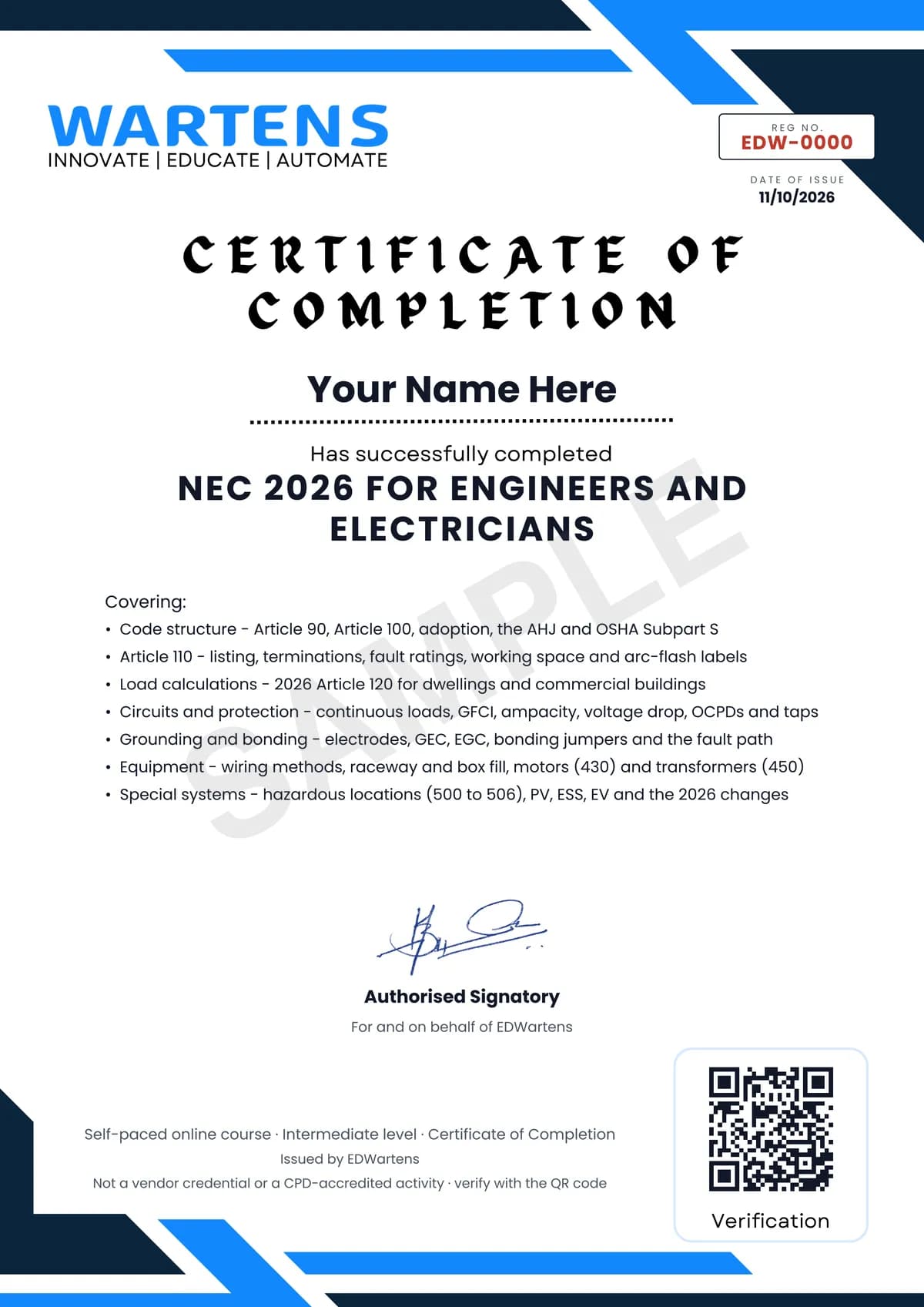
Verifiable by anyone
Adds to LinkedIn in one click
QR code on the certificate
Names what you can do
A permanent link
Earned, not attended
Learning is free. The certificate is optional.
Add it now and pay only when you have finished the course, or come back for it later. One-off, US$28.99, with a receipt.
Issued by EDWartens India (Wartens Automation Private Limited) as a Certificate of Completion for this self-paced course. It is not a vendor certification, a university award or a CPD-accredited activity, and it does not certify competence on live equipment. Delivered electronically; see the refund policy.
FAQ
Common questions
What is the NEC 2026 for Engineers and Electricians course?
It is a free-to-learn online course on the 2026 National Electrical Code (NFPA 70) for people who design, install or inspect electrical systems. It covers code navigation, Article 110, the new Article 120 load calculations, conductor and OCPD sizing, grounding and bonding, wiring methods, motors, transformers, hazardous locations, and PV, energy storage and EV charging, with worked problems in every module.
What are the main changes in the 2026 NEC?
The biggest change is that load calculations moved from Article 220 to a new Article 120, where the dwelling general lighting load dropped from 3 to 2 VA per square foot while branch circuits are still counted at 3 VA. Energy management systems moved to Article 130, systems over 1,000 V ac moved to Articles 265 to 270, control circuits moved to Article 206, Chapter 8 lost its independence, and GFCI, arc-flash labelling and service disconnect rules were revised.
Who is this NEC course for, and what do I need to know first?
It is for electrical engineers, designers, electricians and apprentices, inspectors and estimators who work to the NEC or are moving to NEC projects. You need basic circuit theory, including single-phase and three-phase power, and a calculator; no previous code study is needed.
Is the course free, and how long does it take?
Yes, every module, the notes, worked problems, practice tasks, the project and the final assessment are free to learn. It takes about 22 hours at your own pace, including about 13.6 hours of video, and the optional project takes about 12 hours more.
Do I need to buy the NEC code book?
No. NFPA lets anyone read NFPA 70 (2026) free in a read-only online viewer after a free registration, and the course notes explain each rule in their own words with worked numbers. A printed or licensed copy is useful on the job but optional for the course.
Will this course prepare me for a journeyman or master electrician exam?
It covers much of the NEC knowledge those exams test, including finding rules fast, load calculations, conductor and OCPD sizing, grounding and motors, so it is useful preparation. It is not tied to any state's exam, it gives no continuing-education credit, and electrician licensing is set by each state or country.
What certificate do I get, and how is it verified?
You get a verifiable certificate of completion when you finish the modules and pass the 15-question final at 60 percent. It carries a unique certificate number and a QR code that open a public verification page showing the course, the modules covered and your final score. It is not an NFPA credential or an electrician licence, and EDWartens is not affiliated with NFPA.
Is the NEC used outside the USA?
Yes. Most of the world wires to IEC 60364 (BS 7671 in the UK), which our Wiring Regulations course covers, but the Philippine Electrical Code Part 1 is based on the NEC, Mexico's NOM-001-SEDE follows its structure, and US-specified oil and gas, data centre and pharmaceutical projects, including many in the Gulf, name NFPA 70 in their specifications.
Is the NEC 2026 for Engineers and Electricians course free in India, and what does the certificate cost?
Yes. Learning costs ₹0 in India: every module, the written notes, the practice tasks and the final assessment, with no card and no trial period. The only paid item is the optional EDWartens Certificate of Completion, ₹599 including GST for this intermediate course, paid in rupees through Razorpay, and only if you want it after passing the final assessment.
All course factsHide course facts
- Price
- ₹0, free for good. No trial, no card. Comparable classroom training of this length costs about ₹7,999.
- Who it is for
- Electrical engineers, designers, electricians, apprentices, inspectors and estimators working to the NEC in the USA, the Philippines, Latin America and on US-specified projects worldwide
- Format
- 15 self-paced modules, 13h 35m of video, written notes, a practice task per module and one final assessment.
- Level
- Intermediate. Intermediate. For electrical engineers, designers, electricians and apprentices, inspectors and estimators who work to the NEC or want to. You need basic circuit theory (Ohm's law, single-phase and three-phase power) and a calculator. No previous code study is needed.
- Brand
- Vendor-neutral
- Software
- None required. A spreadsheet (LibreOffice Calc is free) helps with load calculations. Read NFPA 70 (2026) free in read-only form on the NFPA website; a printed or licensed copy is useful but optional.
- Hardware
- None.
- Certificate
- Optional EDWartens Certificate of Completion, verifiable by code. Not a vendor credential.
- Video lessons by
- Ryan Jackson, Electrical 101, MikeHoltNEC, Dave Gordon, Electrician U, Summit Electric Supply, Hazloc Directory (independent creators, credited below)
- Language
- English
- Last updated
- 27 September 2026
Pairs well with
 Electrical · FreeETAP Power System Analysis: Load Flow, Short Circuit, Protection, Arc Flash and Stability
 PLC programming · FreeSiemens TIA Portal
 PLC programming · FreeSiemens TIA Portal in Three Hours
 PLC programming · FreeTIA Portal: Build a Machine
More free courses: Free electrical design and control panel courses · Free power system and ETAP courses
Classroom course, Bangalore
Industrial automation course in Bangalore
The Automation Engineer Program (AEP) covers PLC, SCADA, HMI, drives, measuring instruments, PID basics and control panel design, taught in person at our Electronic City centre.
Credits
Who made the video lessons
The video lessons in this course were created by the people below, not by EDWartens. Every lesson streams from its creator's own YouTube channel; EDWartens neither hosts nor sells that footage, and the creators are not affiliated with EDWartens and do not endorse this course. What EDWartens wrote is the study plan, the notes, the practice tasks and the assessments.
- Ryan Jacksonthe 100 Days of the 2026 NEC Changes series used across the course (overview, 110.3, 110.16, 110.26, 120.5, 120.6, 120.13 and 120.41, 120.56, 120.57, 210.8, 210.22 and 210.23, 230.67, 230.70, 250.64, 250.122, 300.6, 310.14, 408.6, 409.23, 430.132, 625.41 and 690.4), the Article 100 bonding definitions and the raceway fill lesson
- Electrical 101Article 90, navigating the NEC, Article 110 general requirements, the dwelling service calculation, commercial load and service calculations, and motor load and branch-circuit protection examples
- MikeHoltNECthe ampacity table, voltage drop, coordination of OCPDs, grounding and bonding (250.4, grounding versus bonding, objectionable current, why grounding does not stop shock), motor conductor sizing, transformer grounding, hazardous classified locations, and the scope of Articles 690 and 706
- Dave Gordontemperature correction and adjustment factors, overcurrent, overload, short circuit and ground fault, 240.4 with Table 310.16, the round-up rule, transformer OCPDs under Table 450.3(B) and transformer secondary conductors
- Electrician Uthe difference between grounding, bonding and the neutral, and conduit fill worked examples
- Summit Electric Supplythe NEC hazardous location overview
- Hazloc Directoryclass and division against the zone classification system
If you are one of these creators and would like a lesson removed or credited differently, write to info@wartens.com.