Process control · Free online course
Process Simulation with DWSIM for Oil, Gas and Chemicals
Build steady-state process simulations in DWSIM, the free open-source chemical process simulator: property packages, streams and flash calculations, pumps, valves and compressors, separators, heat exchangers, shortcut and rigorous distillation, absorbers, conversion, equilibrium, Gibbs and kinetic reactors, recycle loops, adjust and sensitivity studies, crude assays and a gas processing capstone, with every result checked by hand.
- 13 modules
- 11h 18m of video
- Intermediate
- English
- ₹0, free
₹0Free for good
Worth ₹6,999 by length and depth against classroom training. It has always been free; that is not a former price.
No card. Checkout takes a minute and gives you a receipt.
Overview
About Process Simulation with DWSIM for Oil, Gas and Chemicals
Build steady-state process simulations in DWSIM, the free open-source chemical process simulator: property packages, streams and flash calculations, pumps, valves and compressors, separators, heat exchangers, shortcut and rigorous distillation, absorbers, conversion, equilibrium, Gibbs and kinetic reactors, recycle loops, adjust and sensitivity studies, crude assays and a gas processing capstone, with every result checked by hand.
Process Simulation with DWSIM for Oil, Gas and Chemicals is a free, self-paced online course from EDWartens for chemical and petroleum engineering students and graduates, process and production engineers and plant operators moving into process design and simulation. It has 13 modules and 11h 18m of video lessons by Spoken-Tutorial IIT Bombay, DWSIM Simulator, Chemical Engineering Education and others, with written notes and worked problems, a practical project with a document pack and a 15-question final assessment (pass mark 60%). Learning is free with an account; an optional certificate with a public verification code is issued when you pass. Last updated 27 September 2026.
Who it is for: Chemical and petroleum engineering students and graduates, process and production engineers and plant operators moving into process design and simulation
This course includes
- 11h 18m of video lessons
- 13 modules with written notes and diagrams
- One final assessment: 15 questions, pass mark 60%
- Ask-an-engineer support from practising engineers
- Lifetime access, the course does not expire
- Optional verifiable certificate when you finish
- Step 1 of 3
Learn the 13 modules
11h 18m of video lessons, written notes and a practice task per module, at your own pace.
- Step 2 of 3
Pass the final assessment
15 questions drawn from every module, pass mark 60%, 3 attempts.
- Step 3 of 3
Take the certificate, if you want it
Optional, paid once, only if you choose it. The course stays free either way.
See the certificate and its price
A look inside
From the lessons

Process simulation and DWSIM: the workflow and your first flowsheet
by The Chemical Engineer
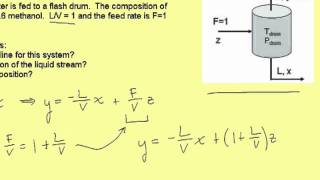
Material streams, flash calculations and phase envelopes
by LearnChemE

Separators, flash drums and gas compression trains
by LearnChemE

Distillation design with the shortcut column (Fenske, Underwood, Gilliland)
by LearnChemE

Reactors I: conversion, equilibrium and Gibbs reactors
by Spoken-Tutorial IIT Bombay

Recycle, adjust, sensitivity analysis and optimisation
by LearnChemE
Lesson frames belong to the creators named in the Credits and are shown from YouTube.
What you learn
What you will be able to do
Set up a DWSIM simulation from compounds, property package and units to a solved flowsheet; choose and defend a property package (Peng-Robinson, SRK, NRTL, UNIQUAC, steam tables and the specialist packages); run TP, PH and vapour fraction flashes, bubble and dew points and phase envelopes, and solve a Rachford-Rice flash by hand; model mixers, splitters, valves, pumps, compressors, separators and heat exchangers and check their power, temperatures and areas; design a column with the Fenske, Underwood and Gilliland shortcut and converge a rigorous column or absorber; choose between conversion, equilibrium, Gibbs, CSTR and plug flow reactors and size a kinetic reactor; converge recycle loops and use adjust, sensitivity analysis and the optimizer; characterise a crude from an assay; and build, check and report a gas conditioning flowsheet.
- Set up DWSIM: compounds, property package, units, streams, unit operations and the solver
- Choose Peng-Robinson, SRK, NRTL, UNIQUAC or steam tables for a mixture and defend the choice
- Solve flashes, bubble and dew points by hand with Rachford-Rice and read phase envelopes
- Model valves, pumps, compressors, separators and heat exchangers and check them by hand
- Design a column with Fenske, Underwood and Gilliland, then converge a rigorous column or absorber
- Pick conversion, equilibrium, Gibbs, CSTR or PFR models and size a kinetic reactor
- Converge recycle loops and run adjust, sensitivity and optimisation studies
- Characterise a crude and build, check and report a gas conditioning flowsheet
Syllabus
Course content, module by module
In order, at whatever pace suits you. Each module ends with a practice task that builds on the last.
- Modules
- 13
- Video lessons
- 56
- Of video
- 11h 18m
- Final questions
- 15
- 01
Process simulation and DWSIM: the workflow and your first flowsheet
4 lessons · 28m - 02
Thermodynamics and choosing a property package
4 lessons · 1h 13m - 03
Material streams, flash calculations and phase envelopes
5 lessons · 51m - 04
Pressure and flow: mixers, splitters, valves, pumps, compressors and pipes
6 lessons · 1h 7m - 05
Separators, flash drums and gas compression trains
5 lessons · 1h 0m - 06
Heat exchangers: heaters, coolers and shell and tube
4 lessons · 55m - 07
Distillation design with the shortcut column (Fenske, Underwood, Gilliland)
4 lessons · 48m - 08
Rigorous distillation, absorption and ChemSep columns
5 lessons · 60m Final assessment · 15 questions, pass mark 60%
Project
The course project
Optional practice that ends in the kind of job the course prepares you for, with the documents that go with it.
About 16 hours
Gas conditioning and condensate recovery in DWSIM: build, check and report a gas plant simulation
Build the steady-state simulation of a small gas conditioning plant as a process engineer would for a feasibility study: write the design basis, choose and justify the property package, model inlet separation, two-stage compression, gas/gas exchange, chilling and low temperature separation, stabilise the condensate, check the key numbers by hand and issue a heat and material balance. The sample pack shows the design basis, hand checks, equipment list, a compressor datasheet and the model checking procedure for a fictional field.
Sample document pack, 5 documents, filled in for the scenario
- ReportProcess design basis: Kestrel Ridge gas conditioning plant
- ReportHand-check calculations for the DWSIM model
- RegisterEquipment list and DWSIM object map
- DatasheetProcess datasheet: export gas compressor K-101 and K-102
- ProcedureSimulation model checking and reporting procedure
Read inside the course and download as a workbook. The project is optional practice, marked when you submit it; the certificate needs only the modules and the final assessment.
Tools
Software, hardware and lessons
Software
DWSIM, free and open source (GPL) from dwsim.org: the current release is DWSIM 10.2 (October 2026) for Windows 10 and 11, Linux and macOS, in a free Open-Source Core Edition and a free-to-download Patreon Edition; DWSIM 9.0.5 is still offered. The lessons were recorded on DWSIM 5 to 9; the workflow is the same in version 10, though some menus have moved. A spreadsheet (LibreOffice Calc is free) for the hand checks. ChemSep LITE, a free CAPE-OPEN column add-on, is optional.
Hardware
Any 64-bit laptop with 4 GB of memory (8 GB recommended) and about 1 GB of free disk space; no graphics card is needed.
Who it is for
Intermediate. For chemical and petroleum engineering students and graduates, process and production engineers, and plant operators moving into process design or simulation. You need first-year material and energy balances and basic thermodynamics (vapour pressure, enthalpy); no simulation experience is needed. HAZOP and Process Safety Management and Pumps, Compressors and Rotating Equipment are the neighbouring courses; this one builds and checks the simulation model.
Video lessons by
- Spoken-Tutorial IIT Bombay
- DWSIM Simulator
- Chemical Engineering Education
- The Chemical Engineer
- eduX
- Dr. Surendra Sasikumar Jampa (PhD,Chem Engg, IITB)
- LearnChemE
- Vincent Stevenson
- Christi Patton Luks
- Kimray Inc
- Carver Pump Company
Independent creators, credited in full under Credits.
Software you need
What to download, where from, what it costs and how to install it. Every link goes to the maker's own site, never a mirror.
Install the free DWSIM Open-Source Core Edition before module 1. A spreadsheet such as LibreOffice Calc is useful for the hand checks; ChemSep LITE, the free CAPE-OPEN column add-on shown in module 8, is optional.
Required
- 01Free and open source
DWSIM
Daniel Wagner (DWSIM open-source project)
- Runs on
- Windows 10 or 11, Linux (Ubuntu 22.04, Debian 12, Fedora 38 or newer) and macOS 11 or newer, on 64-bit Intel/AMD or ARM
- Account
- None needed
- Size
- about 1 GB of disk space (2 GB with samples and documentation)
DWSIM is open-source software under the GNU GPL version 3, free for any use. The Open-Source Core Edition contains everything this course uses. The Patreon Edition is also free to download, but simulations that use its supporter-only extras can be saved only with an active Patreon membership.
Steps
- 1.Open the DWSIM download page on dwsim.org.
- 2.Under DWSIM Open-Source Core Edition, choose the installer for your system: Windows, Linux (Debian package or portable) or macOS (Intel or Apple silicon).
- 3.Run the installer; it is self-contained, so no separate .NET runtime is needed.
- 4.Start DWSIM and create a new simulation; the setup wizard asks for compounds, the property package and the units.
- On Windows both the Classic and the Cross-Platform interfaces are installed; the course videos mostly use the Classic interface.
- The lessons were recorded on DWSIM 5 to 9. If a menu has moved in version 10, look under Edit > Simulation Settings or the Flowsheet Analysis menu.
- DWSIM 9.0.5 is still offered on the same page for older computers.
Official download pagedwsim.org
Optional
Useful, not needed to finish the course.
- 02Free
LibreOffice
The Document Foundation
- Runs on
- Windows 10 or 11, macOS 11 or newer (Intel or Apple silicon), Linux
- Account
- None needed
- Size
- up to 1.5 GB of disk space on Windows
LibreOffice is free, open-source software under the Mozilla Public License 2.0, for any use including business. Calc is its spreadsheet.
Steps
- 1.Open the LibreOffice download page.
- 2.Check the page has picked your operating system, then select Download.
- 3.Run the installer (administrator rights are needed on Windows).
- 4.Start LibreOffice Calc for spreadsheet work.
- 5.Save as .xlsx if you need to share files with Excel users.
- Choose the latest main version unless your organisation asks for the older, more conservative release.
Official download pagelibreoffice.org
Checked against each maker's own page on 27 September 2026. Trial lengths and editions change; the maker's page is the final word.
What you walk away with
Your certificate for Process Simulation with DWSIM for Oil, Gas and Chemicals
Finish the course, pass the final, and this is the document with your name on it.
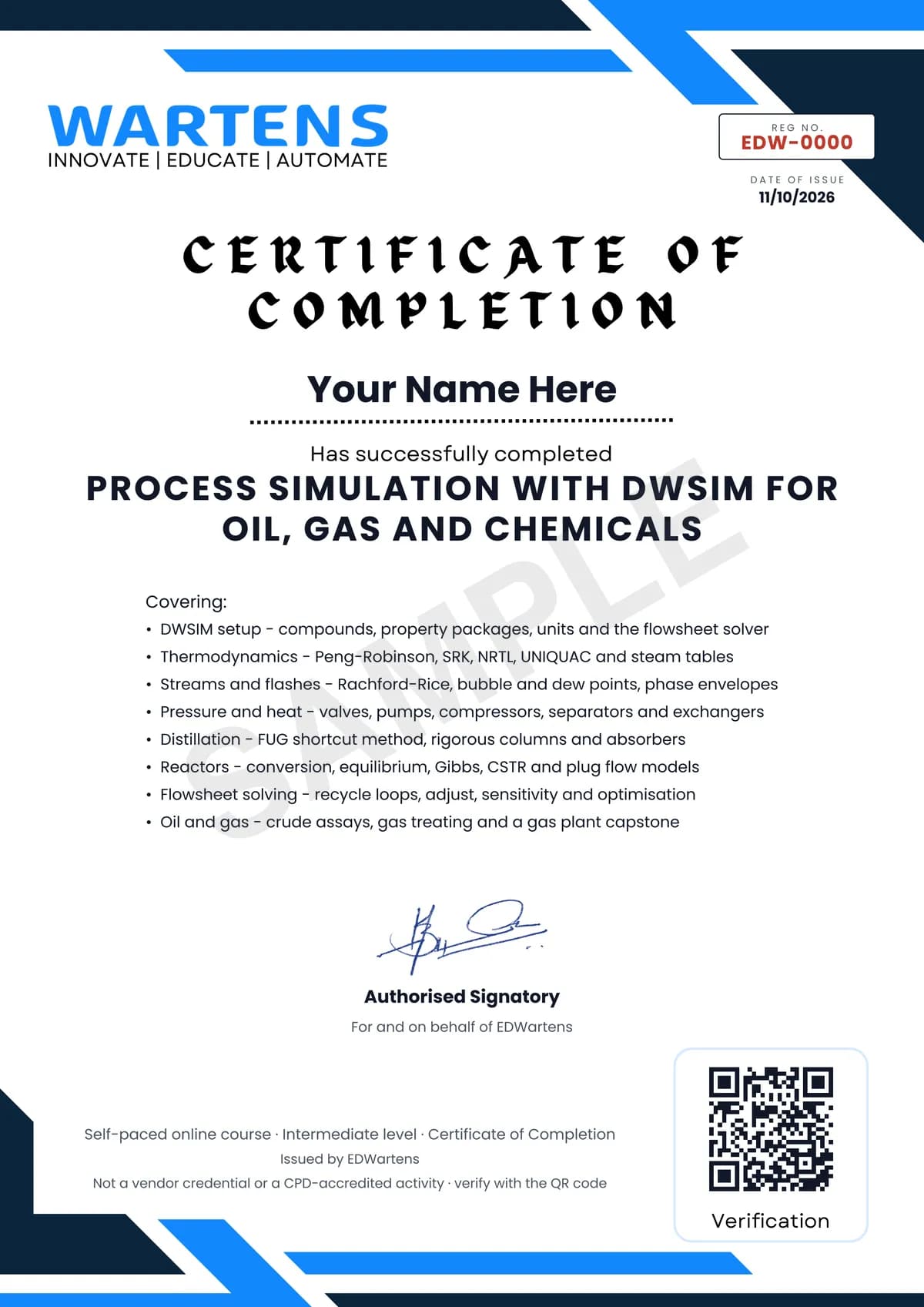
Verifiable by anyone
Adds to LinkedIn in one click
QR code on the certificate
Names what you can do
A permanent link
Earned, not attended
Learning is free. The certificate is optional.
Add it now and pay only when you have finished the course, or come back for it later. One-off, US$28.99, with a receipt.
Issued by EDWartens India (Wartens Automation Private Limited) as a Certificate of Completion for this self-paced course. It is not a vendor certification, a university award or a CPD-accredited activity, and it does not certify competence on live equipment. Delivered electronically; see the refund policy.
FAQ
Common questions
What is DWSIM?
DWSIM is a free, open-source chemical process simulator that solves the material and energy balances of a plant with rigorous thermodynamics. It runs on Windows, Linux and macOS, models streams, separators, compressors, heat exchangers, columns and reactors, and is CAPE-OPEN compliant. It is developed by Daniel Wagner and downloaded from dwsim.org.
Who is this process simulation course for?
It is for chemical and petroleum engineering students and graduates, process and production engineers, and operators moving into process design. You need first-year material and energy balances and basic thermodynamics such as vapour pressure and enthalpy; no simulation experience is needed.
Is DWSIM a free alternative to Aspen HYSYS?
DWSIM is free and does the same kind of steady-state flowsheet work as commercial simulators such as Aspen HYSYS and Aspen Plus, with its own interface and models. The workflow taught here (property package, streams, unit operations, convergence and hand checks) carries across to any simulator. EDWartens is not affiliated with AspenTech or with DWSIM.
Which DWSIM version does the course use?
The course is written for DWSIM 10.2, the current release in October 2026, and works with DWSIM 9.0.5. The video lessons were recorded on DWSIM 5 to 9; every object and calculation they use is still in version 10, and the notes say where menus have moved.
Is the course free to learn, and how long does it take?
Yes, every module, the notes, the worked problems, the practice tasks, the optional project and the final assessment are free to learn, and DWSIM is free. The course takes about 19 hours at your own pace, of which about 11 hours is video; the optional gas plant project takes about 16 hours more.
What certificate do I get, and how is it verified?
You get a verifiable certificate of completion from EDWartens when you finish the modules and pass the 15-question final at 60 percent. It carries a unique certificate number and a QR code that open a public verification page showing the course, the modules covered and your final score.
What jobs does process simulation lead to?
It prepares you for roles such as graduate process engineer, process simulation engineer, production or plant process engineer and operations support engineer at oil and gas producers, refineries, chemical plants and EPC contractors. Gas processing and refining employers in the Gulf, North and West Africa and South Asia ask for simulation skills in process job adverts.
Does the course cover HAZOP or equipment mechanical design?
No. Process hazard studies are taught in HAZOP and Process Safety Management, and pump and compressor selection in Pumps, Compressors and Rotating Equipment. This course builds the simulation that both of those rely on: heat and material balances, duties and stream conditions.
Is the Process Simulation course free in India, and what does the certificate cost?
Yes. Learning costs ₹0 in India: every module, the written notes, the practice tasks and the final assessment, with no card and no trial period. The only paid item is the optional EDWartens Certificate of Completion, ₹599 including GST for this intermediate course, paid in rupees through Razorpay, and only if you want it after passing the final assessment.
Is there classroom process control training in India as well?
Yes. EDWartens India runs the Automation Engineer Program (AEP), a classroom programme at its Electronic City centre in Bangalore. The Automation Engineer Program (AEP) covers PLC, SCADA, HMI, drives, measuring instruments, PID basics and control panel design, taught in person at our Electronic City centre. This free course is separate and fully online; it is a good way to try the subject before deciding on classroom training. Details are at edwartens.co.in/automation-training-bangalore, and the programme itself at edwartens.co.in/courses/aep.
All course factsHide course facts
- Price
- ₹0, free for good. No trial, no card. Comparable classroom training of this length costs about ₹6,999.
- Who it is for
- Chemical and petroleum engineering students and graduates, process and production engineers and plant operators moving into process design and simulation
- Format
- 13 self-paced modules, 11h 18m of video, written notes, a practice task per module and one final assessment.
- Level
- Intermediate. Intermediate. For chemical and petroleum engineering students and graduates, process and production engineers, and plant operators moving into process design or simulation. You need first-year material and energy balances and basic thermodynamics (vapour pressure, enthalpy); no simulation experience is needed. HAZOP and Process Safety Management and Pumps, Compressors and Rotating Equipment are the neighbouring courses; this one builds and checks the simulation model.
- Brand
- Vendor-neutral
- Software
- DWSIM, free and open source (GPL) from dwsim.org: the current release is DWSIM 10.2 (October 2026) for Windows 10 and 11, Linux and macOS, in a free Open-Source Core Edition and a free-to-download Patreon Edition; DWSIM 9.0.5 is still offered. The lessons were recorded on DWSIM 5 to 9; the workflow is the same in version 10, though some menus have moved. A spreadsheet (LibreOffice Calc is free) for the hand checks. ChemSep LITE, a free CAPE-OPEN column add-on, is optional.
- Hardware
- Any 64-bit laptop with 4 GB of memory (8 GB recommended) and about 1 GB of free disk space; no graphics card is needed.
- Certificate
- Optional EDWartens Certificate of Completion, verifiable by code. Not a vendor credential.
- Video lessons by
- Spoken-Tutorial IIT Bombay, DWSIM Simulator, Chemical Engineering Education, The Chemical Engineer, eduX, Dr. Surendra Sasikumar Jampa (PhD,Chem Engg, IITB), LearnChemE, Vincent Stevenson, Christi Patton Luks, Kimray Inc, Carver Pump Company (independent creators, credited below)
- Language
- English
- Last updated
- 27 September 2026
Pairs well with
 Process control · FreeSiemens TIA Portal PID Compact and Analog Processing
 PLC programming · FreeSiemens TIA Portal
 PLC programming · FreeSiemens TIA Portal in Three Hours
 PLC programming · FreeTIA Portal: Build a Machine
More free courses: Free instrumentation and process control courses
Classroom course, Bangalore
Industrial automation course in Bangalore
The Automation Engineer Program (AEP) covers PLC, SCADA, HMI, drives, measuring instruments, PID basics and control panel design, taught in person at our Electronic City centre.
Credits
Who made the video lessons
The video lessons in this course were created by the people below, not by EDWartens. Every lesson streams from its creator's own YouTube channel; EDWartens neither hosts nor sells that footage, and the creators are not affiliated with EDWartens and do not endorse this course. What EDWartens wrote is the study plan, the notes, the practice tasks and the assessments.
- Spoken-Tutorial IIT Bombaythe English DWSIM series by FOSSEE, IIT Bombay, licensed CC BY-SA 4.0: flowsheeting, material streams, bubble and dew points, binary phase envelopes, heat exchangers, shortcut, rigorous and ChemSep columns, absorption, conversion, equilibrium, Gibbs, CSTR, PFR and catalytic reactors, and sensitivity analysis with adjust
- DWSIM Simulatorthe developer's own lessons: DWSIM's features, property packages and flash algorithms, the unit operations overview, the pipe network unit and the basic dynamic simulation tutorial
- Chemical Engineering Educationthe DWSIM 9 lessons on Peng-Robinson against SRK, NRTL and UNIQUAC for azeotropes, bubble and dew points, mixers, splitters, pumps, pipes and valves, gas compression and LPG separation, heat exchangers, shortcut and benzene-toluene distillation, ammonia equilibrium, CSTRs and recycle
- The Chemical Engineerthe DWSIM introduction, the gas and liquid separator, and the recycle block in a complete flowsheet
- eduXthe water gas shift conversion reactor, pump selection with the adjust function, and building a petroleum assay
- Dr. Surendra Sasikumar Jampa (PhD,Chem Engg, IITB)the DWSIM introduction and adiabatic compressor lecture with a hand calculation
- LearnChemEthe flash distillation examples, the Rachford-Rice procedure, the flash energy balance, binary distillation and the single reaction with recycle
- Vincent Stevensonmulticomponent distillation and the Fenske equation
- Christi Patton Luksselecting property packages for simulations
- Kimray Incthe TEG gas dehydration and glycol regeneration system, equipment by equipment
- Carver Pump Companyhow amine sweetening works, absorption and stripping
If you are one of these creators and would like a lesson removed or credited differently, write to info@wartens.com.