SCADA · Free online course
Water and Wastewater Treatment Plant Automation
How drinking water, wastewater and desalination plants are measured and controlled: the process trains, level, flow and water quality instruments, pump station duty and standby logic, VFDs and pump protection, coagulant and chlorine dosing, filter backwash sequences, RO train control, dissolved oxygen and blower control, SCADA, telemetry and alarms, cybersecurity and compliance data, ending with a pump station control narrative.
- 14 modules
- 13h 23m of video
- Intermediate
- English
- ₹0, free
₹0Free for good
Worth ₹7,999 by length and depth against classroom training. It has always been free; that is not a former price.
No card. Checkout takes a minute and gives you a receipt.
Overview
About Water and Wastewater Treatment Plant Automation
How drinking water, wastewater and desalination plants are measured and controlled: the process trains, level, flow and water quality instruments, pump station duty and standby logic, VFDs and pump protection, coagulant and chlorine dosing, filter backwash sequences, RO train control, dissolved oxygen and blower control, SCADA, telemetry and alarms, cybersecurity and compliance data, ending with a pump station control narrative.
Water and Wastewater Treatment Plant Automation is a free, self-paced online course from EDWartens for instrumentation, electrical and PLC engineers, SCADA technicians and plant operators working in water, wastewater and desalination utilities. It has 14 modules and 13h 23m of video lessons by The Wastewater Enthusiast, Wastewater Ace, American Water College and others, with written notes and worked problems, a practical project with a document pack and a 15-question final assessment (pass mark 60%). Learning is free with an account; an optional certificate with a public verification code is issued when you pass. Last updated 27 September 2026.
Who it is for: Instrumentation, electrical and PLC engineers, SCADA technicians and plant operators working in water, wastewater and desalination utilities
This course includes
- 13h 23m of video lessons
- 14 modules with written notes and diagrams
- One final assessment: 15 questions, pass mark 60%
- Ask-an-engineer support from practising engineers
- Lifetime access, the course does not expire
- Optional verifiable certificate when you finish
- Step 1 of 3
Learn the 14 modules
13h 23m of video lessons, written notes and a practice task per module, at your own pace.
- Step 2 of 3
Pass the final assessment
15 questions drawn from every module, pass mark 60%, 3 attempts.
- Step 3 of 3
Take the certificate, if you want it
Optional, paid once, only if you choose it. The course stays free either way.
See the certificate and its price
A look inside
From the lessons

Water and wastewater plants: process trains and the automation layers
by Animagraffs
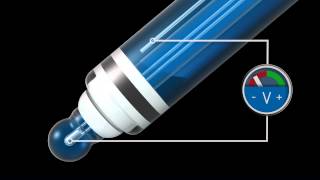
Water quality analysers: pH, turbidity, chlorine and dissolved oxygen
by Endress+Hauser

Pump drives, protection and energy
by Practical Engineering

Filtration: filter control and the backwash sequence
by AmericanWaterWorks
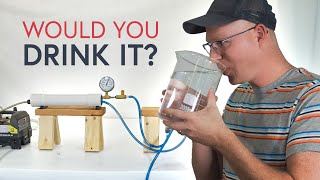
Membranes and RO desalination: train control and cleaning
by Practical Engineering

SCADA, telemetry and alarm management for utilities
by The Wastewater Enthusiast
Lesson frames belong to the creators named in the Credits and are shown from YouTube.
What you learn
What you will be able to do
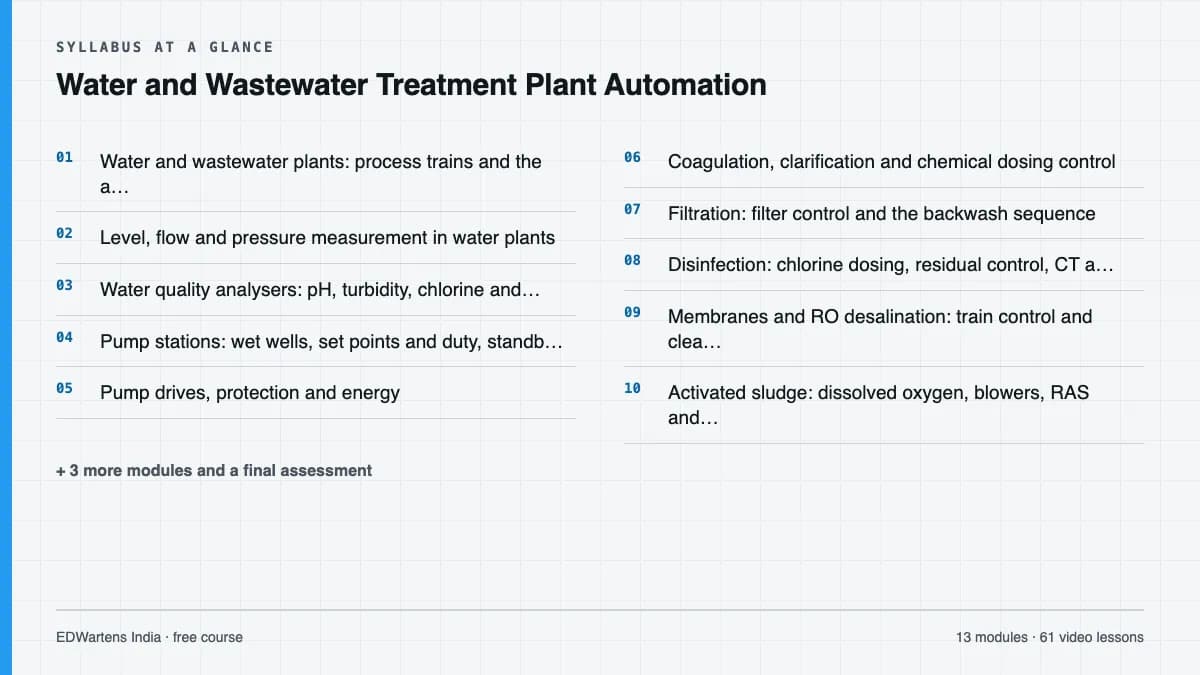
Draw the process train of a drinking water plant, a wastewater plant and an RO desalination plant and name the instruments and control loops on each; scale level and flow signals and convert weir heads to flow; choose and calibrate pH, turbidity, chlorine and dissolved oxygen analysers and work out sample lag; set wet well levels, size the effective volume and write duty, standby, assist and alternation logic; apply the affinity laws, static head and pump protections to VFD-driven pumps; size flow-paced coagulant and chlorine dosing and check CT; write a filter backwash sequence with its permissives and turbidity triggers; control an RO train and decide when to clean from normalized data; control dissolved oxygen with a cascade and most-open-valve logic and set RAS and WAS from SRT; design telemetry, alarms and secure remote access; and write a control narrative, I/O list and test plan for a pump station.
- Draw water, wastewater and RO process trains with their instruments and control loops
- Choose level, open channel flow and water quality instruments, scale signals and allow for sample lag
- Set wet well levels and write duty, assist, standby, alternation and fail-over logic
- Apply affinity laws, static head, VFD limits and pump protections, and track kWh per m³
- Size flow-paced coagulant and chlorine dosing, check CT and write a filter backwash sequence
- Control an RO train and decide when to clean from normalized data
- Control dissolved oxygen with a cascade and most-open-valve logic, and set RAS and WAS from SRT
- Design telemetry, alarms and secure remote access, and write a control narrative, I/O list and SAT
Syllabus
Course content, module by module
In order, at whatever pace suits you. Each module ends with a practice task that builds on the last.
- Modules
- 14
- Video lessons
- 62
- Of video
- 13h 23m
- Final questions
- 15
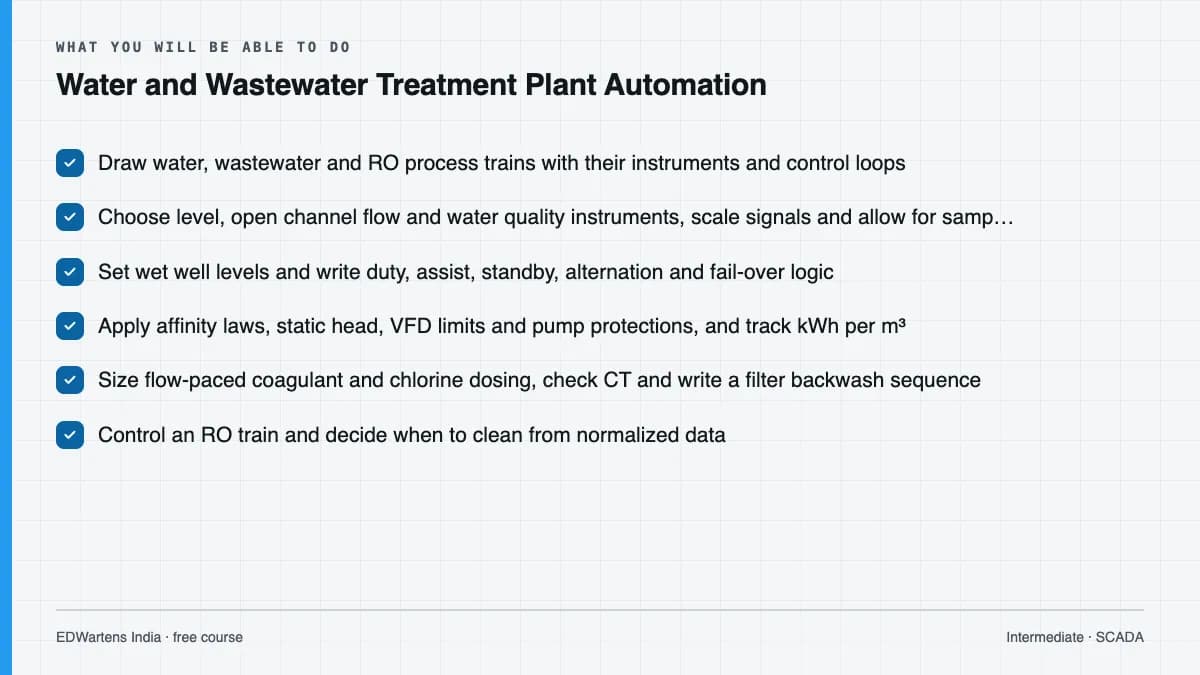
- 01
Water and wastewater plants: process trains and the automation layers
4 lessons · 33m - 02
Level, flow and pressure measurement in water plants
4 lessons · 1h 19m - 03
Water quality analysers: pH, turbidity, chlorine and dissolved oxygen
6 lessons · 1h 2m - 04
Pump stations: wet wells, set points and duty, standby and alternation
5 lessons · 1h 8m - 05
Pump drives, protection and energy
4 lessons · 53m - 06
Coagulation, clarification and chemical dosing control
5 lessons · 38m - 07
Filtration: filter control and the backwash sequence
6 lessons · 46m - 08
Disinfection: chlorine dosing, residual control, CT and UV
5 lessons · 1h 9m Final assessment · 15 questions, pass mark 60%
Project
The course project
Optional practice that ends in the kind of job the course prepares you for, with the documents that go with it.
About 12 hours
Control narrative, I/O list, alarm list, cause and effect and SAT for a three-pump VFD sewage lift station
Write the automation document pack for a sewage lift station as a control system integrator would: a control narrative with modes, set points and failure behaviour, an I/O list with spares, an alarm list rationalised to alarm management practice, a cause and effect matrix and a site acceptance test record. The sample pack shows each document for a fictional station.
Sample document pack, 5 documents, filled in for the scenario
- Control narrativeControl narrative: lift station PS-14, three VFD submersible pumps
- I/O listI/O list: lift station PS-14
- Alarm listAlarm list: lift station PS-14
- Cause & effectCause and effect matrix: lift station PS-14
- SATSite acceptance test record: lift station PS-14
Read inside the course and download as a workbook. The project is optional practice, marked when you submit it; the certificate needs only the modules and the final assessment.
Tools
Software, hardware and lessons
Software
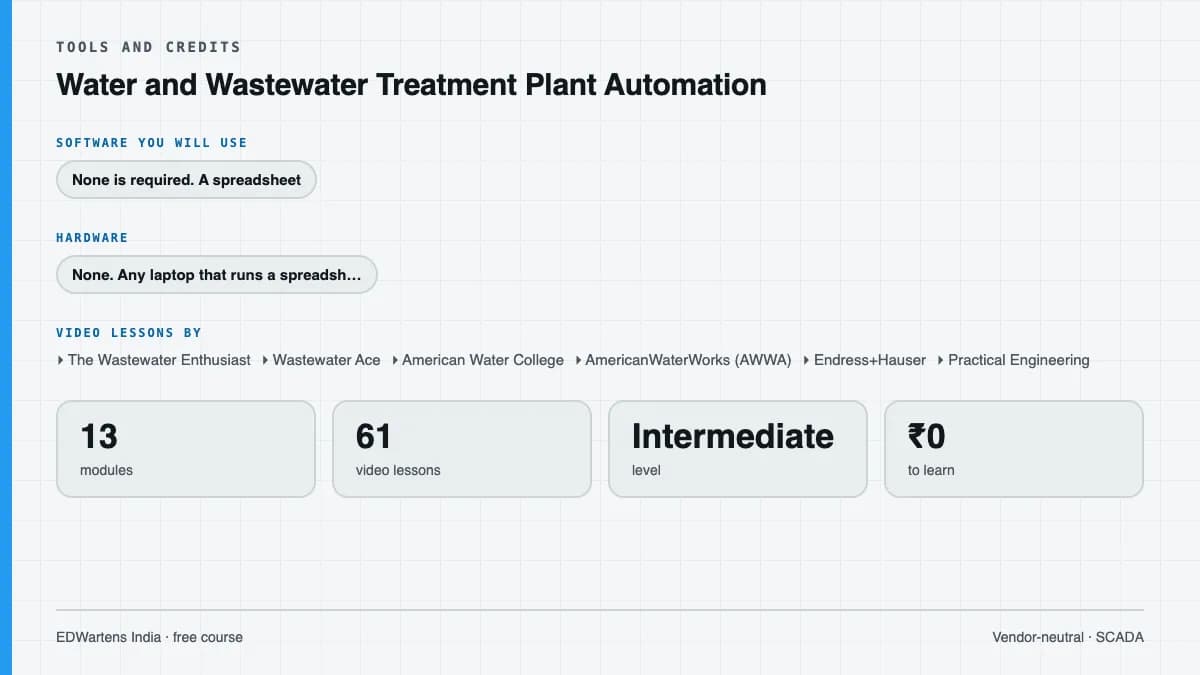
None is required. A spreadsheet (LibreOffice Calc is free) is used for the calculations, and any PLC or SCADA software you already use (for example Ignition Maker Edition or CODESYS) can be used to try the pump station logic, but every exercise can be done on paper.
Hardware
None. Any laptop that runs a spreadsheet is enough.
Who it is for
Intermediate. For instrumentation, electrical and PLC engineers, SCADA technicians and plant operators who work on, or want to move into, water and wastewater utilities, desalination plants and sewage or effluent treatment plants. You should already know what a PLC, a 4-20 mA loop and a PID loop are; Industrial Instrumentation, PID Control for PLC Engineers, Ignition SCADA and Siemens WinCC SCADA teach those and are not retaught here.
Video lessons by
- The Wastewater Enthusiast
- Wastewater Ace
- American Water College
- AmericanWaterWorks (AWWA)
- Endress+Hauser
- Practical Engineering
- Animagraffs
- Concerning Reality
- RealPars
- Siemens Knowledge Hub
- Advance Instruments
- Neal Systems
- Water Engineering
- Smith Pump Company
- The PLC Tech
- Metropolitan Council
- David Ladner
- West Carolina Water Treatment
- Water Academy
- Operator Mindset
- Water Corporation
- Evoqua Water Technologies
- Endless Learning
- DuPont Water Solutions
- Blacoh Industries
- Water Environment Federation
- Aerzen USA
- Tait Communications
- Affinity Energy
- AVEVA Select California
- SANS ICS Security
- Mitsubishi Electric Iconics Digital Solutions
- L&L Lunch and Learn
Independent creators, credited in full under Credits.
Software you need
What to download, where from, what it costs and how to install it. Every link goes to the maker's own site, never a mirror.
Nothing to install
A spreadsheet is enough for every calculation and every exercise can be done on paper. Ignition Maker Edition or CODESYS are useful if you want to try the pump station logic, but optional.
Optional
Useful, not needed to finish the course.
- 01Free
LibreOffice
The Document Foundation
- Runs on
- Windows 10 or 11, macOS 11 or newer (Intel or Apple silicon), Linux
- Account
- None needed
- Size
- up to 1.5 GB of disk space on Windows
LibreOffice is free, open-source software under the Mozilla Public License 2.0, for any use including business. Calc is its spreadsheet.
Steps
- 1.Open the LibreOffice download page.
- 2.Check the page has picked your operating system, then select Download.
- 3.Run the installer (administrator rights are needed on Windows).
- 4.Start LibreOffice Calc for spreadsheet work.
- 5.Save as .xlsx if you need to share files with Excel users.
- Choose the latest main version unless your organisation asks for the older, more conservative release.
Official download pagelibreoffice.org - 02Free trial mode, resets every 2 hours
Ignition
Inductive Automation
- Runs on
- Windows 10 or 11, Windows Server 2016 to 2025, macOS 13 or newer, Linux (tested on Ubuntu 22.04 and 24.04)
- Account
- None needed
- Size
- needs 4 GB RAM and 10 GB free disk space
The full version runs free in trial mode for as long as you want; the only limit is that the Gateway times out every two hours and you restart the trial. Ignition Maker Edition is a free licence for personal, non-commercial use only, with up to 10,000 tags and 10 concurrent sessions.
Steps
- 1.Open the Ignition downloads page.
- 2.Download the installer for your operating system.
- 3.Run the installer; it takes a few minutes.
- 4.Open the Gateway in your browser and start the trial.
- 5.Launch the Ignition Designer and build your first project.
- When the 2-hour trial ends, restart it from the Gateway page; your projects are kept.
- Inductive University has free Ignition training videos.
Official download pageinductiveautomation.comAlternatives
- Ignition Maker Edition: Free for personal, non-commercial projects, with no 2-hour limit; not for use at a business or non-profit.
- 03Free
CODESYS Development System V3
CODESYS GmbH
- Runs on
- Windows 10 or 11, 64-bit (8 GB RAM and 12 GB free disk recommended)
- Account
- A free CODESYS Store account (one-time registration)
The Development System is free in the CODESYS Store. The setup also installs a demo of the CODESYS Control Win SL SoftPLC, which runs for two hours without a licence and then needs a manual restart.
Steps
- 1.Open the CODESYS Development System page in the CODESYS Store.
- 2.Register once for a free CODESYS Store account and sign in.
- 3.Download the 64-bit setup.
- 4.Run the installer as administrator.
- 5.Start CODESYS Control Win SL from the system tray and connect your project to it.
- When the SoftPLC stops after two hours, restart it from the system tray and log in again.
- Allow at least 12 GB of free disk space.
Official download pagestore.codesys.com
Checked against each maker's own page on 27 September 2026. Trial lengths and editions change; the maker's page is the final word.
What you walk away with
Your certificate for Water and Wastewater Treatment Plant Automation
Finish the course, pass the final, and this is the document with your name on it.
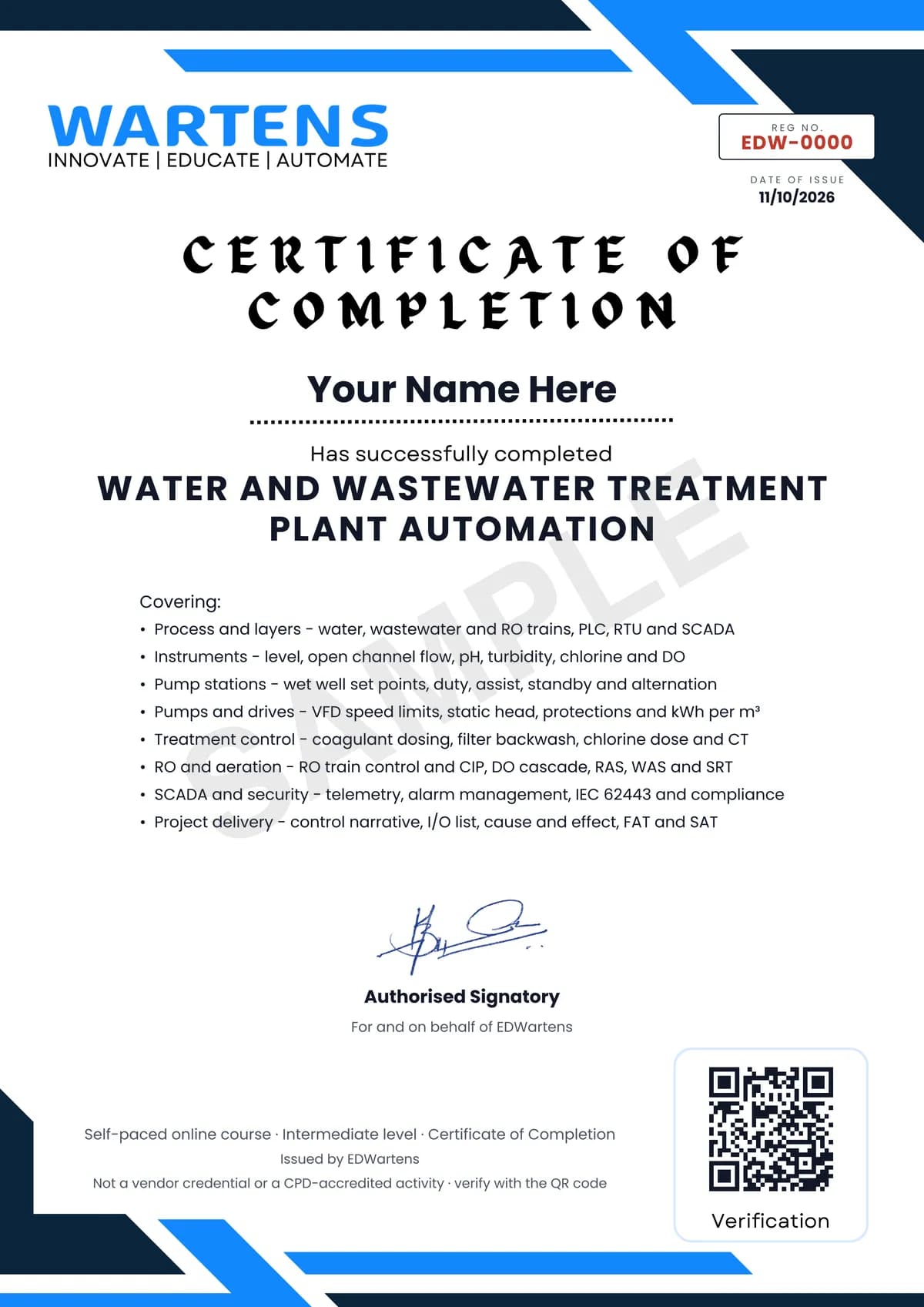
Verifiable by anyone
Adds to LinkedIn in one click
QR code on the certificate
Names what you can do
A permanent link
Earned, not attended
Learning is free. The certificate is optional.
Add it now and pay only when you have finished the course, or come back for it later. One-off, US$28.99, with a receipt.
Issued by EDWartens India (Wartens Automation Private Limited) as a Certificate of Completion for this self-paced course. It is not a vendor certification, a university award or a CPD-accredited activity, and it does not certify competence on live equipment. Delivered electronically; see the refund policy.
FAQ
Common questions
What is water and wastewater treatment plant automation?
Water and wastewater treatment plant automation is the instrumentation, PLC, SCADA and telemetry that measure and control drinking water plants, sewage and effluent treatment plants, desalination plants and their remote pump stations. It runs the pumps, dosing, filters, membranes and aeration, raises alarms, and produces the records a regulator uses to judge whether the water was safe.
Who is this water treatment automation course for?
It is for instrumentation, electrical and PLC engineers, SCADA and telemetry technicians and plant operators who work in, or want to move into, water and wastewater utilities, desalination plants and the contractors and system integrators that build them. You should already know what a PLC, a 4-20 mA loop and a PID loop are.
Do I need software or a PLC to take the course?
No software or hardware is required. A spreadsheet such as LibreOffice Calc is enough for every calculation, and every exercise can be done on paper; if you have Ignition Maker Edition, CODESYS or a vendor trial tool you can also try the pump station logic in it.
Which standards and regulations does the course cover?
The course explains in its own words the ideas of ISA-5.1 tagging, ISA-18.2 and IEC 62682 alarm management, ISA-101 HMI design, IEC 62443 zones and conduits, DNP3 and IEC 60870-5-104 telemetry, the US EPA surface water treatment and disinfectant rules, WHO drinking water guidance and the Ten States design standards. Local regulations and a competent person always govern real work, especially chlorine handling and confined spaces.
Is the course free to learn, and how long does it take?
Yes, every module, the notes, the worked problems, the practice tasks, the optional project and the final assessment are free to learn. The course takes about 21 hours at your own pace, of which about 13.4 hours is video; the optional lift station project takes about 12 hours more.
What certificate do I get, and how is it verified?
You get a verifiable certificate of completion when you finish the modules and pass the 15-question final at 60 percent. It carries a unique certificate number and a QR code that open a public verification page showing the course, the modules covered and your final score. It is not a water or wastewater operator licence or certification.
What jobs does water treatment plant automation lead to, including in the Gulf and India?
It prepares you for roles such as ICA or SCADA engineer at a water utility, telemetry engineer, commissioning engineer for a system integrator, and instrumentation technician at a treatment or desalination plant. Desalination and wastewater programmes in Saudi Arabia and the UAE, and sewage treatment plant projects in India, all need engineers who can commission pump stations, dosing, filters, RO trains and SCADA.
Does the course teach SCADA software or PID tuning?
No. Building screens and tags in a platform is taught in Ignition SCADA by Inductive Automation and Siemens WinCC SCADA, loop tuning in PID Control for PLC Engineers, and instrument principles in Industrial Instrumentation and Process Control. This course applies them to water: what to measure, how to control each process, and how to make the system fail safe.
Is the Water and Wastewater Treatment Plant Automation course free in India, and what does the certificate cost?
Yes. Learning costs ₹0 in India: every module, the written notes, the practice tasks and the final assessment, with no card and no trial period. The only paid item is the optional EDWartens Certificate of Completion, ₹599 including GST for this intermediate course, paid in rupees through Razorpay, and only if you want it after passing the final assessment.
Is there classroom SCADA training in India as well?
Yes. EDWartens India runs the Automation Engineer Program (AEP), a classroom programme at its Electronic City centre in Bangalore. The Automation Engineer Program (AEP) teaches PLC, SCADA and HMI work together, in person at our Electronic City centre. This free course is separate and fully online; it is a good way to try the subject before deciding on classroom training. Details are at edwartens.co.in/plc-scada-training-bangalore, and the programme itself at edwartens.co.in/courses/aep.
All course factsHide course facts
- Price
- ₹0, free for good. No trial, no card. Comparable classroom training of this length costs about ₹7,999.
- Who it is for
- Instrumentation, electrical and PLC engineers, SCADA technicians and plant operators working in water, wastewater and desalination utilities
- Format
- 14 self-paced modules, 13h 23m of video, written notes, a practice task per module and one final assessment.
- Level
- Intermediate. Intermediate. For instrumentation, electrical and PLC engineers, SCADA technicians and plant operators who work on, or want to move into, water and wastewater utilities, desalination plants and sewage or effluent treatment plants. You should already know what a PLC, a 4-20 mA loop and a PID loop are; Industrial Instrumentation, PID Control for PLC Engineers, Ignition SCADA and Siemens WinCC SCADA teach those and are not retaught here.
- Brand
- Vendor-neutral
- Software
- None is required. A spreadsheet (LibreOffice Calc is free) is used for the calculations, and any PLC or SCADA software you already use (for example Ignition Maker Edition or CODESYS) can be used to try the pump station logic, but every exercise can be done on paper.
- Hardware
- None. Any laptop that runs a spreadsheet is enough.
- Certificate
- Optional EDWartens Certificate of Completion, verifiable by code. Not a vendor credential.
- Video lessons by
- The Wastewater Enthusiast, Wastewater Ace, American Water College, AmericanWaterWorks (AWWA), Endress+Hauser, Practical Engineering, Animagraffs, Concerning Reality, RealPars, Siemens Knowledge Hub, Advance Instruments, Neal Systems, Water Engineering, Smith Pump Company, The PLC Tech, Metropolitan Council, David Ladner, West Carolina Water Treatment, Water Academy, Operator Mindset, Water Corporation, Evoqua Water Technologies, Endless Learning, DuPont Water Solutions, Blacoh Industries, Water Environment Federation, Aerzen USA, Tait Communications, Affinity Energy, AVEVA Select California, SANS ICS Security, Mitsubishi Electric Iconics Digital Solutions, L&L Lunch and Learn (independent creators, credited below)
- Language
- English
- Last updated
- 27 September 2026
Pairs well with
 SCADA · FreeIgnition SCADA by Inductive Automation
 SCADA · FreeSiemens WinCC SCADA: V7, Unified and Advanced
 SCADA · FreeCitect SCADA and AVEVA Plant SCADA
 SCADA · FreeFactoryTalk View Site Edition SCADA
More free courses: Free SCADA courses
Classroom course, Bangalore
PLC SCADA training in Bangalore
The Automation Engineer Program (AEP) teaches PLC, SCADA and HMI work together, in person at our Electronic City centre.
Credits
Who made the video lessons
The video lessons in this course were created by the people below, not by EDWartens. Every lesson streams from its creator's own YouTube channel; EDWartens neither hosts nor sells that footage, and the creators are not affiliated with EDWartens and do not endorse this course. What EDWartens wrote is the study plan, the notes, the practice tasks and the assessments.
- The Wastewater Enthusiastan operator's view of SCADA at a wastewater plant, flow and velocity arithmetic, pH and alkalinity, pump horsepower, operating cost and motor inspection, chlorine disinfection dosing and centrifugal blowers
- Wastewater Aceopen channel flow measurement pitfalls and how one DO set point drives the aeration power bill
- American Water Collegecoagulation chemistry, coagulation operation and jar testing, breakpoint chlorination, and wastewater data and records
- AmericanWaterWorks (AWWA)the short Water Treatment Grade 2 lessons on instrumentation and control, pump starting and stopping, coagulation, jar testing, rapid sand filtration, backwash, the filter backwash recycle rule and chlorine safety
- Endress+Hauserthe measuring principles of pH, turbidity, chlorine and dissolved oxygen sensors
- Practical Engineeringthe fluid effects that kill pumps, settling and clarification, why desalination is difficult, and building a sewage pump station
- Animagraffsthe animated tour of drinking water and wastewater treatment
- Concerning Realityhow a drinking water treatment plant works, unit by unit
- RealParsSCADA applications in water treatment and what an RTU is
- Siemens Knowledge Hubultrasonic level measurement
- Advance Instrumentsa Teledyne ISCO presentation on measuring flow in flumes, weirs, rivers and streams
- Neal Systemsthe options for chlorine residual analysers in water and wastewater
- Water Engineeringthe components of a pump station
- Smith Pump Companythe webinar on modern lift station controls
- The PLC Techa ladder logic walkthrough of lift station pump control with alternation
- Metropolitan Councilhow a wastewater lift station works
- David Ladnerbackwash of a granular media filter
- West Carolina Water Treatmenthow a backwashing filter works
- Water Academyrapid sand filters: working principle, components and design
- Operator MindsetUV disinfection of wastewater and the art of wasting activated sludge
- Water Corporationwhat happens at a seawater desalination plant
- Evoqua Water Technologiesreverse osmosis operations
- Endless LearningRO membrane clean-in-place systems and procedure
- DuPont Water Solutionspreparing RO operating data for normalized performance analysis
- Blacoh Industriesthe All Things Water course session on activated sludge
- Water Environment Federationammonia-based aeration control and cybersecurity threats to the water sector
- Aerzen USAa blower maker's dissolved oxygen control system
- Tait Communicationshow SCADA data is carried over radio
- Affinity EnergySCADA alarm management best practices
- AVEVA Select Californiathe webinar on water and wastewater SCADA
- SANS ICS Securitybuilding cybersecurity in the water and wastewater industry
- Mitsubishi Electric Iconics Digital Solutionssecuring SCADA and OT for water and wastewater
- L&L Lunch and Learnhow to develop a control narrative for PLC and DCS projects
If you are one of these creators and would like a lesson removed or credited differently, write to info@wartens.com.