AI in Procurement: 8 Examples Buyers Can Use Today
The short answer
The clearest examples of AI in procurement today are spend classification, supplier risk screening, drafting RFQs, comparing bids, pulling key clauses out of contracts, preparing negotiations, forecasting demand and chasing purchase order confirmations. Some of this runs inside ERP and sourcing suites (SAP Ariba's Joule, Microsoft's Procurement Agent in Dynamics 365, Oracle and Coupa), and in India even the Government e-Marketplace has a generative AI chatbot. Much of the rest a buyer can do today with ChatGPT, Claude, Gemini or Copilot and a spreadsheet. In every example the pattern is the same: AI drafts, sorts and summarises, and the buyer checks the numbers and makes the award. Supplier prices and contracts are confidential, so they never go into a public AI tool.
Product details were checked in October 2026 against the vendor pages linked below.
Eight examples of AI in procurement
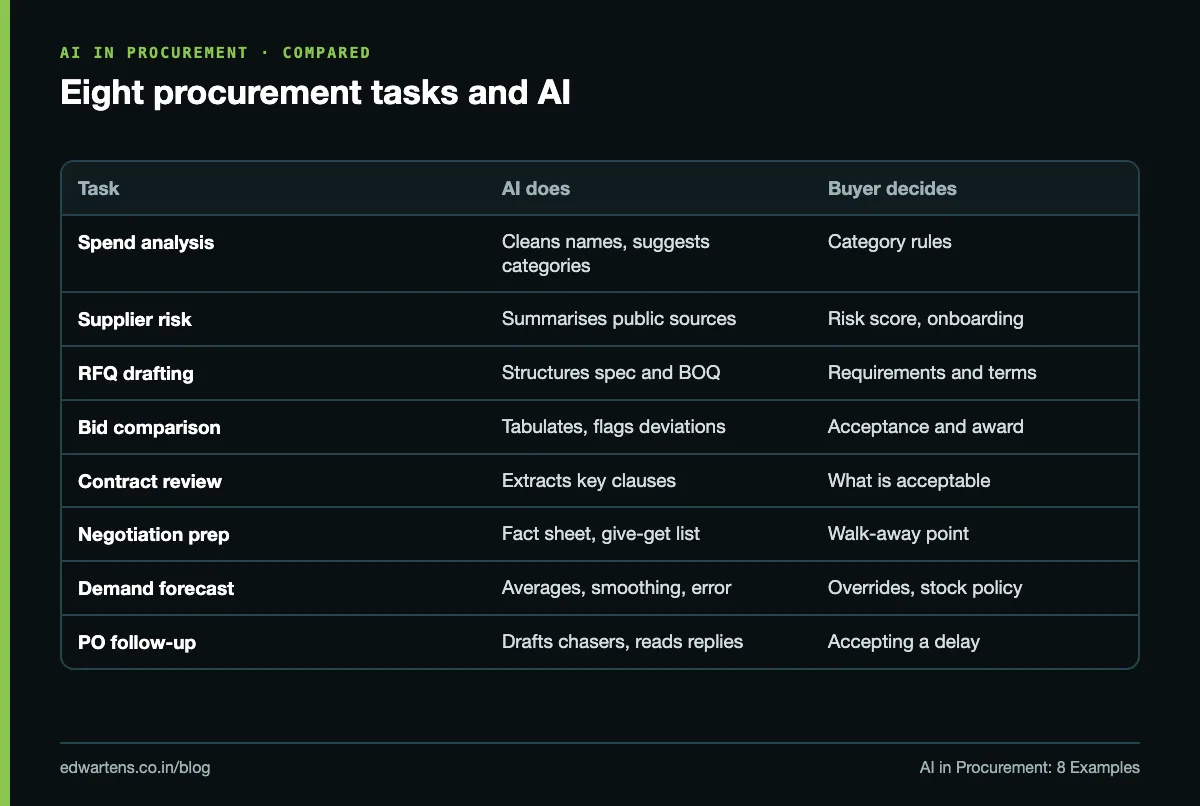
# | Procurement task | What AI does | What the buyer still decides |
|---|---|---|---|
1 | Spend analysis | Cleans supplier names, suggests categories, finds the tail | Category rules and savings targets |
2 | Supplier risk screening | Summarises public news, financial filings, certifications | The risk score and whether to onboard |
3 | RFQ and RFP drafting | Turns a spec and BOQ into a structured RFQ | Technical requirements and terms |
4 | Bid comparison | Tabulates bids, flags deviations, totals landed cost | Technical acceptance and the award |
5 | Contract review support | Extracts payment, LD, warranty and termination clauses | What is acceptable; legal sign-off |
6 | Negotiation preparation | Builds fact sheets, likely objections, give-get lists | Walk-away point and tactics |
7 | Demand forecasting | Moving averages, smoothing, error measures | Forecast overrides and stock policy |
8 | PO follow-up and exceptions | Drafts chasers, reads supplier replies, flags impact | Accepting a delay or a short shipment |
Examples from the big platforms
SAP Ariba. SAP's October 2025 announcement described a Joule agent for bid analysis that "automatically compares supplier bid data, including total cost", planned for Q1 2026, an AI summary of supplier questionnaire responses, and intelligent contracting that extracts key terms and searches past contracts for discrepancies.
Microsoft Dynamics 365. Microsoft's Procurement Agent FAQ (a production-ready preview) describes drafting follow-up emails to vendors on unconfirmed or late purchase orders, reading vendor emails to spot confirmations and change requests, and analysing the downstream impact of a change. It says generated content "should never be used without manual review" and that emails are not sent automatically unless an admin turns that on.
GeM, India's public procurement portal. In a PIB release of 19 May 2025, GeM said it had launched GeMAI, a generative AI chatbot supporting voice and text in 10 Indian languages, and that it uses analytics for real-time fraud detection and risk monitoring. For sellers and buyers on GeM, that means AI-assisted help in the portal itself.
Worked example: a bid comparison where the cheapest unit price loses
This is example 4 in practice, and it shows why the buyer, not the AI, makes the award. Three suppliers quote for 500 control valves. You paste an anonymised summary (Supplier A, B, C, no names) into your company's approved AI tool and ask it to compare the bids. A typical first answer ranks Supplier B first, because it has the lowest unit price. Now do it properly.
Supplier A | Supplier B | Supplier C | |
|---|---|---|---|
Unit price | ₹2,400 | ₹2,300 | ₹2,350 |
Goods value (500 units) | ₹12,00,000 | ₹11,50,000 | ₹11,75,000 |
Freight and packing | ₹40,000 | ₹85,000 | ₹30,000 |
Payment terms | 30 days after delivery | 50% advance, 60 days early | 30 days after delivery |
Cost of the advance at 10% a year | nil | ₹9,452 | nil |
Test certificates as per spec | Yes | Yes | Missing |
Evaluated cost | ₹12,40,000 | ₹12,44,452 | Not technically acceptable |
Check the arithmetic yourself. Supplier B's advance is 50% of ₹11,50,000 = ₹5,75,000, paid 60 days earlier than normal; at a 10% annual cost of money that is 5,75,000 x 0.10 x 60 / 365 = ₹9,452. Add freight: 11,50,000 + 85,000 + 9,452 = ₹12,44,452. Supplier A is 12,00,000 + 40,000 = ₹12,40,000. Supplier C is cheapest on paper at ₹12,05,000 but fails the technical check, so it is out before price is compared.
So the lowest evaluated, technically acceptable bid is Supplier A, by ₹4,452, even though its unit price was the highest. The AI was useful for building the table and spotting the missing certificates; it was wrong on the ranking until you gave it the full evaluation rule (technical first, then landed cost including payment terms). The free AI for Procurement and Supply Chain course teaches this technical-then-commercial method with a full bid comparison exercise.
Where AI in procurement goes wrong
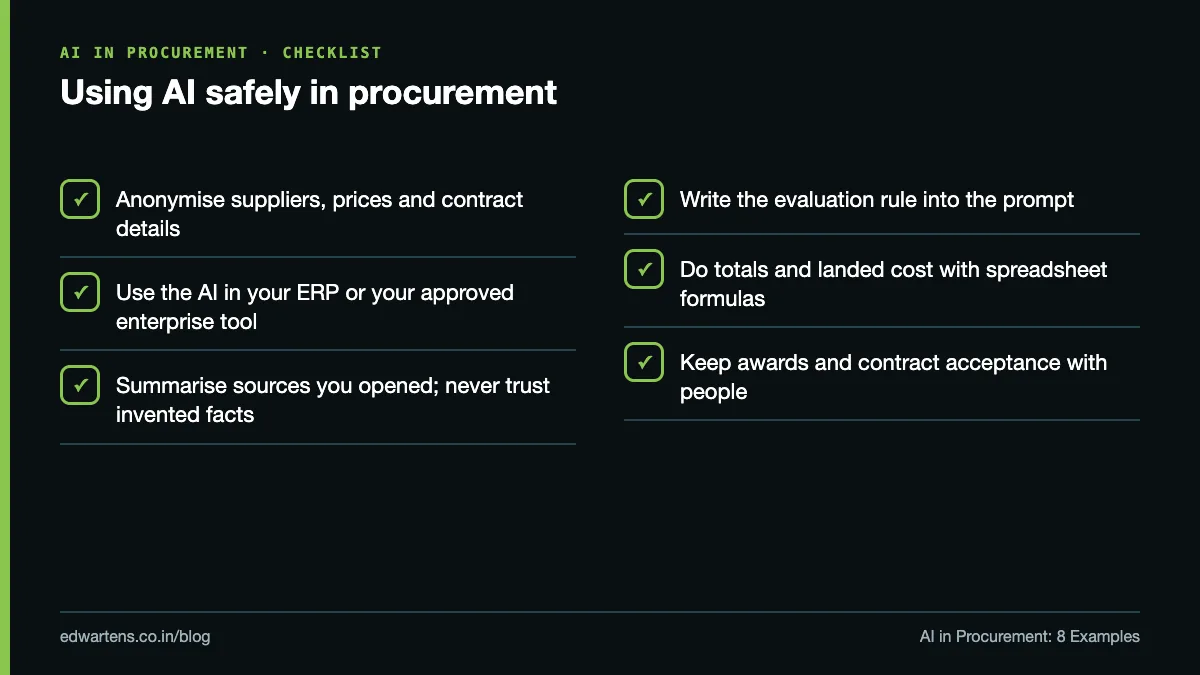
- It ranks on what it can see. Unit price is visible; your evaluation rule is not, unless you write it into the prompt.
- It invents supplier facts. Ask an assistant about a small supplier and it may produce a confident, wrong history. Use it to summarise sources you have opened, not to replace them.
- It is weak at arithmetic across many rows. Totals, percentages and landed costs belong in spreadsheet formulas, with the AI explaining, not calculating.
- It cannot sign. Awards, contract acceptance and supplier blacklisting are decisions with accountability, and they stay with people.
Keep supplier data confidential
Bids, prices, contracts and supplier bank details are confidential, and many are covered by non-disclosure clauses. Never paste them into a public AI tool, and never upload a tender document to a personal ChatGPT, Claude or Gemini account. Use the AI built into your ERP or sourcing suite, or the enterprise AI your employer has approved, under its policy. For practice, use anonymised or made-up data, as in the table above.
How a buyer can start this week
- Read your employer's AI policy and find the approved tool.
- Take last quarter's spend export, anonymise supplier names, and ask the AI to suggest categories. Check 20 lines by hand.
- Rebuild one past bid comparison with AI and compare the result with the award your team actually made.
- Draft one RFQ from a spec you know well, and list what the AI missed.
- Keep a log of time saved and errors caught; that is your case for wider use.
AI does not replace procurement knowledge; it rewards it. A buyer who knows landed cost, EOQ and contract risk gets far more from AI than one who does not. The AI for Procurement and Supply Chain course covers spend analysis, supplier risk, RFQs and bids, contract red flags, negotiation, forecasting, EOQ and safety stock, and the AI in ERP suites. It is a free course with a verifiable certificate of completion; anyone can check a certificate on our verification page. For background on how language models behave, read GenAI and LLMs in Manufacturing: What Engineers Should Know, and for other options see our list of free AI courses with certificate in India.
Frequently asked questions
Q: What are some examples of AI in procurement?
A: Spend classification, supplier risk screening, RFQ drafting, bid comparison, contract clause extraction, negotiation preparation, demand forecasting and purchase order follow-up. Suites such as SAP Ariba and Dynamics 365 build these in, and general assistants like ChatGPT, Claude, Gemini and Copilot handle many of them with a spreadsheet.
Q: How is AI used in procurement in India?
A: Large companies use the AI in SAP, Oracle, Coupa or Microsoft suites, and buyers use approved general assistants for drafting and analysis. In public procurement, GeM launched GeMAI in May 2025, a generative AI chatbot with voice and text support in 10 Indian languages.
Q: Can AI choose the winning supplier?
A: It should not. AI can tabulate bids, flag deviations and total landed cost, but the award depends on technical acceptance, evaluation rules and commercial judgement, and someone has to be accountable for it. In our worked example the AI ranked the wrong supplier first until given the full rule.
Q: Is it safe to upload supplier quotes to ChatGPT?
A: Not to a public or personal account. Quotes, prices and contracts are confidential and often under non-disclosure terms. Use your ERP's built-in AI or the enterprise tool your employer approves, and anonymise data for practice.
Q: Will AI replace procurement jobs?
A: It is automating routine tasks such as PO chasers, data cleaning and first-draft RFQs. Supplier strategy, negotiation, risk judgement and awards still need people, and buyers who can check AI output are more valuable, not less.
Q: Is there a free course on AI for procurement?
A: Yes. EDWartens' AI for Procurement and Supply Chain is a free course with a verifiable certificate of completion, covering spend analysis, supplier risk, RFQs and bid comparison, contracts, negotiation, forecasting, EOQ and safety stock.
Learn this, free
The courses that teach this
Every lesson, the written notes and the practice are free with an account. Only the certificate is optional and paid.