AI for professionals · Free online course
AI for Electrical and MEP Design Engineers
How an electrical or MEP design engineer uses ChatGPT, Claude, Gemini and Copilot on real design work without handing over the engineering: checked calculations, cable sizing, specifications, BOQ, code look-up, Python scripts, PDF extraction and QA of AI output.
- 13 modules
- 10h 53m of video
- Beginner
- English
- ₹0, free
₹0Free for good
Worth ₹5,999 by length and depth against classroom training. It has always been free; that is not a former price.
No card. Checkout takes a minute and gives you a receipt.
Overview
About AI for Electrical and MEP Design Engineers
How an electrical or MEP design engineer uses ChatGPT, Claude, Gemini and Copilot on real design work without handing over the engineering: checked calculations, cable sizing, specifications, BOQ, code look-up, Python scripts, PDF extraction and QA of AI output.
AI for Electrical and MEP Design Engineers is a free, self-paced online course from EDWartens for electrical, mechanical and building services design engineers, MEP coordinators, estimators and graduate engineers who want to use AI assistants safely on design work. It has 13 modules and 10h 53m of video lessons by Design Master Software, Tim Fairley, Connor Ferster and others, with written notes and worked problems, a practical project with a document pack and a 15-question final assessment (pass mark 60%). Learning is free with an account; an optional certificate with a public verification code is issued when you pass. Last updated 27 September 2026.
Who it is for: Electrical, mechanical and building services design engineers, MEP coordinators, estimators and graduate engineers who want to use AI assistants safely on design work
This course includes
- 10h 53m of video lessons
- 13 modules with written notes and diagrams
- One final assessment: 15 questions, pass mark 60%
- Ask-an-engineer support from practising engineers
- Lifetime access, the course does not expire
- Optional verifiable certificate when you finish
- Step 1 of 3
Learn the 13 modules
10h 53m of video lessons, written notes and a practice task per module, at your own pace.
- Step 2 of 3
Pass the final assessment
15 questions drawn from every module, pass mark 60%, 3 attempts.
- Step 3 of 3
Take the certificate, if you want it
Optional, paid once, only if you choose it. The course stays free either way.
See the certificate and its price
A look inside
From the lessons
Where AI helps and where it fails in design work
by Google Cloud Tech

Prompting for design calculations with independent checks
by The Revenue Ready Engineer

AI in MEP design tools, and quick checks for lighting and HVAC
by Design Master Software

Quantity take-off and BOQ with AI help
by Tim Fairley

Python scripts written with AI for repetitive calculations
by Connor Ferster

Quality assurance of AI output
by Design Master Software
Lesson frames belong to the creators named in the Credits and are shown from YouTube.
What you learn
What you will be able to do
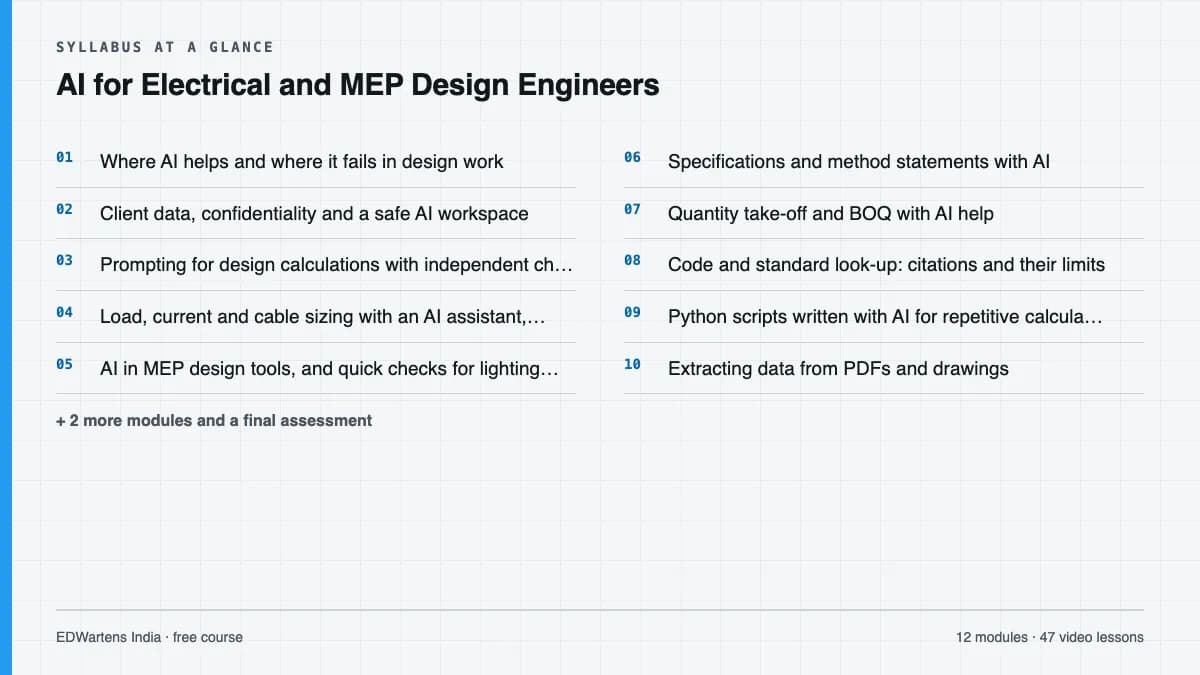
Decide which design tasks AI can speed up and which it must not own; keep client drawings and data confidential; write calculation prompts with inputs, units and method and check every answer by a second route; verify AI load, current, voltage drop and cable sizing results; check lighting and chilled water numbers; draft and review specifications and method statements; use AI on take-off and BOQ with reconciled counts; look up code requirements with editions and citations; write and test Python scripts for repetitive calculations; extract and reconcile data from PDFs and drawings; record a five-step review in a verification register; and build a personal design assistant.
- Sort design tasks into AI drafts, AI assists with checks, and AI must not own
- Keep client drawings and data confidential with the right plan, settings and redaction
- Write calculation prompts with inputs, units and method, and check every answer by a second route
- Catch the classic AI errors in current, maximum demand, voltage drop and cable sizing
- Draft and review specifications, method statements and BOQs with AI, with reconciled counts
- Look up code requirements with editions and citations, and spot edition drift
- Specify, test and run Python scripts for repetitive calculations and PDF data extraction
- Run a five-step review with a verification register and build a personal design assistant
Syllabus
Course content, module by module
In order, at whatever pace suits you. Each module ends with a practice task that builds on the last.
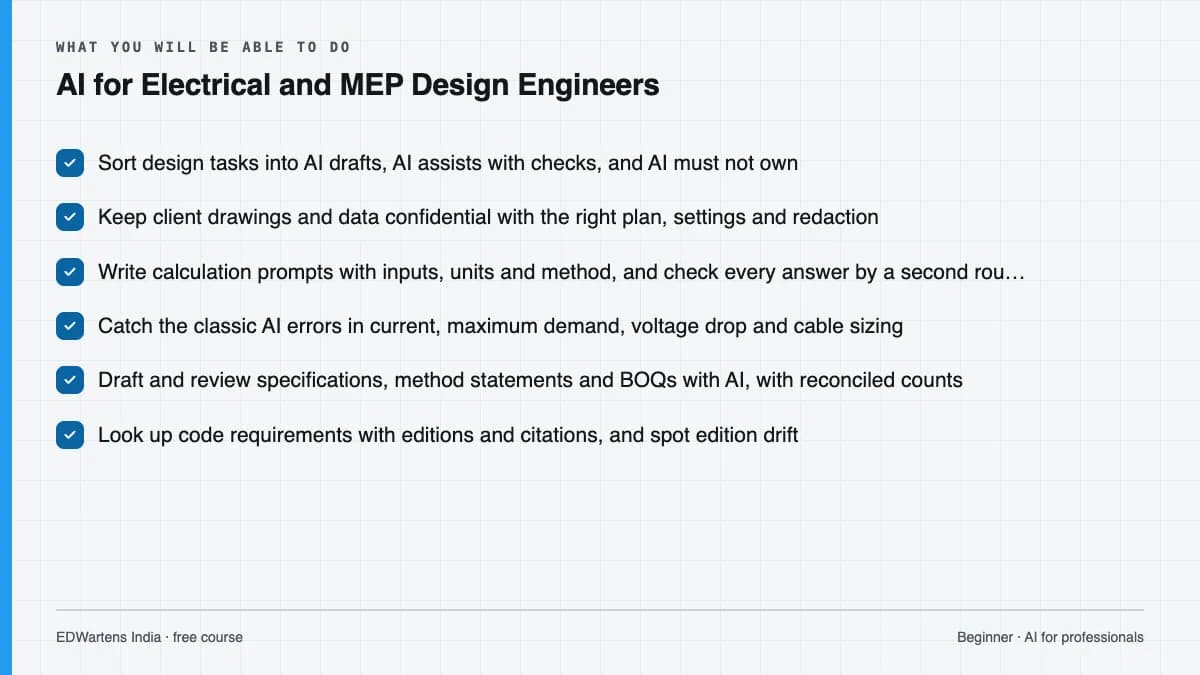
- Modules
- 13
- Video lessons
- 48
- Of video
- 10h 53m
- Final questions
- 15
- 01
Where AI helps and where it fails in design work
4 lessons · 37m - 02
Client data, confidentiality and a safe AI workspace
3 lessons · 22m - 03
Prompting for design calculations with independent checks
3 lessons · 42m - 04
Load, current and cable sizing with an AI assistant, verified
5 lessons · 1h 5m - 05
AI in MEP design tools, and quick checks for lighting and HVAC
3 lessons · 1h 23m - 06
Specifications and method statements with AI
5 lessons · 40m - 07
Quantity take-off and BOQ with AI help
4 lessons · 46m - 08
Code and standard look-up: citations and their limits
4 lessons · 46m Final assessment · 15 questions, pass mark 60%
Project
The course project
Optional practice that ends in the kind of job the course prepares you for, with the documents that go with it.
About 12 hours
AI-assisted design calculation pack with independent verification for a four-storey office
Use an AI assistant to prepare the electrical and MEP calculation pack for a small office building, then prove every number by a second route: a design basis and AI use plan, a load list with maximum demand, a cable schedule with voltage drop, lighting and chilled water checks, and a verification register that records each check and the errors it caught. The sample pack shows each document for a fictional building.
Sample document pack, 5 documents, filled in for the scenario
- ReportDesign basis and AI use plan: Harbour Point Offices
- Load listElectrical load list and maximum demand
- Cable scheduleSub-main cable schedule with voltage drop
- ReportCalculation summary, prompt log and MEP checks
- RegisterVerification register for the AI-assisted calculation pack
Read inside the course and download as a workbook. The project is optional practice, marked when you submit it; the certificate needs only the modules and the final assessment.
Tools
Software, hardware and lessons
Software
Any one AI assistant: ChatGPT, Claude, Gemini or Microsoft Copilot (free tiers work for most exercises; product and model names are as of October 2026 and change often). A spreadsheet (LibreOffice Calc is free). Python with pandas, openpyxl and pdfplumber for two modules, free in Google Colab with nothing to install.
Hardware
None. Any laptop with a browser is enough.
Who it is for
Beginner to intermediate in AI, working level in design. For electrical, mechanical and building services design engineers, MEP coordinators, estimators and graduate engineers who already do or are learning design calculations. No coding experience is needed; the Python modules start from zero. Electrical Design Engineering teaches the calculations themselves; Prompt Engineering for Engineers and AI Coding for Engineers go deeper into prompting and coding agents.
Video lessons by
- Design Master Software
- Tim Fairley
- Connor Ferster
- Josh Turner | Construction AI
- Jeff Su
- Google Cloud Tech
- codebasics
- David Bombal
- Christopher Penn
- John Ferrell, Esq.
- The Revenue Ready Engineer
- Leila Gharani
- LEARN ELECTRICS
- Electrical Code Coach
- Engineering Master
- Schnackel Engineers
- Engineering Institute of Technology
- Young Architect
- Lementai
- Will On Safety
- Awarded Bid
- Construction Learning
- TogalAI
- Dave Cooper LIVE
- The Brazilian Engineer in Australia
- Paul J Lipsky
- Grow with Google
- AI for Civil Engineers
- Dave Ebbelaar
- Tetra Elements LLC
- Pythonology
- Krish Naik
- Anthropic
- Claude
- Kevin Stratvert
- Moveworks
Independent creators, credited in full under Credits.
Software you need
What to download, where from, what it costs and how to install it. Every link goes to the maker's own site, never a mirror.
One AI assistant is enough, and free tiers work for most exercises. Use only a plan your employer approves for client data, and never paste contracts or anything that identifies the client. The Python modules run in Google Colab with nothing to install.
One AI assistant
Any one is enough.
- 01Free plan with limits
ChatGPT
OpenAI, in the browser
- Runs on
- Any modern web browser, plus mobile and desktop apps
- Account
- A free OpenAI account
The Free plan allows everyday text chats. File uploads, image creation, voice and data analysis have tighter limits than paid plans, and ads may appear in some countries. Paid plans raise the limits.
Steps
- 1.Open chatgpt.com.
- 2.Click Sign up and create an account with your email, or a Google, Microsoft or Apple account.
- 3.Verify your email and confirm your details.
- 4.Type your question in the message box.
- Do not paste personal data, passwords or confidential work files.
- ChatGPT tells you when you reach a limit. Wait for it to reset or switch to a lighter task.
Open ChatGPTchatgpt.com - 02Free plan with limits
Claude
Anthropic, in the browser
- Runs on
- Any modern web browser, plus desktop and mobile apps
- Account
- A free Claude account (you must be 18 or over)
The Free plan covers chat on web, desktop and mobile, web search, file creation and Artifacts. Usage limits reset on a rolling five-hour window and depend on message length and features used. Paid plans give more usage.
Steps
- 1.Open claude.ai (or see the plans at claude.com/pricing).
- 2.Sign up with your email or Google account and confirm your email.
- 3.Confirm you are 18 or over and accept the terms.
- 4.Type your question in the message box.
- Long conversations and large files use up your limit faster. Start a new chat for a new topic.
- Do not paste personal data or confidential work files.
Open Claudeclaude.com - 03Free with limits
Google Gemini
Google, in the browser
- Runs on
- Any modern web browser, plus Android and iOS apps
- Account
- A free Google account
Free with a Google account, including a Flash model, limited access to the Pro model, image generation, Deep Research and Gems. Paid Google AI plans give higher limits. Some features require you to be 18 or over.
Steps
- 1.Open gemini.google.com.
- 2.Sign in with your Google account.
- 3.Accept the terms the first time you use it.
- 4.Type your question or upload a file in the prompt box.
- Use a personal Google account. Work or school accounts depend on your administrator's settings.
Open Google Geminigemini.google.com - 04Free
Microsoft Copilot and Microsoft 365 Copilot Chat
Microsoft, in the browser
- Runs on
- Any modern web browser, plus Windows, macOS, Android and iOS apps
- Account
- None needed
Microsoft Copilot is free for individuals; you must be at least 13 (older in some countries). Microsoft 365 Copilot Chat is included at no extra cost for organisations with an eligible Microsoft 365 licence and needs a work or school (Microsoft Entra ID) account.
Steps
- 1.Open copilot.microsoft.com.
- 2.Optionally click Sign in and use your personal Microsoft account.
- 3.Type your question in the message box.
- 4.For work or school use, sign in at microsoft365.com with your organisation account and open Copilot Chat.
- Copilot Chat with a work or school account adds enterprise data protection. Use it for work material if your organisation provides it.
Open Microsoft Copilot and Microsoft 365 Copilot Chatcopilot.microsoft.com
Optional
Useful, not needed to finish the course.
- 05Free
LibreOffice
The Document Foundation
- Runs on
- Windows 10 or 11, macOS 11 or newer (Intel or Apple silicon), Linux
- Account
- None needed
- Size
- up to 1.5 GB of disk space on Windows
LibreOffice is free, open-source software under the Mozilla Public License 2.0, for any use including business. Calc is its spreadsheet.
Steps
- 1.Open the LibreOffice download page.
- 2.Check the page has picked your operating system, then select Download.
- 3.Run the installer (administrator rights are needed on Windows).
- 4.Start LibreOffice Calc for spreadsheet work.
- 5.Save as .xlsx if you need to share files with Excel users.
- Choose the latest main version unless your organisation asks for the older, more conservative release.
Official download pagelibreoffice.org - 06Free, GPU time not guaranteed
Google Colab
Google, in the browser
- Runs on
- Any modern web browser
- Account
- A free Google account
Colab is free to use. In the free version GPUs and TPUs are heavily restricted and not guaranteed, sessions can run for at most 12 hours, and idle sessions are stopped. Paid plans give more reliable access.
Steps
- 1.Open colab.research.google.com and sign in with your Google account.
- 2.Click New notebook (or open the notebook your course links to).
- 3.For a GPU, choose Runtime, then Change runtime type, then pick a GPU if one is offered.
- 4.Type code in a cell and press Shift and Enter to run it.
- Save a copy to your Google Drive so your changes are kept.
- Files on the runtime are deleted when the session ends. Save outputs to Drive.
Open Google Colabcolab.research.google.com - 07Free
Python
Python Software Foundation
- Runs on
- Windows (not Windows 7 or earlier), macOS and Linux. Windows builds for x64, 32-bit and Arm64.
- Account
- None needed
Python is free, open source software. You can use it for learning and for commercial work at no cost.
Steps
- 1.Open python.org/downloads and click the download button for your system.
- 2.On Windows, run the Python install manager (or the classic 64-bit installer) you downloaded.
- 3.If you use the classic installer, tick "Add python.exe to PATH" on the first screen, then click Install Now.
- 4.Open a new Command Prompt or Terminal and run: python --version (on Windows you can also run: py --version).
- 5.Install packages with pip, for example: python -m pip install requests
- pip comes with Python. Run it as python -m pip so it always matches the Python you are using.
- Python.org now recommends the Python install manager on Windows. If it offers to add its folder to PATH, say yes so the python command works everywhere.
- Make a virtual environment for each project: python -m venv .venv
Official download pagepython.orgAlternatives
- Anaconda Distribution: Python with 600+ data science packages and Jupyter already included.
Checked against each maker's own page on 27 September 2026. Trial lengths and editions change; the maker's page is the final word.
What you walk away with
Your certificate for AI for Electrical and MEP Design Engineers
Finish the course, pass the final, and this is the document with your name on it.
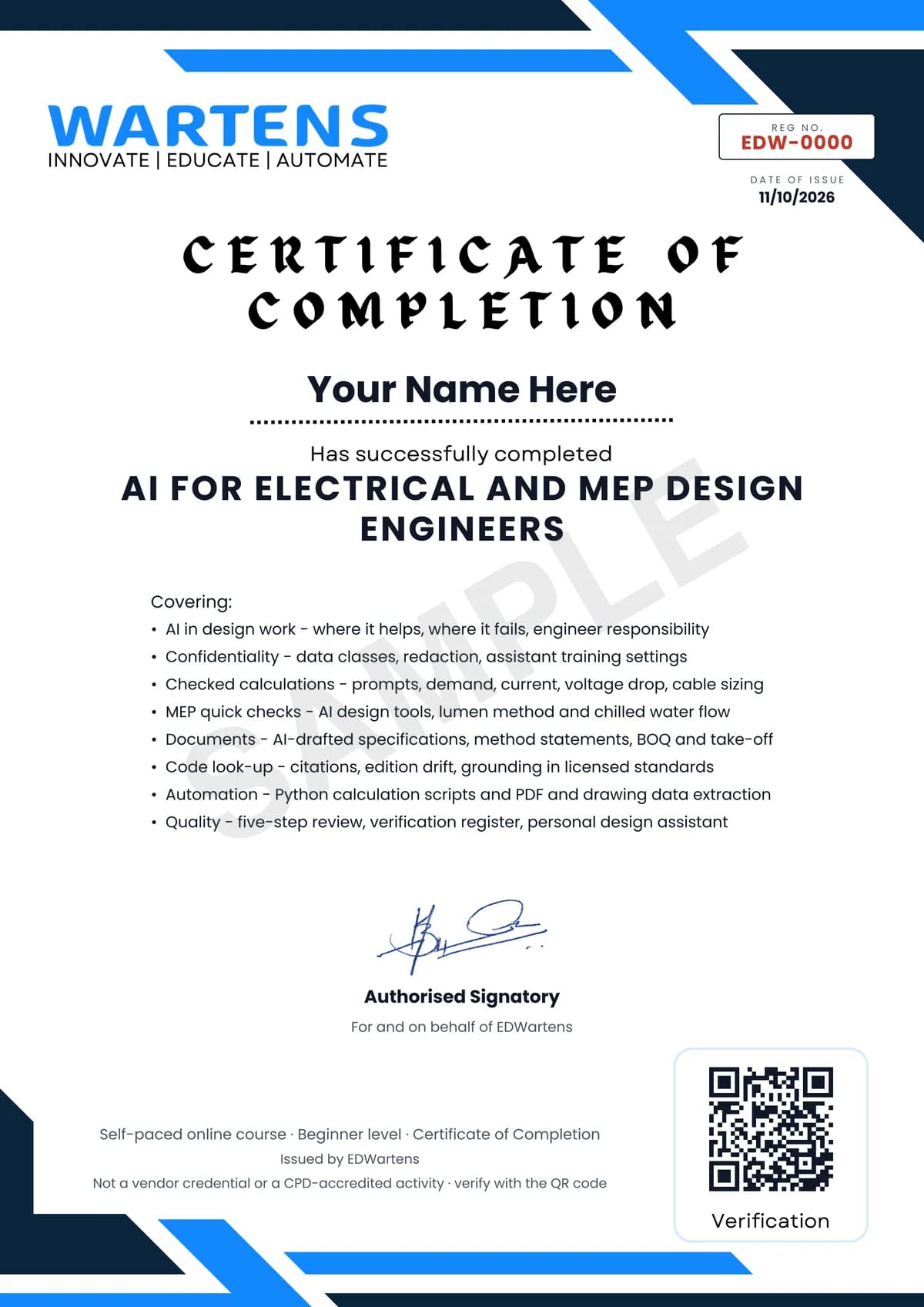
Verifiable by anyone
Adds to LinkedIn in one click
QR code on the certificate
Names what you can do
A permanent link
Earned, not attended
Learning is free. The certificate is optional.
Add it now and pay only when you have finished the course, or come back for it later. One-off, US$23.99, with a receipt.
Issued by EDWartens India (Wartens Automation Private Limited) as a Certificate of Completion for this self-paced course. It is not a vendor certification, a university award or a CPD-accredited activity, and it does not certify competence on live equipment. Delivered electronically; see the refund policy.
FAQ
Common questions
What is the AI for Electrical and MEP Design Engineers course?
It is a free-to-learn online course that teaches electrical and MEP design engineers to use AI assistants such as ChatGPT, Claude, Gemini and Microsoft Copilot on real design work, with every result checked by an independent route. It covers calculation prompts, load and cable sizing checks, lighting and chilled water checks, specifications, method statements, BOQ and take-off, code look-up, Python scripts, PDF and drawing extraction, QA of AI output and client confidentiality.
Can ChatGPT do electrical design calculations?
It can draft and run them, but every answer must be checked by a second route before it is used. Assistants predict text, so they make specific, confident errors such as dropping the root 3 in a three-phase current, using 20 C cable resistance for a hot cable or treating kW as per hour. The course shows how to give the inputs, make the arithmetic run in code and verify the result by hand, spreadsheet or a tested script.
Is AI output compliant with IEC 60364, BS 7671 or the NEC?
No AI output is compliant until a competent engineer has checked it against the adopted edition of the code. Assistants rarely see the full licensed text, mix editions and drop exceptions, for example quoting Article 220 for load calculations that moved to Article 120 in the 2026 NEC. The course teaches look-up with editions and citations, grounding in licensed documents and verification in the code itself.
Is it safe to put client drawings into ChatGPT or Claude?
Only if the client contract and your company's AI policy allow it, and then only on an approved plan with the data classified and redacted first. Consumer plans may use chats for training unless you switch it off, while business plans of the major assistants exclude business data from training by default (as of October 2026). The course covers the settings, a four-level data classification and redaction of drawings and schedules.
Who is this course for and what do I need to know first?
It is for electrical, mechanical and building services design engineers, MEP coordinators, estimators and graduate engineers in consultancies and contractors worldwide, including the Gulf. You should know what a load schedule, a voltage drop check and a specification are; no coding experience is needed. Electrical Design Engineering is the companion course for the calculations themselves.
Which AI tools and software do I need?
One AI assistant is enough: ChatGPT, Claude, Gemini or Microsoft Copilot, and the free tiers work for most exercises. You also need a spreadsheet such as LibreOffice Calc, and Python with pandas and pdfplumber in Google Colab for two modules, with nothing to install. Product and model names in the course are dated October 2026 because they change often.
How long does the course take and is it free?
About 18 hours at your own pace, of which just under 11 hours is video, plus about 12 hours for the optional project. Every module, the notes, worked problems, practice tasks, project and final assessment are free to learn.
What certificate do I get and how is it verified?
You get a verifiable certificate of completion from EDWartens when you finish the modules and pass the 15-question final at 60 percent. It carries a unique certificate number and a QR code that open a public verification page showing the course, the modules covered and your final score. It is not a professional engineering licence or a vendor certification from OpenAI, Anthropic, Google or Microsoft.
Is the AI for Electrical and MEP Design Engineers course free in India, and what does the certificate cost?
Yes. Learning costs ₹0 in India: every module, the written notes, the practice tasks and the final assessment, with no card and no trial period. The only paid item is the optional EDWartens Certificate of Completion, ₹499 including GST for this beginner course, paid in rupees through Razorpay, and only if you want it after passing the final assessment.
All course factsHide course facts
- Price
- ₹0, free for good. No trial, no card. Comparable classroom training of this length costs about ₹5,999.
- Who it is for
- Electrical, mechanical and building services design engineers, MEP coordinators, estimators and graduate engineers who want to use AI assistants safely on design work
- Format
- 13 self-paced modules, 10h 53m of video, written notes, a practice task per module and one final assessment.
- Level
- Beginner. Beginner to intermediate in AI, working level in design. For electrical, mechanical and building services design engineers, MEP coordinators, estimators and graduate engineers who already do or are learning design calculations. No coding experience is needed; the Python modules start from zero. Electrical Design Engineering teaches the calculations themselves; Prompt Engineering for Engineers and AI Coding for Engineers go deeper into prompting and coding agents.
- Brand
- Vendor-neutral
- Software
- Any one AI assistant: ChatGPT, Claude, Gemini or Microsoft Copilot (free tiers work for most exercises; product and model names are as of October 2026 and change often). A spreadsheet (LibreOffice Calc is free). Python with pandas, openpyxl and pdfplumber for two modules, free in Google Colab with nothing to install.
- Hardware
- None. Any laptop with a browser is enough.
- Certificate
- Optional EDWartens Certificate of Completion, verifiable by code. Not a vendor credential.
- Video lessons by
- Design Master Software, Tim Fairley, Connor Ferster, Josh Turner | Construction AI, Jeff Su, Google Cloud Tech, codebasics, David Bombal, Christopher Penn, John Ferrell, Esq., The Revenue Ready Engineer, Leila Gharani, LEARN ELECTRICS, Electrical Code Coach, Engineering Master, Schnackel Engineers, Engineering Institute of Technology, Young Architect, Lementai, Will On Safety, Awarded Bid, Construction Learning, TogalAI, Dave Cooper LIVE, The Brazilian Engineer in Australia, Paul J Lipsky, Grow with Google, AI for Civil Engineers, Dave Ebbelaar, Tetra Elements LLC, Pythonology, Krish Naik, Anthropic, Claude, Kevin Stratvert, Moveworks (independent creators, credited below)
- Language
- English
- Last updated
- 27 September 2026
Pairs well with
 AI for professionals · FreeMicrosoft 365 Copilot and Copilot Studio Agents
 PLC programming · FreeSiemens TIA Portal
 PLC programming · FreeSiemens TIA Portal in Three Hours
 PLC programming · FreeTIA Portal: Build a Machine
More free courses: Free AI courses for professionals
Classroom course, Bangalore
PLC training in Bangalore
The Automation Engineer Program (AEP) is our classroom course in PLC programming and industrial automation, taught in person at our Electronic City centre.
Credits
Who made the video lessons
The video lessons in this course were created by the people below, not by EDWartens. Every lesson streams from its creator's own YouTube channel; EDWartens neither hosts nor sells that footage, and the creators are not affiliated with EDWartens and do not endorse this course. What EDWartens wrote is the study plan, the notes, the practice tasks and the assessments.
- Design Master Softwarethe series on AI in MEP design: whether MEP design is ready for AI, AI electrical design in Revit, AI against 201 Revit panels, the future of MEP design, and the ElectroBIM AI design review webinar
- Tim Fairleygetting AI to read construction drawings, comparing AI models on drawings, estimating with ChatGPT and reviewing a construction contract with ChatGPT
- Connor Fersterhandcalcs for readable Python calculations, handcalcs in Jupyter against Excel, and Python in structural engineering practice
- Josh Turner | Construction AIwhat ChatGPT does and does not do for construction, and turning a drawing set into a database with Claude
- Jeff Sudata analysis with ChatGPT and the ChatGPT Work agent
- Google Cloud Techthe introduction to large language models that opens the course
- codebasicshallucination, simply explained
- David Bombalwhy secrets and private data stay out of ChatGPT
- Christopher Pennkeeping data confidential with ChatGPT
- John Ferrell, Esq.a lawyer's view of data, privacy and AI chat tools
- The Revenue Ready EngineerChatGPT prompts for engineering work
- Leila Gharaniwhat ChatGPT does with a messy Excel file
- LEARN ELECTRICSthe voltage drop formula and cable size calculation used as the independent check
- Electrical Code Coacha quick method for voltage drop calculations
- Engineering Masterthe guide to cable selection and voltage drop calculation
- Schnackel Engineersan MEP consultancy's AI for MEP tooling
- Engineering Institute of Technologythe webinar on AI in electrical engineering and automation
- Young Architectconstruction specifications and the project manual
- Lementaihow to write a construction method statement
- Will On Safetywhat risk assessments and method statements are and why they matter
- Awarded BidCSI MasterFormat for construction specifications
- Construction Learningautomating construction take-offs with ChatGPT
- TogalAIAI symbol search and counting in an electrical take-off tool
- Dave Cooper LIVEan electrical estimator's walk-through of AI take-off
- The Brazilian Engineer in Australiagrounding NotebookLM in engineering textbooks and checking its answers
- Paul J Lipskyworking with Gemini Notebook
- Grow with Googlemanaging project documentation with NotebookLM
- AI for Civil EngineersNotebookLM use cases for engineers working with codes and documents
- Dave Ebbelaarreading Excel files with pandas
- Tetra Elements LLCautomating calculations and writing formulas into Excel with openpyxl
- Pythonologyextracting text and tables from PDFs with PyMuPDF, PyPDF and pdfplumber
- Krish Naikwhat LLM hallucination is and how to reduce it
- Anthropicgetting started with projects in Claude
- Claudegetting started with Claude Cowork
- Kevin StratvertChatGPT projects for beginners
- Moveworksthe two-minute recap on AI hallucinations in the final module
If you are one of these creators and would like a lesson removed or credited differently, write to info@wartens.com.