DOL vs Star-Delta vs Soft Starter vs VFD: Choosing a Motor Starter Properly

The starting problem
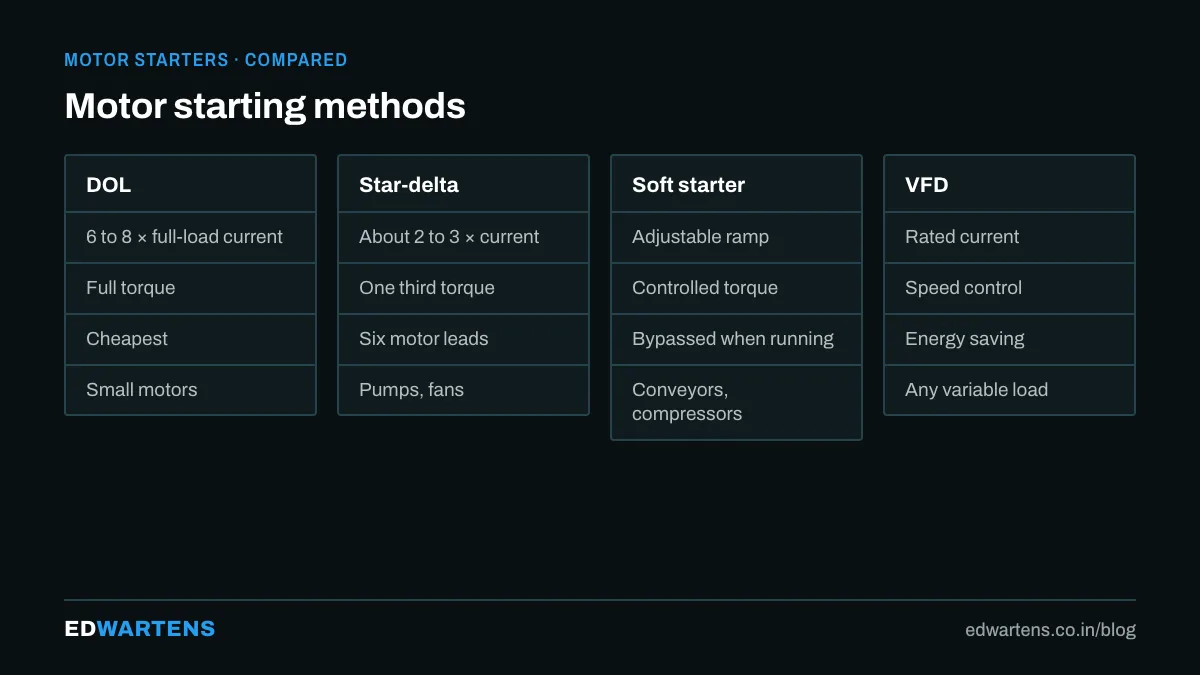
A three-phase induction motor switched straight onto the supply draws six to eight times its full-load current while it accelerates, and its torque at that moment is well above rated. For a 5 kW pump on a strong supply that is a non-event. For a 200 kW compressor on a weak feeder it dips the voltage, stalls neighbouring drives and stresses the coupling. The starter you choose is a decision about current, torque, control and money.
Direct-on-line (DOL)
A contactor and an overload relay. Full voltage, full inrush, full starting torque, no speed control.
- Current: 6 to 8 × full-load current.
- Torque: 100 percent of the motor's starting torque.
- Use: motors up to roughly 7.5 to 15 kW on a normal supply, and anything that must start under full load, such as a positive displacement pump or a conveyor.
- PLC interface: one digital output for the contactor, one digital input for the auxiliary contact, one for the overload trip.
Star-delta
Two contactors bring the motor in star (each winding sees 58 percent of line voltage) then switch to delta after a timer. The motor must be delta-connected with all six terminals brought out.
- Current: one third of DOL.
- Torque: one third of DOL, which is the catch: the load must accelerate on a third of the torque, so it suits fans and centrifugal pumps started unloaded, not loaded conveyors.
- The transition: open transition causes a second current spike when the delta contactor closes; closed transition adds resistors to avoid it.
- Use: 15 to 100 kW, low cost, still the most common starter in Indian plants.
Soft starter
Thyristors ramp the voltage from a set initial value to full over a set time, then a bypass contactor takes over. Current limit and ramp time are parameters.
- Current: adjustable, typically 2.5 to 4 × full load.
- Torque: reduced during the ramp, and a current-limit start adapts to the load.
- Extras: soft stop for pumps to prevent water hammer, motor protection built in, communication over Modbus or Profinet.
- Use: pumps, fans, compressors, conveyors from 15 kW upward where speed control is not needed but a gentle start is.
Variable frequency drive (VFD)
The drive rectifies the supply, holds a DC bus, and inverts it to a variable frequency and voltage. The motor starts at a low frequency with full torque and current near rated.
- Current: at or near full-load current during start.
- Torque: full torque from near zero speed, with vector control.
- Extras: speed control, energy saving on fans and pumps (the affinity laws make a 20 percent speed reduction a near 50 percent power reduction), braking, PID inside the drive, full fieldbus integration.
- Use: anything that benefits from speed control, and increasingly anything above 15 kW because energy savings pay for the drive.
The decision in one table
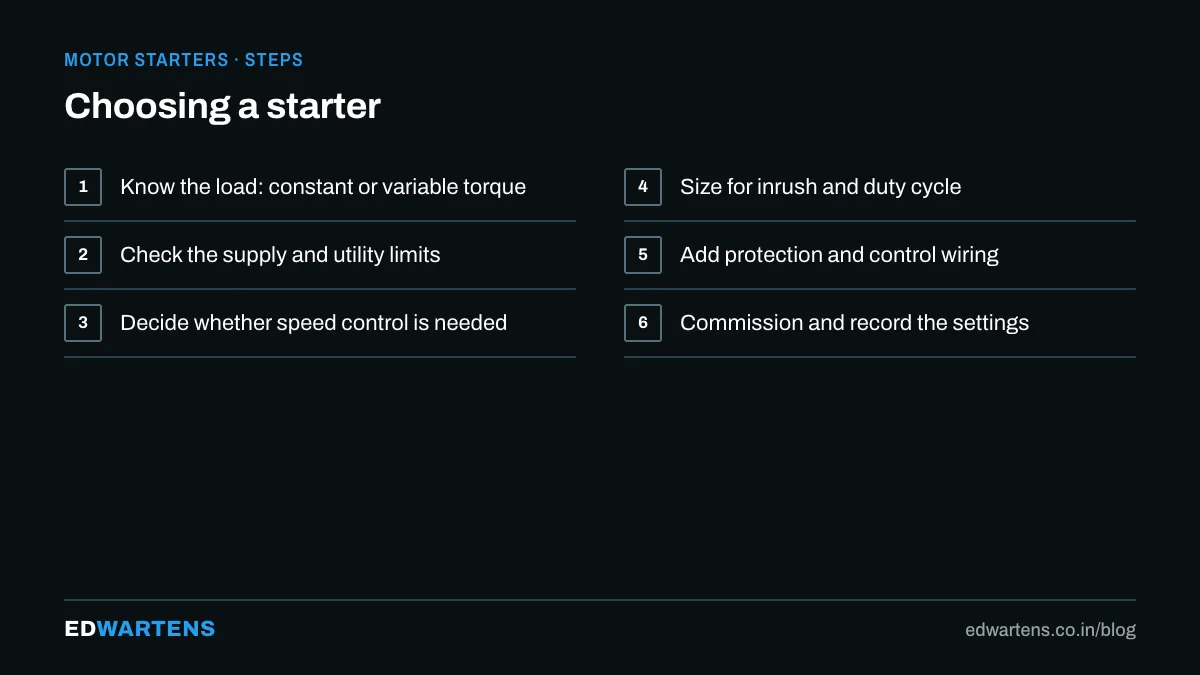
Question | Answer points to |
|---|---|
Must the motor start under full load? | DOL or VFD |
Is the supply weak or the motor large? | Soft starter or VFD |
Does the process benefit from variable speed? | VFD |
Is the budget minimal and the load a fan or unloaded pump? | Star-delta |
Is water hammer or belt snatch a problem? | Soft starter or VFD |
How the PLC sees each one
DOL and star-delta are contactor logic: outputs, auxiliaries, timers and an overload input, which the Industrial Motor Control course wires and programs. Soft starters and VFDs are devices with parameters and, usually, a network interface: start, stop, reference and status words over Profinet or EtherNet/IP, covered in the VFD course, the SINAMICS course and the PowerFlex course. Sizing the cable and breaker for each starter type is in the electrical design course.
This is part of the wider skill set covered in our industrial automation training in Bangalore.
Frequently asked questions
Can a soft starter control speed? No. It controls the ramp only; at full voltage the motor runs at rated speed.
Does a VFD always save energy? On variable-torque loads (fans, centrifugal pumps) run below full speed, yes. On a constant-speed conveyor, no.
Why do star-delta starters fail so often? Open-transition spikes, contactor wear from the changeover, and loads that never should have been on a reduced-torque starter.
Learn this, free
The courses that teach this
Every lesson, the written notes and the practice are free with an account. Only the certificate is optional and paid.


