Digital Twins in Manufacturing: What They Actually Are and How a Plant Builds One

A definition you can use
A digital twin is a model of a physical asset, process or plant that is kept in step with the real thing by live data, and that is used to answer questions the real thing cannot answer safely or cheaply: what happens if, why did that happen, what will happen next. The two halves matter equally: a model with no live data is a simulation; live data with no model is a dashboard.
Three kinds, three uses
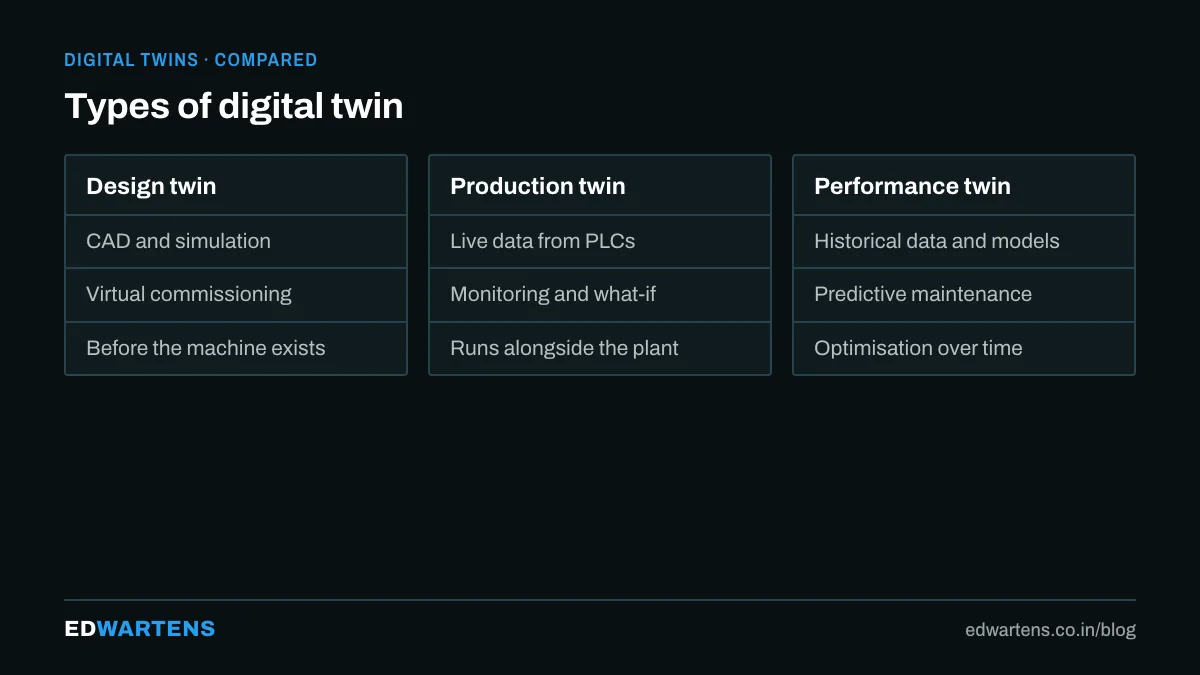
- Product or asset twin. A model of one machine or component with its as-built configuration, service history and condition data. Used for maintenance and warranty. A pump with its vibration trend and remaining-life estimate.
- Process twin. A model of a production process, from a single line to a plant, fed by historian data. Used for what-if analysis, bottleneck studies and operator training. A filling line modelled in Plant Simulation with real cycle times.
- Virtual commissioning twin. A model of a machine's mechanics and I/O connected to the real PLC program, so the code is tested before the machine exists. Built in NX MCD, Emulate3D, RoboDK or the vendor's simulator.
The data a twin needs
- Structure: the asset model, ideally from CAD (the SolidWorks and Fusion 360 courses cover the modelling side) and the P&ID.
- Live state: tags from the PLC through OPC UA or MQTT.
- History: the historian, for the behaviour the model must reproduce.
- Context: recipes, orders, shifts, maintenance records from MES and CMMS.
The plants that succeed spend most of the project on data plumbing, not on 3D graphics.
Tools you will meet
Purpose | Tools |
|---|---|
Virtual commissioning | Siemens NX MCD and SIMIT, Rockwell Emulate3D, RoboDK, Visual Components |
Process simulation | Siemens Plant Simulation, AnyLogic, FlexSim |
Asset and plant twins | AVEVA, Siemens Xcelerator, Azure Digital Twins, AWS IoT TwinMaker |
Data layer | Ignition, Node-RED, OPC UA, MQTT, time-series databases |
A realistic first project
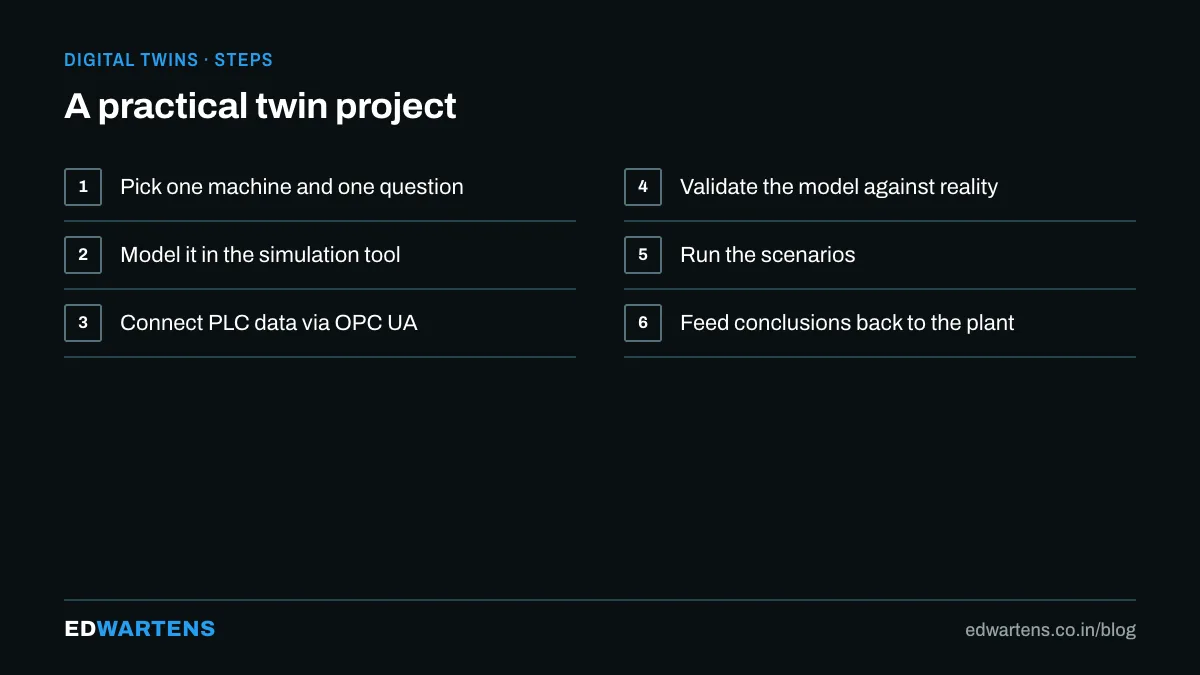
Pick one machine or one line. Then:
- Connect the PLC to a historian or a time-series database and record a month.
- Build a simple model: a state machine of the line's stations with cycle times and failure rates taken from the data.
- Validate the model's throughput against the real month.
- Use it for one decision: buffer size, a second robot, a shift pattern.
- Only then add 3D, and only if someone needs to see it.
A virtual commissioning twin is the other good first project: connect PLCSIM Advanced to a mechatronic model of the machine and prove the sequence before the electrician wires the panel. The S7-1500 Advanced course and TIA Portal course work with PLCSIM throughout.
What to be sceptical of
- A 3D model with no live data is a rendering.
- A dashboard with no model is a dashboard.
- Any twin without a validation step against real data is a guess with graphics.
For a classroom route that puts topics like this next to PLC programming, see industrial automation course in Bangalore.
Frequently asked questions
Do we need the cloud? No. Most useful twins run on a server in the plant with data that never leaves it.
What skills does a twin engineer need? PLC and OPC UA for the data, a simulation tool, enough Python or SQL to validate, and the process knowledge to know what question the twin answers.
Is this relevant to a fresher? Yes: virtual commissioning is now how automotive and pharma OEMs deliver, and engineers who can test a program against a simulated machine are hired ahead of those who cannot.
Learn this, free
The courses that teach this
Every lesson, the written notes and the practice are free with an account. Only the certificate is optional and paid.


