Instrumentation Basics for PLC Engineers: RTD vs Thermocouple, Transmitters and the 4 to 20 mA Loop

Where the number on the HMI comes from
A temperature on the screen is the end of a chain: a sensor produces a tiny electrical change, a transmitter turns it into a 4 to 20 mA current, the PLC's analog card turns that into an integer, and the program scales the integer to degrees. A PLC engineer who understands the first two links diagnoses bad readings in minutes instead of days.
RTDs
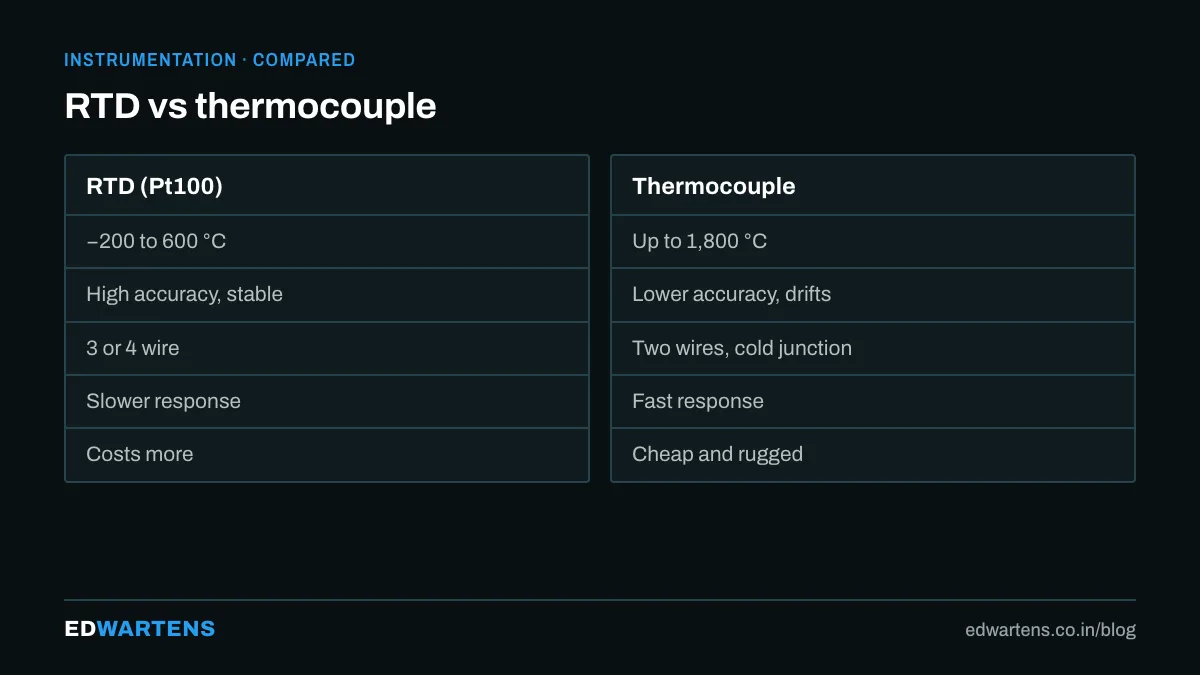
A resistance temperature detector is a platinum element whose resistance rises with temperature: Pt100 is 100 ohms at 0 °C and about 138.5 ohms at 100 °C; Pt1000 is ten times that and less sensitive to lead resistance.
- Range: about −200 to 600 °C.
- Accuracy: excellent, Class A around ±0.15 °C at 0 °C.
- Wiring: two, three or four wires. Three-wire is the plant standard; the third wire lets the input cancel lead resistance. Two-wire is only for short runs; four-wire is for laboratory accuracy.
- Weakness: slower response, fragile at high vibration, and expensive above 600 °C.
Thermocouples
Two dissimilar metals joined at the tip produce a millivolt signal that depends on the temperature difference between the tip and the reference junction.
- Types: K (chromel-alumel, −200 to 1,250 °C, the general-purpose choice), J (iron-constantan, to 750 °C), T (copper-constantan, cryogenic and food), N, and the platinum types R, S and B for furnaces above 1,000 °C.
- Cold junction compensation: the input measures its own terminal temperature and adds it back. Using copper wire instead of the matching extension cable moves the reference junction to the wrong place and reads wrong by tens of degrees.
- Strengths: rugged, fast, cheap, very high temperatures.
- Weakness: accuracy of ±1 to 2 °C, drift with age, and the compensation cable rules.
Which to use
Below about 400 °C where accuracy matters (pharma, food, HVAC, most process loops): RTD. Above that, or where the sensor lives on a moving or vibrating machine, or where response must be fast: thermocouple. Furnaces, kilns and exhaust gas: thermocouple, always.
The transmitter
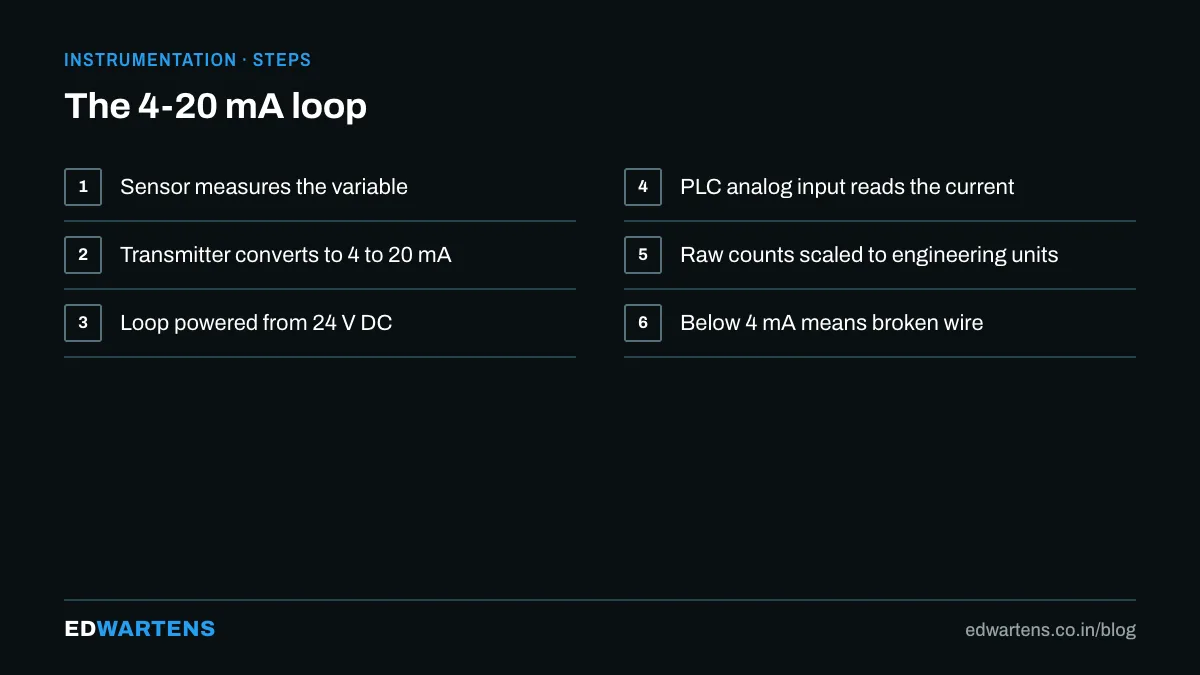
A head-mounted or field transmitter converts the sensor signal into a 4 to 20 mA current proportional to a configured range, say 0 to 200 °C. The current loop is used because current does not fall with cable length, 4 mA at zero means a broken wire reads as 0 mA and is detectable, and a two-wire transmitter powers itself from the loop.
- Two-wire, loop powered: the PLC card or a power supply provides 24 V; the transmitter regulates the current. Most temperature and pressure transmitters.
- Four-wire: separately powered; the output is an active current source. Analysers and some flow meters.
- HART: a digital signal over the same 4 to 20 mA pair for configuration and diagnostics, read with a handheld or a HART-enabled input card.
Reading the loop in the PLC
The card reads 4 to 20 mA as a raw integer (0 to 27648 on Siemens, 0 to 32767 or engineering-scaled on Rockwell, 4000 to 20000 on some others). The scaling formula, the under-range check for a broken wire, and filtering are covered in NORM_X and SCALE_X and, brand-neutral, in the Instrumentation and Process Control course.
The five faults you will actually see
- Reading stuck at bottom of range: broken wire or transmitter without power (loop current 0 mA).
- Reading offset by a constant: wrong range in the transmitter or the PLC scaling.
- Reading wanders with ambient: thermocouple wired with copper instead of extension cable.
- Noisy reading: shield not earthed at one end, or signal cable run with power cables.
- Two-wire RTD reads high on a long run: lead resistance; rewire as three-wire.
Our guide to 4 to 20 mA loop troubleshooting gives the meter-based method for each.
For a classroom route that puts topics like this next to PLC programming, see industrial automation course in Bangalore.
Frequently asked questions
Can I connect an RTD directly to a PLC? Yes, with an RTD input card, for short runs. A transmitter is better for long runs and for isolation.
Why 4 mA and not 0? So that a dead loop is distinguishable from a zero reading, and so the transmitter has power to run on.
What does a transmitter cost in India? Head-mounted temperature transmitters from a few thousand rupees; smart field transmitters with HART from around 15,000 upward.
Learn this, free
The courses that teach this
Every lesson, the written notes and the practice are free with an account. Only the certificate is optional and paid.


