PLC vs RTU in SCADA: Differences, Uses and How to Choose
The short answer
An RTU (remote terminal unit) is a rugged, low-power field controller that collects data from a remote site, time-stamps every change, stores it, and reports it to a SCADA master over a slow or unreliable link such as radio, GPRS/4G or fibre, usually with DNP3 or IEC 60870-5-101/104. A PLC (programmable logic controller) is built for fast, deterministic control of a local machine or process, scanning its program every few milliseconds. In short: a PLC controls, an RTU reports. Modern products blur the line, because many RTUs now run IEC 61131-3 logic and many PLCs speak DNP3, so you choose on site conditions and protocols, not on the label.
Watch: IEC 60870-5, the protocol many RTUs speak
The video above is IEC 60870-5 Training #1 - Introduction by Triangle MicroWorks, embedded with thanks. EDWartens is not affiliated with the creator. It runs about 13 minutes and introduces the IEC 60870-5 telecontrol family (101 over serial, 104 over TCP/IP) that links RTUs to a control centre. It is part of our free IEC 61850 Substation Automation course. The written guide below adds what the video does not: how an RTU differs from a PLC, where each one is used in India, and how to pick between them.
What is an RTU in SCADA?
RTU full form in SCADA is Remote Terminal Unit. It is the field device at the far end of a SCADA system: a pumping station, a pipeline valve, a 33/11 kV substation or a ring main unit.
An RTU sits between field signals (contacts, 4 to 20 mA transmitters, energy meters, protection relays) and a communication link back to the control centre. Its job is to make a remote site visible and controllable from far away, often over a link that is slow, expensive per byte, or drops out for minutes at a time.
Hitachi Energy describes its RTU500 series (the range formerly sold under the ABB name) as the device that brings information from the physical power grid to your SCADA system. That is a fair one-line definition of every RTU.
What is MTU and RTU in SCADA?
The MTU (master terminal unit) is the SCADA master: the servers and front-end processors in the control centre that poll the field, receive reports, store history and send commands. The RTU is the outstation in the field. One MTU typically talks to tens or hundreds of RTUs.
Protocol standards use their own words for the same pair. DNP3 calls them master and outstation. IEC 60870-5-104 calls them controlling station and controlled station. If you read an Indian utility tender, you will often see "SCADA control centre" for the MTU and "RTU" or "FRTU" (feeder RTU, mounted at a ring main unit or sectionaliser) for the field end.
What is the function of an RTU in SCADA?
An RTU does six jobs that a plain PLC is not designed around:
- Acquire digital and analogue inputs, counters and data from serial devices such as meters and relays.
- Time-stamp each change of state at the RTU, usually to the millisecond, from a GPS or network time source, so the control centre can rebuild the true sequence of events.
- Store and forward: buffer events while the link is down and send them, in order, when it returns.
- Report by exception: send only what changed, instead of every value on every poll, to save bandwidth on radio and cellular links.
- Execute commands from the master, often with select-before-operate checks so a breaker or valve is not operated by a corrupted message.
- Run local logic: interlocks, pump sequencing, or flow calculations, so the site keeps working if the link is lost.
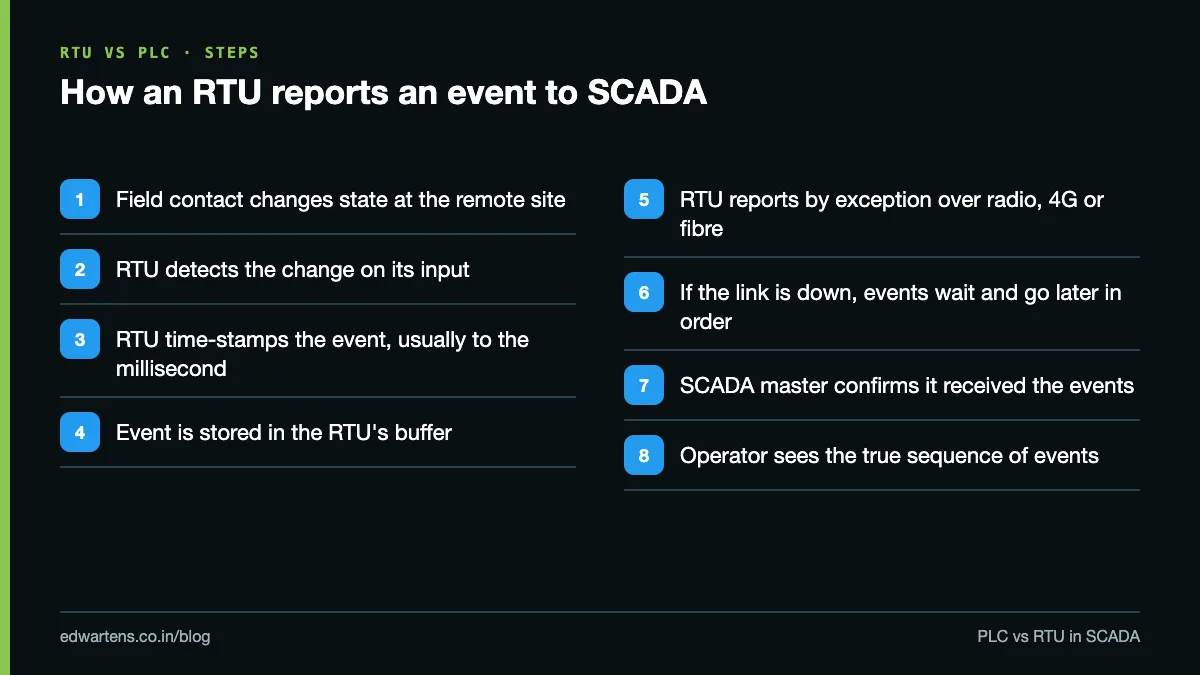
The archive is not a small detail. Hitachi Energy documents that RTU500 devices keep archives on non-volatile flash for events, measurements, counter values and protection disturbance files, retrievable by file transfer over IEC 60870-5-101 or DNP3. A typical machine PLC has no equivalent built in.
What is a PLC built for?
A PLC is built to control a machine or process directly. It reads inputs, executes its program and writes outputs in a fixed scan, typically a few milliseconds to tens of milliseconds, and it must do so deterministically: a conveyor interlock or a press guard cannot wait for a radio link.
PLCs are optimised for high I/O counts in a panel, fast scan times, motion and drive integration, and fieldbuses such as PROFINET, EtherNet/IP and EtherCAT. They usually sit in a plant with mains power, an air-conditioned panel room and a reliable local network. If you are new to how a PLC fits under a SCADA layer, start with our PLC vs SCADA beginner's guide and what SCADA is.
PLC vs RTU: the difference in one table
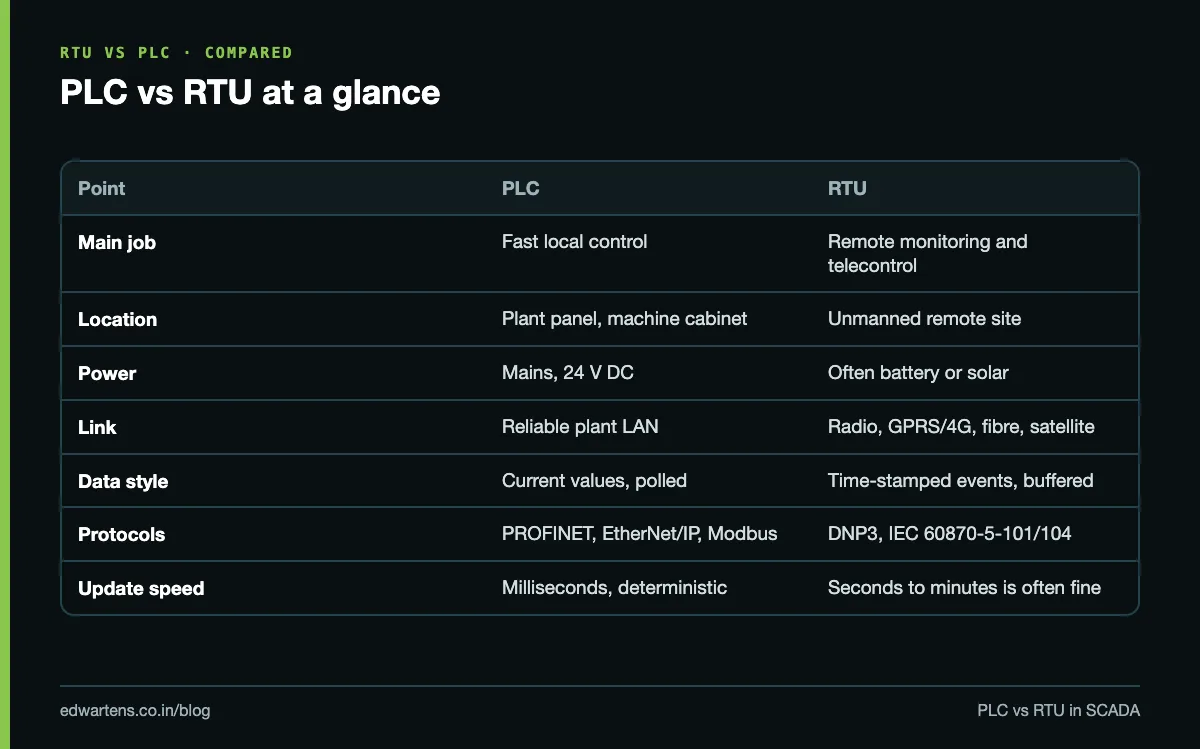
Point | PLC | RTU |
|---|---|---|
Main job | Fast local control of a machine or process | Remote monitoring and telecontrol over a wide area |
Typical location | Plant panel room, machine cabinet | Unmanned site: substation, pump house, valve station, wellhead |
Power | Mains, 24 V DC supply | Often battery or solar, low power draw matters |
Communication | Ethernet fieldbuses on a reliable LAN | Radio, GPRS/4G, fibre, leased line, satellite; slow or intermittent |
Data style | Polled values, current state | Time-stamped events, store and forward, report by exception |
Typical protocols | PROFINET, EtherNet/IP, Modbus TCP | DNP3, IEC 60870-5-101/104, Modbus, IEC 61850 in substations |
Environment | Indoor, controlled | Wide temperature, dust, surge; often conformal-coated boards |
Scan or update | Milliseconds, deterministic | Seconds to minutes per report is often enough |
Where the line between PLC and RTU blurs
The table describes the classic split. Real products overlap in both directions.
PLCs used as RTUs. Many small water schemes and pipeline stations use a PLC with a cellular router and a DNP3 or IEC 60870-5-104 driver as the outstation. It works when the site has mains power and a decent link, and the integrator already knows the PLC software. What you must check is whether the PLC really time-stamps events at the source and buffers them during a link outage, or only serves current values when polled.
RTUs that run PLC logic. Modern RTUs are programmable. Hitachi Energy's RTU540 includes programmable logic control and a local HMI. Emerson positions its ROC800-Series as combining RTU ruggedness and low power with PLC-style control and flow-computer audit trails, and its DS800 Development Suite lets you write custom control strategies in any of six programming languages.
The honest rule: the name on the box matters less than four questions. Where is the site? How is it powered? What is the link? What protocol does the master expect?
PLC vs RTU vs IED in substations
In an electrical substation there is a third device. An IED (intelligent electronic device) is a microprocessor-based protection relay, bay controller or meter that both protects equipment and reports data.
Since IEC 61850, IEDs in a modern substation talk to each other and to the station computer over Ethernet, using GOOSE messages for fast interlocks and MMS for reporting. The IEC 61850 series defines the data models, the SCL configuration language and these services.
The RTU's role in such a substation changes. It often becomes a gateway or data concentrator: it collects data from the IEDs over IEC 61850 (and older IEDs over IEC 60870-5-103 or Modbus) and forwards a single, tidy data set to the control centre over IEC 60870-5-104 or DNP3.
Device | Main job in a substation | Typical protocols |
|---|---|---|
IED (relay, bay controller) | Protect and control one bay, record faults | IEC 61850 GOOSE and MMS, IEC 60870-5-103, Modbus |
RTU or gateway | Concentrate station data, telecontrol to the control centre | IEC 60870-5-101/104, DNP3 upward; IEC 61850 downward |
PLC | Auxiliary systems: cooling, pumps, DG sets, building services | Modbus, PROFINET, EtherNet/IP |
SCADA master (MTU) | Operator view, history, alarms, commands for many stations | IEC 60870-5-104, DNP3, ICCP between control centres |
Siemens' SICAM A8000 range shows this split in practice: the CP-8010/12 is a compact RTU for low and medium voltage switchgear in distribution automation, with LTE and GPRS fallback on the CP-8012, while the CP-8050 adds network and device redundancy and fibre-optic interfaces for bigger stations.
PLC vs RTU vs DCS
A DCS (distributed control system) is a third architecture again: an integrated control system for a continuous process plant such as a refinery or power station, with controllers, operator stations and a single engineering database from one vendor. A DCS covers one site, densely. An RTU-based SCADA covers many sites, sparsely. A PLC can sit under either. Our SCADA vs DCS and PLC vs DCS guides go deeper.
Which protocols do RTUs use? DNP3, IEC 60870-5-104 and Modbus
DNP3 was developed by Harris Distributed Automation Products and handed to the DNP Users Group in November 1993; it was adopted as IEEE Std 1815 in 2010, according to the DNP Users Group overview. It was built for interoperability between master stations, RTUs and IEDs in electric utilities and is now also used in water, transport and oil and gas.
IEC 60870-5 is the IEC telecontrol family. Part 101 runs over serial links; part 104 carries the same application layer over TCP/IP networks; part 103 is for protection equipment. The current parts are listed in the IEC 60870-5 series pack on the IEC webstore. Which one you meet in India depends on the utility's or owner's specification, so always read the protocol clause of the tender first.
Modbus is simple and everywhere, but it has no native event time stamps or report-by-exception (the Modbus Organization now also publishes a Modbus Security protocol that wraps Modbus in TLS), so it is better suited to talking to meters and drives below the RTU than to the long-haul link above it.
Feature | DNP3 | IEC 60870-5-104 | Modbus TCP/RTU |
|---|---|---|---|
Built for | Utility telemetry, master to outstation | Utility telecontrol over TCP/IP | Simple device data exchange |
Time-stamped events | Yes | Yes | No (not in the base protocol) |
Report by exception | Yes, unsolicited responses | Yes, spontaneous transmission | No, master polls |
Secure version | DNP3 Secure Authentication | IEC 62351 profiles | Modbus Security (TLS, port 802) |
Best fit | Telemetry over slow or intermittent links | Utility telecontrol over IP networks | Meters, drives, short local links |
Modbus RTU is not a remote terminal unit
This confuses many beginners. In Modbus RTU, "RTU" is a framing mode, not a device. The Modbus serial line specification defines two transmission modes, RTU and ASCII, and says all devices must implement RTU mode, which must also be the default (Modbus Serial Line Protocol and Implementation Guide, Modbus Organization). RTU mode simply sends each byte as 8-bit binary data with a CRC check.
So a VFD "with Modbus RTU" is not an RTU. It is a drive that speaks Modbus over RS-485 in binary framing. Our Modbus RTU explained post covers the frame format.
Real RTU products and what they tell you
Product | Vendor | What the vendor page highlights |
|---|---|---|
RTU500 series (RTU530, RTU540, RTU560) | Hitachi Energy (formerly ABB) | Grid telecontrol, flash archives, DNV certified secure IEC 60870-5-104 |
SICAM A8000 CP-8010/12 | Siemens | Compact distribution RTU, LTE with GPRS fallback, IEC 62443 and IEC 62351 |
SICAM A8000 CP-8050 | Siemens | Rack I/O, fibre-optic modules, built-in redundancy |
ROC800-Series | Emerson | Low-power RTU with PLC-style control and flow-computer audit trail |
FloBoss 107/107E | Emerson | Gas flow computer with AGA calculations, low power, PID control |
Schneider Electric's SCADAPack smart RTUs are another family you will meet in tenders and datasheets. Three patterns stand out across the vendor pages above: low power, secure telecontrol protocols, and local archives. Those three features are what you pay for when you buy an RTU instead of a PLC.
Where RTUs are used in India
Power distribution. The Ministry of Power's Revamped Distribution Sector Scheme (RDSS) funds SCADA and Distribution Management Systems in urban areas. The RDSS guidelines list SCADA/DMS for about 100 larger towns and basic SCADA in 3,875 towns through district-wise or circle-wise common control centres. SCADA of this kind relies on RTUs at substations, and distribution automation adds feeder RTUs at ring main units and sectionalisers.
Water supply pipelines. Bulk water schemes that pump from a river or reservoir to a city over tens of kilometres use RTUs at pump houses, reservoirs and valve chambers, and a remote valve chamber may have only solar power.
Oil and gas pipelines. Cross-country pipelines use RTUs at sectionalising valve stations and metering stations, where a flow computer and RTU may be one device, as Emerson's ROC800 and FloBoss pages show.
City gas distribution. CGD networks use RTUs or small PLCs at city gate stations and district regulating stations to report pressures, flows and valve status to a central SCADA.
In all four, the pattern is the same: many unmanned sites, long distances, limited power, and a control centre that needs a reliable sequence of events.
PLC or RTU: how to choose
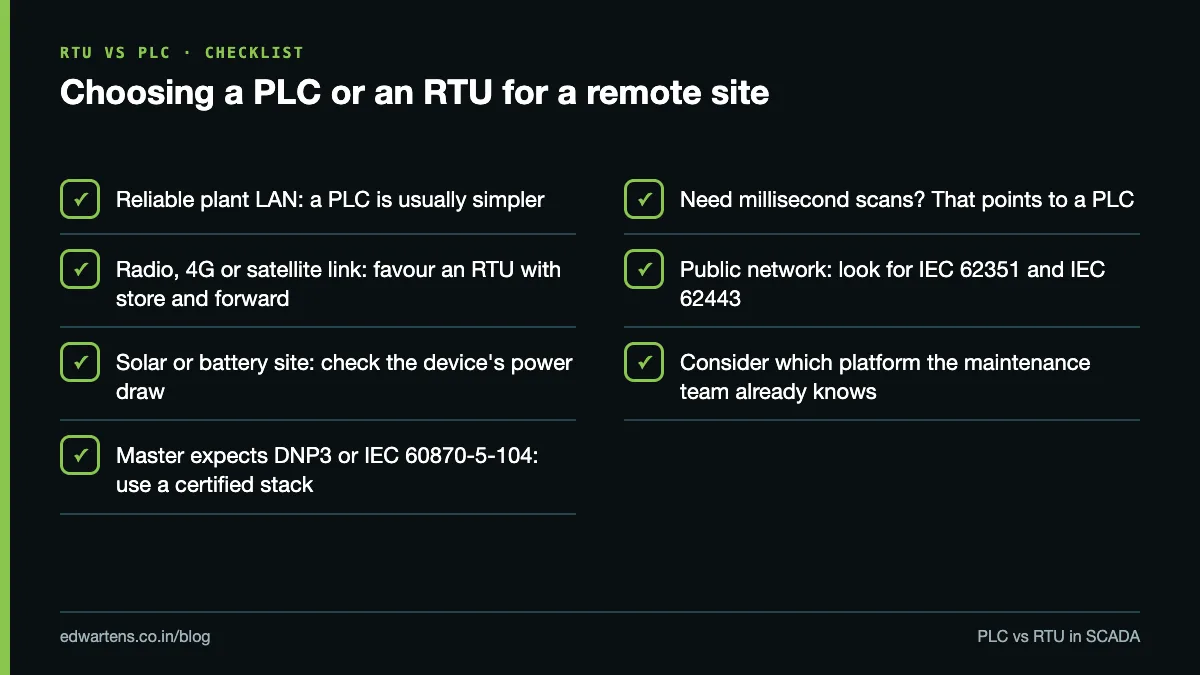
- Start with the link. If the site is on a reliable plant LAN, a PLC is usually simpler. If it is on radio, GPRS/4G or satellite, favour an RTU that supports report by exception and store and forward.
- Check the power. Solar or battery sites need a device with a low quiescent draw; check the vendor's power figures, not just the I/O.
- Match the master's protocol. If the utility specifies IEC 60870-5-104 or DNP3 with time-stamped events, choose a device with a proven, tested implementation, not a free add-on driver.
- Count the speed you really need. A packaging line needs millisecond scans; a reservoir level does not.
- Plan for cybersecurity. Look for IEC 62351 or DNP3 Secure Authentication and IEC 62443 certification if the device sits on a public network.
- Think about who maintains it. A district water engineer may already know one PLC platform well; that skill base is a real cost factor.
For new IIoT links from remote sites, some projects now add MQTT alongside the SCADA protocol; our MQTT Sparkplug B guide explains where that fits.
How to learn RTU and SCADA work
Start with the protocols, because they are the same whatever the hardware. Our free Industrial Communication course covers serial, Modbus and Ethernet basics, and the IEC 61850 Substation Automation course covers GOOSE, SCL and IEC 60870-5. For the control centre side, try Ignition SCADA or Siemens WinCC SCADA.
If you want hands-on time with PLCs, SCADA screens and communication setups in a lab, the EDWartens engineering team runs classroom SCADA training in Bangalore at Electronic City.
Frequently asked questions
Q: What is the full form of RTU in SCADA?
A: RTU stands for Remote Terminal Unit. It is the field device that collects data at a remote site and exchanges it with the SCADA master over a communication link.
Q: What is the main difference between a PLC and an RTU?
A: A PLC is built for fast, deterministic local control of a machine or process. An RTU is built for remote telemetry: low power, slow or unreliable links, time-stamped events, store and forward, and protocols such as DNP3 and IEC 60870-5-104.
Q: What is MTU and RTU in SCADA?
A: The MTU (master terminal unit) is the SCADA master in the control centre that polls and commands the field. RTUs are the outstations at the remote sites that report to it.
Q: Can a PLC be used as an RTU?
A: Yes, many water and pipeline sites use a PLC with a cellular router and a DNP3 or IEC 60870-5-104 driver. Check that it time-stamps events at the source and buffers them during link outages, because that is what the control centre relies on.
Q: What is the difference between an RTU and an IED?
A: An IED is a protection relay, bay controller or meter that protects and controls one piece of equipment and reports its data. An RTU collects data from many IEDs and field signals and forwards it to the control centre, often acting as a gateway between IEC 61850 inside the substation and IEC 60870-5-104 or DNP3 to the control centre.
Q: Is Modbus RTU the same as a remote terminal unit?
A: No. In Modbus RTU, "RTU" is the binary framing mode of Modbus on a serial line, as opposed to ASCII mode. Any device, including a drive or meter, can speak Modbus RTU without being a remote terminal unit.
Q: Which protocol does an RTU use to talk to SCADA?
A: Usually IEC 60870-5-104 or DNP3 to the control centre, with IEC 60870-5-101 on older serial links; the owner's SCADA specification decides. Inside a modern substation, IEC 61850 links the IEDs to the RTU or gateway.
Q: Is a PLC, RTU or DCS better for a pipeline?
A: A cross-country pipeline is many remote sites over a long distance, so RTUs reporting to a SCADA master are the usual fit. A DCS suits a single dense process plant, and PLCs often control the compressor or pump packages at individual stations.
Learn this, free
The courses that teach this
Every lesson, the written notes and the practice are free with an account. Only the certificate is optional and paid.