VFD Interview Questions and Answers with Real Parameters

The short answer
VFD interviews test four things. First, how a drive works: rectifier, DC bus and PWM inverter, and why voltage and frequency change together. Second, commissioning: entering motor nameplate data, running an auto-tune, and setting acceleration, deceleration, minimum and maximum speed. Third, control and braking: V/f versus sensorless vector versus closed-loop vector, ramp stop versus coast, DC injection and braking resistors. Fourth, faults and wiring: overcurrent, overvoltage on deceleration, undervoltage, overheating and earth faults, plus shielded cable and line reactors. Expect brand questions on Siemens SINAMICS G120 or Allen-Bradley PowerFlex 525 parameters, and on controlling a drive from a PLC.
Watch: what a VFD is
The video above is What is a VFD? (Variable Frequency Drive) by RealPars, embedded with thanks. EDWartens is not affiliated with the creator. It runs about 5 minutes and gives a clear animated introduction to what a variable frequency drive is and why it is used. It is also used in our free Industrial Motor Control course. The guide below goes further, into the parameters, faults and PLC questions interviewers ask.
How a VFD works: the basic interview questions
What is a VFD?
A variable frequency drive is a power electronic converter that controls the speed and torque of an AC motor by changing the frequency and voltage it supplies. Siemens calls it an inverter or converter, Rockwell and Danfoss call it a drive or frequency converter; they mean the same thing.
What are the main sections of a VFD?
- Rectifier: converts the incoming three-phase AC (415 V, 50 Hz in most Indian plants) to DC, usually with a diode bridge.
- DC bus (DC link): capacitors smooth the rectified DC; on a 415 V supply the bus sits at roughly 1.35 to 1.41 times the line voltage, about 560 to 585 V DC depending on load.
- Inverter: IGBTs switch the DC bus on and off to build a variable-frequency, variable-voltage output using pulse width modulation.
What is PWM and what is carrier frequency?
Pulse width modulation switches the IGBTs at a fixed high rate, the carrier or switching frequency, and varies the width of each pulse so the motor current approximates a sine wave at the wanted output frequency. A higher carrier frequency makes the motor quieter but raises switching losses in the drive, so drives derate output current at high carrier settings. On a PowerFlex 525 the setting is A440 [PWM Frequency], with a 4 kHz default; on a SINAMICS G120 it is p1800, and Siemens notes that raising it lowers the available output current.
Why must voltage change with frequency?
Motor flux is proportional to voltage divided by frequency. Keep V/f constant and the flux, and therefore the available torque, stays roughly constant. Lower the frequency without lowering voltage and the motor saturates and overheats. For a 415 V, 50 Hz motor the ratio is 8.3 V per Hz.
How do you calculate motor speed from frequency?
Synchronous speed Ns = 120 × f ÷ P, where P is the number of poles. A 4-pole motor at 50 Hz runs at 1,500 rpm synchronous, and slightly less in practice because of slip. At 25 Hz it runs at about half that.
Can a VFD run a motor above 50 Hz?
Yes, but above base frequency the drive cannot raise voltage further, so the motor enters field weakening: speed rises, available torque falls and power stays roughly constant. Check the motor and the driven machine's mechanical speed limit first.
Why do VFDs save energy on pumps and fans?
For centrifugal loads, the affinity laws say flow varies with speed and power varies roughly with the cube of speed. Slowing a fan instead of throttling a damper therefore cuts power sharply. This does not apply to constant-torque loads such as conveyors.
VFD parameter interview questions
Interviewers love asking "which parameters do you set first?" The answer is the same on every brand: motor nameplate data, control mode, auto-tune, speed limits, ramps, then start and speed sources. The parameter numbers differ, which is why brand questions exist.
Setting | Siemens SINAMICS G120 | Allen-Bradley PowerFlex 525 | Danfoss VLT FC 51 |
|---|---|---|---|
Motor current | p0305 rated motor current | P034 [Motor NP FLA] | 1-24 Motor Current |
Motor power | p0307 rated motor power | P037 [Motor NP Power] | 1-20 Motor Power |
Control mode | p1300 (0 = linear V/f, 20 = encoderless vector) | P039 [Torque Perf Mode] (0 = V/Hz, 1 = SVC) | 1-01 Motor Control Principle (U/f or VVC+) |
Auto-tune | Motor data identification in basic commissioning | P040 [Autotune] (1 = static, 2 = rotate) | 1-29 Automatic Motor Tuning (AMT) |
Minimum speed | p1080 minimum speed | P043 [Minimum Freq] | 4-12 Motor Speed Low Limit |
Maximum speed | p1082 maximum speed | P044 [Maximum Freq] | 4-14 Motor Speed High Limit |
Acceleration | p1120 ramp-up time | P041 [Accel Time 1] | 3-41 Ramp1 Ramp-up Time |
Deceleration | p1121 ramp-down time | P042 [Decel Time 1] | 3-42 Ramp1 Ramp-down Time |
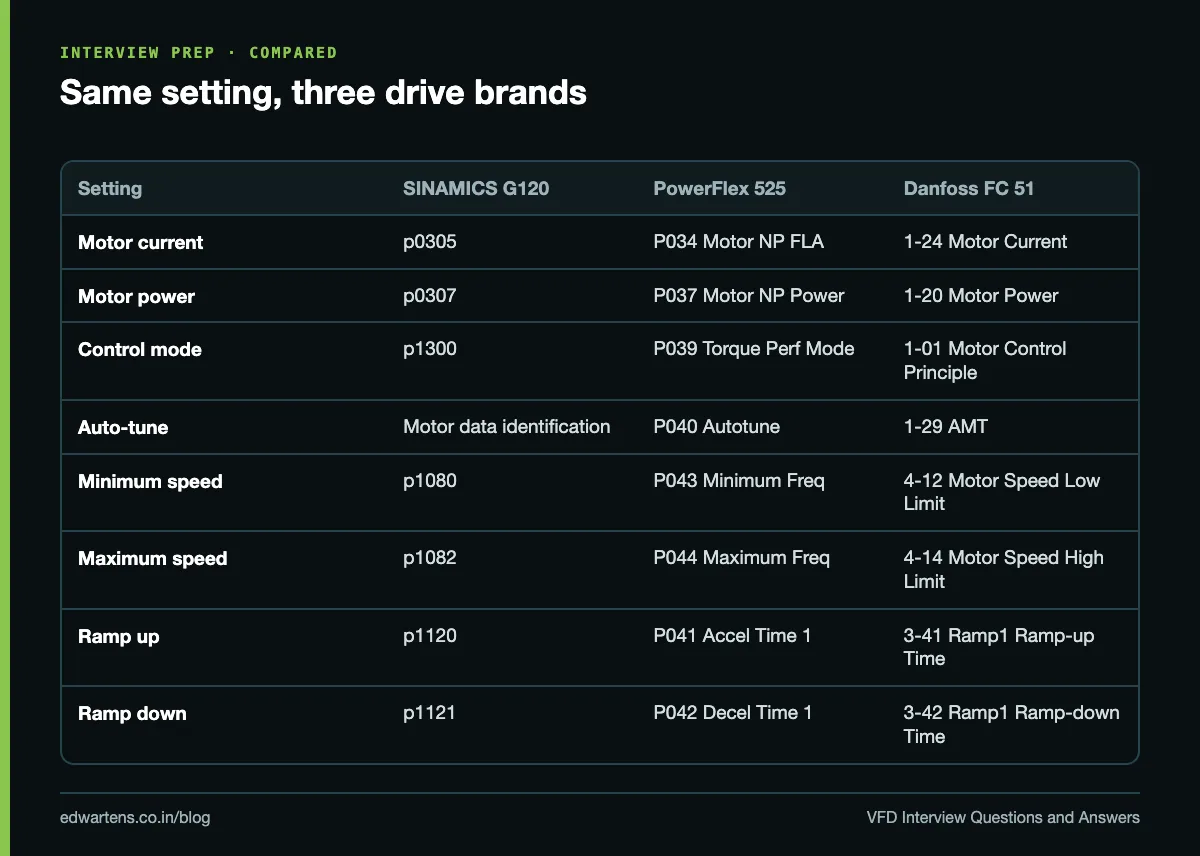
Sources: the Siemens CU240B-2 and CU240E-2 operating instructions (edition 04/2014, firmware V4.7), the Rockwell PowerFlex 520-series user manual (520-UM001O, September 2025) and the Danfoss VLT Micro Drive FC 51 programming guide. Always check the manual for your firmware.
What is the ramp time measured from?
Not from zero to the current setpoint. On a G120, p1120 is the time from zero to maximum speed p1082, factory setting 10 s. On a PowerFlex 525, P041 is the time from 0 Hz to P044 [Maximum Freq]. So if you halve maximum speed without changing the ramp time, the real acceleration rate halves too.
What is a common mistake with an imported drive in India?
Leaving the default motor frequency or maximum frequency at 60 Hz. The PowerFlex 525 manual lists 60.00 Hz as the default for P044 [Maximum Freq], so on a 50 Hz Indian motor you must check P032 [Motor NP Hertz] and P044 before running.
What is auto-tune and when do you use static instead of rotating?
Auto-tune measures the motor's electrical parameters, such as stator resistance, so the drive's motor model is accurate. A rotating tune gives better results but needs the motor uncoupled from the load. Use a static tune when the motor cannot be decoupled. Rockwell's manual describes P040 option 1 as a non-rotating stator resistance test and option 2 as a static test followed by a rotating test.
What does the current limit do?
It stops the drive from supplying more than a set current, by slowing acceleration or reducing speed. On a G120 it is p0640. Too low a value causes stalls and slow starts; too high gives less protection.
Control mode questions: V/f vs sensorless vector vs closed loop
Point | V/f (scalar) | Sensorless vector | Closed-loop vector |
|---|---|---|---|
Feedback | None | Motor model only | Encoder on the motor |
Low-speed torque | Weak without boost | Good | Full torque to zero speed |
Speed accuracy | Depends on slip | Better, slip compensated | Best |
Typical loads | Fans, pumps, several motors on one drive | Conveyors, mixers, extruders | Hoists, winders, positioning |
Auto-tune needed | Optional | Yes | Yes |
The G120 manual recommends vector control for most applications and V/f with a square-law (parabolic) curve for basic pumps and fans. Danfoss says U/f mode suits parallel-connected motors. That last point is a frequent question: one drive running several motors must use V/f, because vector control models only one motor.
VFD braking interview questions
What stop modes does a drive offer?
- Ramp to stop: the drive brings the frequency down along the deceleration ramp.
- Coast to stop: the drive switches off its output and the load freewheels.
- DC injection braking: the drive feeds DC into the stator to hold or slow the motor at low speed.
- Quick stop: a separate, shorter ramp. On a G120 this is OFF3 with ramp-down time p1135.
The PowerFlex 525 sets the stop mode in P045 [Stop Mode], with DC braking time and level in A434 and A435.
Why does a drive trip on overvoltage while decelerating?
A load with high inertia turns the motor into a generator when the drive slows it faster than it would coast. Regenerated energy flows back to the DC bus and the bus voltage rises until the drive trips. Fixes, in order: lengthen the deceleration ramp, enable the DC bus voltage controller (Siemens calls it Vdc_max control, Rockwell calls it bus regulation, A550), or fit a braking chopper and resistor. A regenerative or active front end drive returns the energy to the supply.
What is a braking resistor?
A resistor connected across the DC bus through a braking transistor (chopper), which switches on when bus voltage rises and burns the excess energy as heat. Siemens notes it must be the approved resistor, wired with shielded cable and fitted with temperature monitoring wired to a drive input.
VFD fault interview questions
Fault | Typical cause | First check | Siemens G120 | PowerFlex 525 |
|---|---|---|---|---|
Overcurrent | Short acceleration ramp, jammed load, output short | Ramp time, motor cable, load | F30001 | F012 HW OverCurrent |
DC bus overvoltage | Fast deceleration of high inertia, high supply | Decel time, braking resistor | F30002 | F005 OverVoltage |
DC bus undervoltage | Supply dip, lost phase, blown fuse | Incoming supply and fuses | F30003 | F004 UnderVoltage |
Drive overtemperature | Blocked fan, dirty heatsink, hot panel | Fan, airflow, ambient | F30004 | F008 Heatsink OvrTmp |
Motor overload | Sustained overload, wrong motor current set | Load and motor current setting | F07011 (motor overtemperature) | F007 Motor Overload |
Earth fault | Damaged motor cable or winding insulation | Megger the cable and motor | F30021 Ground fault | F013 Ground Fault |
Both manuals list these codes; on a G120, r0945 shows the fault code. For a wider brand list, read VFD fault codes across brands and what they mean.
How do you troubleshoot a VFD that trips?
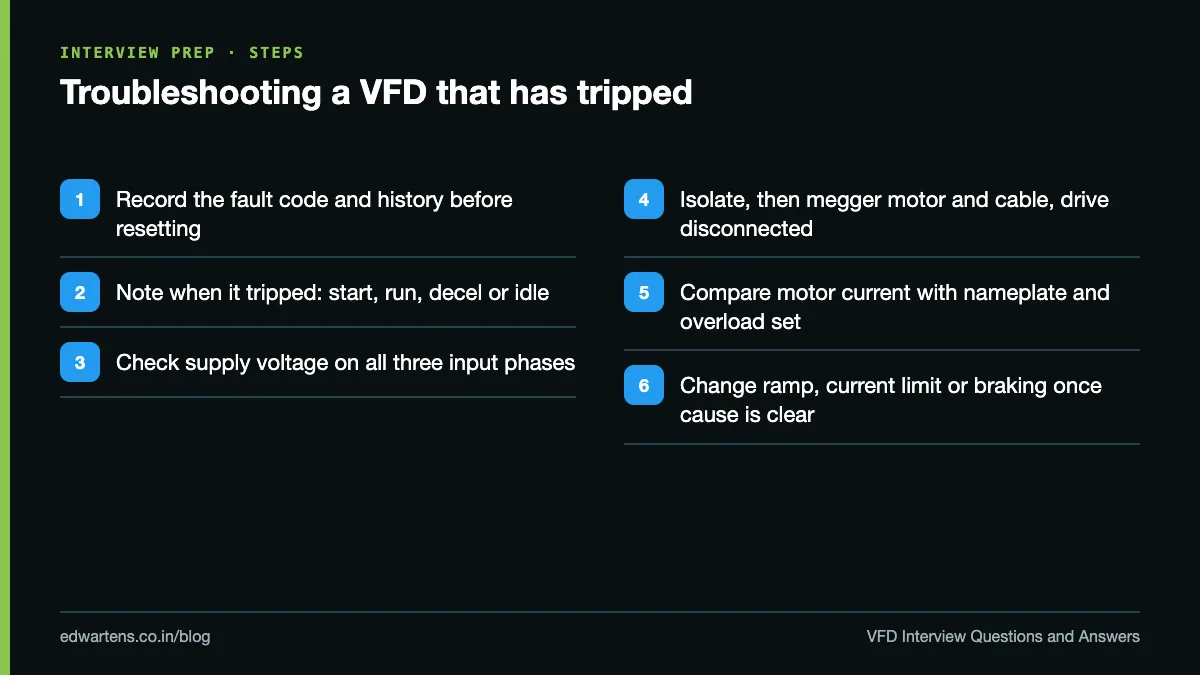
- Read and record the fault code and the fault history before resetting.
- Note when it tripped: starting, running, decelerating or idle.
- Check the supply voltage on all three phases at the drive input.
- Isolate, then test the motor and cable insulation with the drive disconnected.
- Compare motor current with the nameplate and the set overload current.
- Adjust the ramp, current limit or braking only once the cause is clear.
Never megger with the drive's output terminals connected: the test voltage can damage the IGBTs.
Wiring and EMC questions
Why use shielded motor cable?
The fast switching edges of PWM create high-frequency noise. Siemens' EMC instructions call for shielded motor cables, with the shield bonded to the shield plate or earth over the largest possible surface area, and motor cables routed separately from signal cables. Pigtail shield connections defeat the purpose.
What does a line reactor do?
It adds impedance on the drive's input, limiting inrush and harmonic current and protecting the rectifier from supply transients. Rockwell's manual recommends installing a line reactor where line impedance is low (less than 1 percent reactance) and in other supply conditions it lists.
What about long motor cables?
Long cables cause voltage reflections at the motor terminals that stress winding insulation. Manufacturers specify maximum cable lengths and recommend output reactors or dv/dt or sine-wave filters beyond them.
PLC control of a VFD: interview questions
What are the ways to control a VFD from a PLC?
- Hardwired digital I/O: run, direction, fault reset and preset speeds from PLC outputs, with run and fault status back to PLC inputs.
- Analog speed reference: 0 to 10 V or 4 to 20 mA from a PLC analog output. On a PowerFlex 525, P047 [Speed Reference1] set to 5 selects the 0 to 10 V input and 6 selects 4 to 20 mA.
- Serial fieldbus: Modbus RTU over RS-485, common on Delta and other compact drives.
- Industrial Ethernet: PROFINET for Siemens drives, EtherNet/IP for the PowerFlex 525, which has an embedded EtherNet/IP port.
What is 2-wire and 3-wire control?
2-wire control uses one maintained contact: closed means run. 3-wire uses momentary start and stop pushbuttons, with the drive latching the run internally. The 3-wire scheme does not restart by itself after a power loss.
How does a Siemens drive work on PROFINET?
The drive exchanges a telegram with the PLC. Standard telegram 1, selected with p0922 = 1, carries control word 1 (STW1) and a speed setpoint out, and status word 1 and actual speed back. In STW1, bit 0 is ON/OFF1, bit 1 is OFF2 (coast), bit 2 is OFF3 (quick stop) and bit 3 enables operation. The speed setpoint is scaled as a percentage of the reference speed in p2000.
Brand-specific VFD interview questions
- Siemens SINAMICS G120: modular drive with a Control Unit (such as CU240E-2) on a Power Module. Know p0015 macros for terminal presets, p1300 control mode, the ramp and speed parameters above, and commissioning in Startdrive or STARTER. Our free Siemens SINAMICS drives course covers both tools.
- Allen-Bradley PowerFlex 525: Basic Program group parameters P031 to P047 for motor data, ramps, limits and sources; A-group advanced parameters; embedded EtherNet/IP. See our free Allen-Bradley PowerFlex drives course.
- Danfoss VLT: parameters are grouped by function, such as 1-xx load and motor, 3-xx references and ramps; AMT is the auto-tune.
- Delta and ABB ACS580: expect general questions on where nameplate data, ramps and start and speed sources sit in the menu, and on Modbus setup. Say which manual you would check rather than guessing numbers.
For a hands-on first setup, read setting up a VFD for the first time, and for starter selection questions read DOL vs star-delta vs soft starter vs VFD.
How to prepare
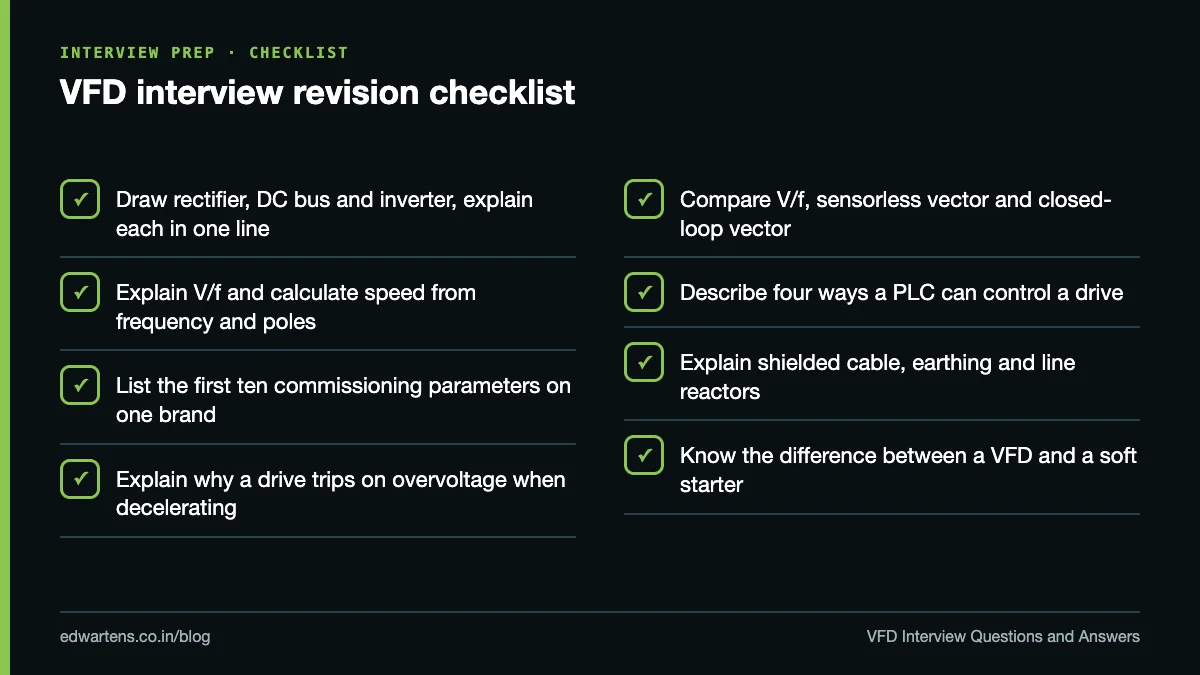
- Draw rectifier, DC bus and inverter, and explain each in one line.
- Explain V/f and calculate speed from frequency and poles.
- List the first ten commissioning parameters on one brand.
- Explain why a drive trips on overvoltage when decelerating.
- Compare V/f, sensorless vector and closed-loop vector.
- Describe four ways a PLC can control a drive.
- Explain shielded cable, earthing and line reactors.
- Know the difference between a VFD and a soft starter.
Our free VFD course covers wiring, keypad and terminal control, analog and preset speeds, PLC and Modbus control and troubleshooting. If you prefer to practise with an instructor, see our VFD and drives training in Bangalore. Drive questions also turn up in general automation interviews, so it is worth reading our PLC SCADA interview questions too.
Frequently asked questions
Q: What are the basic VFD interview questions?
A: What a VFD is, its rectifier, DC bus and inverter sections, why V/f is kept constant, how PWM and carrier frequency work, and how to calculate motor speed from frequency and poles.
Q: Is there a VFD interview questions and answers PDF?
A: You can save this page as a PDF using your browser's print option. Practise answering aloud as well, since interviewers ask follow-up questions on every answer.
Q: Are VFD interview questions available in Hindi?
A: This guide is in English, and the technical terms (V/f, DC bus, IGBT, ramp time) are the same in a Hindi-medium interview. Many interviewers in India accept answers in Hindi or English as long as the terms are correct.
Q: What Siemens VFD interview questions are common?
A: Expect p1080 and p1082 speed limits, p1120 and p1121 ramp times, p1300 control mode, OFF1, OFF2 and OFF3, PROFINET telegram 1 and common faults such as F30001 overcurrent and F30002 DC link overvoltage.
Q: What is the difference between a VFD and a soft starter?
A: A soft starter only ramps voltage during starting and stopping, then the motor runs at full speed. A VFD controls speed continuously throughout operation.
Q: Why does a VFD trip on overcurrent at start?
A: Usually the acceleration ramp is too short for the load inertia, the load is jammed, the motor data is wrong or there is a short or earth fault on the motor cable.
Q: Can one VFD run two motors?
A: Yes, in V/f mode, with each motor given its own overload protection. Vector control is not used because it models one motor.
Learn this, free
The courses that teach this
Every lesson, the written notes and the practice are free with an account. Only the certificate is optional and paid.