AI in Banking Jobs in India: What Changes for Bankers

The short answer
AI in banking jobs in India is changing the work inside roles faster than it is removing roles: drafting credit notes, summarising KYC files, writing alert narratives, answering routine customer queries and reading circulars are moving to AI-assisted workflows, while credit decisions, AML judgements and customer accountability stay with people. The Reserve Bank of India's FREE-AI framework (August 2025) says final authority should rest with humans who can override AI, and asks regulated entities for a board-approved AI policy. For a banker, the practical skill is using ChatGPT, Claude, Gemini or Copilot inside the bank's approved tools, without ever pasting customer data into a public AI service.
Facts in this article were checked on 11 October 2026 against the sources linked in the text.
How many Indian banks actually use AI today?
Fewer than the headlines suggest, but the number is climbing. The RBI's FREE-AI committee report includes the regulator's own surveys of the entities it supervises:
RBI survey finding (FREE-AI report, Aug 2025) | Figure |
|---|---|
Regulated entities using or developing AI | 20.80% (127 of 612) |
NBFCs using AI in some form | 27% of 171 |
Entities exploring at least one generative AI use case | 67% of 76 |
AI users with human-in-the-loop mechanisms | 28% |
AI users validating models for bias and fairness | 35% |
Respondents with a board-level AI oversight framework | about one-third |
Compare 67% exploring generative AI with 28% using human-in-the-loop checks: AI use is growing faster than the controls around it. That is exactly where bank staff who understand both the work and the AI become valuable.
What the RBI's FREE-AI framework means for bank staff
The RBI announced the report in a press release on 13 August 2025. The committee, set up on 26 December 2024, wrote 7 "Sutras" (principles) and 26 recommendations under six pillars. Three points matter most at the desk level:
- People first. The report says "final authority should rest with humans, who should be able to override AI". An AI-drafted credit note is a draft; the sanctioning officer still decides.
- Board-approved AI policy. The committee recommends that regulated entities formulate a board-approved AI policy. Expect your bank to tell you which tools are approved and what data may go into them.
- Tell the customer. The report lists making consumers aware when they are dealing with AI as a protection step. Chatbots and AI-written letters need to be disclosed and reviewed.
FREE-AI is a framework report, not a circular with deadlines, so check your bank's own policy for what applies to you.
Which banking jobs does AI change, and how?
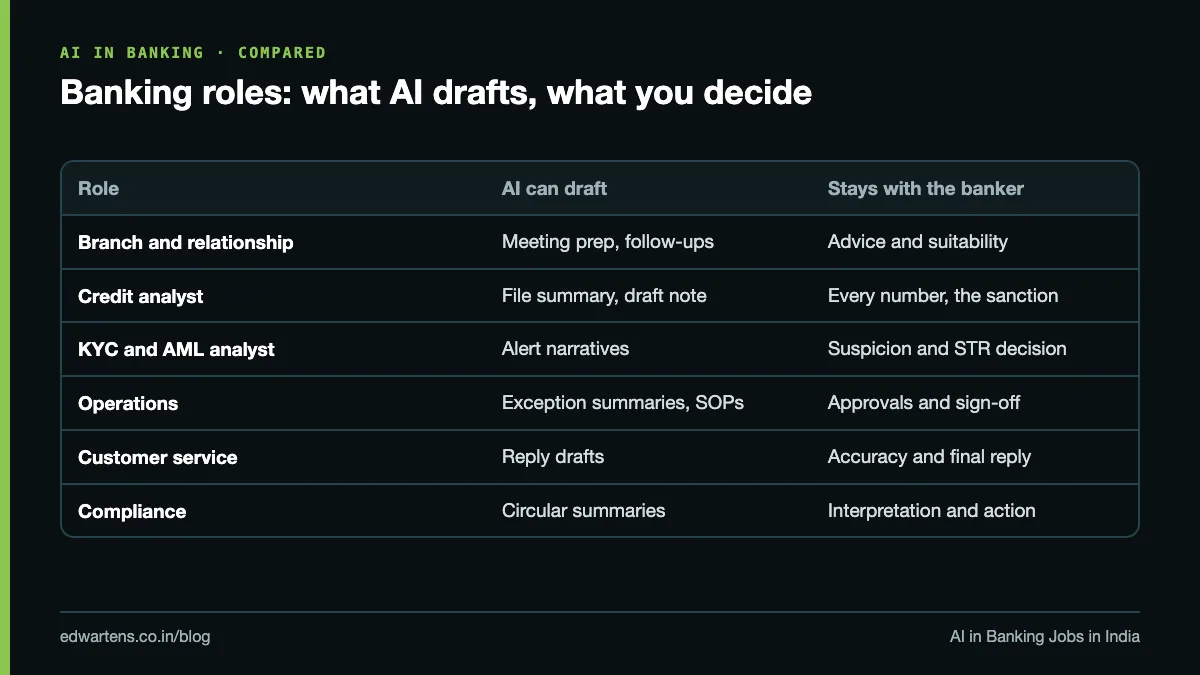
Role | Work AI can draft or speed up | What stays with the banker |
|---|---|---|
Branch and relationship staff | Meeting prep, product comparisons, follow-up letters | Advice, suitability, the relationship |
Credit analyst | File summaries, ratio tables, first-draft credit notes | Every number, the recommendation, sanction |
KYC and AML analyst | Alert narratives, adverse media triage | Whether activity is suspicious, any STR decision |
Operations | Reconciliations, exception summaries, SOP drafts | Approvals and control sign-off |
Customer service | Reply drafts, complaint summaries | Tone, accuracy, the final response |
Compliance | Circular summaries with citations | Interpretation and what the bank does |
The roles most exposed are repetitive back-office tasks: data entry, routine document checks and standard replies. The roles that grow are the ones that check, explain and decide.
Worked example: checking an AI loan book summary
AI is quick at summarising portfolio data and quietly wrong surprisingly often, so the habit that matters is checking. Suppose you export an anonymised arrears table (no names, no account numbers) and ask Copilot in Excel or Gemini in Sheets, inside your bank's approved setup, to summarise it.
Bucket (days past due) | Outstanding (₹ crore) | Share of book |
|---|---|---|
Current | 44.0 | 88.0% |
1 to 30 | 3.0 | 6.0% |
31 to 60 | 1.5 | 3.0% |
61 to 90 | 0.7 | 1.4% |
Over 90 | 0.8 | 1.6% |
Total | 50.0 | 100% |
Suppose the AI's summary says "30+ days delinquency is 3.9%". Check it: 1.5 + 0.7 + 0.8 = 3.0 crore, and 3.0 / 50.0 = 6.0%. The model added the wrong buckets. A sum formula in the sheet catches this in seconds; forwarding the AI's sentence to your manager would not. Loans overdue more than 90 days are generally classed as non-performing under RBI norms, so the 1.6% over 90 days is the number senior management will ask about first, and it has to be right.
The same discipline applies to credit memos: let the AI lay out the structure (borrower, facility, financials, risks, mitigants), then tick every number back to the source document yourself. The free AI for Banking and Financial Services course has a full module on loan book analysis in Excel and Sheets, and one on credit files and memos.
The confidentiality rule comes first
Customer data in a bank is protected by banking secrecy, the RBI's directions and, increasingly, India's data protection law. The DPDP Rules, 2025 were notified on 14 November 2025 with an eighteen-month phased compliance period, and PIB's summary notes penalties of up to ₹250 crore for failing to keep reasonable security safeguards.
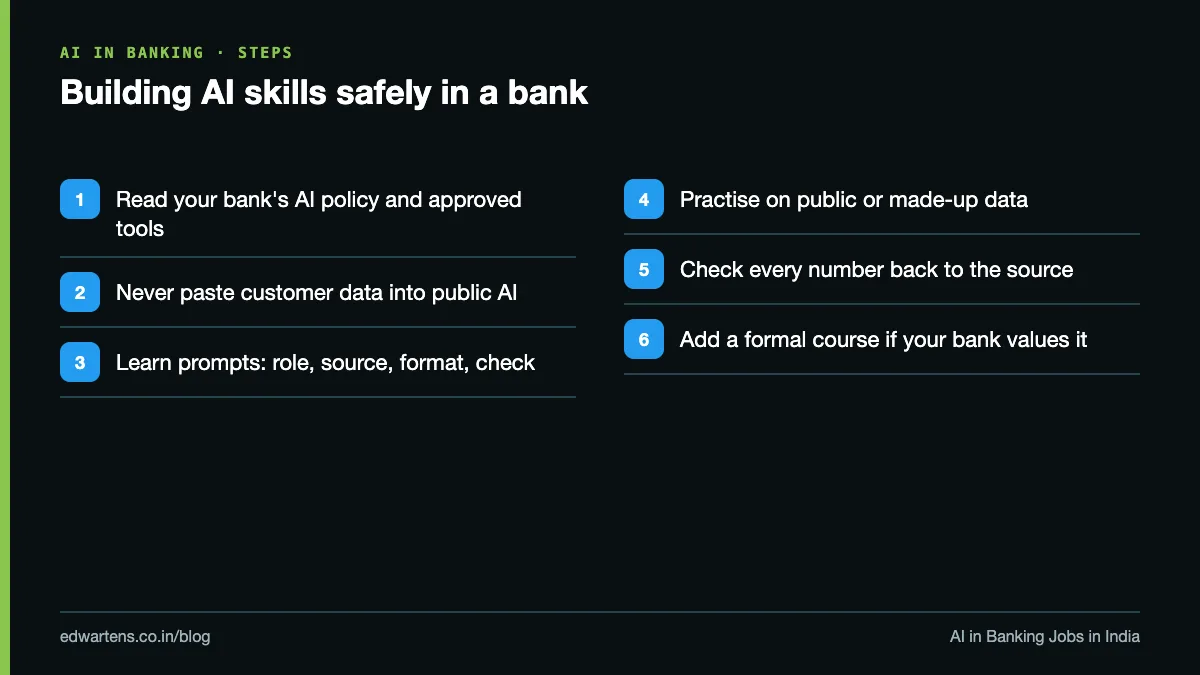
So the rule is absolute: never paste customer names, account numbers, PAN, Aadhaar, statements or loan files into a public AI tool, and do not upload them to a personal ChatGPT, Claude or Gemini account. Use only the AI tools your bank has approved, and anonymise even then if the policy asks. For learning and practice, use made-up or public data.
Do you need an AI certification for banking jobs?
Not to start, but structured learning helps. The Indian Institute of Banking and Finance runs a Certificate Course in Artificial Intelligence and Machine Learning for Bankers in self-paced e-learning mode. Its 2026 rules say members and non-members who have passed class 12 can register, the pass mark is 60 out of 100, and the final assessment must be completed within 90 days of registration. It covers fraud detection, customer service automation, credit risk analysis and RegTech, with a banker's view of what AI is.
A practical route for most bank staff:
- Learn to prompt for banking tasks and check outputs (free courses are enough for this).
- Learn your bank's AI policy and approved tools.
- Practise on public data: annual reports, RBI circulars, made-up loan books.
- If your bank values it, add the IIBF certificate for the formal banking-sector view.
Where to start
The free AI for Banking and Financial Services course is written for people already in a bank, NBFC or fintech: prompting for bank tasks, confidentiality, what the RBI and other regulators expect, credit memos, KYC and AML narratives, complaint replies, reading circulars with verified citations, loan book analysis and model risk. It is a free course with a verifiable certificate of completion, and anyone can check a certificate on our verification page. If your work is spreadsheet-heavy, add our Excel Copilot and AI for Finance course. For a broader picture, see our guides to free AI courses with certificate in India and the top AI skills in demand in India.
If you want classroom training with placement support, where the conditions apply and are published, see our PLC training in Bangalore with a written job guarantee.
Frequently asked questions
Q: Will AI replace bank jobs in India?
A: It is replacing tasks more than roles so far. Routine data entry, document checks and standard replies are most exposed, while credit decisions, AML judgements and customer relationships stay with people. The RBI's FREE-AI framework says final authority should rest with humans who can override AI.
Q: What is the RBI FREE-AI framework?
A: It is the report of an RBI committee on the Framework for Responsible and Ethical Enablement of Artificial Intelligence in the financial sector, published on 13 August 2025. It sets out 7 Sutras (principles) and 26 recommendations under six pillars, including a board-approved AI policy for regulated entities.
Q: How many Indian banks use AI?
A: In the RBI's own survey reported in the FREE-AI report, 20.80% of 612 regulated entities (127) were using or developing AI, and 67% of 76 entities in a separate survey were exploring at least one generative AI use case.
Q: Can bank employees use ChatGPT at work?
A: Only if the bank allows it, and only the approved version. Never paste customer names, account numbers, PAN, Aadhaar or loan files into a public AI tool. Many banks provide an internal or enterprise AI tool with its own data terms instead.
Q: Is there an AI certification for bankers in India?
A: Yes. IIBF offers a Certificate Course in Artificial Intelligence and Machine Learning for Bankers in e-learning mode, open to members and non-members who have passed class 12, with a pass mark of 60 out of 100.
Q: Is there a free course on AI for banking?
A: Yes. EDWartens' AI for Banking and Financial Services is a free course with a verifiable certificate of completion, covering prompting, confidentiality, regulators' expectations, credit memos, KYC and AML narratives, complaints, circulars and loan book analysis.
Learn this, free
The courses that teach this
Every lesson, the written notes and the practice are free with an account. Only the certificate is optional and paid.


