AI Copilots for PLC Programming in 2026: What Siemens, Rockwell and the LLMs Can Actually Do

What has changed
Two years ago an LLM could produce plausible-looking ladder that did not compile. Today Siemens Industrial Copilot sits inside TIA Portal, generates SCL from a description, explains existing blocks, and drafts HMI screens; the general models write competent structured text for standard patterns; and integrators use them daily for documentation, test cases and translation between vendor dialects. The question is no longer whether to use them but how to stay the engineer in charge.
What they do well
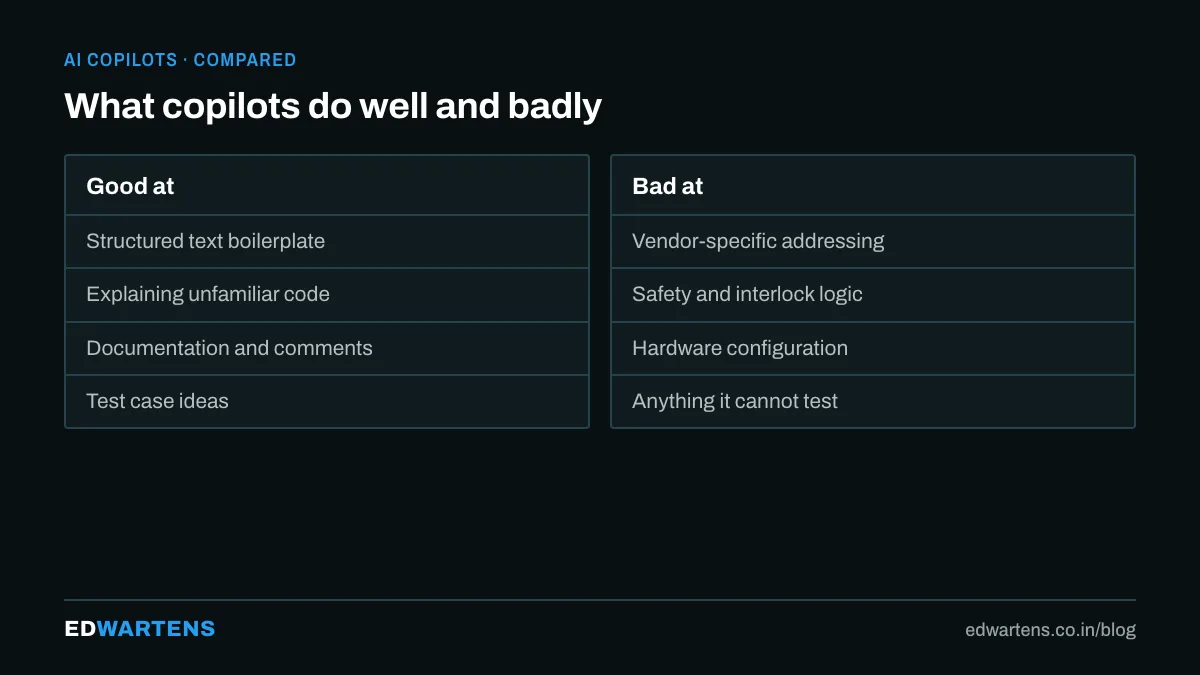
- Standard patterns: a debounce, a valve with feedback and timeout, a state machine skeleton, a recipe handler. Describe it and the draft is ninety percent there.
- Explaining code: paste an undocumented FB from 2011 and ask what it does. Excellent for handovers.
- Translation: RSLogix structured text to SCL, or ladder to ST, as a starting point.
- Documentation and comments: the part every engineer skips.
- Test cases: given a block, list the conditions to test.
- Tag naming and standards: rewrite a tag list to a naming convention.
Where they are dangerous
- Safety logic. Never. A safety function is designed from a risk assessment and validated; it is not generated. See emergency stop and safety circuits.
- Timing and scan behaviour. Models do not understand the scan cycle; generated code with edge detection or one-shots is often subtly wrong.
- Vendor specifics. Instruction names, data types and addressing get mixed between brands. A TON in Rockwell is not a TON in Siemens.
- Confident nonsense. The draft looks finished. It is a draft.
A working method
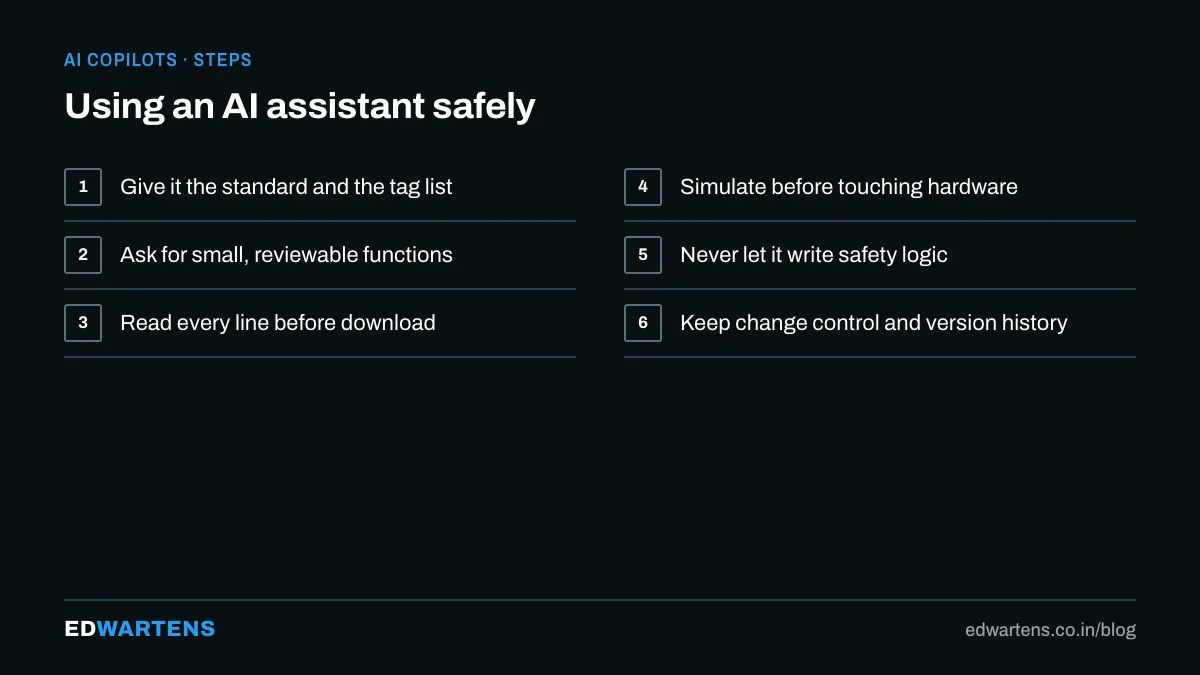
- Write the functional description yourself, in plain language, as you would for a colleague. This is the prompt and it is also the specification.
- Generate, then read every line. If you cannot explain a line, delete it.
- Compile and simulate in PLCSIM, Studio 5000 Emulate or CODESYS before it goes near hardware.
- Test the edge cases the model was asked to list.
- Keep the generated code in version control with the prompt as the commit message. You will want to know how it was made.
What it means for learning
The copilot makes a good engineer faster and a weak one dangerous, because only the good one can tell which draft is wrong. The fundamentals matter more, not less: the IEC 61131-3 languages, data types, the scan cycle, program structure. The free TIA Portal, SCL and Studio 5000 courses teach exactly the knowledge that lets you supervise a machine that writes code.
Frequently asked questions
Will AI replace PLC programmers? It will replace the part of the job that was typing standard blocks. Commissioning, fault finding, safety and knowing the process remain human, and are most of the job.
Is Industrial Copilot available in India? Yes, as a licensed add-on for TIA Portal V19 and later, with a cloud connection.
Can I use ChatGPT for customer code? Check the customer's data policy first. Many forbid pasting their code into public models; local models and enterprise tiers exist for that reason.
Learn this, free
The courses that teach this
Every lesson, the written notes and the practice are free with an account. Only the certificate is optional and paid.


