PLI Schemes and the Automation Hiring Wave: Where India's Manufacturing Money Is Going in 2026

What PLI did
The production-linked incentive schemes pay manufacturers a percentage of incremental sales for a fixed number of years if they build and produce in India. Fourteen sectors, from mobile phones and IT hardware to pharma, solar modules, batteries, white goods, textiles and food processing. The effect for automation engineers is simple: new factories, built to global standards, that must run at global efficiency to hit their production targets, which means they automate from day one.
The sectors automating fastest
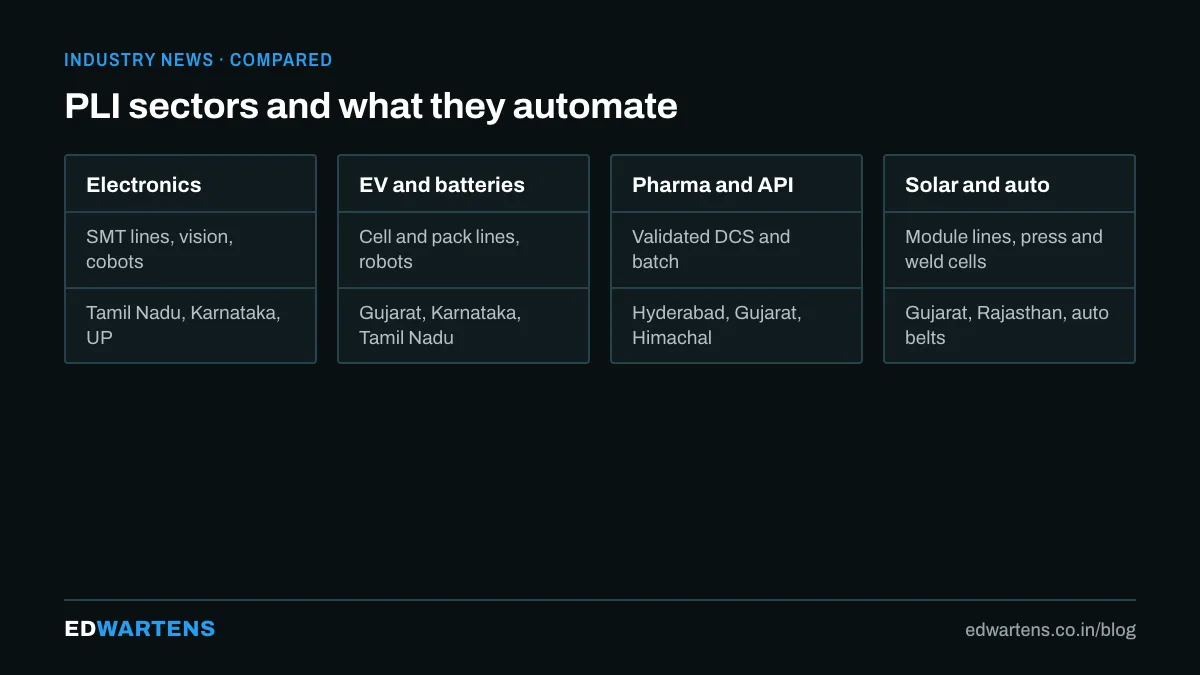
- Electronics manufacturing: phone and laptop assembly in Tamil Nadu, Karnataka and Uttar Pradesh. High-speed SMT lines, vision inspection, conveyors, cobots, MES integration.
- EV and batteries: cell plants and pack assembly in Gujarat, Karnataka and Tamil Nadu. Cleanroom-grade process control, robots, formation and test automation.
- Solar modules: stringers, laminators and testers on automated lines in Gujarat and Rajasthan.
- Pharma and API: validated automation, DCS and batch control, expanding in Hyderabad, Gujarat and Himachal.
- White goods and auto components: press shops, welding cells, paint lines and assembly with PLCs and robots across the auto belts.
- Food processing and textiles: packaging automation and process control catching up fast.
What these plants buy
Siemens and Rockwell PLCs, servo and motion systems, FANUC, ABB, KUKA and Yaskawa robots, cobots for assembly, machine vision, SCADA and MES, industrial networks, and the IIoT layer their global customers ask for. Every purchase needs engineers to specify, integrate, commission and maintain it, and the integrators serving these plants are hiring continuously.
The skills in demand
- PLC programming on one major platform, with servo and motion for electronics and battery lines.
- Robot programming, especially cobots and vision-guided cells.
- SCADA and MES integration, OPC UA, data.
- Electrical design and panels for the new plants.
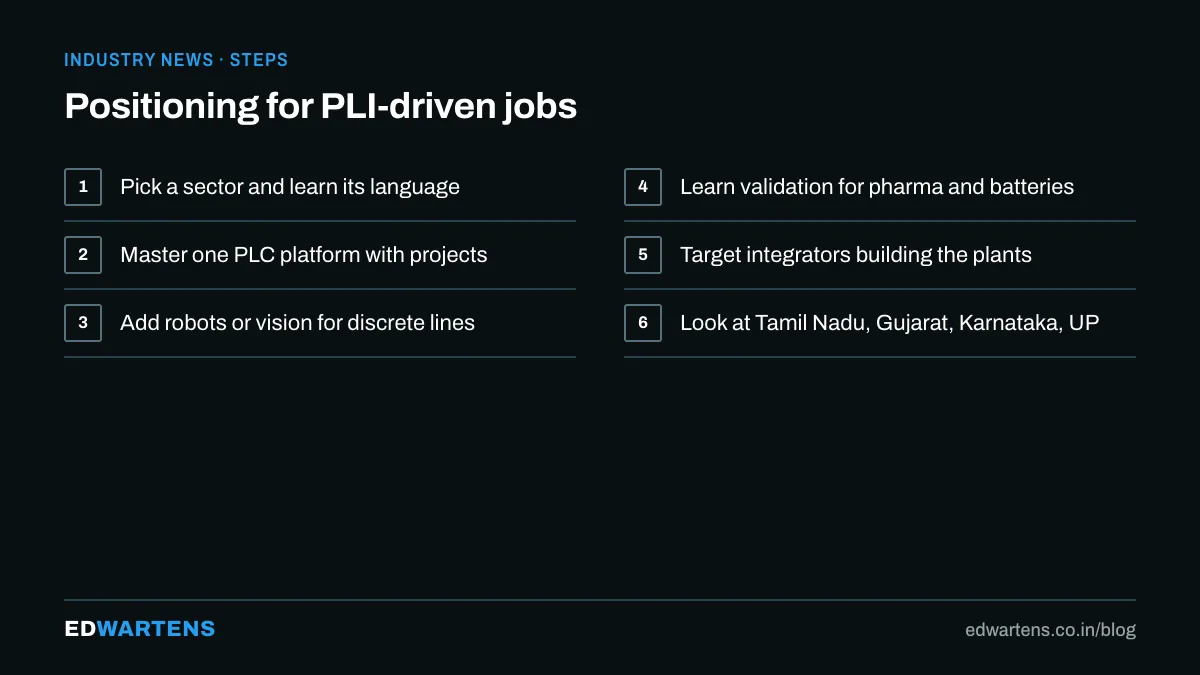
- Validation discipline for pharma and batteries.
Positioning yourself
- Pick a sector and learn its language: SMT and vision for electronics; batch and validation for pharma; robots and welding for auto.
- Build the platform skills on the free catalogue and prove them with projects.
- Target the integrators, not only the brands. Most PLI plants are built by integrators who hire in numbers.
- Look at the states where the plants are: Tamil Nadu, Gujarat, Karnataka, Uttar Pradesh, Telangana.
The wider picture is in why Indian manufacturing is hiring automation engineers and automation jobs in Bangalore's industrial corridors.
If you want to learn this alongside PLCs, SCADA and drives in a classroom, see our industrial automation course in Bangalore.
Frequently asked questions
Will PLI end? Schemes have fixed windows, but the plants stay and keep needing engineers.
Which sector pays best for automation? Semiconductors and batteries at the top, then pharma, then electronics and auto.
Do these plants hire freshers? The integrators and EPCs do, in volume, during build and commissioning. Get in during construction.
Learn this, free
The courses that teach this
Every lesson, the written notes and the practice are free with an account. Only the certificate is optional and paid.


