World Robotics 2026: India Is Now 6th for Robot Installs
The short answer
The International Federation of Robotics' World Robotics 2026 report, released on 24 September 2026, says more than 5 million industrial robots now work in factories worldwide, and more than 600,000 were installed in 2025. India installed about 10,500 robots in 2025, up 15%, and ranks sixth in the world, behind China, the US, Japan, South Korea and Germany. With India's installations growing at 27% a year since 2020, each year adds more robots that someone in India has to program, commission and maintain.
What the IFR reported
The figures below come from the IFR press release of 24 September 2026, with the India ranking confirmed the same day by The Robot Report.
- Operational stock: more than 5 million industrial robots, up 9%.
- New installations in 2025: more than 600,000, up 11%.
- India: about 10,500 installations in 2025, up 15%, 6th in the world. Its compound annual growth from 2020 to 2025 was 27%.
- Forecast: 655,000 installations in 2026 and 806,000 by 2029.
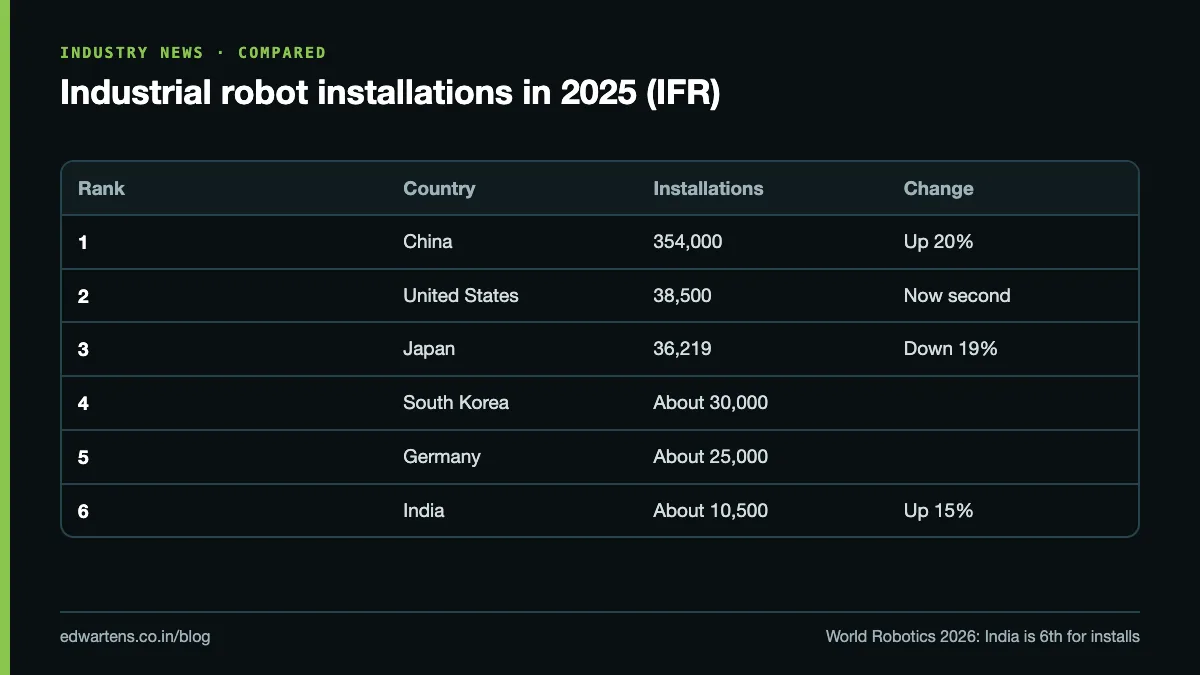
The top six for installations in 2025
| Rank | Country | Installations in 2025 | Change |
|---|---|---|---|
| 1 | China | 354,000 (59% of the world) | Up 20% |
| 2 | United States | 38,500 | Now second |
| 3 | Japan | 36,219 | Down 19%, now third |
| 4 | South Korea | About 30,000 | |
| 5 | Germany | About 25,000 | |
| 6 | India | About 10,500 | Up 15% |
How to read India's number honestly
Two things are true at once.
India is small in absolute terms. 10,500 robots is well under half of what Germany installed and a tiny fraction of China's total. A typical Indian factory still has no robot at all, and many lines that would be robotised in Europe are manual because labour is cheaper.
India is growing fast and from a real base. Ranking sixth puts India ahead of every European country except Germany. A 27% compound growth rate means the yearly number has roughly tripled in five years. That is the number that matters for careers: every one of those robots needs someone to integrate it, program it, commission it and keep it running for ten years or more.
The growth also changes what employers ask for. A plant with two robots relies on the integrator's engineer. A plant with forty has its own robot technicians and programmers on the shift roster.
What a robot job in India actually involves
"Robotics" in job adverts covers several different jobs. Here is how they split in Indian plants and integrators:
| Role | Day-to-day work | Where you find it |
|---|---|---|
| Robot technician | Teach-pendant touch-ups, mastering, fault recovery, preventive maintenance | Automotive and component plants, on shift |
| Robot programmer | Writing and optimising programs, I/O and PLC handshakes, cycle time | Integrators and large plants |
| Offline programming and simulation engineer | Building cells in simulation, reach and cycle-time studies, path generation | Integrators, robot OEM offices, engineering centres |
| Cell or line commissioning engineer | Bringing a robot cell, PLC, safety and HMI up together on site | Integrators; heavy travel |
| Cobot application engineer | Light assembly, machine tending, screwdriving, palletising | SMEs, electronics, pharma |
Most people start as a technician or junior programmer and move towards commissioning or simulation. The technical core across all of them is the same: one robot language well, PLC communication, safety, and the discipline of not crashing a robot into a fixture.
Which robot brands to learn
The IFR report does not give brand shares for India, and we will not invent them. In Indian plants and job adverts you will meet four families repeatedly: FANUC, ABB, KUKA and Yaskawa in automotive and heavy industry, plus Universal Robots among collaborative robots. Each has its own language:
| Brand | Language | Programming and simulation software |
|---|---|---|
| FANUC | TP (teach pendant), KAREL | ROBOGUIDE |
| ABB | RAPID | RobotStudio |
| KUKA | KRL | KUKA.Sim, WorkVisual |
| Universal Robots | URScript, PolyScope graphical | URSim |
| Any brand | Generated by the simulator | RoboDK |
The concepts carry across: frames, tools, payloads, motion types, I/O and program structure. Learn one brand thoroughly and the second takes weeks, not months. Our comparison of robot programming languages shows the same move written in each.
A learning path that matches the jobs
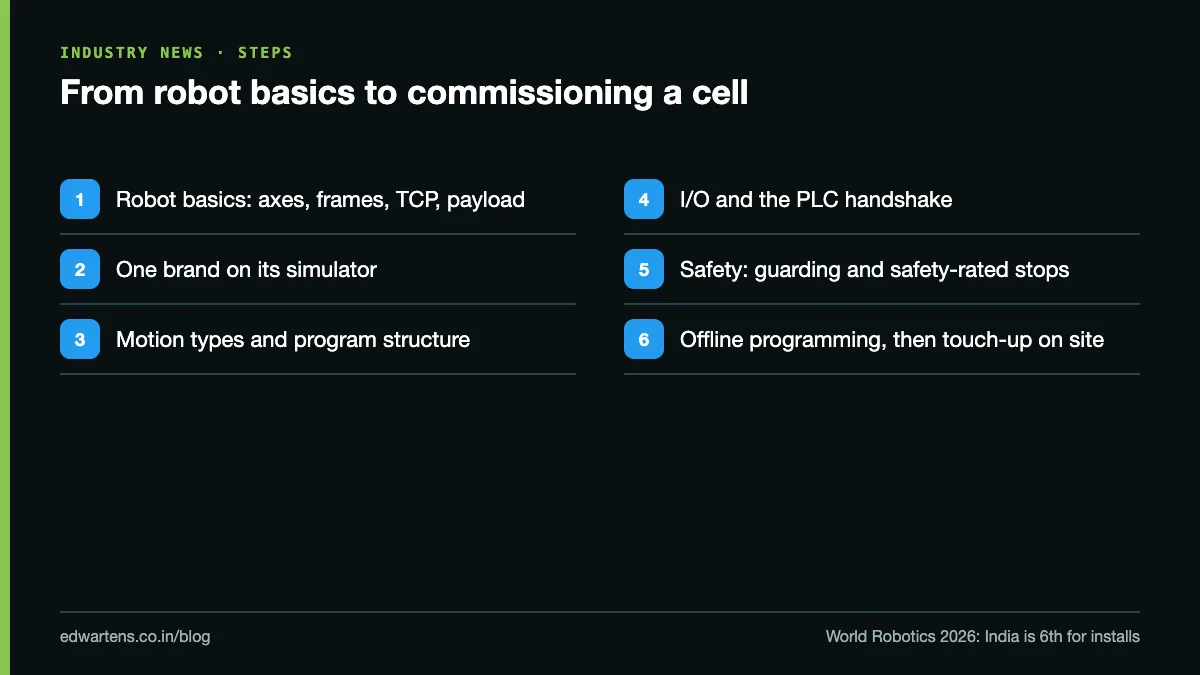
- Robot basics: axes, coordinate frames, tool centre point, payload.
- One brand on its simulator: FANUC ROBOGUIDE or ABB RobotStudio are the most common starting points. Several of these simulators have free versions or trial licences, so you can learn a great deal without a robot.
- Motion and program structure: joint versus linear moves, approach points, speed and zone settings, subroutines.
- I/O and the PLC handshake: how a robot asks the PLC for a part, waits for a clamp, reports a fault.
- Safety: guarding, safety-rated stops, speed and separation monitoring. Read our guide to robot safety with ISO 10218 before you go near a live cell.
- Offline programming: build the cell in simulation first, then touch up on site. See our guide to offline robot programming and simulation.
If you are deciding between a full industrial arm and a cobot for a project, our post on cobots versus industrial robots covers the trade-offs.
What this means if you are starting now
- Pair robots with PLCs. Almost no Indian job is "robot only". A robot programmer who can also read the cell PLC is worth more than one who cannot.
- Build a portfolio in simulation. A recorded pick-and-place or palletising cell in RobotStudio or ROBOGUIDE, with a written cycle-time explanation, is a stronger interview piece than a certificate alone.
- Expect travel early. Integrators do the most commissioning, and commissioning means site work. It is also the fastest way to learn.
- Look past automotive. Automotive is still the biggest robot user, but electronics, food, pharma and logistics are where many new cells go.
Learn it free
Five of our free courses cover the brands and tools named above:
- FANUC Robot Programming with the Teach Pendant and ROBOGUIDE
- ABB Robot Programming with RobotStudio and RAPID
- KUKA Robot Programming with KUKA.Sim, smartPAD and WorkVisual
- Universal Robots Cobot Programming with PolyScope
- RoboDK Offline Programming and Simulation
All are free with an account, with written notes, practice tasks and a 15-question final assessment. For a guide to choosing between them, see our post on free robot programming courses with a certificate. The optional EDWartens certificate is ours, not a FANUC, ABB or KUKA credential. If you want hands-on time with real hardware in Bengaluru, the classroom Automation Engineer Program includes robotics.
Frequently asked questions
Q: How many industrial robots are there in the world in 2026?
A: More than 5 million in operation, up 9%, according to the IFR's World Robotics 2026 report released on 24 September 2026.
Q: How many robots did India install in 2025?
A: About 10,500, up 15% on 2024, which ranks India sixth in the world for new installations.
Q: Which countries install the most industrial robots?
A: In 2025: China (354,000), the United States (38,500), Japan (36,219), South Korea (about 30,000), Germany (about 25,000) and India (about 10,500).
Q: What does the IFR forecast for robot installations?
A: 655,000 installations worldwide in 2026, rising to 806,000 by 2029.
Q: Which robot brand should I learn first in India?
A: FANUC or ABB are common first choices because both have widely used simulators. The concepts transfer, so the brand matters less than learning one properly.
Q: Can I learn robot programming without a robot?
A: Yes, to a useful level. ROBOGUIDE, RobotStudio, KUKA.Sim, URSim and RoboDK let you build and test programs in simulation before touching real hardware.
Learn this, free
The courses that teach this
Every lesson, the written notes and the practice are free with an account. Only the certificate is optional and paid.