Exide's Bengaluru Lithium Cell Plant: The Jobs It Creates
The short answer
Exide Industries' subsidiary Exide Energy Solutions has commissioned Phase I (6 GWh) of its lithium-ion cell plant at Devanahalli, Bengaluru, making LFP and NMC cells, as Energetica India reported on 28 September 2026. It is one of the first large cell factories in India, with Reliance's 40 GWh plant at Jamnagar due next. A cell plant is a long chain of automated machines, so the jobs it creates are for PLC and SCADA engineers, machine-vision specialists, instrumentation and electrical maintenance engineers, and battery-system engineers.
What happened
India has assembled battery packs for years from imported cells. Making the cell itself, the electrochemistry inside the can or pouch, is the step the country has been missing. Exide's plant is a real step towards filling that gap.
The facts, from the sources:
- Who: Exide Energy Solutions Ltd, a subsidiary of Exide Industries.
- What: Phase I of a lithium-ion cell plant, 6 GWh a year, producing LFP and NMC cells (Energetica India, 28 Sept 2026).
- Where: Devanahalli, on the north side of Bengaluru near the airport.
- The plan behind it: the plant was planned at 12 GWh over two phases, with about ₹5,000 crore earmarked for phase one and technology from SVOLT (Autocar Professional, 14 Nov 2024). That is background from 2024; the second phase is a plan, not a commissioned line.
The wider build-out
Exide is not alone. At its 49th AGM, Reliance said phase one of its 40 GWh battery and cell gigafactory at Jamnagar would be commissioned this year with all equipment delivered, and set a longer-term target of 120 GWh using LFP chemistry (pv magazine India, 22 June 2026). Reliance's dates have slipped before, so treat "this year" as a target until production is announced.
Behind both is the government's Advanced Chemistry Cell PLI scheme, worth ₹18,100 crore, which asks each beneficiary for at least 5 GWh of capacity, according to a Zetwerk explainer. For the policy picture across sectors, see our post on PLI schemes and the automation hiring wave.
| Project | Location | Capacity | Status (as reported) |
|---|---|---|---|
| Exide Energy Solutions, Phase I | Devanahalli, Bengaluru | 6 GWh, LFP and NMC | Commissioned, Sept 2026 |
| Exide Energy Solutions, full plan | Devanahalli, Bengaluru | 12 GWh over two phases | Phase II planned |
| Reliance gigafactory, phase one | Jamnagar, Gujarat | 40 GWh | Due for commissioning in 2026 |
| Reliance long-term target | Jamnagar, Gujarat | 120 GWh, LFP | Target |
What a cell factory actually does
To see the jobs, follow the cell down the line. Every lithium-ion cell plant, whoever builds it, runs some version of these stages:
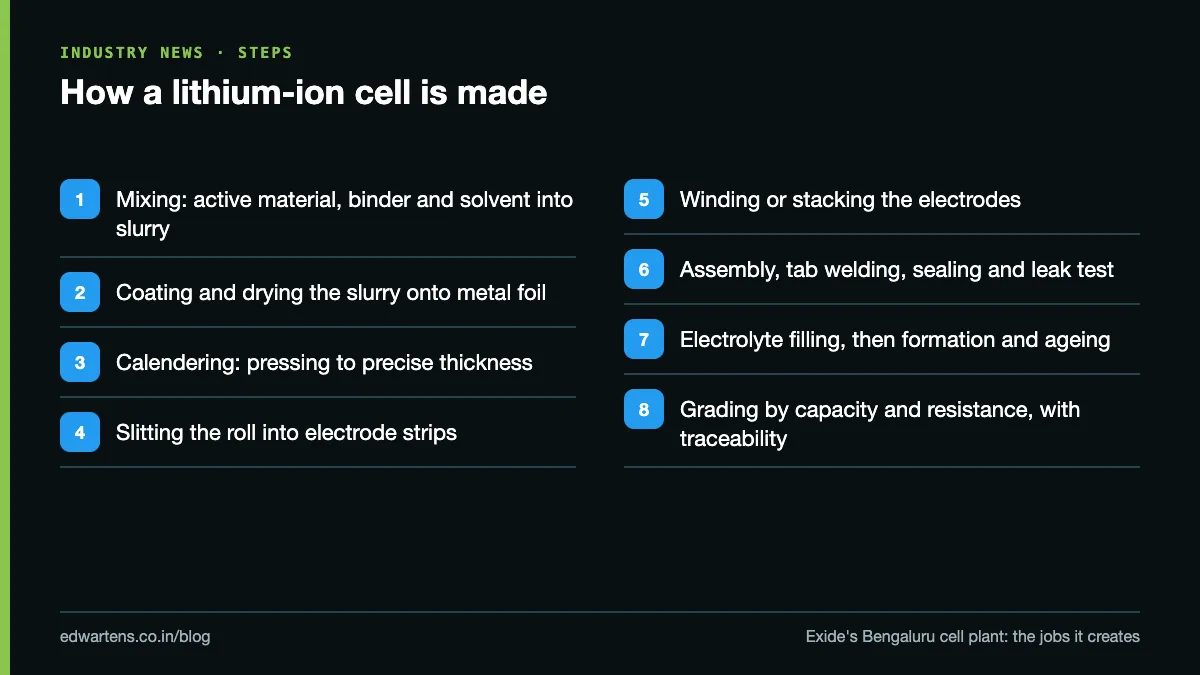
- Mixing. Active material, binder, conductive additive and solvent are mixed into a slurry. Batch control, weighing, viscosity and temperature: classic process automation.
- Coating and drying. The slurry is coated onto metal foil (aluminium for the cathode, copper for the anode) and dried in a long oven. Web tension, coating thickness and oven zone temperatures are under closed-loop control.
- Calendering. Rollers press the coated foil to a precise thickness and density.
- Slitting. The wide roll is cut into electrode strips. Burrs and edge defects matter, so vision inspection is heavy here.
- Winding or stacking. Cylindrical cells are wound; prismatic and pouch cells are wound or stacked. High-speed motion control, servo axes and cameras checking alignment.
- Assembly. Insertion into the can or pouch, tab welding, sealing, and leak testing.
- Electrolyte filling. Dosing under controlled conditions, then sealing.
- Formation and ageing. The first charge and discharge cycles, done on racks of power electronics, then days of storage while voltage drift is measured.
- Grading and packing. Each cell is measured for capacity and internal resistance, sorted into grades and traced by its serial code.
Much of this happens in dry rooms, where the air is kept extremely dry because moisture damages the cells. Dry rooms are a large HVAC and controls job in their own right: dehumidifiers, air handling, dew-point monitoring and alarms.
The automation and electrical jobs it creates
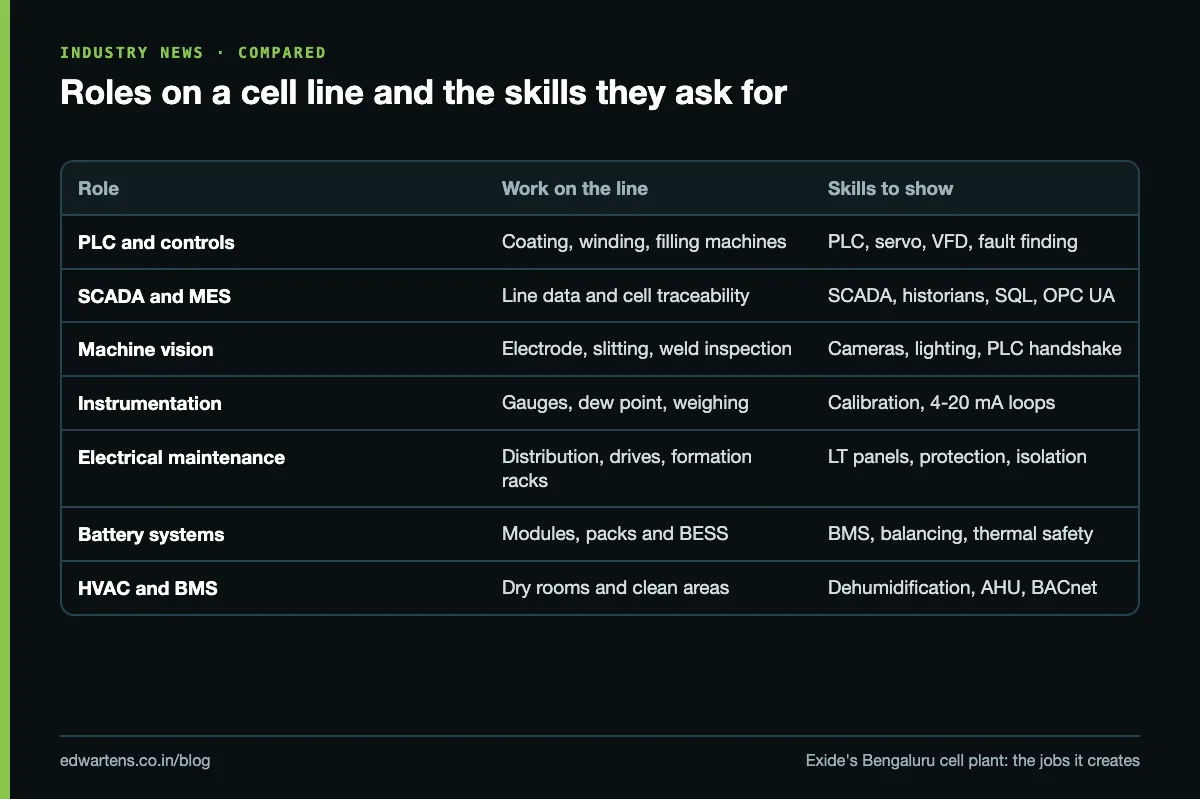
Every stage above is a machine with a PLC, drives, sensors and a SCADA or MES connection. Here is how that turns into roles. We have not invented hiring numbers for Exide or Reliance; neither has published them in our sources.
| Role | What you do on a cell line | Skills to show |
|---|---|---|
| PLC and controls engineer | Commission and maintain coating, winding, assembly and filling machines | Siemens or Rockwell PLC, servo and VFD, interlocks, fault finding |
| SCADA and MES engineer | Collect line data, batch records and cell traceability | SCADA, historians, SQL, OPC UA |
| Machine vision engineer | Electrode surface, slitting edge, winding alignment and weld inspection | Cameras, lighting, PLC handshakes, defect classification |
| Instrumentation engineer | Thickness gauges, flow, temperature, dew point, weighing | Calibration, 4-20 mA loops, transmitters |
| Electrical maintenance engineer | Plant distribution, drives, formation power racks | LT panels, protection, drives, safe isolation |
| Battery systems engineer | Modules, packs and BESS products downstream | BMS, cell balancing, thermal and safety design |
| HVAC and BMS engineer | Dry rooms and clean areas | Dehumidification, AHU control, BACnet, alarms |
Why Bengaluru matters
For engineers in Karnataka, Devanahalli is commuting distance from the city's north side. A new plant does not hire only its own staff; it also pulls in machine suppliers' service engineers, system integrators doing line changes, and maintenance contractors. Our list of companies hiring PLC engineers in Bangalore is a starting point for the integrator side.
What to learn, in order
If you want to be ready when cell plants advertise, build the skills in this order:
- One PLC platform properly. Most cell-line machines are PLC-controlled. Learn one platform to the point of reading someone else's program and fixing a fault.
- Drives and motion. Coating, calendering and winding are web-handling and servo problems: tension control, speed synchronisation, homing.
- Instrumentation. Scaling a 4-20 mA signal, calibrating a transmitter, trusting or doubting a reading. Our 4-20 mA scaling guide covers the arithmetic.
- Machine vision. Defect detection on moving foil is one of the hardest and best-paid niches on the line.
- Battery fundamentals. LFP versus NMC, what formation does, what a BMS measures, why thermal runaway is the safety case for everything.
LFP and NMC in one table
| LFP | NMC | |
|---|---|---|
| Cathode | Lithium iron phosphate | Lithium nickel manganese cobalt oxide |
| Energy density | Lower | Higher |
| Thermal stability | Better, safer under abuse | Lower, needs tighter thermal management |
| Typical uses | Stationary storage (BESS), three-wheelers, buses | Two-wheelers and cars where weight matters |
Exide's plant makes both, so engineers there will see both kinds of line.
Learn it free
These free courses line up with the roles above:
- Battery Energy Storage Systems (BESS): cells, BMS, controls and safety for stationary storage, which is where much LFP output goes.
- Electric Vehicle Technology Fundamentals: the EV side of the market, battery packs, motors and power electronics.
- Machine Vision and Quality Inspection: cameras, lighting and inspection logic, the skill a cell line leans on hardest.
- Siemens TIA Portal: a solid PLC foundation for the machines on the line.
They are free with an account and self-paced, with written notes, practice tasks and a final assessment. Browse the rest at /free-courses, or, if you are in Bengaluru and want hands-on hardware, look at the classroom Automation Engineer Program at our Electronic City centre.
Frequently asked questions
Q: Where is Exide's lithium-ion cell plant?
A: At Devanahalli, on the north side of Bengaluru. It is run by Exide Energy Solutions Ltd, a subsidiary of Exide Industries.
Q: How big is the Exide cell plant?
A: Phase I, commissioned in September 2026, is 6 GWh a year. The plant was planned at 12 GWh over two phases.
Q: What cells does the Exide plant make?
A: Lithium iron phosphate (LFP) and nickel manganese cobalt (NMC) lithium-ion cells, according to Energetica India.
Q: When will Reliance's Jamnagar gigafactory start?
A: Reliance said at its 49th AGM that phase one, 40 GWh, would be commissioned in 2026 with all equipment delivered. Its dates have slipped before, so wait for a production announcement.
Q: What jobs does a battery cell plant need?
A: PLC and controls engineers, SCADA and MES engineers, machine vision engineers, instrumentation and electrical maintenance engineers, HVAC engineers for dry rooms, and battery systems engineers.
Q: Do I need a chemistry degree to work in a cell plant?
A: Not for the automation roles. Process chemists set the recipe; the machines that run it are maintained by electrical, instrumentation and controls engineers.
Learn this, free
The courses that teach this
Every lesson, the written notes and the practice are free with an account. Only the certificate is optional and paid.