Robot Programming Languages Compared: FANUC TP, ABB RAPID, KUKA KRL, Yaskawa INFORM and URScript

The good news first
Robot languages differ in syntax, not in ideas. Every one of them has:
- Positions: a point in space, taught or typed, with a configuration.
- Motion instructions: joint moves, linear moves, circular moves, each with a speed and a blending (approximation) setting.
- I/O: read a sensor, set a gripper.
- Program flow: if, loops, wait, call a subroutine.
- Frames: a tool frame at the end of the arm and a user or base frame in the world, so a program taught on one fixture can be shifted to another.
Learn those on one brand and the next brand is a vocabulary exercise.
FANUC TP (Teach Pendant)
FANUC dominates automotive and machine tending in India. TP programs are line-numbered lists edited on the pendant:
1: J P[1] 100% FINE ;
2: L P[2] 500mm/sec CNT100 ;
3: DO[1]=ON ;
4: WAIT DI[2]=ON ;
5: CALL PICK ;
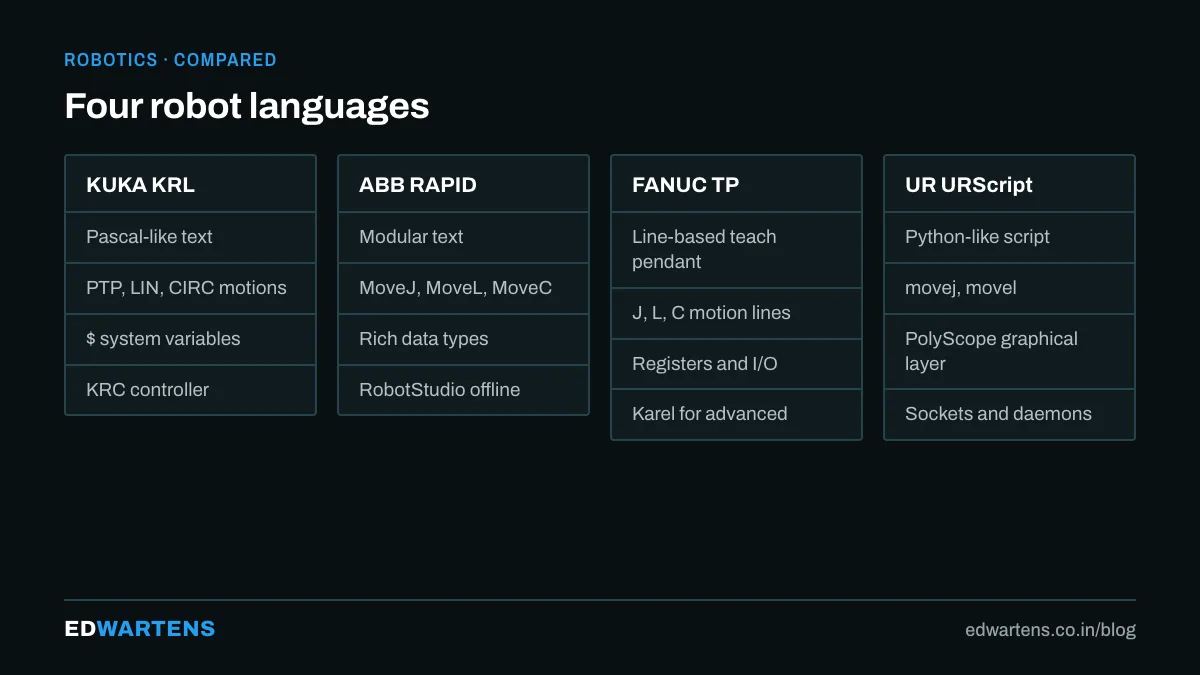
J is a joint move, L is linear, FINE stops at the point and CNT blends through it. Positions live in position registers (PR) and the program's own P[n] points; numbers in R[n]. Karel is FANUC's text language for background logic, but most cells are pure TP. ROBOGUIDE is the simulator. Our FANUC course covers TP from the first jog to ROBOGUIDE.
ABB RAPID
RAPID is a structured text language, closer to Pascal than to a pendant list, edited in RobotStudio or on the FlexPendant:
MoveJ pHome, v1000, z50, tGripper\WObj:=wobjTable;
MoveL pPick, v200, fine, tGripper\WObj:=wobjTable;
SetDO doGrip, 1;
WaitDI diPartPresent, 1;
Modules, procedures, data types (robtarget, jointtarget, tooldata, wobjdata), error handlers and interrupts make RAPID the most software-like of the pendant languages. RobotStudio's simulation is excellent and free for learning, which the ABB RobotStudio and RAPID course uses throughout.
KUKA KRL
KRL is also a structured language, with a strong split between the program file (.src) and its data (.dat):
PTP HOME Vel=100 % DEFAULT
LIN P1 Vel=0.5 m/s CPDAT1 Tool[1] Base[2]
$OUT[1]=TRUE
WAIT FOR $IN[3]
PTP is the joint move, LIN and CIRC are Cartesian, and inline forms on the smartPAD hide most of the syntax from a beginner. KUKA.Sim and WorkVisual are the offline tools. The KUKA course covers smartPAD, KRL and WorkVisual.
Yaskawa Motoman INFORM
INFORM is pendant-oriented like TP, with jobs made of instructions such as MOVJ, MOVL, MOVC, DOUT and WAIT. Positions are stored in the job or in position variables (P000). MotoSim is the simulator. It is common in welding cells and increasingly in Indian packaging lines; see the Yaskawa course.
Universal Robots: PolyScope and URScript
UR programs are built as a tree on the tablet: Move nodes with waypoints, Set, Wait, If, Loop and Folder nodes. Under the tree runs URScript, a Python-like language:
movej(home, a=1.4, v=1.05)
movel(p[0.2, -0.3, 0.1, 0, 3.14, 0], a=1.2, v=0.25)
set_digital_out(0, True)
Scripts can be sent to the controller over a socket, which is why UR integrates so easily with vision and PLCs. The PolyScope course covers both layers.
Offline programming crosses the brands
RoboDK generates programs for all of the above from one simulation, which is the fastest way to learn the differences: build a cell once and export it as TP, RAPID, KRL and URScript. The RoboDK course does exactly that.
Which to learn first in India
FANUC first if you want automotive and machine tending; ABB or KUKA if you are heading for welding, body shops or European OEMs; UR if you are joining an SME or an integrator selling cobot cells. Learn the pendant of one, read the language of two, and be able to explain frames and blending on a whiteboard. That combination gets interviews.
If you want the PLC side of a robot cell taught in a classroom, our page on robotics training in Bangalore explains what is covered there and what is left to the free robot programming courses.
Frequently asked questions
Is there a universal robot language? No, though ROS 2 and vendor SDKs let you drive several brands from one application. On the factory floor the vendor language still runs the cell.
How long to learn a pendant? Two weeks to be useful, six months to be trusted alone with a cell.
Do I need to be a programmer? No. Robot programming is mostly teaching positions and sequencing I/O; the logic is simpler than most PLC programs.
Learn this, free
The courses that teach this
Every lesson, the written notes and the practice are free with an account. Only the certificate is optional and paid.


