Safety · Free online course
Safety Instrumented Systems and SIL to IEC 61511
The protection layer that acts once control has already failed: why the SIS is kept apart from the BPCS, safety instrumented functions written with a trip point and a safe state, LOPA and the SIL target, PFDavg arithmetic, sensors, logic solvers and shutdown valves, de-energise against energise to trip, bypass and MOS discipline, 1oo2 and 2oo3 voting, common cause failure, the safety requirements specification, application programs, validation, proof testing and repair deferral.
- 15 modules
- 11h 9m of video
- Advanced
- English
- ₹0, free
- Lab practice in your browser

₹0Free for good
Worth ₹7,999 by length and depth against classroom training. It has always been free; that is not a former price.
No card. Checkout takes a minute and gives you a receipt.
Overview
About Safety Instrumented Systems and SIL to IEC 61511
Understand how a safety instrumented system protects a plant when control fails, from SIL targets to proof testing.
Safety Instrumented Systems and SIL to IEC 61511 is a free, self-paced online course from EDWartens for engineering students, ITI and diploma holders, and working engineers in machine building and automation. It has 15 modules and 11h 9m of video lessons by Instrumentation Tools, with written notes and worked problems, a practical project with a document pack and a 15-question final assessment (pass mark 60%). Learning is free with an account; an optional certificate with a public verification code is issued when you pass. Last updated 27 September 2026.
Who it is for: Engineering students, ITI and diploma holders, and working engineers in machine building and automation
This course includes
- 11h 9m of video lessons
- 15 modules with written notes and diagrams
- One final assessment: 15 questions, pass mark 60%
- Ask-an-engineer support from practising engineers
- Lifetime access, the course does not expire
- Optional verifiable certificate when you finish
- Step 1 of 3
Learn the 15 modules
11h 9m of video lessons, written notes and a practice task per module, at your own pace.
- Step 2 of 3
Pass the final assessment
15 questions drawn from every module, pass mark 60%, 3 attempts.
- Step 3 of 3
Take the certificate, if you want it
Optional, paid once, only if you choose it. The course stays free either way.
See the certificate and its price
A look inside


From the lessons

Why a plant needs a safety layer
by Instrumentation Tools

Functional safety, IEC 61508, IEC 61511 and LOPA
by Instrumentation Tools

The SIS loop end to end
by Instrumentation Tools
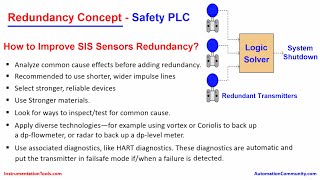
Redundancy, voting and safety architecture
by Instrumentation Tools

The safety requirements specification
by Instrumentation Tools

The application program in the safety logic solver
by Instrumentation Tools
Lesson frames belong to the creators named in the Credits and are shown from YouTube.
What you learn
What you will be able to do
By the end you will be able to:
- Write a safety instrumented function with a trip point and safe state
- Follow a LOPA to a SIL target and check it with a PFDavg calculation
- Choose a voting architecture such as 1oo2 or 2oo3
- Read a safety requirements specification and name what is missing
- Plan a validation test and a proof test
How it works
How this course works
Watch the lessons
Short video lessons, one module at a time, at your own pace.
Read the notes
Open the Reading tab for the written notes and diagrams of the module.
Practise in the 3D labOptional
Try the module in the free 3D lab, in your browser.
Check yourself
Answer the questions to see what stuck before you move on.
Final assessment
Pass the final once you have been through the modules.
Certificate, if you want oneOptional
Optional, with a page anyone can use to verify it.
Syllabus
Course content, module by module
In order, at whatever pace suits you. Each module ends with a practice task that builds on the last.
- Modules
- 15
- Video lessons
- 49
- Of video
- 11h 9m
- Final questions
- 15
- 01
Why a plant needs a safety layer
4 lessons · 39m - 02
BPCS, SIS and the safety instrumented function
3 lessons · 35m - 03
Functional safety, IEC 61508, IEC 61511 and LOPA
3 lessons · 49m - 04
PFD and the reliability arithmetic behind SIL
3 lessons · 32m - 05
The SIS loop end to end
4 lessons · 1h 1m - 06
Trip philosophy, fail-safe design and overrides, with lab practice:
4 lessons · 56m - 07
Redundancy, voting and safety architecture
3 lessons · 59m - 08
Common cause failure and how SIS equipment fails
4 lessons · 50m Final assessment · 15 questions, pass mark 60%
3D lab
Practise in the 3D lab
Find a valve's fail position, stroke-test it, and run interlock tests on a finished skid, the field side of a safety function.
- Flow loop and control valveProcess lab, about 45 minOpen in the lab (opens in a new tab): Flow loop and control valve
- Site acceptance and fault findingProcess lab, about 70 minOpen in the lab (opens in a new tab): Site acceptance and fault finding
Optional. Skip it whenever you like: it never blocks your progress or your certificate.
Project
The course project
Optional practice that ends in the kind of job the course prepares you for, with the documents that go with it.
About 18 hours
LPG sphere SIS to IEC 61511: LOPA, SRS with 2oo3 voting, PFDavg verification, proof test and FAT on paper
Design, verify and document the safety instrumented system for a 600-tonne LPG storage sphere at a bottling plant. It has a HAZOP/LOPA register that sets a SIL target per scenario. It has an SRS with one row per SIF, written to IEC 61511 clause 10, and a cause-and-effect matrix. It has the logic solver I/O list and a SIL verification with the PFDavg arithmetic shown line by line. It has a proof-test procedure with a completed record. It has a FAT that tests degraded voting and maintenance overrides, and the bypass and repair-deferral register the plant keeps afterwards. No software is needed. You deliver the documents, with your own LOPA, SRS, verification and FAT record. The sample pack shows what a functional-safety engineer hands an LPG plant.
- 8documents in the pack
- 8steps to follow
- 6things to hand in
- 18 hof work, at your pace
Sample document pack, 8 documents, filled in for the scenario
- Risk registerHAZOP and LOPA Register: LPG Sphere V-101
- SRSSafety Requirements Specification: V-101 Sphere SIS
- Cause & effectCause and Effect Matrix: V-101 Sphere SIS
- I/O listLogic Solver I/O List: HIMatrix F60, SIS Cabinet SC-SIS-1
- Test reportSIL Verification Report: PFDavg and Architectural Constraints, V-101 SIS
- ProcedureProof-Test Procedure and Record: SIF-01 High-High Level and SIF-03 Isolation
- FATFactory Acceptance Test Record: V-101 SIS Logic Solver
- RegisterBypass, Override and Repair-Deferral Register: V-101 SIS
Read inside the course and download as a workbook. The project is optional practice, marked when you submit it; the certificate needs only the modules and the final assessment.
Tools
Software, hardware and lessons
Software
None required.
Hardware
None required. Access to a plant P&ID and a cause and effect chart makes the practice tasks real.
Who it is for
Advanced. Assumes PLC or DCS basics and some field instrumentation experience, so it is best taken after any of the free PLC or DCS courses. No coding and no software licence needed.
Software you need
Nothing to install
What you walk away with
Your certificate for Safety Instrumented Systems and SIL to IEC 61511
Finish the course, pass the final, and this is the document with your name on it.

Verifiable by anyone
Adds to LinkedIn in one click
QR code on the certificate
Names what you can do
A permanent link
Earned, not attended
Learning is free. The certificate is optional.
Add it now and pay only when you have finished the course, or come back for it later. One-off, US$44.99, with a receipt.
Issued by Wartens Ltd (England and Wales, company no. 15262249) through the EDWartens training portal, as a Certificate of Completion for this self-paced course. Sold in India by Wartens Automation Private Limited. It is not a vendor certification, a university award or a CPD-accredited activity, and it does not certify competence on live equipment. Delivered electronically; see the refund policy.
Practise what you learn in the free 3D lab
Technical work is judged on what you can do: wiring, commissioning, finding a fault. Doing a task yourself teaches more than watching it a second time, and a lab lets you try it safely before you meet real equipment. It does not replace working on real hardware.
- Practise safely, so a mistake costs nothing.
- The lab checks your work like a site test, so you know when it is right.
- Free, in your browser, with nothing to install.
Why learn with EDWartens
What you get with this course.
- Free from the first lesson to the final assessment.
- Practice in a free 3D lab in your browser, with nothing to install.
- Video lessons with written notes and a project.
- An optional certificate that anyone can verify online.
FAQ
Common questions
Is the Safety Instrumented Systems and SIL to IEC 61511 course really free?
Yes. Every module, practice task and assessment. You create an account so your progress is saved and the assessments can be marked. The certificate is the only paid item, and only if you want it.
What certificate does the Safety Instrumented Systems and SIL to IEC 61511 course give?
An EDWartens Certificate of Completion, issued when you have finished every module and passed the final assessment at 60 percent, with a verification code anyone can check. It is not a vendor credential and is never described as one.
Is this the same as a TUV or exida functional safety engineer certification?
No, and it is not equivalent to one. Those are paid, examined certifications awarded by certification bodies and they have their own fees, syllabus and eligibility rules. This course is preparation: it teaches the subject those exams are built on, so you arrive knowing the material rather than meeting it for the first time in a classroom.
Who made the video lessons in the Safety Instrumented Systems and SIL to IEC 61511 course?
Instrumentation Tools, on their own YouTube channel, credited in the Credits block at the foot of this page. EDWartens did not make the videos and the creator is not affiliated with EDWartens. What EDWartens wrote is the study plan, the notes, the practice tasks and the assessments.
What should I know before starting?
PLC or DCS basics and some field instrumentation experience. You should be comfortable reading a loop drawing and know what a transmitter, a solenoid and a shutdown valve do. Any of the free PLC or DCS courses on this site is enough of a foundation.
Do I need any software, hardware or a licence?
No. There is nothing to install and nothing to buy. If you can get hold of a P&ID, a cause and effect chart and a few SIS work orders from a plant you know, the practice tasks become much more useful, but the course works without them.
Does the course cover HAZOP?
No. It starts where the hazard study leaves off. LOPA, SIL determination, the SIL target and everything downstream of it are covered in full, but facilitating a HAZOP is a separate skill and this course does not teach it.
Who is the Safety Instrumented Systems and SIL to IEC 61511 course for?
Instrumentation, control, DCS and maintenance engineers in refineries, petrochemicals, chemicals, fertiliser and gas processing, EPC design engineers working on ESD and fire and gas packages, and instrumentation graduates who want to move towards the safety systems group rather than stay on general loop maintenance.
Do I have to use the lab?
No. The lab is optional practice. You can skip it whenever you like, and it never blocks your progress, the final assessment or your certificate.
Is the lab free?
Yes. Every lab level for this course opens in your browser, free, with nothing to install.
Is the Safety Instrumented Systems and SIL to IEC 61511 course free in India, and what does the certificate cost?
Yes. Learning costs ₹0 in India: every module, the written notes, the practice tasks and the final assessment, with no card and no trial period. The only paid item is the optional EDWartens Certificate of Completion, ₹999 including GST for this advanced course, paid in rupees through Razorpay, and only if you want it after passing the final assessment.
All course factsHide course facts
- Price
- ₹0, free for good. No trial, no card. Comparable classroom training of this length costs about ₹7,999.
- Who it is for
- Engineering students, ITI and diploma holders, and working engineers in machine building and automation
- Format
- 15 self-paced modules, 11h 9m of video, written notes, a practice task per module and one final assessment.
- Level
- Advanced. Advanced. Assumes PLC or DCS basics and some field instrumentation experience, so it is best taken after any of the free PLC or DCS courses. No coding and no software licence needed.
- Brand
- Vendor-neutral
- Software
- None required.
- Hardware
- None required. Access to a plant P&ID and a cause and effect chart makes the practice tasks real.
- Certificate
- Optional EDWartens Certificate of Completion, ₹999 inclusive of GST for learners in India, verifiable by code. Not a vendor credential.
- Video lessons by
- Instrumentation Tools (independent creators, credited below)
- Language
- English
- Last updated
- 27 September 2026
Pairs well with
 Safety · FreeSiemens Safety Integrated: S7-1500F and S7-1200F in TIA Portal
 Safety · FreeAllen-Bradley GuardLogix Safety and CompactLogix 5380
 PLC programming · FreeSiemens TIA Portal
 PLC programming · FreeSiemens TIA Portal in Three Hours
More free courses: Free machine safety courses
Classroom course, Bangalore
Industrial automation course in Bangalore
The Automation Engineer Program (AEP) covers PLC, SCADA, HMI, drives, measuring instruments, PID basics and control panel design, taught in person at our Electronic City centre.
Credits
Who made the video lessons
The video lessons in this course were created by the people below, not by EDWartens. Every lesson streams from its creator's own YouTube channel; EDWartens neither hosts nor sells that footage, and the creators are not affiliated with EDWartens and do not endorse this course. What EDWartens wrote is the study plan, the notes, the practice tasks and the assessments.
- Instrumentation Toolsthe Safety Instrumented System training playlist, which supplies every video lesson in this course, from BPCS against SIS through LOPA, SIL and PFD to voting, the SRS, application programs, validation, proof testing and maintenance
If you are one of these creators and would like a lesson removed or credited differently, write to info@wartens.com.