Cobots vs Industrial Robots: Which One Does Your Application Actually Need?

Two different tools
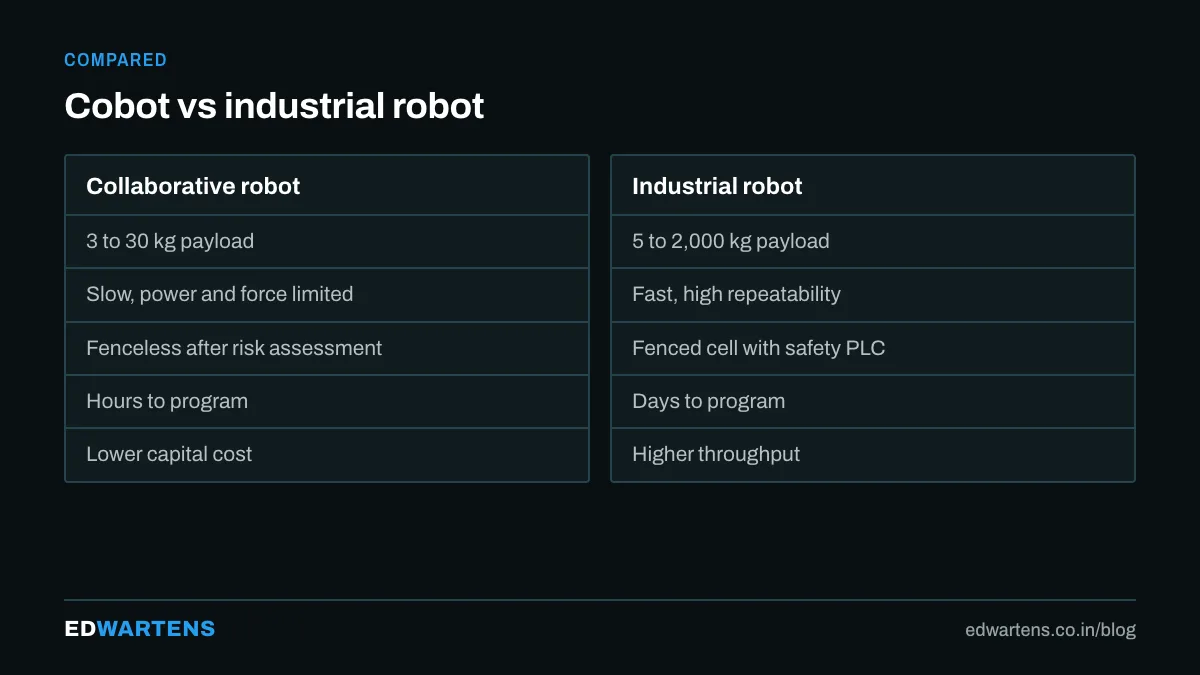
An industrial robot is a fast, strong, precise machine that must be fenced off from people because it will not stop for them. A collaborative robot (cobot) is a slower, lighter arm with force and power limiting that can, after a risk assessment, share a workspace with a person.
They are not old versus new. FANUC, ABB, KUKA and Yaskawa all sell both, and Universal Robots, which built the cobot market, sells nothing else. The right choice depends on four numbers.
The four numbers
- Payload. Cobots top out around 20 to 35 kg (UR20, FANUC CRX-25iA, Doosan H-series). Above that, or with a heavy gripper, it is an industrial robot.
- Cycle time. A cobot in collaborative mode typically runs at 250 mm/s near people. An industrial robot runs at 2,000 mm/s and more. If the takt time is seconds, not tens of seconds, the fence pays for itself.
- Reach and precision. Both families are precise (repeatability of 0.02 to 0.05 mm is common); industrial robots offer longer reach and stiffer arms for machining, welding and large parts.
- Risk of the application. Force limiting protects a person from the arm. It does not protect them from a welding torch, a knife, a sharp part or a pinch between the part and a fixture. Many "cobot" cells end up fenced anyway, and then the speed penalty is paid for nothing.
Where cobots genuinely win
- Machine tending of CNC machines and injection moulders, where the robot loads and unloads at the machine's pace and an operator works nearby.
- Packing and palletising at low rates, especially with the palletising software packages UR, Doosan and FANUC sell.
- Screwdriving, dispensing and light assembly next to people on a line.
- Redeployable tasks. A cobot on a cart moves between three machines in a week; an industrial cell does not.
- Small factories with no robot engineer. The teach-by-demonstration and app-style programming lowers the entry cost, which is why Indian SMEs buy them.
Where industrial robots stay unbeatable
- Spot and arc welding at production rates.
- Press tending, die casting, foundry.
- High-speed pick and place (delta robots at 150 picks a minute).
- Heavy payload handling, engines, panels, batteries.
- Painting and any hazardous environment.
The safety reality
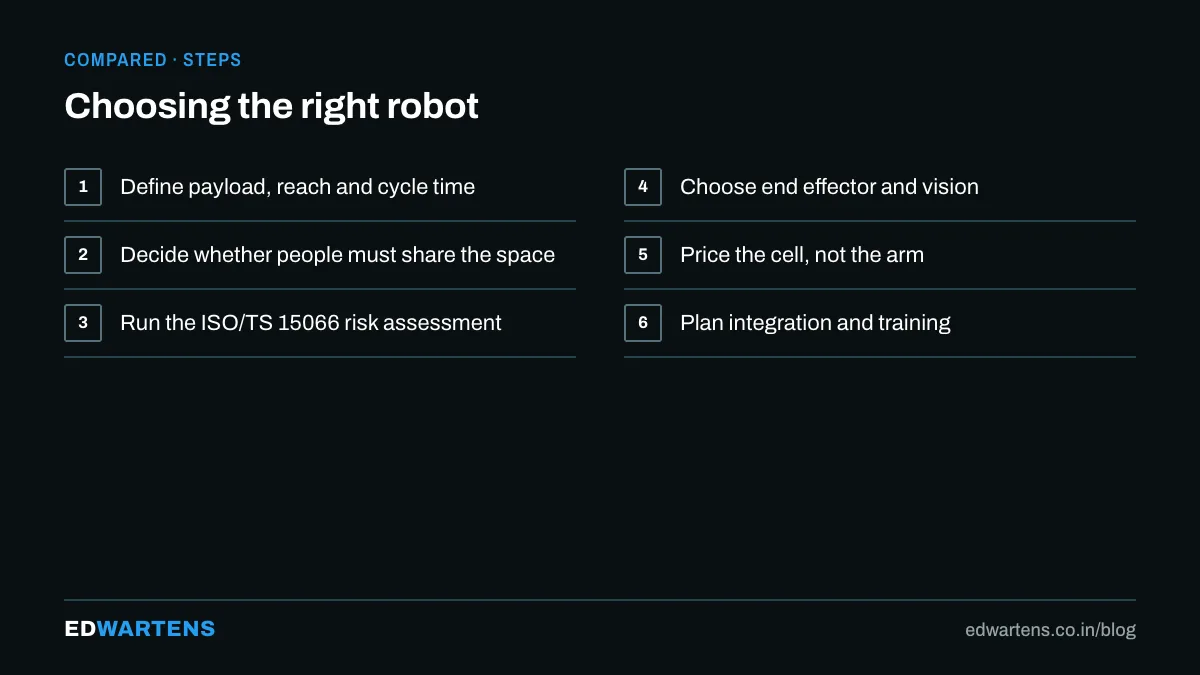
Collaborative operation is defined in ISO 10218 and the technical specification ISO/TS 15066, which gives allowable force and pressure values for body regions. Four collaborative modes exist: safety-rated monitored stop, hand guiding, speed and separation monitoring, and power and force limiting. Only the last two mean the robot keeps moving with a person close, and both need a risk assessment of the whole application, gripper and part included. Our guide to robot safety under ISO 10218 explains what the assessment involves.
Cost, honestly
A 10 kg cobot with gripper and a simple stand is a smaller number than a fenced industrial cell, mostly because the fence, safety scanner, PLC and integration are what cost money, not the arm. But a cobot cell that needs the fence anyway costs about the same as an industrial one and runs slower. Price the application, not the arm.
Programming skills
Cobots are programmed on a tablet with waypoints, functions and, on UR, URScript. Industrial robots use the vendor language on a teach pendant: FANUC TP, ABB RAPID, KUKA KRL, Yaskawa INFORM. The concepts transfer. The free courses on Universal Robots PolyScope, FANUC, ABB RobotStudio, KUKA and Yaskawa cover both worlds, and offline programming with RoboDK works with all of them.
In our Bangalore classroom you learn how a PLC commands and interlocks a robot cell; see robotics training in Bangalore. Robot programming itself is taught in our free online courses.
Frequently asked questions
Can a cobot run at full speed inside a fence? Yes, and many do. Then it is simply a small industrial robot with a gentler price.
Is a cobot safe out of the box? The arm's force limiting is certified. The application is not until it has been assessed.
Which should a fresher learn first? Either. Learn one pendant well and the second takes a week.
Learn this, free
The courses that teach this
Every lesson, the written notes and the practice are free with an account. Only the certificate is optional and paid.


