Quality management · Free · ₹0
Welding Inspection and Mechanical QA/QC with NDT Basics
What a mechanical QA/QC inspector checks on a fabrication or piping job: the welding processes, joints and welding symbols, WPS, PQR and welder qualification, weld imperfections and visual inspection with gauges, destructive tests, penetrant, magnetic particle, radiographic and ultrasonic testing, material certificates and traceability, hydrotests, and the ITPs, NCRs and reports that record it all.
Inside the course
From the lessons

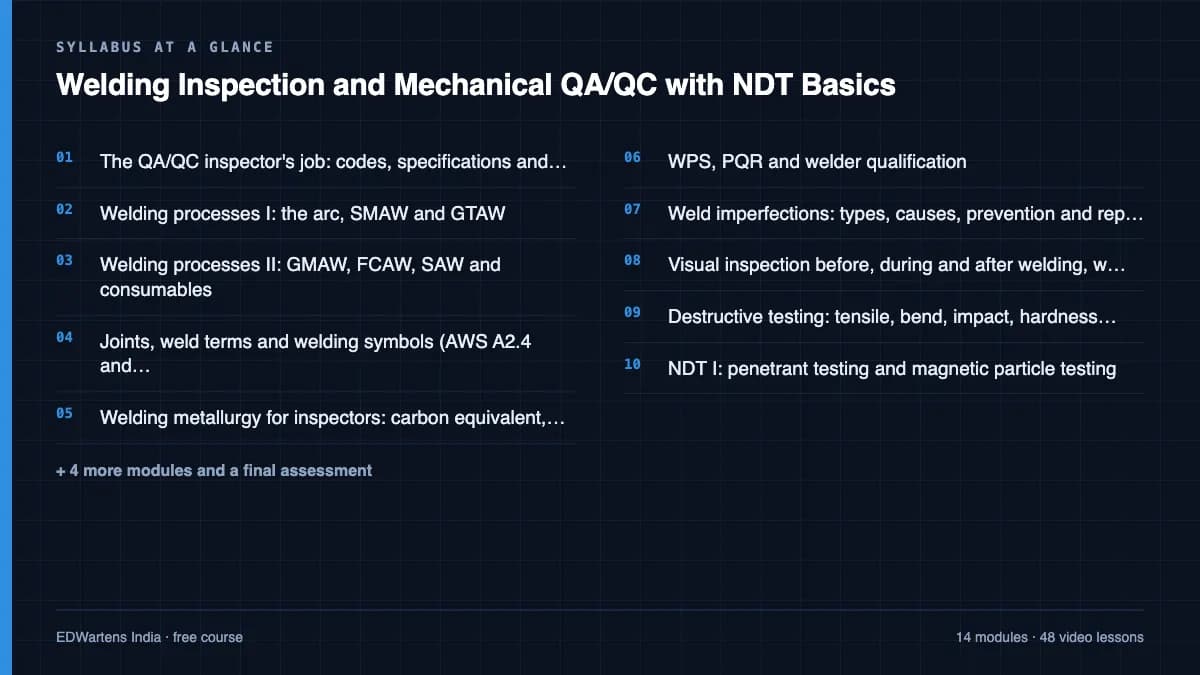
The QA/QC inspector's job: codes, specifications and the ITP
HardHat Engineer
![[English] CSWIP 3.1 Chapter 13 (Part-1): MIG/MAG WELDING & FCAW](https://i.ytimg.com/vi/Loo6pk9Dx5U/mqdefault.jpg)
Welding processes II: GMAW, FCAW, SAW and consumables
Welding and NDT
![[English] CSWIP 3.1 Chapter 17: Weldability of Steels (Part 1)](https://i.ytimg.com/vi/sfg_5042mzw/mqdefault.jpg)
Welding metallurgy for inspectors: carbon equivalent, preheat, cracking and PWHT
Welding and NDT
![[English] CSWIP 3.1 Chapter 3: Welding Imperfections and Materials Inspection](https://i.ytimg.com/vi/Kj7Yp6mTWc4/mqdefault.jpg)
Weld imperfections: types, causes, prevention and repair
Welding and NDT
![[English] CSWIP 3.1 Chapter 4: Destructive Testing](https://i.ytimg.com/vi/eECQv-1li6I/mqdefault.jpg)
Destructive testing: tensile, bend, impact, hardness and macro
Welding and NDT
![[English] Ultrasonic Test (UT) Part 1](https://i.ytimg.com/vi/ryxjFbFAsJU/mqdefault.jpg)
NDT II: radiography and ultrasonic testing
Welding and NDT
Lesson frames belong to the creators named in the Credits below and are shown from YouTube.
What you will learn
Explain what QA and QC inspectors do and read an inspection and test plan; describe how SMAW, GTAW, GMAW, FCAW and SAW work and what to check on each; calculate heat input and carbon equivalent; read welding symbols to ISO 2553 and AWS A2.4; check a WPS against its PQR and a welder's qualification against the joint; name weld imperfections, their causes and their prevention; carry out visual inspection with gauges before, during and after welding; judge destructive test results; explain how PT, MT, RT and UT each find defects and what each misses; review material certificates and keep traceability; calculate a hydrotest pressure and check a test pack; and write inspection reports and NCRs. It prepares you to study for CSWIP 3.1 and AWS CWI; it is neither of those qualifications.
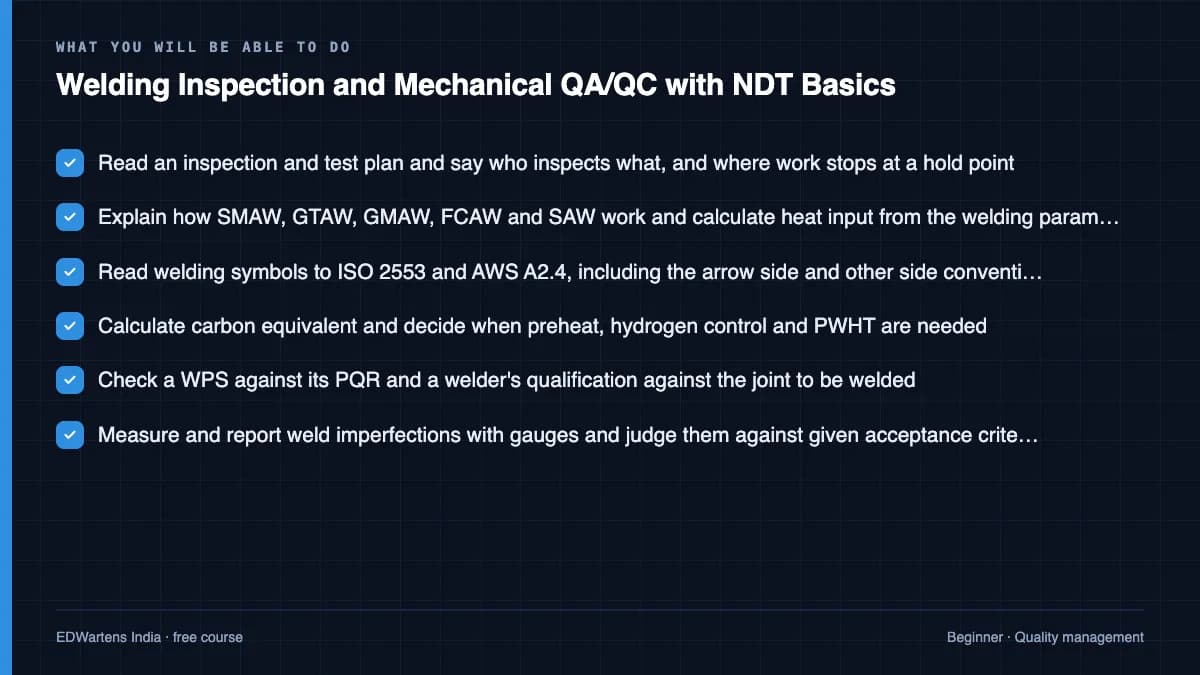
- Read an inspection and test plan and say who inspects what, and where work stops at a hold point
- Explain how SMAW, GTAW, GMAW, FCAW and SAW work and calculate heat input from the welding parameters
- Read welding symbols to ISO 2553 and AWS A2.4, including the arrow side and other side conventions
- Calculate carbon equivalent and decide when preheat, hydrogen control and PWHT are needed
- Check a WPS against its PQR and a welder's qualification against the joint to be welded
- Measure and report weld imperfections with gauges and judge them against given acceptance criteria
- Explain what PT, MT, RT and UT each find and miss, and choose the method for a joint
- Review an EN 10204 type 3.1 certificate, calculate a hydrotest pressure, and write the report and NCR
The course project · about 10 hours
QC inspection of a process pipe spool package: ITP, welder and material review, weld log, visual report, NCR and hydrotest
Act as the fabricator's QC inspector on a package of carbon steel process pipe spools built to ASME B31.3: write the inspection and test plan, check the WPS and welder qualifications, review the material certificates, inspect and report welds with gauges, keep the weld log and select the radiography sample, raise and close an NCR, and calculate and release the hydrostatic test.
Sample document pack, 5 documents, filled in for the scenario
- PlanInspection and test plan: line 1203 pipe spools
- RegisterWeld log extract and radiography selection: line 1203
- Test reportVisual inspection report: spool 1203-SP-06 after PWHT
- ReportNonconformance report NCR-007: undercut on 1203-SP-06-W3 after PWHT
- Test reportHydrostatic test report and pre-test release: test pack TP-1203-01
Read inside the course and download as a workbook. The project is optional practice, marked when you submit it; the certificate needs only the modules and the final assessment.
Course content
15 modules · 49 lessons · 14h 56m
In order, at whatever pace suits you. Each module ends with a practice task that builds on the last.
- 01The QA/QC inspector's job: codes, specifications and the ITP3 lessons28m
- 02Welding processes I: the arc, SMAW and GTAW4 lessons1h 5m
- 03Welding processes II: GMAW, FCAW, SAW and consumables4 lessons1h 24m
- 04Joints, weld terms and welding symbols (AWS A2.4 and ISO 2553)2 lessons45m
- 05Welding metallurgy for inspectors: carbon equivalent, preheat, cracking and PWHT5 lessons1h 51m
- 06WPS, PQR and welder qualification4 lessons1h 33m
- 07Weld imperfections: types, causes, prevention and repair3 lessons1h 31m
- 08Visual inspection before, during and after welding, with gauges4 lessons1h 4m
Requirements
- Who it is for
- Beginner to intermediate. For mechanical engineering graduates and diploma holders, welders and fitters moving into inspection, and QA/QC engineers new to welding. No inspection experience is needed; school physics and arithmetic are enough.
- Software
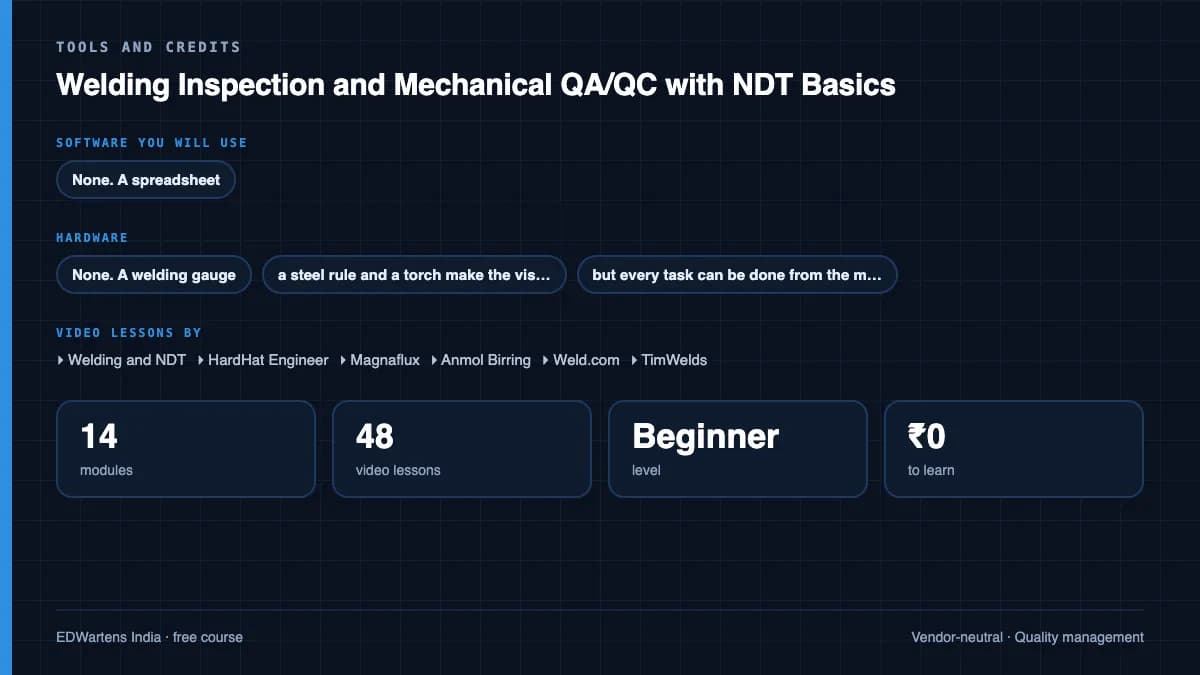
- None. A spreadsheet (LibreOffice Calc is free) helps with the weld log and the heat input, carbon equivalent and test pressure calculations. What to download, and how
- Hardware
- None. A welding gauge, a steel rule and a torch make the visual inspection practice more real if you have them, but every task can be done from the measurements and drawings in the notes.
Software you need
What to download, where from, what it costs and how to install it. Every link goes to the maker's own site, never a mirror.
Nothing to install
A spreadsheet is enough for the weld log and the heat input, carbon equivalent and test pressure calculations, and any document editor for the ITP, the reports and the NCR.
Optional
Useful, not needed to finish the course.
- 01Free
LibreOffice
The Document Foundation
- Runs on
- Windows 10 or 11, macOS 11 or newer (Intel or Apple silicon), Linux
- Account
- None needed
- Size
- up to 1.5 GB of disk space on Windows
LibreOffice is free, open-source software under the Mozilla Public License 2.0, for any use including business. Calc is its spreadsheet.
Steps
- 1.Open the LibreOffice download page.
- 2.Check the page has picked your operating system, then select Download.
- 3.Run the installer (administrator rights are needed on Windows).
- 4.Start LibreOffice Calc for spreadsheet work.
- 5.Save as .xlsx if you need to share files with Excel users.
- Choose the latest main version unless your organisation asks for the older, more conservative release.
Official download pagelibreoffice.org
Checked against each maker's own page on 27 September 2026. Trial lengths and editions change; the maker's page is the final word.
Welding Inspection and Mechanical QA/QC with NDT Basics at a glance
Welding Inspection and Mechanical QA/QC with NDT Basics is a free, self-paced online course from EDWartens for mechanical graduates and diploma holders, welders and fitters moving into QC inspection, and QA/QC engineers new to welding, on fabrication, piping, pressure equipment and oil and gas projects in the Gulf and worldwide. It has 15 modules and 14h 56m of video lessons by Welding and NDT, HardHat Engineer, Magnaflux and others, with written notes and worked problems, a practical project with a document pack and a 15-question final assessment (pass mark 60%). Learning is free with an account; an optional certificate with a public verification code is issued when you pass. Last updated 27 September 2026.
All course factsHide course facts
- Price
- ₹0, free for good. No trial, no card. Comparable classroom training of this length costs about ₹7,999.
- Who it is for
- Mechanical graduates and diploma holders, welders and fitters moving into QC inspection, and QA/QC engineers new to welding, on fabrication, piping, pressure equipment and oil and gas projects in the Gulf and worldwide
- Format
- 15 self-paced modules, 14h 56m of video, written notes, a practice task per module and one final assessment.
- Level
- Beginner. Beginner to intermediate. For mechanical engineering graduates and diploma holders, welders and fitters moving into inspection, and QA/QC engineers new to welding. No inspection experience is needed; school physics and arithmetic are enough.
- Brand
- Vendor-neutral
- Software
- None. A spreadsheet (LibreOffice Calc is free) helps with the weld log and the heat input, carbon equivalent and test pressure calculations.
- Hardware
- None. A welding gauge, a steel rule and a torch make the visual inspection practice more real if you have them, but every task can be done from the measurements and drawings in the notes.
- Certificate
- Optional EDWartens Certificate of Completion, verifiable by code. Not a vendor credential.
- Video lessons by
- Welding and NDT, HardHat Engineer, Magnaflux, Anmol Birring, Weld.com, TimWelds, Hardhat Learning, GAL Gage, I4I Academy, QualityEngineers Guide, Welding inspection & NDT, Welding /NDT Inspection (independent creators, credited below)
- Language
- English
- Last updated
- 27 September 2026
A shareable EDWartens certificate
Finish every module and pass the final assessment, and the optional EDWartens certificate is yours. It carries a unique verification code on a public page anyone can check, so it stands up when a recruiter looks it up. See it below.
The course itself stays free whether or not you ever buy one.
Stuck? Ask a practising engineer
A free course usually means a comment section and hope. This one does not. Every module has an Ask-your-trainer panel that reaches the same engineers who teach our paid programme: people who commission panels for a living, not moderators.
Pairs well with
 PLC programming · FreeSiemens TIA PortalFrom zero electrical knowledge to a working, simulated S7-1200 program, for nothing.
 PLC programming · FreeSiemens TIA Portal in Three HoursThe first three hours of the Siemens TIA Portal course, cut to end on a win: what a PLC is, how it is wired, a project configured in TIA Portal, and your first ladder program running in simulation. Finish it in an evening or two, earn a certificate, and carry straight on into the full course.
 PLC programming · FreeTIA Portal: Build a MachineOne machine, start to finish. Take a bottle filling line from a written specification and an I/O list to a structured S7-1200 program with a fill station, a capper, a reject sorter and an operator screen with alarms, then test it against a written record and archive it for hand-over. The lessons are the reference; the machine is yours, and it is what you submit.
 Instrumentation · FreeInstrumentation for PLC EngineersThe half of the loop that is not code. Follow one measurement from the transmitter in the field, down the 4-20 mA loop, into the analog card, through NORM_X and SCALE_X into engineering units, out again to a valve, and back to the control room when the reading is wrong.
More free courses: Free Six Sigma and quality courses
Learner reviews
No reviews yet
Reviews here are written only by learners who have finished every module of Welding Inspection and Mechanical QA/QC with NDT Basics, and they are published exactly as written. Finish the course and yours will be the first.
Common questions
Who is this welding inspection course for?
Mechanical engineering graduates and diploma holders, welders and fitters moving into inspection, and QA/QC engineers new to welding, on fabrication, piping, pressure equipment, structural steel and oil and gas projects anywhere. No inspection experience is needed; school physics and arithmetic are enough.
Is the course free to learn?
Yes. Every module, the notes, the worked problems, the project and the final assessment are free, and the only software you might use is a free spreadsheet. The certificate is optional.
Does it prepare me for CSWIP 3.1 or AWS CWI?
It covers the knowledge both exams test, and module 14 sets out their formats as published at the time of writing, so you can study for either with a plan. It is not CSWIP 3.1 or AWS CWI and does not award either: CSWIP is awarded by TWI Certification and the CWI by the American Welding Society, each after its own exams, eyesight test and documented experience. Check cswip.com and aws.org for the current rules before you book.
Will it make me a qualified NDT technician?
No. It teaches how penetrant, magnetic particle, radiographic and ultrasonic testing work, what each finds and misses, and how to read their reports. Carrying out NDT and signing results needs practical training, an examination and certification under ISO 9712 or an employer's scheme to ASNT SNT-TC-1A, and radiography also needs radiation safety authorisation under local law.
Which codes and standards does it use?
It names them by family and teaches their structure in its own words: ISO 15614 and ISO 9606 with ASME Section IX for procedure and welder qualification, ISO 5817 and ISO 6520 for imperfections, ISO 2553 with AWS A2.4 for symbols, EN 10204 for material certificates, ISO 9712 with ASNT SNT-TC-1A for NDT personnel, and ASME B31.3, AWS D1.1 and API 1104 as the piping, structural and pipeline codes. Acceptance values in the problems are given as project data. On real work the code and edition in your contract govern, and a competent person decides.
Does it help with QC inspector jobs in the Gulf?
Gulf oil and gas and fabrication adverts usually ask for CSWIP 3.1 or AWS CWI, NDT Level II and, on Saudi Aramco work, the client's own approval. This course covers the knowledge behind those and the documents you will handle there: the ITP, weld log, NCR and hydrotest pack. Client approval is granted only by the client after its own review and test.
How long does the Welding Inspection and Mechanical QA/QC with NDT Basics course take?
About 20 hours of video, notes and practice at your own pace, of which about 15 hours is video. The optional project takes about 10 hours more.
What certificate does the Welding Inspection and Mechanical QA/QC with NDT Basics course give?
An EDWartens certificate of completion, issued when you finish the modules and pass the 15-question final at 60 percent, with a number anyone can verify on our site. It is not a CSWIP, AWS CWI, ASNT, PCN or ISO 9712 certificate or a client approval, and EDWartens is not affiliated with TWI, the American Welding Society or ASNT.
What is the project in the Welding Inspection and Mechanical QA/QC with NDT Basics course?
You act as the fabricator's QC inspector on carbon steel process pipe spools built to ASME B31.3 in a shop near Rotterdam: the ITP, the WPS and welder review, a material certificate check, a visual inspection report, the weld log with its radiography sample, an NCR from statement to closure, and the hydrotest calculation and release. A fully worked pack for one line shows you the standard expected.
Is the Welding Inspection and Mechanical QA/QC with NDT Basics course free in India, and what does the certificate cost?
Yes. Learning costs ₹0 in India: every module, the written notes, the practice tasks and the final assessment, with no card and no trial period. The only paid item is the optional EDWartens Certificate of Completion, ₹459 including GST for this beginner course, paid in rupees through Razorpay, and only if you want it after passing the final assessment.
What you walk away with
Your certificate for Welding Inspection and Mechanical QA/QC with NDT Basics
Finish the course, pass the final, and this is the document with your name on it.
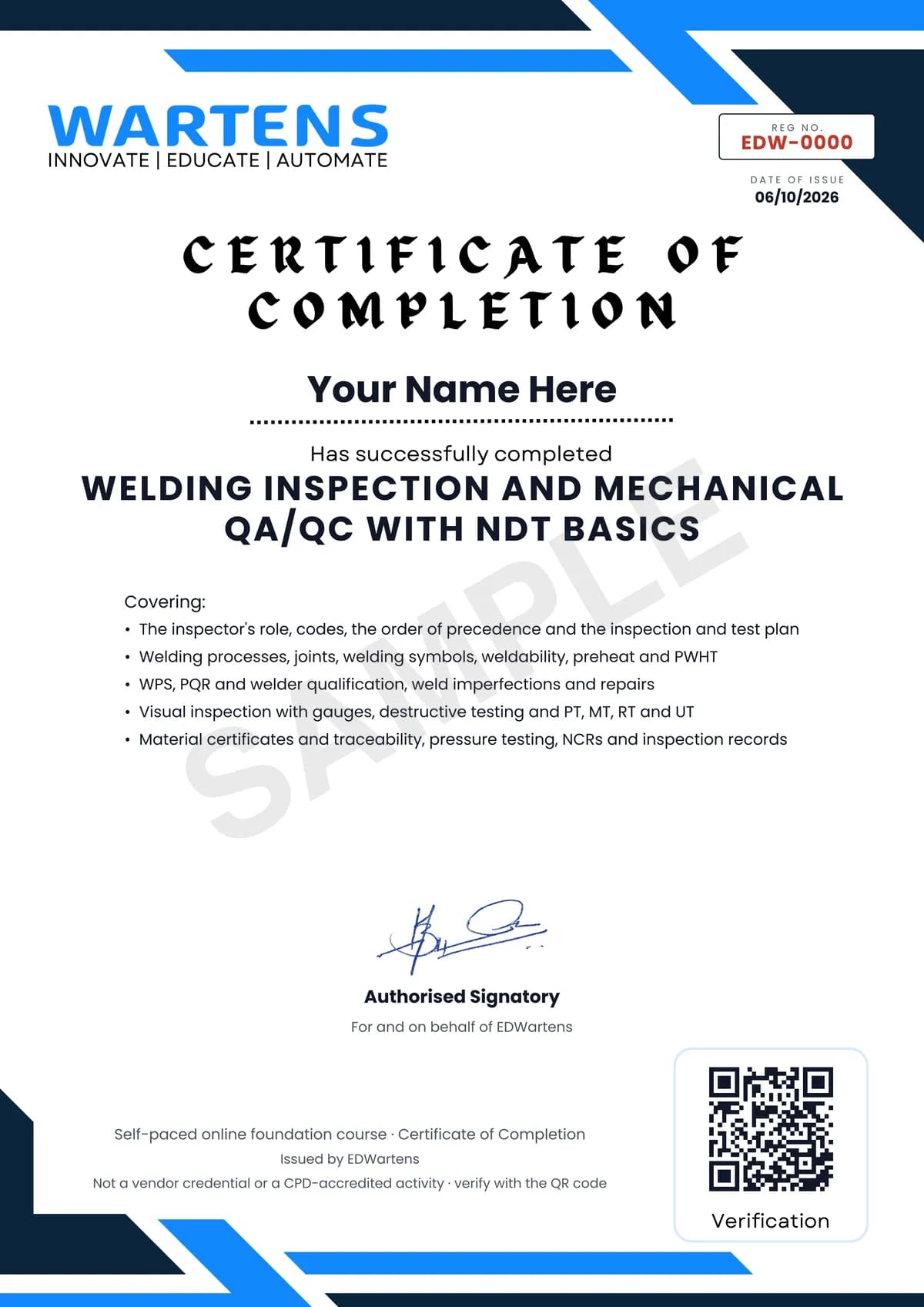
Verifiable by anyone
Adds to LinkedIn in one click
QR code on the certificate
Names what you can do
A permanent link
Earned, not attended
Learning is free. The certificate is optional.
Add it now and pay only when you have finished the course, or come back for it later. One-off, US$23.99, with a receipt.
Issued by EDWartens India (Wartens Automation Private Limited) as a Certificate of Completion for this self-paced course. It is not a vendor certification, a university award or a CPD-accredited activity, and it does not certify competence on live equipment. Delivered electronically; see the refund policy.
Credits
Who made the video lessons
The video lessons in this course were created by the people below, not by EDWartens. Every lesson streams from its creator's own YouTube channel; EDWartens neither hosts nor sells that footage, and the creators are not affiliated with EDWartens and do not endorse this course. What EDWartens wrote is the study plan, the notes, the practice tasks and the assessments.
- Welding and NDTthe English CSWIP 3.1 lecture series: codes and standards, welding processes (SMAW, TIG, MIG/MAG and FCAW, SAW), consumables, welding symbols, weldability of steels, preheat, heat treatment, WPS and welder qualification, weld imperfections, repairs, the inspector's duties, gauges, destructive testing, ultrasonic testing, materials inspection and the exam pattern
- HardHat Engineerthe inspection and test plan, the order of precedence of technical documents, inward material inspection, EN 10204 certificate types, reviewing material test certificates and material traceability
- Magnafluxthe webinars on liquid penetrant fundamentals and the magnetic particle yoke, and the short demonstrations of visible dye penetrant and magnetic particle inspection
- Anmol Birringangle beam ultrasonic testing of welds, radiographic sensitivity and IQIs, and single wall and double wall radiographic techniques
- Weld.comreading welding symbols, and porosity, arc strikes and undercut
- TimWeldsMIG, TIG, stick and flux core welding compared
- Hardhat Learningwriting a WPS and PQR to ASME Section IX
- GAL Gagethe Hi-Lo welding gauge for internal misalignment
- I4I Academyhydrostatic and pneumatic test pressure calculation for ASME B31.3 process piping
- QualityEngineers Guidewriting a nonconformance report and closing it
- Welding inspection & NDTreviewing a welder qualification to ASME Section IX
- Welding /NDT Inspectionthe basic hydrotest requirements for pipelines, piping and equipment
If you are one of these creators and would like a lesson removed or credited differently, write to info@wartens.com.