Condition monitoring · Free online course
Vibration Analysis Training
Condition monitoring for rotating machines, worked the way a route is actually walked: units and running speed, analyser setup and averaging, then reading the spectrum, the time waveform, the orbit and the shaft centreline, and separating unbalance, misalignment, looseness, resonance, bearing faults and sidebands. It ends where the job ends, with ISO 10816 limits, ISO 1940 balance grades, a field balance and a findings note.
- 14 modules
- 11h 6m of video
- Intermediate
- English
- ₹0, free

₹0Free for good
Worth ₹6,999 by length and depth against classroom training. It has always been free; that is not a former price.
No card. Checkout takes a minute and gives you a receipt.
Overview
About Vibration Analysis Training
Learn to read vibration spectra and waveforms, tell common machine faults apart and write findings a plant manager can act on.
Vibration Analysis Training is a free, self-paced online course from EDWartens for maintenance and reliability engineers and technicians. It has 14 modules and 11h 6m of video lessons by Mobius Institute, Mega Technical Hub, ADASH and others, with written notes and worked problems, a practical project with a document pack and a 15-question final assessment (pass mark 60%). Learning is free with an account; an optional certificate with a public verification code is issued when you pass. Last updated 27 September 2026.
Who it is for: Maintenance and reliability engineers and technicians
This course includes
- 11h 6m of video lessons
- 14 modules with written notes and diagrams
- One final assessment: 15 questions, pass mark 60%
- Ask-an-engineer support from practising engineers
- Lifetime access, the course does not expire
- Optional verifiable certificate when you finish
- Step 1 of 3
Learn the 14 modules
11h 6m of video lessons, written notes and a practice task per module, at your own pace.
- Step 2 of 3
Pass the final assessment
15 questions drawn from every module, pass mark 60%, 3 attempts.
- Step 3 of 3
Take the certificate, if you want it
Optional, paid once, only if you choose it. The course stays free either way.
See the certificate and its price
A look inside


From the lessons

Condition monitoring and the case for vibration
by Mega Technical Hub

From time waveform to spectrum
by Turbo mass

Routes, baselines and trending
by ADASH

Unbalance
by Mega Technical Hub
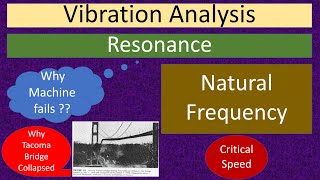
Resonance, natural frequency and critical speed
by Mega Technical Hub

Modulation and sidebands
by Turbo mass
Lesson frames belong to the creators named in the Credits and are shown from YouTube.
What you learn
What you will be able to do
By the end you will be able to:
- Set Fmax, lines of resolution and averages for a machine
- Name each spectrum peak as 1x, a harmonic or non-synchronous
- Separate unbalance, misalignment, looseness and resonance
- Place a bearing fault on the four failure stages
- Run a single plane trial weight balance
How it works
How this course works
Watch the lessons
Short video lessons, one module at a time, at your own pace.
Read the notes
Open the Reading tab for the written notes and diagrams of the module.
Check yourself
Answer the questions to see what stuck before you move on.
Final assessment
Pass the final once you have been through the modules.
Certificate, if you want oneOptional
Optional, with a page anyone can use to verify it.
Syllabus
Course content, module by module
In order, at whatever pace suits you. Each module ends with a practice task that builds on the last.
- Modules
- 14
- Video lessons
- 33
- Of video
- 11h 6m
- Final questions
- 15
- 01
Condition monitoring and the case for vibration
3 lessons · 35m - 02
Vibration fundamentals: motion, frequency and amplitude
3 lessons · 47m - 03
From time waveform to spectrum
3 lessons · 50m - 04
Taking the measurement: sensor, mounting and technique
4 lessons · 1h 37m - 05
Routes, baselines and trending
2 lessons · 19m - 06
Reading the displays: spectrum and time waveform
2 lessons · 50m - 07
Unbalance
2 lessons · 33m - 08
Misalignment, looseness and phase
2 lessons · 32m Final assessment · 15 questions, pass mark 60%
Project
The course project
Optional practice that ends in the kind of job the course prepares you for, with the documents that go with it.
About 14 hours
Twenty critical machines: criticality ranking, vibration route and first survey at a cement plant
Design the vibration-monitoring programme for the twenty most critical rotating machines of a cement plant. Rank the assets with a scoring you can defend. Build the route with measurement points, directions, mountings and ISO 10816 alarm limits. Write the FMEA that says which fault each measurement is looking for. Then diagnose the first survey from the numbers in the spectra. You deliver your own criticality register, route, procedure and survey report. The sample pack shows what a condition-monitoring contractor hands over.
- 8documents in the pack
- 9steps to follow
- 6things to hand in
- 14 hof work, at your pace
Sample document pack, 8 documents, filled in for the scenario
- PlanCondition Monitoring Programme Plan: Rotating Machinery, Westfield Cement Works
- RegisterAsset Criticality Register: Rotating Machines on the Programme
- RegisterVibration Route Register: Measurement Points and Alarm Limits
- FMEAFMEA: Failure Modes Detectable by the Vibration Route, by Machine Class
- ProcedureProcedure: Route Data Collection with the Adash A4400 VA4 Pro
- ReportFirst Survey Report: Baseline Readings and Findings, May 2026
- Calibration recordSensor and Collector Verification Record: Accelerometers AC150-1A on Portable Shaker
- Training recordTraining Record: Route Technicians and Planner
Read inside the course and download as a workbook. The project is optional practice, marked when you submit it; the certificate needs only the modules and the final assessment.
Tools
Software, hardware and lessons
Software
None required. Any spectrum plot from your own plant reports is enough for the practice tasks.
Hardware
None. An accelerometer, tachometer and data collector are discussed and are not needed to finish the course.
Who it is for
Intermediate. Suits maintenance and plant technicians who already do rounds, and mechanical, electrical and instrumentation graduates. No prior vibration training is needed, but you should be comfortable with RPM, Hz and a machine layout.
Video lessons by
- Mobius Institute
- Mega Technical Hub
- ADASH
- Turbo mass
Independent creators, credited in full under Credits.
Software you need
Nothing to install
Any spectrum plot from your own plant reports is enough for the practice tasks.
What you walk away with
Your certificate for Vibration Analysis Training
Finish the course, pass the final, and this is the document with your name on it.
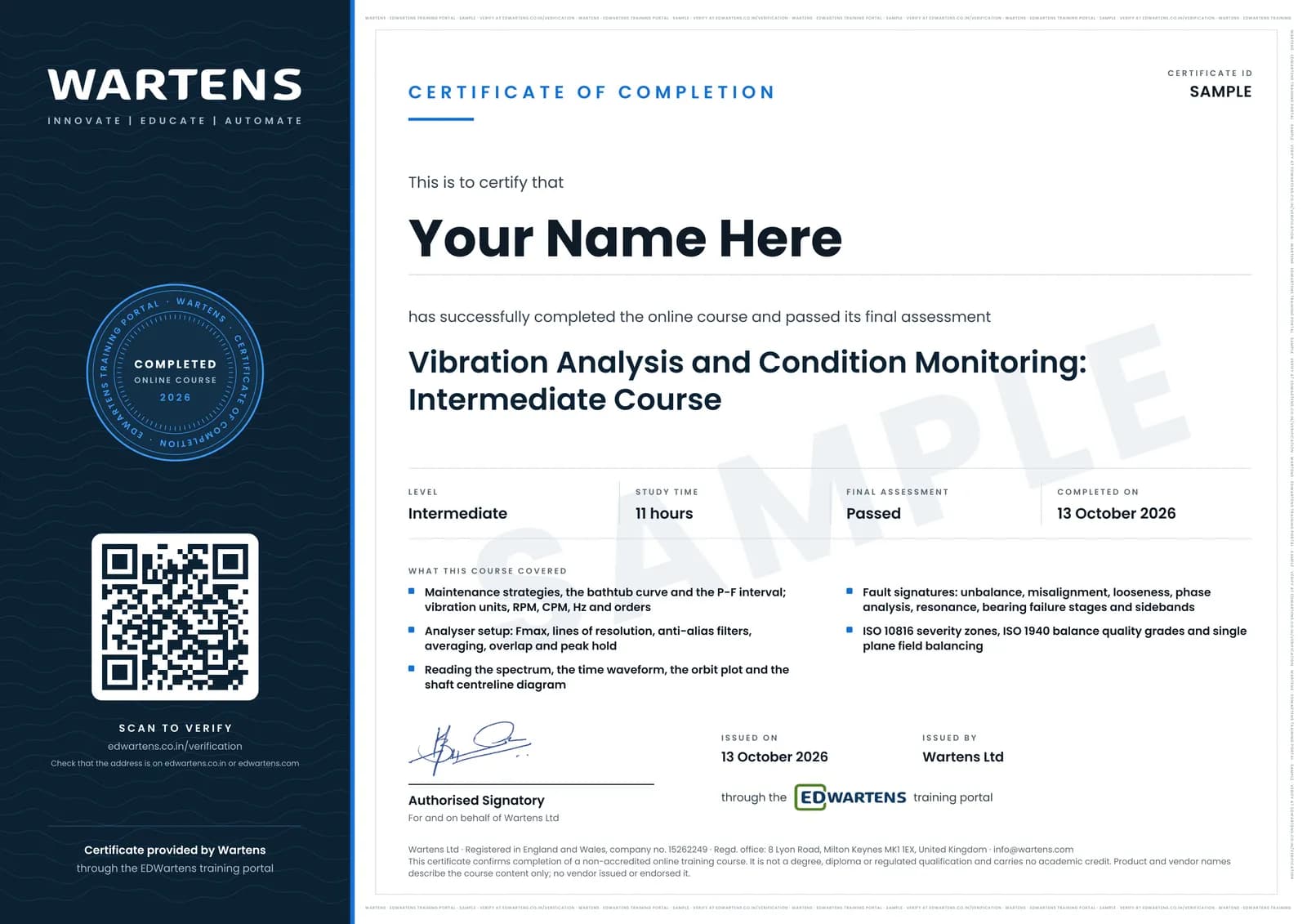
Verifiable by anyone
Adds to LinkedIn in one click
QR code on the certificate
Names what you can do
A permanent link
Earned, not attended
Learning is free. The certificate is optional.
Add it now and pay only when you have finished the course, or come back for it later. One-off, US$28.99, with a receipt.
Issued by Wartens Ltd (England and Wales, company no. 15262249) through the EDWartens training portal, as a Certificate of Completion for this self-paced course. Sold in India by Wartens Automation Private Limited. It is not a vendor certification, a university award or a CPD-accredited activity, and it does not certify competence on live equipment. Delivered electronically; see the refund policy.
Why learn with EDWartens
What you get with this course.
- Free from the first lesson to the final assessment.
- Video lessons with written notes and a project.
- An optional certificate that anyone can verify online.
FAQ
Common questions
Who is the Vibration Analysis Training course for?
Maintenance and plant technicians who already take readings but cannot yet read a spectrum, and mechanical, electrical and instrumentation graduates heading for a condition monitoring cell in cement, steel, power, refinery, paper, sugar or textile plants.
Do I need an analyser, a sensor or any software?
No. Nothing is bought and nothing is installed. The practice tasks are done on paper and on spectra you can get from your own plant reports or from printed examples, so the course works whether or not you have access to a data collector.
Is this the same as ISO 18436-2 Category I or II certification?
No, and it is never described as one. ISO 18436-2 categories are awarded by certification bodies after their own examination and a logged period of field experience. This course is preparation: it covers much of the same ground so that a body's syllabus and a real route make sense, and you still sit their examination separately.
Is the Vibration Analysis Training course really free?
Yes. Every module, practice task, practice question and the final assessment. You create an account so your progress is saved and the papers can be marked. The certificate is the only paid item, and only if you want it.
What certificate does the Vibration Analysis Training course give?
An EDWartens Certificate of Completion, issued when you have finished every module and passed the final at 60 percent, with a verification code anyone can check. It is not a vendor credential and not an accreditation, and it is never described as either.
Who made the video lessons in the Vibration Analysis Training course?
Mobius Institute, Mega Technical Hub and ADASH, on their own YouTube channels, and they are credited at the foot of the course page. EDWartens did not make the videos and the creators are not affiliated with EDWartens. What EDWartens wrote is the study plan, the module notes, the practice tasks and the assessments.
How much maths does it need?
School arithmetic. You divide RPM by 60 for Hz, divide Fmax by lines for resolution, and multiply a balance grade by a rotor mass. Bearing fault frequencies are looked up or calculated for you.
Can I do it if I have never worked in a plant?
Yes, though it is written for someone who can walk up to a machine. If you cannot, use the printed spectra and job cards in the practice tasks; the diagnosis work is the same, and the reasoning is what an interview asks about.
Is the Vibration Analysis Training course free in India, and what does the certificate cost?
Yes. Learning costs ₹0 in India: every module, the written notes, the practice tasks and the final assessment, with no card and no trial period. The only paid item is the optional EDWartens Certificate of Completion, ₹599 including GST for this intermediate course, paid in rupees through Razorpay, and only if you want it after passing the final assessment.
All course factsHide course facts
- Price
- ₹0, free for good. No trial, no card. Comparable classroom training of this length costs about ₹6,999.
- Who it is for
- Maintenance and reliability engineers and technicians
- Format
- 14 self-paced modules, 11h 6m of video, written notes, a practice task per module and one final assessment.
- Level
- Intermediate. Intermediate. Suits maintenance and plant technicians who already do rounds, and mechanical, electrical and instrumentation graduates. No prior vibration training is needed, but you should be comfortable with RPM, Hz and a machine layout.
- Brand
- Vendor-neutral
- Software
- None required. Any spectrum plot from your own plant reports is enough for the practice tasks.
- Hardware
- None. An accelerometer, tachometer and data collector are discussed and are not needed to finish the course.
- Certificate
- Optional EDWartens Certificate of Completion, ₹599 inclusive of GST for learners in India, verifiable by code. Not a vendor credential.
- Video lessons by
- Mobius Institute, Mega Technical Hub, ADASH, Turbo mass (independent creators, credited below)
- Language
- English
- Last updated
- 27 September 2026
Pairs well with
 PLC programming · FreeSiemens TIA Portal
 PLC programming · FreeSiemens TIA Portal in Three Hours
 PLC programming · FreeTIA Portal: Build a Machine
 Instrumentation · FreeInstrumentation for PLC Engineers
More free courses: Free maintenance and reliability courses
Classroom course, Bangalore
PLC training in Bangalore
The Automation Engineer Program (AEP) is our classroom course in PLC programming and industrial automation, taught in person at our Electronic City centre.
Credits
Who made the video lessons
The video lessons in this course were created by the people below, not by EDWartens. Every lesson streams from its creator's own YouTube channel; EDWartens neither hosts nor sells that footage, and the creators are not affiliated with EDWartens and do not endorse this course. What EDWartens wrote is the study plan, the notes, the practice tasks and the assessments.
- Mobius Institutethe animated introduction and its Q&A, analyser settings, resolution and filters, the averaging clips, time waveform analysis, orbit and centreline plots, modulation, and the rolling element bearing failure stages
- Mega Technical Hubmaintenance strategies and the P-F curve, vibration fundamentals and amplitude units, spectrum reading, unbalance types, misalignment, phase analysis, resonance and the bump test, ISO 10816 limits and ISO 1940 balance grades
- ADASHthe Secrets of imbalance series on heavy spot, phase and the rules that make a balance hold, together with the on-site balancing guide
- Turbo mass7 lessons in "From time waveform to spectrum", "Taking the measurement: sensor, mounting and technique", "Reading the displays: spectrum and time waveform", "Rolling element bearing faults" and "Modulation and sidebands"
If you are one of these creators and would like a lesson removed or credited differently, write to info@wartens.com.