DCS Interview Questions and Answers: Engineer and Operator

The short answer
DCS interview questions fall into three groups. Basic questions test whether you know what a distributed control system is and how it differs from a PLC or SCADA. Engineer questions go into controllers, I/O, redundancy, function blocks, PID modes, cascade control, alarm management to ISA-18.2 and the line between a DCS interlock and a safety instrumented system. Operator questions test how you run a plant from the console: reading PV, SP and OP, changing modes, handling alarms and responding to an upset. Learn one vendor's terms properly, Yokogawa CENTUM VP, Emerson DeltaV, Honeywell Experion PKS, ABB 800xA or Siemens PCS 7, and map the others onto it.
Watch: what a distributed control system is
The video above is What is a Distributed Control System? by ABB Control Systems, embedded with thanks. EDWartens is not affiliated with the creator. It runs about 4 minutes and gives a vendor's plain-language view of what a DCS is and why process plants use one. It is also a lesson in our free ABB Ability System 800xA DCS course. Watch it before the questions below, which go well past the overview into what interviewers actually probe.
How DCS interviews are usually structured
Most DCS interviews in India follow the same pattern whether the employer is a refinery, fertiliser plant, power station, pharma site or a system integrator in Bangalore, Pune or Vadodara. A technical round opens with definitions, then moves to the vendor platform named in the job description, then to a loop or alarm scenario. Operator interviews spend less time on configuration and more on what you would do when a pump trips or a level runs away.
Two habits help in every round. First, answer with the vendor's own words when you know them, then translate: "on CENTUM that is the FCS, the controller". Second, when you do not know a platform, say so and map it to one you know. Interviewers forgive a missing term far more readily than a confident wrong one.
DCS terminology across the five big vendors
Every vendor names the same building blocks differently. This table is the single most useful thing to revise before an interview, because questions like "what is an HIS?" or "what is a control module?" are vendor vocabulary checks.
Building block | Yokogawa CENTUM VP | Emerson DeltaV | Honeywell Experion PKS | ABB 800xA | Siemens PCS 7 |
|---|---|---|---|---|---|
Controller | FCS (Field Control Station) | M-series, S-series, PK controllers | C300 controller | AC 800M | Automation system (AS) |
Operator station | HIS (Human Interface Station) | DeltaV Operate or DeltaV Live | Experion Station | Operator workplace | OS (operator station) |
Engineering tool | Automation Design Suite | DeltaV Explorer, Control Studio | Control Builder | Control Builder | SIMATIC Manager with CFC and SFC |
Control network | Vnet/IP | Area control network | Fault Tolerant Ethernet | Control network with RNRP | Plant bus |
Unit of control logic | Function blocks in control drawings | Control modules | Control modules (CM, SCM) | Control modules and function blocks | CFC charts with library blocks |
Safety system | ProSafe-RS | DeltaV SIS | Safety Manager | AC 800M High Integrity | Safety Integrated (F-systems) |
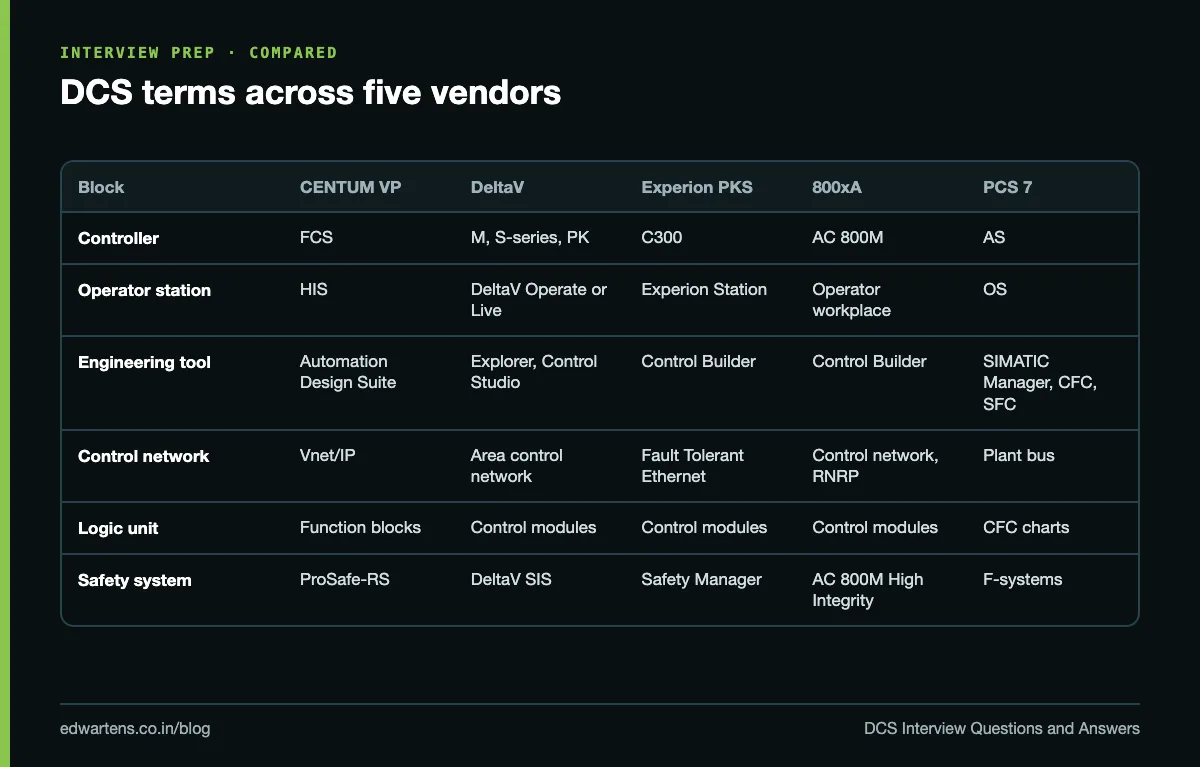
Names shift between releases, so check the manual for the version you will work on. The sources behind this table are Yokogawa's CENTUM VP brochure, Honeywell's C300 controller page, ABB's Compact Control Builder AC 800M product guide, Emerson's DeltaV DCS page and Siemens' SIMATIC PCS 7 page. For a deeper comparison of the three most common platforms, read DeltaV vs Experion vs CENTUM: choosing a DCS.
Basic DCS interview questions for freshers
What is a DCS?
A distributed control system is a plant-wide control system in which control is spread across several redundant controllers, each running part of the process, all tied to shared operator stations, engineering tools and a historian over a redundant network. It is built for continuous and batch processes with hundreds to thousands of analog loops.
How is a DCS different from a PLC?
A PLC is a fast, general-purpose controller usually engineered machine by machine, with HMI and SCADA added separately. A DCS ships controllers, operator graphics, alarms, history and one engineering database as one system, so a tag configured once appears everywhere. The full comparison is in PLC vs DCS: understanding the key differences.
How is a DCS different from SCADA?
SCADA supervises geographically spread assets, such as pipelines, water networks and substations, through RTUs or PLCs over slower links, with control largely local at each site. A DCS controls one plant with continuous closed-loop control as its main job. See SCADA vs DCS: the difference explained.
What do PV, SP and OP mean?
PV is the process variable, the measured value, such as flow from a transmitter. SP is the setpoint, the value you want. OP (or MV, the manipulated variable) is the controller output, usually a valve position in percent.
What signals does DCS I/O handle?
Analog inputs (4 to 20 mA, often with HART), analog outputs to valve positioners, digital inputs from switches and motor feedback, digital outputs to solenoids and motor starters, plus fieldbus such as FOUNDATION Fieldbus or PROFIBUS PA on many sites.
Why is 4 to 20 mA used instead of 0 to 20 mA?
The 4 mA live zero lets the system tell a genuine zero reading from a broken wire or dead transmitter. Many systems follow the NAMUR NE 43 convention, which treats a signal below about 3.6 mA or above about 21 mA as a failure.
DCS engineer interview questions: controllers, I/O and redundancy
What is redundancy in a DCS and what is made redundant?
Redundancy means a standby component takes over without upsetting the process when the active one fails. Yokogawa states that the CENTUM FCS processor module, power supply, I/O modules and I/O networks are all dual redundant, and that failed modules can be replaced online. Honeywell describes its C300 as supporting 1:1 redundancy. ABB's 5.1.1 product guide lists AC 800M CPU redundancy on the PM861, PM864, PM866 and PM891 processor units. Operator stations and servers are normally duplicated too.
What is "pair and spare"?
It is Yokogawa's CENTUM processor design. Each processor module has two main processing units running the same computation, with their outputs compared continuously. If they disagree, control switches bumplessly to the standby processor module, which has its own pair. That is how Yokogawa's CENTUM VP brochure describes it.
What is a bumpless transfer?
A change of mode or of active controller that does not cause a step in the controller output. On a redundant pair it means the standby is already synchronised. On a PID block it means switching from manual to auto starts from the current output rather than jumping.
What is marshalling, and what is electronic marshalling?
Marshalling is cross-wiring field cables from junction boxes to the right I/O channel in a marshalling cabinet. Electronic marshalling replaces that cross-wiring with configurable single-channel I/O, so a signal can be assigned to any controller in software. Emerson's CHARMs and Yokogawa's N-IO are examples; Yokogawa says N-IO removes the need for conventional marshalling.
What is a control module or function block?
A function block is a prebuilt algorithm such as AI, PID, AO, a calculation or a logic gate. A control module groups the blocks for one piece of equipment or one loop, say FIC-101 with its AI, PID and AO, so it can be configured, downloaded and viewed as a unit. Yokogawa uses function blocks on control drawings; DeltaV and Experion use control modules; PCS 7 uses CFC charts.
What does "online download" or "online change" mean?
Changing logic or parameters in a running controller without stopping control. Yokogawa calls it online maintenance. Interviewers ask this to check you know the risk: always back up first, download only the changed module, and agree the change with operations.
PID, modes and cascade questions
What are the common controller modes?
Mode | Who sets the setpoint | Who sets the output | When it is used |
|---|---|---|---|
Manual (MAN) | Not used | Operator | Start-up, faulty transmitter, valve stroking |
Auto (AUT) | Operator | PID algorithm | Normal single-loop control |
Cascade (CAS) | Upstream controller | PID algorithm | Inner loop of a cascade |
Remote cascade or remote output | Supervisory application | PID or the application | Advanced process control writing to the loop |
Out of service (O/S) | Not used | Not executed | Maintenance, configuration changes |
Yokogawa and DeltaV both use variants of these mode names; Honeywell and Siemens use their own labels for the same ideas.
What is cascade control? Give an example.
Two controllers in series where the output of the primary (outer) controller becomes the setpoint of the secondary (inner) controller. Example: reactor temperature as the primary, jacket coolant flow as the secondary. The inner loop corrects coolant pressure disturbances before they ever reach the reactor temperature. The inner loop must be faster than the outer one.
How do you commission a cascade?
- Put both controllers in manual.
- Tune the inner loop first, alone, in auto.
- Put the inner controller in cascade mode so it takes its setpoint from the outer one.
- Tune the outer loop with the inner loop in cascade.
- Check bumpless transfer and windup protection between the two.
What is reset windup and how is it prevented?
When the output saturates, at a fully open valve for example, the integral term keeps growing, so the loop overshoots badly when it recovers. DCS PID blocks prevent it by stopping integration at output limits and, in cascade, by passing the inner loop's saturation status back to the outer loop.
What is direct and reverse action?
Reverse action means the output falls when PV rises above SP, as for a flow loop with an air-to-open valve. Direct action means the output rises. Getting this wrong makes the loop drive the process away from setpoint, and it is a favourite interview trap.
What is split-range, ratio and feedforward control?
Split range: one controller output drives two valves over different parts of its range, such as heating below 50 percent and cooling above. Ratio: one flow setpoint follows another flow multiplied by a ratio, common for blending and fuel-air. Feedforward: a measured disturbance adjusts the output before the PV is upset.
Alarm, interlock and safety questions
What is ISA-18.2?
ANSI/ISA-18.2-2016, Management of Alarm Systems for the Process Industries, sets out an alarm lifecycle that starts with a written alarm philosophy and runs through identification, rationalization, detailed design, implementation, operation, maintenance, monitoring and assessment, management of change and audit. Its core idea is that an alarm exists only for a condition that requires an operator response. The guide SCADA alarm management and ISA-18.2 covers the lifecycle in more detail.
What is an alarm flood?
A period when alarms arrive faster than an operator can respond. A Digital Refining article cites the ISA-18.2 definition as 10 or more annunciated alarms in any 10-minute period per operator.
What are chattering, stale and shelved alarms?
Chattering alarms go in and out repeatedly, usually fixed with deadband or on and off delays. Stale alarms stay active for a long time with no action. Shelving is a controlled, logged and time-limited suppression by the operator.
What is the difference between a DCS interlock and a SIS?
Point | DCS interlock | Safety instrumented system (SIS) |
|---|---|---|
Purpose | Protects equipment and process, permissives | Brings the process to a safe state on a hazard |
Governing standard | Plant philosophy and good practice | IEC 61511, with SIL targets |
Hardware | Same controller that does control | Separate certified logic solver |
Bypass | Engineered, logged permission | Strict bypass management and permits |
Testing | Functional checks at commissioning | Periodic proof tests at a set interval |
IEC 61511-1 covers the specification, design, installation, operation and maintenance of a SIS so that it can be trusted to reach or hold a safe state. A good answer adds that control and safety must stay independent, so a single controller failure cannot both cause a hazard and defeat its protection.
What is a historian used for?
Storing time-stamped process data, alarms and events for trends, reports, incident analysis and performance monitoring. Interviewers may ask about compression and scan rates: a historian stores a value only when it changes by more than a set deviation, so storage stays manageable.
How to answer a loop troubleshooting question
Expect a scenario such as "FIC-101 is oscillating" or "the level reading is frozen". Interviewers want a method, not a guess.
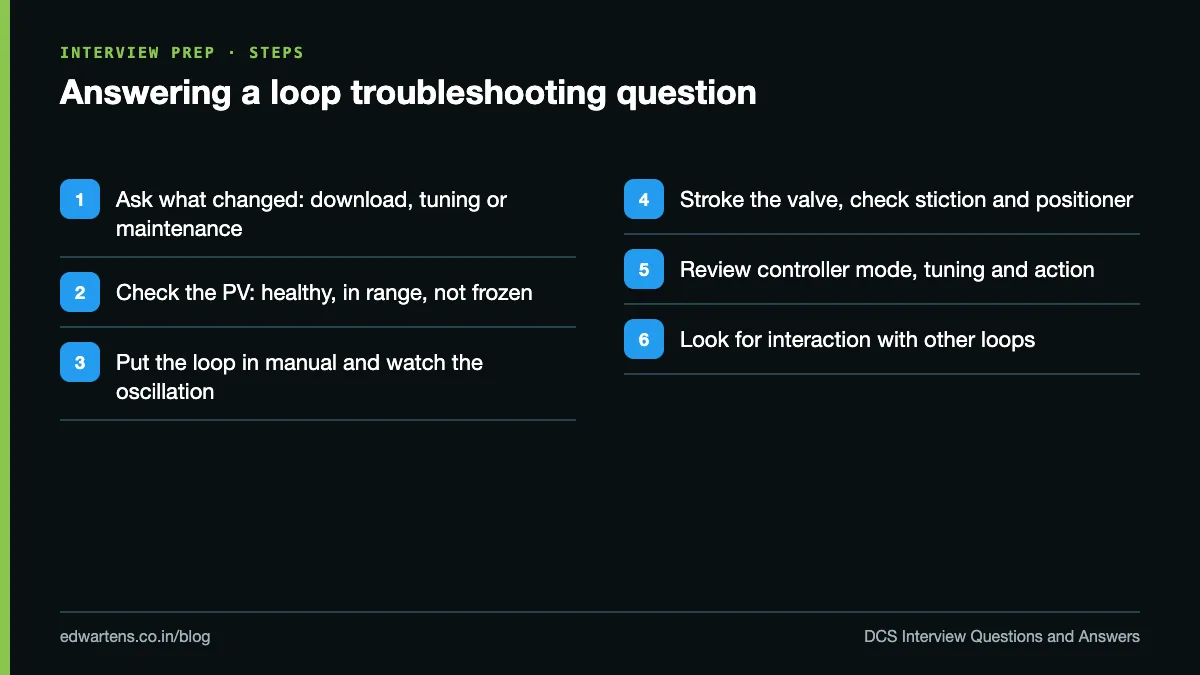
- Ask what changed: a recent download, tuning change or maintenance.
- Check the PV: is the signal healthy, in range, not frozen, not in bad status?
- Put the loop in manual and watch whether the oscillation stops.
- Stroke the valve and check for stiction or a positioner fault.
- Review the controller mode, tuning and action.
- Look for interaction with other loops before retuning.
DCS operator interview questions and answers
What do you check at shift handover?
Standing alarms, loops in manual and why, bypassed interlocks and their permits, equipment out of service, any abnormal trend and the shift log. Walk through these in order; that alone tells an interviewer you have done the job.
A high-level alarm comes on a drum. What do you do?
Acknowledge the alarm, check the trend and a second indication if one exists, confirm whether the level transmitter is healthy, then act on the cause: inlet flow, outlet pump or level control valve. Inform the shift in-charge and follow the operating procedure before the high-high trip acts.
What is the difference between acknowledging and resetting?
Acknowledge tells the system you have seen the alarm. Reset clears a latched trip so equipment can restart, and only after the cause is cleared and the permissives are healthy.
When would you put a loop in manual?
When the transmitter is faulty, during start-up or a big transition, or when the controller is clearly making things worse. Always note it in the log and return the loop to auto once the reason has gone.
What is a first-out alarm?
The alarm that shows which trip condition acted first when several follow together. It tells you the root cause of a shutdown.
Yokogawa DCS interview questions
Yokogawa questions come up often because CENTUM is common in Indian refineries, fertiliser and power plants. Expect these:
- What are FCS, HIS and ENG? The controller, the operator station and the engineering station.
- What is Vnet/IP? Yokogawa's redundant control network, based on gigabit Ethernet, supporting star and ring topologies.
- What is N-IO? Network I/O where a single module handles AI, AO, DI and DO, with the signal type set per channel through an adapter.
- What is ProSafe-RS? Yokogawa's safety instrumented system, whose alarms the HIS can display alongside DCS alarms.
Our free Yokogawa CENTUM VP DCS course walks through FCS and HIS architecture, function blocks and a full water-treatment project.
DCS interview questions for chemical engineers
Chemical engineers are usually asked process-control questions rather than configuration. Be ready to sketch control for a distillation column (reflux, reboiler duty, pressure via condenser), a reactor temperature cascade, level control on a surge drum (averaging control rather than tight control) and ratio control on a blending header. Explain which variable you would control, which you would manipulate and why.
What DCS jobs pay in India
Role (AmbitionBox, read 11 October 2026) | Typical range shown | Sample |
|---|---|---|
DCS Engineer, 1 to 9 years | ₹5 to 5.6 lakh a year | about 1.9k salaries |
DCS Engineer, 1 to 3 years | ₹3.7 to 4.1 lakh a year | 404 salaries |
DCS Operator, 1 to 13 years | ₹6.6 to 7.2 lakh a year | about 2.2k salaries |
These are self-reported figures from AmbitionBox's DCS Engineer page and DCS Operator page, read 11 October 2026. Our guide to a DCS engineer career in India's process industries covers growth paths.
How to prepare in the week before
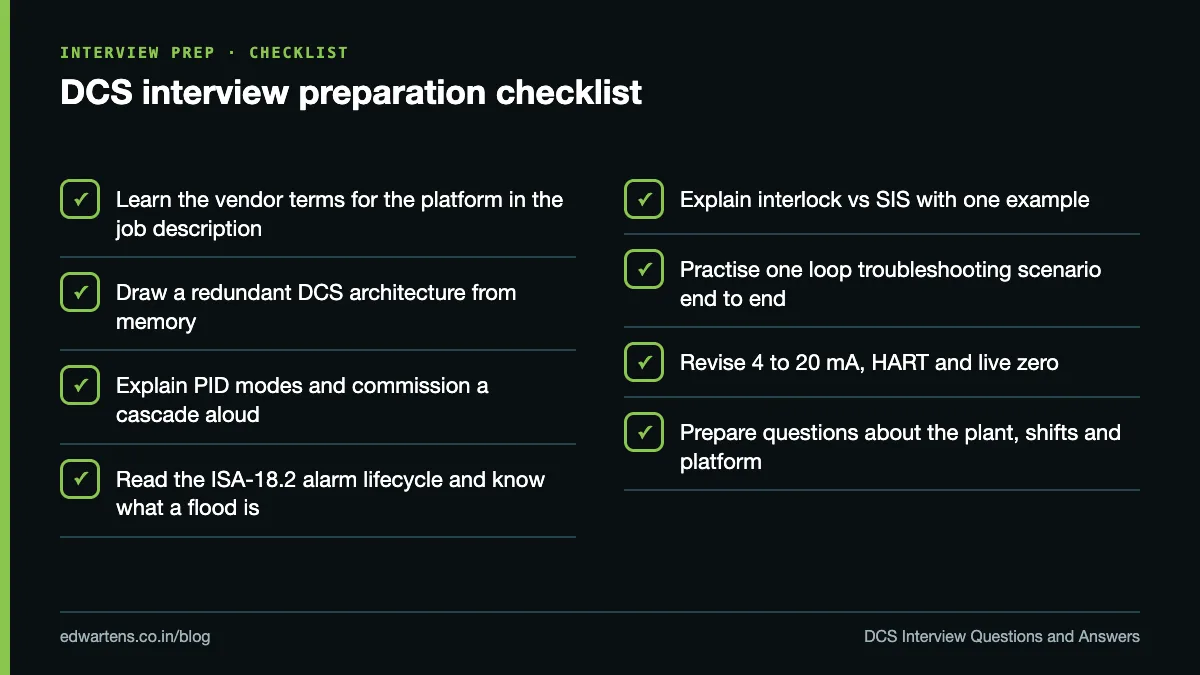
- Learn the vendor terms in the table above for the platform in the job description.
- Draw a redundant DCS architecture from memory.
- Explain PID modes and commission a cascade aloud.
- Read the alarm lifecycle and know what a flood is.
- Explain interlock vs SIS with one example.
- Practise one loop troubleshooting scenario end to end.
- Revise 4 to 20 mA, HART and live zero.
- Prepare questions about the plant, shift pattern and platform.
If you want hands-on practice, our free Emerson DeltaV DCS course covers Control Studio programming and PID, and the free Honeywell Experion PKS DCS and Siemens PCS 7 DCS courses cover those platforms. For instructor-led classroom work in Electronic City, see our DCS training in Bangalore. The EDWartens engineering team also keeps a list of PLC and SCADA interview questions if your interview covers both.
Frequently asked questions
Q: What are the most common DCS interview questions?
A: What a DCS is and how it differs from PLC and SCADA, controller and I/O redundancy, PID modes, cascade control, alarm management to ISA-18.2, and the difference between a DCS interlock and a SIS.
Q: Is there a DCS interview questions and answers PDF?
A: You can save this page as a PDF from your browser's print menu. It is better to practise answering aloud than to memorise a PDF, because interviewers follow up on every answer.
Q: What questions are asked in a DCS operator interview?
A: Mostly operational: PV, SP and OP, controller modes, alarm acknowledgement and reset, shift handover checks, and what you would do in a specific upset such as a high level or a pump trip.
Q: Do I need to know every DCS vendor for an interview?
A: No. Know one platform well, learn the vendor term map for the others, and say honestly when you have not used a system.
Q: What Yokogawa DCS questions should I prepare?
A: FCS, HIS and ENG roles, pair and spare redundancy, Vnet/IP, N-IO, function block modes, online maintenance and ProSafe-RS.
Q: Can a chemical engineer become a DCS engineer?
A: Yes. Chemical engineers often start as panel operators or process engineers and move into control because they understand the process; they need to add instrumentation, I/O and configuration skills.
Q: What is the difference between an interlock and a trip?
A: A trip is the action, such as stopping a pump. An interlock is the logic that causes it, or that blocks a start until conditions are safe.
Learn this, free
The courses that teach this
Every lesson, the written notes and the practice are free with an account. Only the certificate is optional and paid.


