Instrumentation Engineer vs Automation Engineer: Which Role Is Right for You?

Two ends of the same loop
An instrumentation engineer owns the measurement: transmitters, analysers, valves, positioners, the wiring and calibration that make the number on the screen true. An automation engineer owns the logic: PLC and DCS programs, HMI and SCADA, networks and the sequence that runs the plant. In a refinery they are two departments; in a mid-sized factory one person does both and is called the control engineer.
Day to day
Instrumentation | Automation | |
|---|---|---|
Morning | Calibrating a pressure transmitter, checking a loop | Modifying a sequence, adding an alarm |
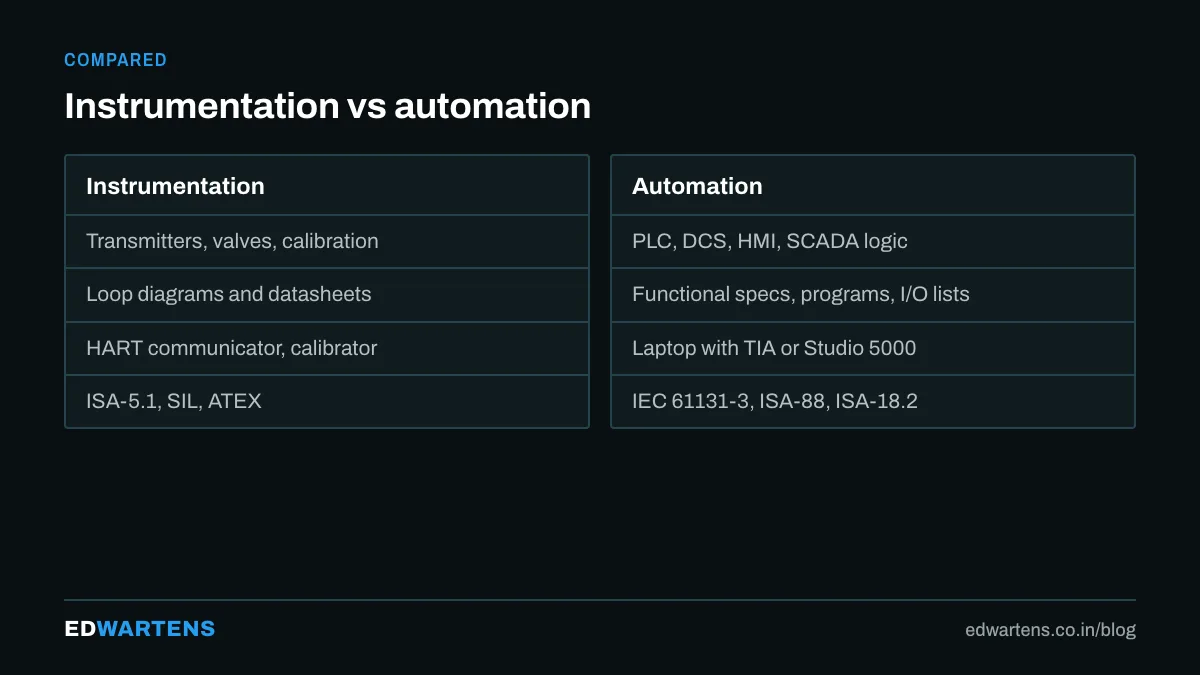
Documents | Loop diagrams, datasheets, calibration records, hook-ups | Functional specs, PLC programs, HMI screens, I/O lists |
Tools | HART communicator, calibrator, multimeter | Laptop with TIA Portal or Studio 5000, SCADA designer |
Standards | ISA-5.1, IEC 61508 SIL, ATEX for hazardous areas | IEC 61131-3, ISA-88 batch, ISA-18.2 alarms |
Failure they fix | A reading that drifts or a valve that sticks | A sequence that hangs or a network that drops |
The skills each needs
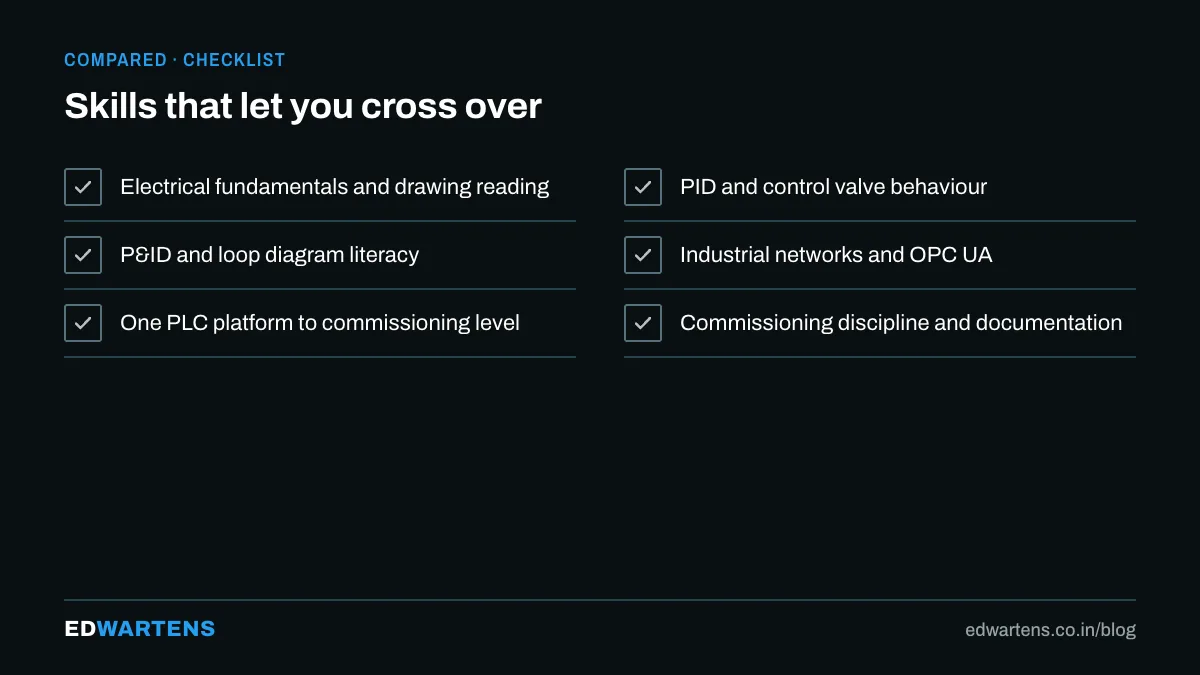
Instrumentation: measurement principles, RTDs, thermocouples and transmitters, control valves and sizing, P&IDs, hazardous area classification, functional safety and SIL, and calibration procedures.
Automation: one PLC platform deeply, HMI and SCADA, networks, PID, motor control and drives, and increasingly OPC UA and data.
Both need electrical fundamentals, drawing reading, and commissioning discipline.
Where the jobs are
Instrumentation: process industries, oil and gas, pharma, power, water, EPCs and instrument vendors (Emerson, Yokogawa, ABB, Endress+Hauser, Honeywell). Automation: system integrators, OEMs, discrete manufacturing, pharma, plus the same process industries. Automation roles are more numerous in Bangalore and Pune; instrumentation roles cluster around refineries, chemical belts and the Gulf.
Salaries
Freshers in both start around 3 to 4.5 lakh at Indian companies. Instrumentation engineers with SIL and hazardous-area experience earn strongly in oil and gas and the Gulf; automation engineers with a strong platform and SCADA skill set move faster in integrators and OEMs. At ten years both reach 12 to 25 lakh in India, more abroad, as covered in automation engineer salary in India.
Moving between them
From instrumentation to automation: learn a PLC platform and SCADA; your loop knowledge makes you the best process automation engineer in the room. Start with PID Control and TIA Portal. From automation to instrumentation: learn measurement and valves properly; the Instrumentation and Process Control course is the bridge, and functional safety training follows.
This is part of the wider skill set covered in our industrial automation training in Bangalore.
Frequently asked questions
Which is easier to enter as a fresher? Automation, because integrators hire in volume and simulators let you practise at home.
Which pays more? Similar in India; instrumentation edges ahead in oil and gas abroad, automation in OEMs and software-heavy roles.
Can I be both? In most Indian plants you will be, whatever the title says.
Learn this, free
The courses that teach this
Every lesson, the written notes and the practice are free with an account. Only the certificate is optional and paid.


