

ISO 14001 Internal Audit Requirements Explained

The short answer
ISO 14001 internal audit requirements are these. The organisation must run internal audits at planned intervals. They check that its environmental management system meets its own requirements and the standard, and that it is effectively implemented and maintained. It needs an audit programme with frequency, methods and responsibilities. Each audit needs defined criteria and scope, and auditors must be objective and impartial. Results go to the relevant managers, and documented evidence shows that the programme and the results exist. Auditors cannot audit their own work.
The standard was checked through certification-body notices on 1 November 2026 (November 2026). This guide paraphrases ISO 14001 and ISO 19011 and never reproduces their text. Anyone building a real system should hold a licensed copy of the edition they work to.
Which edition applies
ISO 14001:2026, the fourth edition, was published on 15 April 2026 and replaces ISO 14001:2015 including its 2024 climate amendment. DNV's notice calls the changes moderate. It says certificates to the 2015 edition must transition within three years, before May 2029. Other certification bodies quote April 2029, so ask yours. The internal audit clause keeps its place in the "Performance evaluation" section, clause 9.2, and the core duty is unchanged. Reports from certification bodies describe clearer wording on audit objectives and on documenting the programme, so read the clause in your licensed copy.
The guidance for auditing any management system is ISO 19011. SQS lists the ISO 14001:2026 edition, and the Chartered Quality Institute describes the 2026 edition of ISO 19011 as an evolution that covers remote auditing. The 2015 and 2026 editions of ISO 14001 share the same structure, so the steps below hold for both.
What the standard asks, in plain words
Requirement | What an auditor looks for |
|---|---|
Planned intervals | A programme with dates, not audits when someone remembers |
Criteria and scope | For each audit, which clauses, processes, sites and legal requirements are covered |
Programme considers importance and past results | Higher-risk processes and areas with earlier findings are audited more often |
Objective and impartial | The auditor does not audit their own work |
Reported to relevant management | A report that reaches the people who can act |
Documented information | The programme, the plans, the reports and the follow-up are kept |
An internal audit is not an inspection of the site for spills, though it may involve a walk round. It is a check of whether the system works: do the people doing the work follow the procedure, is the procedure adequate, and does the evidence show results?
Building the programme
Start with a list of the system's processes: context and scope, policy, aspects, legal register, objectives, training, operational control, emergency response, monitoring, internal audit, management review and corrective action. Decide how often each is audited. A common approach is to cover every clause and every site at least once in a year or in the certification cycle, with higher-risk processes more often.
For a plant with a diesel store, a wastewater plant and a hazardous waste yard, operational control and emergency preparedness deserve more audits than the training clause. Past nonconformities, a change in process, a new legal requirement or a spill all justify an extra audit. In India, for example, an audit would check that the plant works within the consent conditions set by its state pollution control board, as part of its compliance obligations.
Planning a single audit
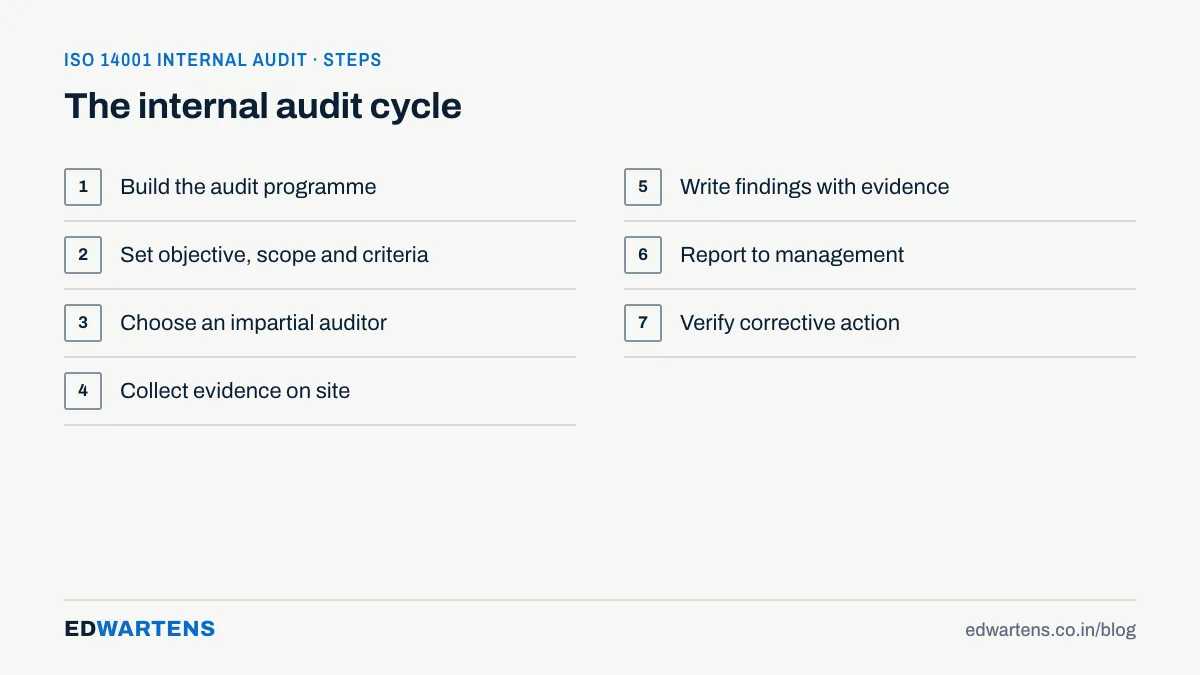
- Set the objective, scope and criteria. For example: "Check operational control of chemical storage against the procedure and the legal register."
- Pick an impartial auditor. The stores supervisor should not audit the stores.
- Prepare a checklist of questions, but allow the evidence to lead.
- Open meeting, evidence collection, closing meeting. Evidence comes from interviews, documents and observation.
- Write findings. A good finding states the requirement, the evidence and the gap.
- Report to management and track corrective action until it is verified as effective.
A worked example: how many records to sample
Auditors rarely check every record. Suppose the system has 60 monthly waste-handling records for the year, and 6 of them are missing a signature. The auditor does not know this. How likely is a random sample to include at least one bad record?
The chance of missing every bad record in a sample of n from 60 with 6 bad is the number of ways to pick only good records divided by all ways.
- Sample of 8: miss chance = C(54,8) / C(60,8) = 0.407, so the chance of finding at least one is 59.3%.
- Sample of 15: miss chance 0.163, find chance 83.7%.
- Sample of 20: miss chance 0.077, find chance 92.3%.
Sample size | Chance of finding at least one bad record |
|---|---|
8 of 60 | 59.3% |
15 of 60 | 83.7% |
20 of 60 | 92.3% |
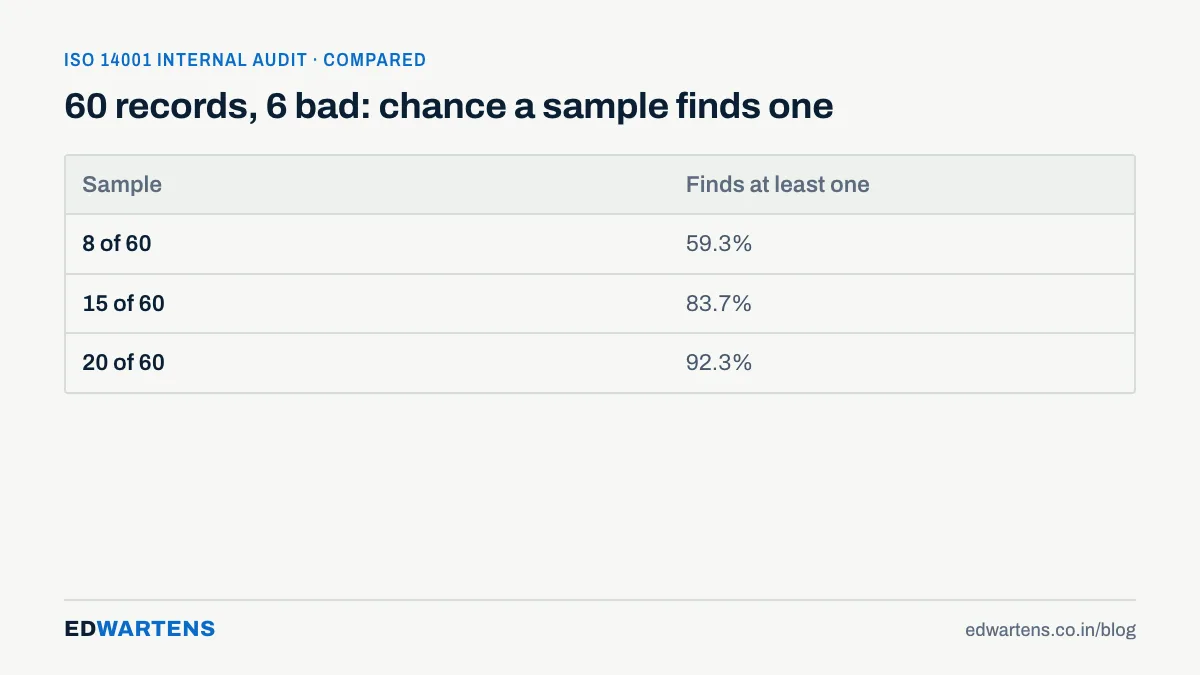
A small sample can look clean while a problem sits in the rest. That is why a clean sample is reported as "no nonconformity found in the sample", not "no nonconformity exists", and why a finding in any sample deserves a wider look. The numbers were computed in node using the hypergeometric formula.
Common mistakes
- Auditing only the paperwork and never the operation. Walk to the chemical store.
- Using one person for every audit, including their own area.
- Reports that list findings but have no owner or due date.
- Treating the audit as a rehearsal for the certification body rather than a check of the system.
What a good finding looks like
A finding is useful only if someone can act on it. State the requirement, the evidence and the gap in three short parts, and say how serious it is.
Here is an example. The requirement: the organisation controls the storage of hazardous materials according to its procedure. The evidence: on 12 March the diesel day tank bund held rainwater to 40 percent of its depth, and the weekly bund check sheet had no entry for four weeks. The gap: the check was not carried out as the procedure states. The auditor then records the finding as a nonconformity and agrees an owner and a due date.
Compare that with a weak finding such as "bund checks poor". It names no evidence and no requirement, so nobody can tell whether it is fixed. Good findings make the corrective action easy to verify later.
Learn it free on EDWartens
The ISO 14001 Environmental Management Systems course teaches the management system in 14 modules and a final. Two of them cover internal auditing to ISO 19011. One covers the programme and plan, and the other covers the checklist, sampling, evidence and findings. It is a free course with a verifiable certificate of completion, and anyone can check a certificate on the verification page. The content is internal audit knowledge for your own organisation. It is not an auditor registration, and EDWartens is not affiliated with ISO or any certification body.
If you also work with information security, our ISO 27001 implementation steps use the same audit and review cycle. For quality projects see where Six Sigma helps manufacturing engineers. Start the ISO 14001 course alongside your own site or a practice case.
Q: How often must ISO 14001 internal audits be done?
A: The standard says at planned intervals and leaves the frequency to the organisation. Most cover every clause and site at least once a year or over the certification cycle, with risky processes audited more often.
Q: Who can be an internal auditor for ISO 14001?
A: Anyone competent who is objective and impartial and does not audit their own work. The standard sets no formal qualification, but organisations usually train auditors using ISO 19011.
Q: What is the difference between an internal audit and a certification audit?
A: An internal audit is run by the organisation on itself. A certification audit is run by an independent certification body that decides whether to issue or keep a certificate.
Q: Is ISO 14001:2026 different for internal audits?
A: The core duty is the same. Certification-body notices describe clearer wording on audit objectives and documenting the programme, so check your licensed copy of the 2026 edition.
Q: How many records should an auditor sample?
A: There is no fixed number. The example above shows 15 of 60 records finds a 6-in-60 problem about 84% of the time, so sample size should match risk.
Q: Does the EDWartens course make me a qualified auditor?
A: No. It gives internal audit knowledge and a verifiable certificate of completion, not an auditor registration.
For a classroom route that puts topics like this next to PLC programming, see industrial automation course in Bangalore.
Learn this, free
The courses that teach this
Every lesson, the written notes and the practice are free with an account. Only the certificate is optional and paid.


