

IATF 16949 Internal Auditor Certification: What Counts

The short answer
There is no IATF 16949 internal auditor certificate that IATF issues, and the standard names none. IATF 16949:2016 asks the plant to define what its internal auditors must know, verify that each one has it, and keep records. The proof can be a training certificate, observed audits, a competence matrix, or all three. Only third-party auditors, who work for IATF-recognized certification bodies, go through an IATF qualification route.
Facts were checked on the [IATF Global Oversight site](https://www.iatfglobaloversight.org/) on 1 November 2026. IATF 16949:2016 is the current edition, and the site says a revision is under way (Stakeholder Communiqué SC-2026-005, approved 30 July 2026). It named no transition dates. We explain requirements in our own words and never copy the standard's text. The scoring arithmetic in the worked example was run in Node.
Who needs which kind of "certification"
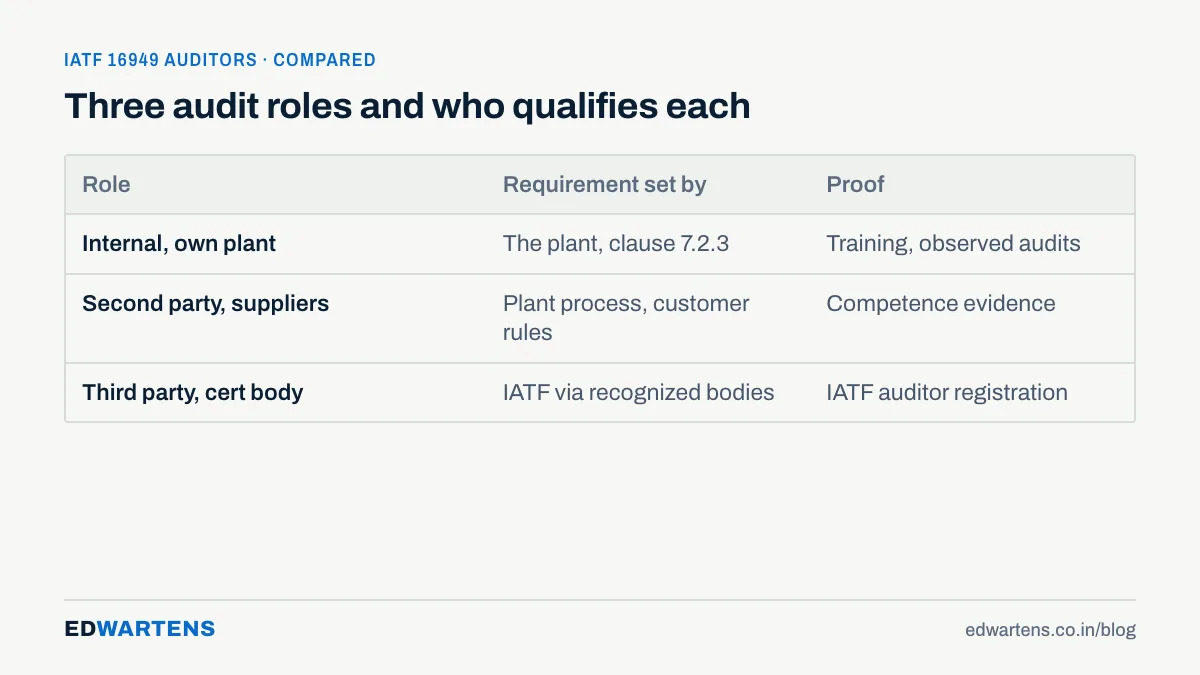
The word certification covers three different jobs. Mixing them up is the most common source of wasted course fees.
Role | Who sets the requirement | What proves it |
|---|---|---|
Internal auditor in your own plant | The plant, under clause 7.2.3 (2016 numbering), plus customer rules | Training, observed audits, a competence record |
Auditor of your suppliers (second party) | The plant's own process, plus customer rules; see 8.4.2.4.1 | Competence evidence for supplier audits |
Certification body auditor (third party) | IATF, through its recognized certification bodies | Registration through IATF's Auditor Development Process |
The IATF 16949:2016 page explains the standard's background. The main IATF site also describes the third route, which is for auditors working for recognized certification bodies. It publishes an Auditor Guide for IATF 16949 (fifth edition, announced 14 November 2024). An internal auditor can read that guide to see how third-party audits think. None of it turns a plant employee into a certification body auditor.
What clause 7.2.3 asks the plant to prove
In plain words, the plant must have a documented way to verify that internal auditors are competent. The auditors should understand five things. These are the automotive process approach, the customer specific requirements that apply to the plant, and the requirements of ISO 9001 and IATF 16949. The fourth is the core tools relevant to what they audit. The fifth is audit practice: they must know how to plan an audit, run it, report it and close it. The standard sets no hours, no exam and no named certificate.
This matters for cost. A plant can train one lead auditor externally and then qualify colleagues through its own programme, as long as the evidence is credible. A plant can also send ten people to a paid course and still fail an audit if it cannot show who may audit which process.
Customers can add rules. A customer specific requirement may name a minimum for second-party auditors or ask for particular training. IATF publishes a page of customer specific requirements for the automotive makers, so check it before you design the programme.
Worked example: scoring five auditors
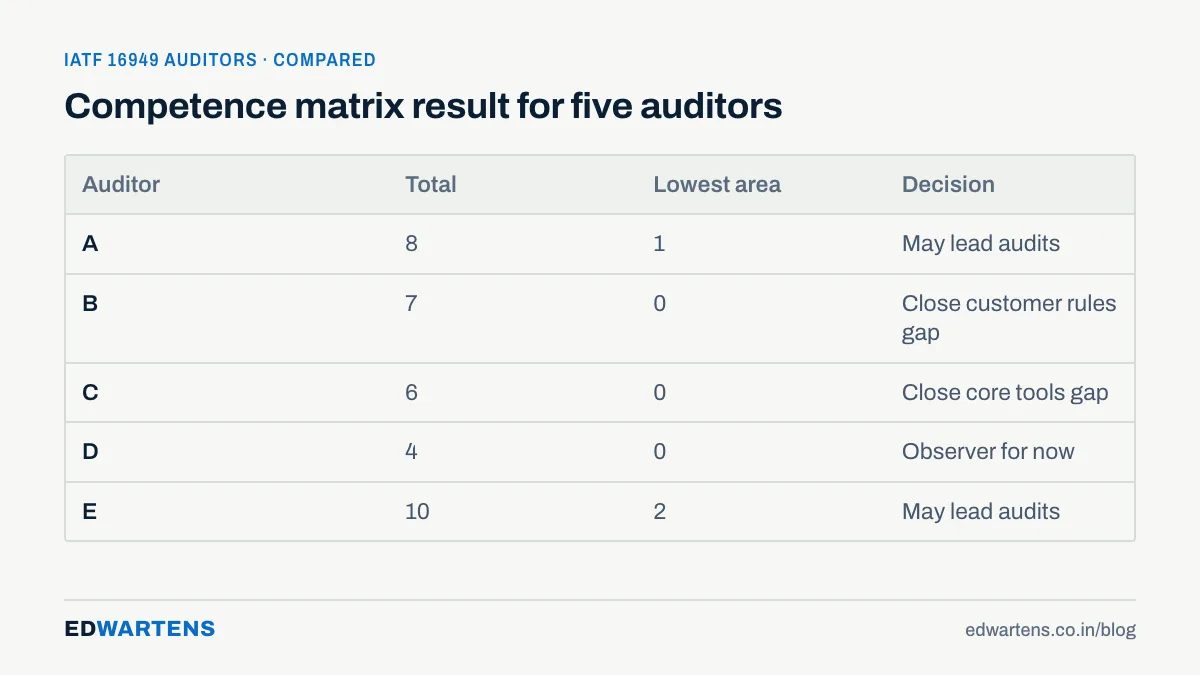
A 140-person stamping and welding plant has five possible internal auditors. For each of the five areas above, the quality manager scores 0 for no evidence, 1 for trained, and 2 for trained and seen doing it in an observed audit. The plant's rule is simple. Every area must score at least 1. To lead an audit, the audit practice area must score 2.
Auditor | Process approach | Customer rules (CSR) | ISO 9001 + IATF 16949 | Core tools you audit | Audit practice | Total (max 10) | May audit alone? |
|---|---|---|---|---|---|---|---|
Auditor A | 2 | 1 | 2 | 1 | 2 | 8 | Yes, may lead |
Auditor B | 1 | 0 | 2 | 2 | 2 | 7 | No, close the gap first |
Auditor C | 2 | 2 | 1 | 0 | 1 | 6 | No, close the gap first |
Auditor D | 1 | 1 | 1 | 1 | 0 | 4 | No, close the gap first |
Auditor E | 2 | 2 | 2 | 2 | 2 | 10 | Yes, may lead |
The totals are 8, 7, 6, 4 and 10, with a mean of 7.0. Totals do not decide anything on their own:
- Auditors A and E meet the rule and may lead audits. A is the weaker on customer rules and core tools, so A is paired with a process owner who knows the customer's requirements.
- Auditor B has a high total of 7 but a 0 for customer rules, so B cannot audit alone until that gap closes. A half-day review of the customer's requirements and one observed audit would fix it.
- Auditor C scores 6 but has no core tools evidence, so C cannot audit alone yet. A short module on the tools C will meet, plus one observed audit, closes the gap.
- Auditor D is a trainee with no observed audit and is not yet independent. D joins audits as an observer.
The matrix is a record. It shows an assessor who may audit what, and it makes the next training decision obvious.
Building a small programme in one week
You do not need a large team to start. List the plant's processes and sort them into the three audit types the programme must cover. Score each process for effect on the customer, recent results and recent change, and audit the high scorers more often. Then check who on your list passes the competence rule above. If only one person does, schedule that person for the first audits. Use the others as observers, so each one earns the observed audit that moves a 1 to a 2. Write the matrix, the programme and the first audit dates in one workbook. An assessor who asks "show me how you know" can then see the answer on one screen.
What a training certificate does and does not prove
Many providers sell two to five day courses for IATF 16949 internal auditors, often ending in a certificate of attendance or a short test. These help, because a structured course covers the audit method and the clause structure in a short time. They prove training, not IATF qualification. Whether a customer accepts the certificate is for the customer to say.
When you choose a course, ask the provider five questions:
- Which edition of IATF 16949 and which version of the Rules does it teach?
- Does it cover the three audit types: system, manufacturing process and product?
- Does it include a real or simulated audit, with graded nonconformity statements?
- Is the certificate described honestly, as a training record and not as an IATF credential?
- Does it say who the instructor is and what auditing experience they have?
Where an internal auditor starts in India
India has automotive supplier clusters around Pune, Chennai, the Gurugram belt and Sanand. A plant there that holds IATF 16949 certification needs trained internal auditors every year. A graduate who understands the standard, can read a control plan and can write a clear finding is a useful hire for such a plant. Our AIAG-VDA FMEA guide explains the risk tool an auditor meets in almost every process file. Our post on computer vision for quality inspection shows how inspection data is changing the audit trail. The AIAG manuals page lists the core tool manuals that a plant buys for its own people.
Learn the knowledge free first
The free IATF 16949 Automotive QMS and Internal Auditing course teaches what IATF 16949 adds to ISO 9001, the automotive process approach, supplier and production controls, SPC and gauge checks. It then moves to the internal audit programme, interviews, audit trails and graded nonconformity statements, with a project at the end. It is planned over 6 weeks of part-time study, about 8.7 hours of lessons.
It is a free course with a verifiable certificate of completion, and anyone can check a certificate on our verification page. It gives internal auditor knowledge only. It is not an IATF credential, it does not qualify anyone as a third-party auditor, and it does not replace a customer's own competence rules. EDWartens is not affiliated with IATF, AIAG or any certification body. Start the IATF 16949 internal auditor course and keep the finished matrix as your own record.
To learn this with an instructor in a classroom, see classroom PLC training in Bangalore.
Frequently asked questions
Q: Is there an official IATF 16949 internal auditor certification?
A: No. IATF 16949:2016 requires the plant to verify that its internal auditors are competent and to keep records. It names no certificate. IATF qualification routes exist only for third-party auditors of IATF-recognized certification bodies.
Q: What must an IATF 16949 internal auditor know?
A: The automotive process approach, the plant's customer specific requirements and the ISO 9001 and IATF 16949 requirements. Also the core tools relevant to the processes audited, and how to plan, conduct, report and close an audit.
Q: Can I become an IATF 16949 lead auditor by taking this course?
A: No. Third-party IATF auditors qualify through IATF-recognized certification bodies and IATF's own process. This course teaches internal auditor knowledge only.
Q: How long does it take to qualify an internal auditor?
A: The standard sets no duration. Plants commonly combine a short training course with one or more observed audits, then record the result in a competence matrix.
Q: Do customers set their own auditor requirements?
A: They can. Customer specific requirements may add rules, particularly for second-party audits of suppliers, so read the ones that apply to your plant.
Q: Is IATF 16949 changing?
A: The IATF site lists IATF 16949:2016 as current and says a revision is under way. It gave no transition dates on 1 November 2026, so check the IATF Global Oversight site and your certification body.
Learn this, free
The courses that teach this
Every lesson, the written notes and the practice are free with an account. Only the certificate is optional and paid.


