

APQP vs PPAP: What Is the Difference?

The short answer
The difference between APQP and PPAP is scope and timing. APQP (Advanced Product Quality Planning) is the whole five-phase process that takes a new part from customer requirements to stable production. PPAP (Production Part Approval Process) is the package of evidence, and the customer's approval decision, that closes the validation phase. APQP is the road, and PPAP is the border check before launch. Yes, PPAP belongs to APQP, but it is only one output of it.
The AIAG manual pages were read on 1 November 2026. The APQP manual is in its third edition, the Control Plan is now a standalone first edition, and the PPAP manual is in its fourth edition. We describe the ideas in our own words and copy nothing from the manuals. The timing arithmetic below was run in Node.
Side by side
Question | APQP | PPAP |
|---|---|---|
What is it? | A planning process with five phases and gate reviews | A set of 18 evidence elements and a part submission warrant |
When does it happen? | From concept to launch and into production feedback | Near the end of validation, before shipping production parts |
Who drives it? | A cross-functional team led by the supplier | The supplier submits; the customer approves, rejects or gives interim approval |
What does it produce? | Design records, risk analyses, control plans, validated process | A decision: approved, interim or rejected |
How long? | Often many months for a new part | Weeks to assemble, if the earlier phases were done properly |
AIAG manual | APQP, third edition | PPAP, fourth edition |
The Control Plan sits between them. The third edition of the APQP manual moved Control Plan content into its own manual. So you now use three documents together. APQP gives the plan, the Control Plan manual gives the controls, and PPAP gives the proof.
How the five phases feed the PPAP
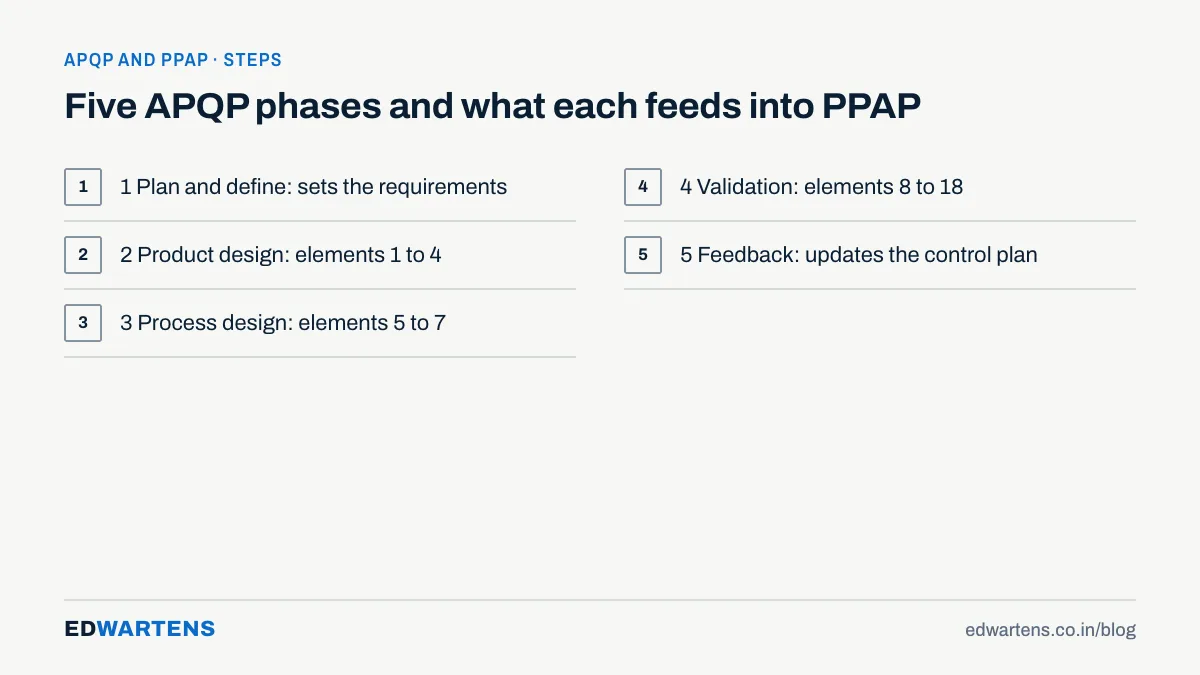
PPAP does not create evidence. It collects what the five phases already made, so a weak phase 2 or 3 shows up as a missing element in phase 4.
APQP phase | Typical outputs | PPAP elements it supplies |
|---|---|---|
1 Plan and define | Design goals, reliability targets | Sets the customer requirements the package must meet |
2 Product design | DFMEA, drawings, special characteristics | Design records, change documents, customer engineering approval, DFMEA (elements 1 to 4) |
3 Process design | Flow diagram, PFMEA, pre-launch control plan | Process flow, PFMEA, control plan (elements 5 to 7) |
4 Validation | Trial run, MSA, capability, run at rate | Measurement studies, dimensional and test results, process studies, samples, checking aids, declarations (elements 8 to 18) |
5 Feedback | Production data, corrective actions | Updates the control plan; triggers a new PPAP if a change needs one |
Counting by this grouping, 4 elements come from phase 2, 3 from phase 3 and 11 from phase 4, a total of 18. The split is our teaching grouping and not an official one, because some elements, such as engineering change documents, appear only when a change happens.
Worked example: where a submission date comes from
A supplier plans a bracket programme. Each activity has a duration in weeks and predecessors, and the earliest finish of the last one is the submission date. The task names are from our teaching example.
Activity | Task | Weeks | Earliest start | Earliest finish | Float |
|---|---|---|---|---|---|
A | Kick-off and feasibility | 3 | 0 | 3 | 0 |
B | Design release | 10 | 3 | 13 | 0 |
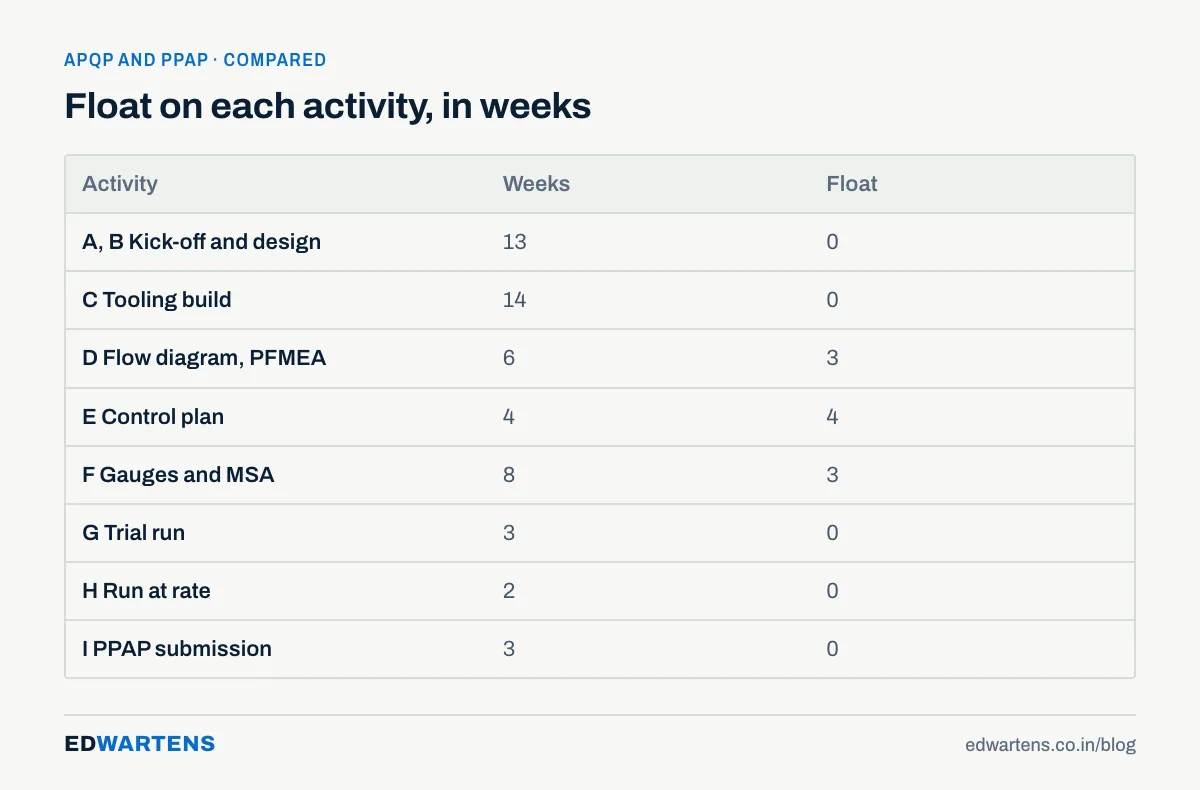
C | Tooling build | 14 | 13 | 27 | 0 |
D | Flow diagram and PFMEA | 6 | 13 | 19 | 3 |
E | Pre-launch control plan | 4 | 19 | 23 | 4 |
F | Gauges and MSA studies | 8 | 19 | 27 | 3 |
G | Trial production run | 3 | 27 | 30 | 0 |
H | Run at rate, initial process study | 2 | 30 | 32 | 0 |
I | PPAP package and submission | 3 | 32 | 35 | 0 |
The programme takes 35 weeks. The critical path is A, B, C, G, H and I: kick-off, design release, tooling, trial run, run at rate and the PPAP package. Tooling has no float, so a two-week tooling delay moves the submission by two weeks. The process documents and gauge work have float of 3 to 4 weeks, so they can slip a little without moving the date.
Float runs out, though. If the gauge and MSA studies (activity F) take 12 weeks instead of 8, they now finish in week 31, after the trial run ends in week 30. Run at rate starts in week 31, and the submission slips from week 35 to week 36. That is the practical link between the two: PPAP is late when any phase 4 input is late.
What PPAP adds that APQP does not
APQP can finish on paper. PPAP forces the proof: parts made with production tooling, at the quoted rate, measured with checked gauges, and signed on a warrant. The customer chooses one of five submission levels per part number, and Level 3 is the usual default if nothing is said. The levels decide how much evidence is sent and how much stays at the supplier's plant, but all 18 elements must exist. The point here is the relationship between the two, not the detail of each level.
APQP also covers things PPAP does not: feasibility, project timing, supplier selection, change management and lessons learned. A supplier can run a good APQP and still fail PPAP on one gauge study, which is why gauge and capability work are scheduled early.
Mistakes that mix the two up
- Treating PPAP as paperwork for the last month. The 18 elements depend on work done in phases 2 and 3, so start the checklist at kick-off.
- Planning backward from shipping, not from the submission date. Customers approve first and ship later. The timing plan must end at approval, with time for a rejection and a resubmission.
- Writing the control plan after the trial run. The pre-launch control plan guides the trial run, and the trial run tests the control plan. Reverse the order and the evidence means little.
- Forgetting feedback. APQP phase 5 is where complaints and scrap data change the control plan. A change that matters may need customer notice or a fresh PPAP.
Where this matters in India
Many Indian component makers supply global vehicle and equipment makers, and those customers ask for APQP milestones and PPAP packages in their supplier manuals. A fresher who can read a timing plan and name the 18 elements is useful in a supplier quality or launch team from the first week. Customer manuals differ, so always read the one for your customer.
Which one do you need to learn first?
Learn APQP first. It tells you why each document exists and when it is due, and PPAP then becomes a checklist you can finish rather than a surprise. A quality engineer in a supplier plant often works on both in the same month. Pair this with the risk side in our AIAG-VDA FMEA guide, and with the statistics side in Six Sigma for manufacturing engineers. The AIAG manual pages for APQP, the Control Plan and PPAP show the editions and how to buy them. Your customer names the edition you must use.
Practise APQP and PPAP free
The free APQP, Control Plan and PPAP course follows this order. It starts with the five phases and gates, special characteristics, and the chain from process flow to PFMEA to control plan. It then covers Safe Launch, the 18 PPAP elements, the part submission warrant and run at rate. It includes a timing plan exercise like the one above, and everything works in a spreadsheet.
It is a free course with a verifiable certificate of completion, and anyone can check a certificate on our verification page. It is not a CPD or industry credential, and it does not replace the AIAG manuals your customer requires. EDWartens is not affiliated with AIAG, VDA or IATF. Start the APQP and PPAP course when you have a part to practise on.
For classroom practice, our PLC course in Bangalore: syllabus and duration sets out what is taught and for how long.
Frequently asked questions
Q: What is the difference between APQP and PPAP?
A: APQP is the five-phase planning process for launching a new part. PPAP is the evidence package and approval decision at the end of validation. APQP produces the work and PPAP proves it.
Q: Is PPAP part of APQP?
A: Yes. PPAP is the main output of APQP phase 4, product and process validation. It also draws on documents from phases 2 and 3.
Q: How many phases does APQP have?
A: Five: plan and define, product design, process design, validation and feedback. Each ends in a gate review.
Q: How many elements does PPAP have?
A: Eighteen, including the part submission warrant. The customer's submission level decides how many are sent and how many are kept at the supplier.
Q: Which AIAG editions are current?
A: On 1 November 2026 the AIAG pages showed APQP third edition, Control Plan first edition and PPAP fourth edition. Your customer may require a specific edition.
Q: Can a supplier skip APQP and only do PPAP?
A: It is risky. PPAP collects evidence that earlier phases create, so skipping the planning usually produces missing or weak elements and a rejected submission.
Learn this, free
The courses that teach this
Every lesson, the written notes and the practice are free with an account. Only the certificate is optional and paid.


