

Instrumentation · Free online course
Control Valves and Flow Measurement: Sizing and Selection
Choose and size the right control valve, actuator and positioner, and the right flowmeter: valve types and characteristics, Cv and the installed characteristic, liquid sizing with flashing and cavitation, gas and steam sizing and noise, fail action and spring sizing, the valve datasheet, orifice plates to ISO 5167, magnetic, vortex, ultrasonic, Coriolis and thermal meters, installation and loop troubleshooting.
- 13 modules
- 7h 50m of video
- Intermediate
- English
- ₹0, free
- Lab practice in your browser

₹0Free for good
Worth ₹4,999 by length and depth against classroom training. It has always been free; that is not a former price.
No card. Checkout takes a minute and gives you a receipt.
Certificate ₹599, optional. The course is free either way.
Overview
About Control Valves and Flow Measurement: Sizing and Selection
Choose and size control valves, actuators and flowmeters, and find faults in valve and flow loops.
Control Valves and Flow Measurement: Sizing and Selection is a free, self-paced online course from EDWartens for instrumentation, process and control engineers and technicians who size, specify and maintain control valves and flowmeters. It has 13 modules and 7h 50m of video lessons, with written notes, a practice task per module, a practical project and a final assessment of 15 questions (pass mark 60%). Learning costs nothing and needs only a free account. The optional EDWartens Certificate of Completion, verifiable by code, is a one-off ₹599 inclusive of GST for learners in India; it is not a vendor credential. Updated 1 November 2026.
Who it is for: Instrumentation, process and control engineers and technicians who size, specify and maintain control valves and flowmeters
This course includes
- 7h 50m of video lessons
- 13 modules with written notes and diagrams
- One final assessment: 15 questions, pass mark 60%
- Ask-an-engineer support from practising engineers
- Lifetime access, the course does not expire
- Optional verifiable certificate when you finish
- Step 1 of 3
Learn the 13 modules
7h 50m of video lessons, written notes and a practice task per module, at your own pace.
- Step 2 of 3
Pass the final assessment
15 questions drawn from every module, pass mark 60%, 3 attempts.
- Step 3 of 3
Take the certificate, if you want it
Optional, paid once, only if you choose it. The course stays free either way.
See the certificate and its price
A look inside


From the lessons

Control valve types and what the trim does
by Fisher Valves & Instruments

Liquid sizing to IEC 60534 and ISA-75: flashing and cavitation
by Fisher Valves & Instruments

Actuators, fail action and spring sizing
by Technical Engineering School

The control valve datasheet and specification
by Asad (I&C Engineer)

Differential pressure flow: orifice plates to ISO 5167, and venturis
by Rosemount

Installation: straight runs, impulse lines and magmeter grounding
by Calibration Academy
Lesson frames belong to the creators named in the Credits and are shown from YouTube.
What you learn
What you will be able to do
By the end you will be able to:
- Choose a control valve body and trim for a duty
- Calculate Cv and size liquid, gas and steam valves
- Check for choked flow, flashing, cavitation and noise
- Fill in a control valve datasheet
- Size an orifice plate and choose between flowmeter types
How it works
How this course works
Watch the lessons
Short video lessons, one module at a time, at your own pace.
Read the notes
Open the Reading tab for the written notes and diagrams of the module.
Practise in the 3D labOptional
Try the module in the free 3D lab, in your browser.
Check yourself
Answer the questions to see what stuck before you move on.
Final assessment
Pass the final once you have been through the modules.
Certificate, if you want oneOptional
Optional, with a page anyone can use to verify it.
Syllabus
Course content, module by module
In order, at whatever pace suits you. Each module ends with a practice task that builds on the last.
- Modules
- 13
- Video lessons
- 42
- Of video
- 7h 50m
- Final questions
- 15
- 01
Control valve types and what the trim does, with lab practice:
3 lessons · 11m - 02
Cv, pressure drop and the installed characteristic
4 lessons · 57m - 03
Liquid sizing to IEC 60534 and ISA-75: flashing and cavitation
4 lessons · 1h 8m - 04
Gas and steam sizing, and valve noise
5 lessons · 32m - 05
Actuators, fail action and spring sizing, with lab practice:
3 lessons · 17m - 06
Positioners, boosters, solenoids and limit switches, with lab practice:
4 lessons · 25m - 07
The control valve datasheet and specification
2 lessons · 2h 7m - 08
Flow measurement principles: accuracy, turndown and selection
2 lessons · 17m Final assessment · 15 questions, pass mark 60%
3D lab
Practise in the 3D lab
Find control valves on a P&ID, stroke-test one, set its fail position and tune the flow loop it controls in the Process lab.
- Read the P&IDProcess lab, about 20 minOpen in the lab (opens in a new tab): Read the P&ID
- Flow loop and control valveProcess lab, about 45 minOpen in the lab (opens in a new tab): Flow loop and control valve
Optional. Skip it whenever you like: it never blocks your progress or your certificate.
Project
The course project
Optional practice that ends in the kind of job the course prepares you for, with the documents that go with it.
About 14 hours
Size and specify a cooling water control valve and its orifice flowmeter, with both datasheets
Size one liquid control valve and one orifice flowmeter for a cooling water line, checking choked flow, cavitation, travel and the ISO 5167-2 limits. Fill both datasheets and a check register, write a short report, and then compare your answer with the worked solution.
- 4documents in the pack
- 7steps to follow
- 8things to hand in
- 14 hof work, at your pace
Sample document pack, 4 documents, filled in for the scenario
- ReportSizing calculation, FV-2101 and FE-2101, cooling water to product cooler
- DatasheetControl valve datasheet, FV-2101
- DatasheetOrifice plate and DP transmitter datasheet, FE-2101 and FT-2101
- RegisterCalculation check register, FV-2101 and FE-2101
Read inside the course and download as a workbook. The project is optional practice, marked when you submit it; the certificate needs only the modules and the final assessment.
Tools
Software, hardware and lessons
Software
A spreadsheet for the sizing calculations (LibreOffice Calc is free). Vendor sizing tools such as Fisher Specification Manager and the free online sizing tools from valve and flowmeter makers are used to check hand calculations; none is required.
Hardware
None.
Who it is for
Intermediate. For instrumentation, process and control engineers, technicians and final-year students. You should know what a 4-20 mA loop and a P&ID are and be comfortable with algebra and a spreadsheet.
Video lessons by
- Fisher Valves & Instruments
- Endress+Hauser
- Rosemount
- Kimray
- Control Station
- HardHat Engineer
- Asad (I&C Engineer)
- IMI Climate Control
Independent creators, credited in full under Credits.
Software you need
What to download, where from, what it costs and how to install it. Every link goes to the maker's own site, never a mirror.
Nothing to install
A spreadsheet is enough for the valve and orifice sizing; vendor sizing tools such as Fisher Specification Manager are optional checks.
Optional
Useful, not needed to finish the course.
- 01Free
LibreOffice
The Document Foundation
- Runs on
- Windows 10 or 11, macOS 11 or newer (Intel or Apple silicon), Linux
- Account
- None needed
- Size
- up to 1.5 GB of disk space on Windows
LibreOffice is free, open-source software under the Mozilla Public License 2.0, for any use including business. Calc is its spreadsheet.
Steps
- 1.Open the LibreOffice download page.
- 2.Check the page has picked your operating system, then select Download.
- 3.Run the installer (administrator rights are needed on Windows).
- 4.Start LibreOffice Calc for spreadsheet work.
- 5.Save as .xlsx if you need to share files with Excel users.
- Choose the latest main version unless your organisation asks for the older, more conservative release.
Official download pagelibreoffice.org
Checked against each maker's own page on 27 September 2026. Trial lengths and editions change; the maker's page is the final word.
What you walk away with
Your certificate for Control Valves and Flow Measurement: Sizing and Selection
Finish the course, pass the final, and this is the document with your name on it.
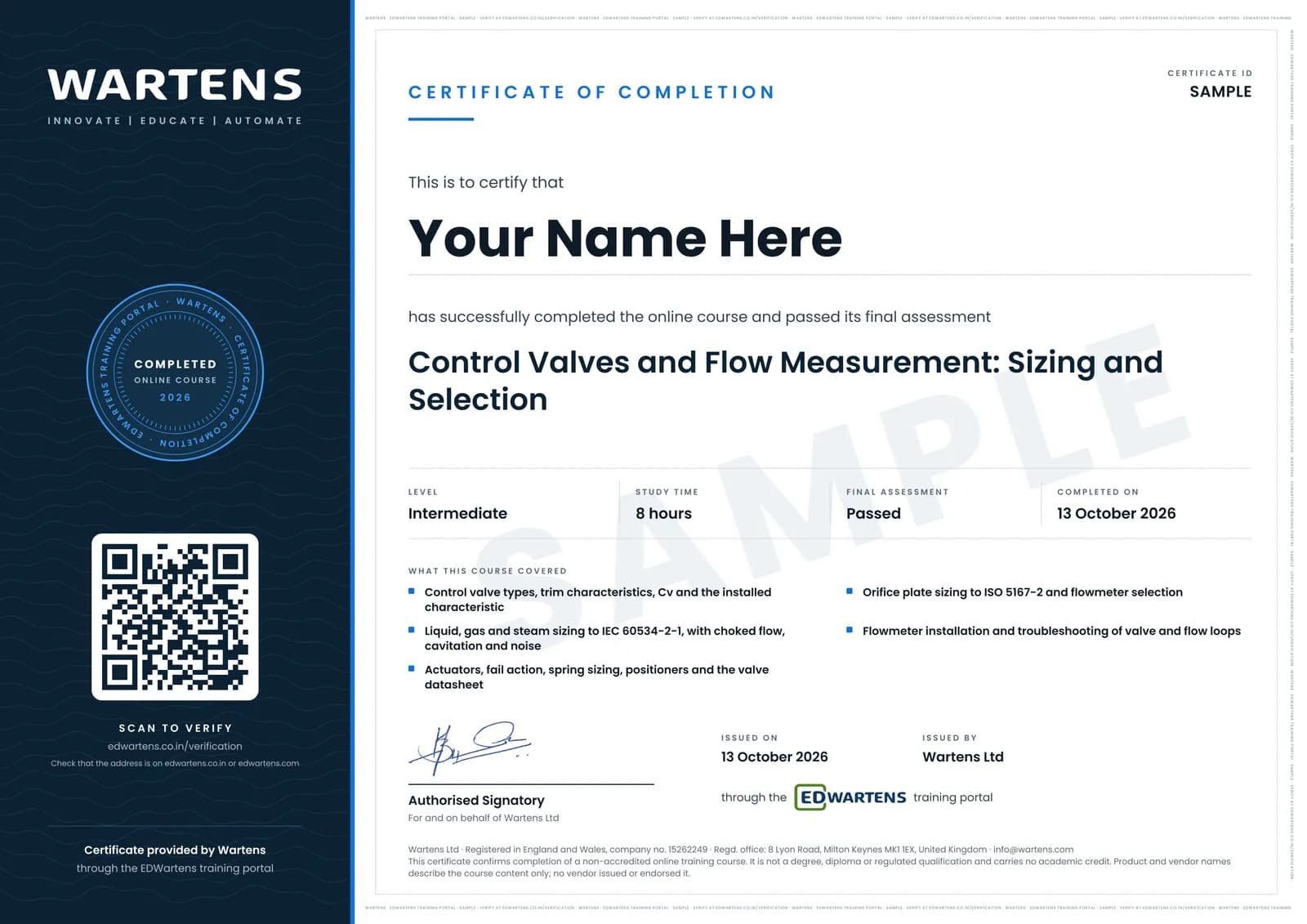
Verifiable by anyone
Adds to LinkedIn in one click
QR code on the certificate
Names what you can do
A permanent link
Earned, not attended
Learning is free. The certificate is optional.
Add it now and pay only when you have finished the course, or come back for it later. One-off, US$28.99, with a receipt.
Issued by Wartens Ltd (England and Wales, company no. 15262249) through the EDWartens training portal, as a Certificate of Completion for this self-paced course. Sold in India by Wartens Automation Private Limited. It is not a vendor certification, a university award or a CPD-accredited activity, and it does not certify competence on live equipment. Delivered electronically; see the refund policy.
Practise what you learn in the free 3D lab
Technical work is judged on what you can do: wiring, commissioning, finding a fault. Doing a task yourself teaches more than watching it a second time, and a lab lets you try it safely before you meet real equipment. It does not replace working on real hardware.
- Practise safely, so a mistake costs nothing.
- The lab checks your work like a site test, so you know when it is right.
- Free, in your browser, with nothing to install.
Why learn with EDWartens
What you get with this course.
- Free from the first lesson to the final assessment.
- Practice in a free 3D lab in your browser, with nothing to install.
- Video lessons with written notes and a project.
- An optional certificate that anyone can verify online.
FAQ
Common questions
Who is this control valve sizing course for?
It is for instrumentation, process and control engineers, instrument technicians and final-year students who specify or maintain control valves and flowmeters, including those working on EPC projects in India and on Gulf oil, gas and utility plants. You need to know a 4-20 mA loop and a P&ID and be comfortable with a spreadsheet.
Is the course free to learn?
Yes. Every module, the notes, the worked problems, the project and the final assessment are free. Only the certificate is paid, if you want one.
Which standards does it follow?
Valve sizing follows IEC 60534-2-1 (the same equations as ANSI/ISA-75.01.01), noise is introduced through IEC 60534-8-3, seat leakage through ANSI/FCI 70-2, and orifice sizing follows ISO 5167-2 with the Reader-Harris/Gallagher equation. The notes paraphrase the standards; buy the editions your project cites for design work.
Do I need Fisher Specification Manager or other sizing software?
No. Every calculation is done by hand or in a spreadsheet you build, and every worked number was checked. Vendor sizing tools are shown as a way to check your work, not as a requirement.
How long does the Control Valves and Flow Measurement course take?
About 14 hours of video, notes and practice at your own pace, with about 8 hours of video. The optional project takes about 14 hours more.
What certificate does the Control Valves and Flow Measurement course give?
An EDWartens Certificate of Completion, issued when you pass the 15-question final at 60 percent, with a number anyone can verify on our site. It is not an ISA certification such as CCST or CAP and not a vendor qualification; the course covers knowledge those exams also test.
How is it different from the Industrial Instrumentation course?
Industrial Instrumentation introduces every kind of measurement and the control valve. This course goes deep on sizing and selection: Cv calculations, cavitation, actuators, datasheets and orifice sizing. Go on to the PID Control course for loop tuning and the Instrument Calibration, Loop Checks and Commissioning course for site work.
What job does it help with?
It covers the sizing and specification work of an instrumentation design engineer at an EPC contractor or consultant, and the troubleshooting a plant instrument or control engineer does on flow loops.
Do I have to use the lab?
No. The lab is optional practice. You can skip it whenever you like, and it never blocks your progress, the final assessment or your certificate.
Is the lab free?
Yes. Every lab level for this course opens in your browser, free, with nothing to install.
Is the Control Valves and Flow Measurement course free in India, and what does the certificate cost?
Yes. Learning costs ₹0 in India: every module, the written notes, the practice tasks and the final assessment, with no card and no trial period. The only paid item is the optional EDWartens Certificate of Completion, ₹599 including GST for this intermediate course, paid in rupees through Razorpay, and only if you want it after passing the final assessment.
Is there classroom instrumentation training in India as well?
Yes. EDWartens India runs the Automation Engineer Program (AEP), a classroom programme at its Electronic City centre in Bangalore. The Automation Engineer Program (AEP) covers PLC, SCADA, HMI, drives, measuring instruments, PID basics and control panel design, taught in person at our Electronic City centre. This free course is separate and fully online; it is a good way to try the subject before deciding on classroom training. Details are at edwartens.co.in/automation-training-bangalore, and the programme itself at edwartens.co.in/courses/aep.
What topics does the Control Valves and Flow Measurement course cover, module by module?
The Control Valves and Flow Measurement course has 13 modules. It opens with "Control valve types and what the trim does", goes through "Cv, pressure drop and the installed characteristic", "Actuators, fail action and spring sizing", "Differential pressure flow: orifice plates to ISO 5167, and venturis" and "Troubleshooting valve and flow loops: stiction, hunting and drift" and ends with "Final Assessment". The full list with minutes is under "What you learn" on this page.
What can I do after the Control Valves and Flow Measurement course?
After the Control Valves and Flow Measurement course: Choose globe, ball, butterfly or eccentric plug valves and the right trim characteristic; Calculate Cv and Kv, valve authority and the installed characteristic; Size liquid valves to IEC 60534-2-1 and check choked flow, flashing and cavitation. These are the practical outcomes the course is written around, and the final assessment of 15 questions checks them.
What software and hardware do I need for the Control Valves and Flow Measurement course, and does it cost anything?
For the Control Valves and Flow Measurement course, software: A spreadsheet for the sizing calculations (LibreOffice Calc is free). Vendor sizing tools such as Fisher Specification Manager and the free online sizing tools from valve and flowmeter makers are used to check hand calculations; none is required. Hardware: none. The course itself is free.
Is the Control Valves and Flow Measurement course suitable for me, and what level is it?
Control Valves and Flow Measurement is rated intermediate. Intermediate. For instrumentation, process and control engineers, technicians and final-year students. You should know what a 4-20 mA loop and a P&ID are and be comfortable with algebra and a spreadsheet. It is written for instrumentation, process and control engineers and technicians who size, specify and maintain control valves and flowmeters, and has 7h 50m of video lessons at your own pace.
Which jobs use the skills from the Control Valves and Flow Measurement course?
Skills from the Control Valves and Flow Measurement course (for example: choose globe, ball, butterfly or eccentric plug valves and the right trim characteristic) are used in instrumentation engineer work. The course gives you practical evidence of the skill; it does not promise a job, and employers decide on experience and interview.
All course factsHide course facts
- Price
- ₹0, free for good. No trial, no card. Comparable classroom training of this length costs about ₹4,999.
- Who it is for
- Instrumentation, process and control engineers and technicians who size, specify and maintain control valves and flowmeters
- Format
- 13 self-paced modules, 7h 50m of video, written notes, a practice task per module and one final assessment.
- Level
- Intermediate. Intermediate. For instrumentation, process and control engineers, technicians and final-year students. You should know what a 4-20 mA loop and a P&ID are and be comfortable with algebra and a spreadsheet.
- Brand
- Vendor-neutral
- Software
- A spreadsheet for the sizing calculations (LibreOffice Calc is free). Vendor sizing tools such as Fisher Specification Manager and the free online sizing tools from valve and flowmeter makers are used to check hand calculations; none is required.
- Hardware
- None.
- Certificate
- Optional EDWartens Certificate of Completion, ₹599 inclusive of GST for learners in India, verifiable by code. Not a vendor credential.
- Video lessons by
- Fisher Valves & Instruments, Endress+Hauser, Rosemount, Kimray, Control Station, HardHat Engineer, Asad (I&C Engineer), IMI Climate Control (independent creators, credited below)
- Language
- English
- Last updated
- 1 November 2026
Pairs well with
 PLC programming · FreeSiemens TIA Portal
 PLC programming · FreeSiemens TIA Portal in Three Hours
 PLC programming · FreeTIA Portal: Build a Machine
 Instrumentation · FreeInstrumentation for PLC Engineers
More free courses: Free instrumentation and process control courses
Classroom course, Bangalore
Industrial automation course in Bangalore
The Automation Engineer Program (AEP) covers PLC, SCADA, HMI, drives, measuring instruments, PID basics and control panel design, taught in person at our Electronic City centre.
Credits
Who made the video lessons
The video lessons in this course were created by the people below, not by EDWartens. Every lesson streams from its creator's own YouTube channel; EDWartens neither hosts nor sells that footage, and the creators are not affiliated with EDWartens and do not endorse this course. What EDWartens wrote is the study plan, the notes, the practice tasks and the assessments.
- Fisher Valves & Instruments (Emerson)the lessons on the types of control valves, the Control-Disk rotary valve, sizing a control valve for liquid flow and for compressible fluid, the cavitation demonstration, the noise demonstration and treating valve noise with Whisper trim
- Endress+Hauserthe electromagnetic, vortex, ultrasonic and Coriolis flow measuring principle animations
- Rosemount (Emerson)how differential pressure flow works, how conditioning orifice plates work, installing the 405 conditioning orifice with a centering ring, grounding procedures for magnetic flowmeters and the plugged impulse line diagnostic
- Kimraythe lessons on the three types of control valve trim and on selecting and sizing a control valve
- Control Stationthe webinar on how stiction disrupts PID control and what to do about it
- HardHat Engineerthe lessons on fail open, fail closed and fail lock, and on the types of flowmeters in piping
- Asad (I&C Engineer)the lesson on how a valve positioner works, and the two long webinars on control valve datasheet preparation and control valve knowledge
- IMI Climate Controlthe webinar on sizing and selection of control valves, including authority
- Douglas Pricethe lecture on control valve basics
- Boostrand ChemEthe lesson on sizing parameters and inherent and installed characteristics
- Simple Sciencethe Cv calculation for liquids
- Instrumentation Toolsthe lesson on cavitation, flashing and choked flow
- BAS Simplifiedthe steam control valve sizing lesson with a worked example
- Process Simulationthe walk-through of gas valve sizing in Fisher sizing software
- Technical Engineering Schoolthe lesson on how pneumatic actuators work and their types
- REXAthe clip on spring fail-safe actuation
- Smart Automation Solutionsthe DVC6200 positioner installation and stroking clip
- Instrument Specialtiesthe lesson on pneumatic volume boosters on valve systems
- Process Systemsthe lesson on limit switch boxes for pneumatic actuators
- 3D DECODEthe comparison of DP, vortex, magnetic and Coriolis technologies for selection
- Hibiscus Pinkthe lesson relating Bernoulli's theorem to the ISO 5167 mass flow equation
- Set-Pointthe orifice plate flow and pressure drop calculation
- Flow Control Magazine (Sierra Instruments video)the Sierra video on how thermal mass flow meter technology works
- ifm efector USAthe lesson on installing a magnetic flowmeter
- Calibration Academythe lesson on DP transmitter installation for flow and level
If you are one of these creators and would like a lesson removed or credited differently, write to info@edwartens.co.in.