

Electric vehicles · Free online course
EV Charging Infrastructure: AC, DC, CCS2 and Charging Stations
How EV charging actually works, from the grid to the battery: AC and DC chargers and what is inside them, Type-2 and CCS2, the control pilot, OCPP, public charging stations, battery swapping, and the economics of a charging business. Built on NPTEL lectures from IIT Madras and IIT Roorkee.
- 9 modules
- 6h 18m of video
- Intermediate
- English
- ₹0, free
- Lab practice in your browser

₹0Free for good
Worth ₹3,999 by length and depth against classroom training. It has always been free; that is not a former price.
No card. Checkout takes a minute and gives you a receipt.
Certificate ₹599, optional. The course is free either way.
Overview
About EV Charging Infrastructure: AC, DC, CCS2 and Charging Stations
Learn how AC and DC electric vehicle chargers work, from CCS2 plugs to OCPP software, and plan a public charging site.
EV Charging Infrastructure: AC, DC, CCS2 and Charging Stations is a free, self-paced online course from EDWartens for electrical and site engineers working on EV charging. It has 9 modules and 6h 18m of video lessons, with written notes, a practice task per module, a practical project and a final assessment of 15 questions (pass mark 60%). Learning costs nothing and needs only a free account. The optional EDWartens Certificate of Completion, verifiable by code, is a one-off ₹599 inclusive of GST for learners in India; it is not a vendor credential. Updated 1 November 2026.
Who it is for: Electrical and site engineers working on EV charging
This course includes
- 6h 18m of video lessons
- 9 modules with written notes and diagrams
- One final assessment: 15 questions, pass mark 60%
- Ask-an-engineer support from practising engineers
- Lifetime access, the course does not expire
- Optional verifiable certificate when you finish
- Step 1 of 3
Learn the 9 modules
6h 18m of video lessons, written notes and a practice task per module, at your own pace.
- Step 2 of 3
Pass the final assessment
15 questions drawn from every module, pass mark 60%, 3 attempts.
- Step 3 of 3
Take the certificate, if you want it
Optional, paid once, only if you choose it. The course stays free either way.
See the certificate and its price
A look inside


From the lessons

Charging and swapping: the picture
by NPTEL-NOC IITM

Slow or fast: charger types
by NPTEL-NOC IITM

Inside an AC charger and Type-2 charging
by IIT Roorkee July 2018

Inside a DC charger and CCS2
by IIT Roorkee July 2018

Standards, on-board chargers and OCPP
by NPTEL-NOC IITM

Public charging stations
by NPTEL-NOC IITM
Lesson frames belong to the creators named in the Credits and are shown from YouTube.
What you learn
What you will be able to do
By the end you will be able to:
- Explain the difference between AC and DC charging
- Calculate charging times and currents
- Describe what is inside AC and DC chargers
- Explain how OCPP and OCPI connect chargers to software
- Calculate the payback of a charger from use and margin
How it works
How this course works
Watch the lessons
Short video lessons, one module at a time, at your own pace.
Read the notes
Open the Reading tab for the written notes and diagrams of the module.
Practise in the 3D labOptional
Try the module in the free 3D lab, in your browser.
Check yourself
Answer the questions to see what stuck before you move on.
Final assessment
Pass the final once you have been through the modules.
Certificate, if you want oneOptional
Optional, with a page anyone can use to verify it.
Syllabus
Course content, module by module
In order, at whatever pace suits you. Each module ends with a practice task that builds on the last.
- Modules
- 9
- Video lessons
- 17
- Of video
- 6h 18m
- Final questions
- 15
- 01
Charging and swapping: the picture, with lab practice:
1 lesson · 19m - 02
Slow or fast: charger types
2 lessons · 52m - 03
Inside an AC charger and Type-2 charging, with lab practice:
2 lessons · 59m - 04
Inside a DC charger and CCS2
2 lessons · 57m - 05
Standards, on-board chargers and OCPP
3 lessons · 35m - 06
Public charging stations, with lab practice:
2 lessons · 51m - 07
Battery swapping and bulk charging
3 lessons · 55m - 08
Economics and analytics of public charging
2 lessons · 51m Final assessment · 15 questions, pass mark 60%
3D lab
Practise in the 3D lab
Walk a charging site, read the control pilot when a car will not charge, and share a limited supply between chargers in the Solar and EV lab.
- Site survey: name every part and every isolation pointSolar and EV labOpen in the lab (opens in a new tab): Site survey: name every part and every isolation point
- EV charger fault: a car will not chargeSolar and EV labOpen in the lab (opens in a new tab): EV charger fault: a car will not charge
- Load management: three chargers on a limited supplySolar and EV labOpen in the lab (opens in a new tab): Load management: three chargers on a limited supply
Optional. Skip it whenever you like: it never blocks your progress or your certificate.
Project
The course project
Optional practice that ends in the kind of job the course prepares you for, with the documents that go with it.
About 8 hours
Planning a highway fast-charging hub at a fuel station: load list, site design basis, risk register and business case
Plan an EV charging hub at a highway fuel station, as the project engineer. Produce a load list, a site design basis, a risk register and a business case with payback and sensitivity. The sample pack shows each document for a station near Naivasha, Kenya.
- 4documents in the pack
- 6steps to follow
- 5things to hand in
- 8 hof work, at your pace
Sample document pack, 4 documents, filled in for the scenario
- Load listLoad list: Naivasha highway charging hub
- PlanSite design basis: Naivasha highway charging hub
- Risk registerRisk register: Naivasha highway charging hub
- ReportBusiness case: Naivasha highway charging hub
Read inside the course and download as a workbook. The project is optional practice, marked when you submit it; the certificate needs only the modules and the final assessment.
Tools
Software, hardware and lessons
Software
None required. A spreadsheet for the calculations.
Hardware
None.
Who it is for
Intermediate. You should know basic electrical theory: single and three-phase supply, power and current. No power electronics background is needed; the course explains what is inside a charger at the block level.
Video lessons by
- NPTEL IIT Madras
- NPTEL IIT Roorkee
- Juic'd Garage
- MG Prodtech
- IIT Roorkee July 2018
- NPTEL-NOC IITM
Independent creators, credited in full under Credits.
Software you need
What to download, where from, what it costs and how to install it. Every link goes to the maker's own site, never a mirror.
Nothing to install
Any spreadsheet (Excel, Google Sheets or LibreOffice Calc) is enough for the calculations.
Optional
Useful, not needed to finish the course.
- 01Free
LibreOffice
The Document Foundation
- Runs on
- Windows 10 or 11, macOS 11 or newer (Intel or Apple silicon), Linux
- Account
- None needed
- Size
- up to 1.5 GB of disk space on Windows
LibreOffice is free, open-source software under the Mozilla Public License 2.0, for any use including business. Calc is its spreadsheet.
Steps
- 1.Open the LibreOffice download page.
- 2.Check the page has picked your operating system, then select Download.
- 3.Run the installer (administrator rights are needed on Windows).
- 4.Start LibreOffice Calc for spreadsheet work.
- 5.Save as .xlsx if you need to share files with Excel users.
- Choose the latest main version unless your organisation asks for the older, more conservative release.
Official download pagelibreoffice.org
Checked against each maker's own page on 27 September 2026. Trial lengths and editions change; the maker's page is the final word.
What you walk away with
Your certificate for EV Charging Infrastructure: AC, DC, CCS2 and Charging Stations
Finish the course, pass the final, and this is the document with your name on it.
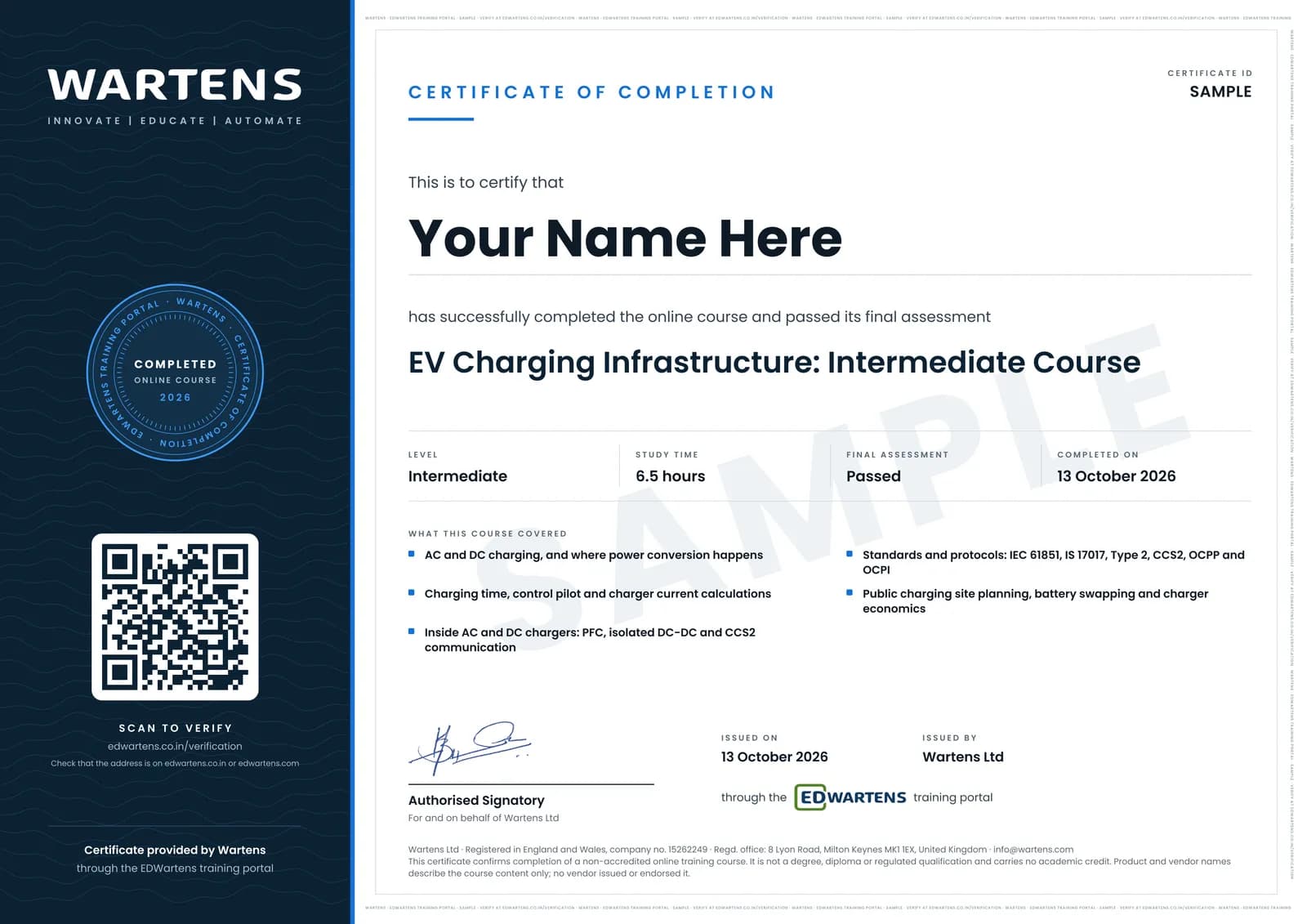
Verifiable by anyone
Adds to LinkedIn in one click
QR code on the certificate
Names what you can do
A permanent link
Earned, not attended
Learning is free. The certificate is optional.
Add it now and pay only when you have finished the course, or come back for it later. One-off, US$28.99, with a receipt.
Issued by Wartens Ltd (England and Wales, company no. 15262249) through the EDWartens training portal, as a Certificate of Completion for this self-paced course. Sold in India by Wartens Automation Private Limited. It is not a vendor certification, a university award or a CPD-accredited activity, and it does not certify competence on live equipment. Delivered electronically; see the refund policy.
Practise what you learn in the free 3D lab
Technical work is judged on what you can do: wiring, commissioning, finding a fault. Doing a task yourself teaches more than watching it a second time, and a lab lets you try it safely before you meet real equipment. It does not replace working on real hardware.
- Practise safely, so a mistake costs nothing.
- The lab checks your work like a site test, so you know when it is right.
- Free, in your browser, with nothing to install.
Why learn with EDWartens
What you get with this course.
- Free from the first lesson to the final assessment.
- Practice in a free 3D lab in your browser, with nothing to install.
- Video lessons with written notes and a project.
- An optional certificate that anyone can verify online.
FAQ
Common questions
Who is the EV Charging Infrastructure course for?
Electrical engineers, site engineers and technicians moving into EV charging, and anyone planning or running charging sites. Basic electrical theory is assumed.
Is this an NPTEL course?
No. It is built on NPTEL's free public lectures from IIT Madras and IIT Roorkee, credited on each module, but it is not the NPTEL programme and is not affiliated with NPTEL or the IITs. EDWartens wrote the notes, practice, project and assessment.
Do I need power electronics?
No. The course explains AC and DC chargers at the block level. The full IIT Roorkee lectures go deeper if you want to.
Does it cover Indian standards?
Yes. It covers IEC 61851 and its Indian adoption in the IS 17017 series, Type 2 and CCS2 connectors, India's earlier Bharat AC-001 and DC-001 standards, and the Ministry of Power's 2024 charging guidelines.
How long does the EV Charging Infrastructure course take?
About 6.4 hours of video lessons across eight teaching modules, plus the notes, practice questions, the final assessment and an optional project of around 8 hours. At a few hours a week it fits into three to four weeks.
What is the project in the EV Charging Infrastructure course?
You plan a fast-charging hub at a highway fuel station on NH48 near Satara: the load list and charger mix, the site design basis from grid connection to OCPP, a risk register and a business case with payback. A worked sample pack shows each document.
Is the EV Charging Infrastructure course really free?
Yes. Every module, the notes, the project and the final assessment. The only paid item is the certificate, if you want it.
What certificate does the EV Charging Infrastructure course give?
An EDWartens Certificate of Completion, issued when you pass the final assessment, with a number anyone can verify on our site.
Do I have to use the lab?
No. The lab is optional practice. You can skip it whenever you like, and it never blocks your progress, the final assessment or your certificate.
Is the lab free?
Yes. Every lab level for this course opens in your browser, free, with nothing to install.
Is the EV Charging Infrastructure course free in India, and what does the certificate cost?
Yes. Learning costs ₹0 in India: every module, the written notes, the practice tasks and the final assessment, with no card and no trial period. The only paid item is the optional EDWartens Certificate of Completion, ₹599 including GST for this intermediate course, paid in rupees through Razorpay, and only if you want it after passing the final assessment.
What topics does the EV Charging Infrastructure course cover, module by module?
The EV Charging Infrastructure course has 9 modules. It opens with "Charging and swapping: the picture", goes through "Slow or fast: charger types", "Inside a DC charger and CCS2", "Public charging stations" and "Economics and analytics of public charging" and ends with "Final Assessment". The full list with minutes is under "What you learn" on this page.
What can I do after the EV Charging Infrastructure course?
After the EV Charging Infrastructure course: Explain AC and DC charging and where conversion happens; Calculate charging times and control pilot currents; Describe what is inside AC and DC chargers. These are the practical outcomes the course is written around, and the final assessment of 15 questions checks them.
What software and hardware do I need for the EV Charging Infrastructure course, and does it cost anything?
For the EV Charging Infrastructure course, software: None required. A spreadsheet for the calculations. Hardware: none. The course itself is free.
Is the EV Charging Infrastructure course suitable for me, and what level is it?
EV Charging Infrastructure is rated intermediate. Intermediate. You should know basic electrical theory: single and three-phase supply, power and current. No power electronics background is needed; the course explains what is inside a charger at the block level. It is written for electrical and site engineers working on EV charging, and has 6h 18m of video lessons at your own pace.
Which jobs use the skills from the EV Charging Infrastructure course?
Skills from the EV Charging Infrastructure course (for example: explain AC and DC charging and where conversion happens) are used in EV charging engineer work. The course gives you practical evidence of the skill; it does not promise a job, and employers decide on experience and interview.
All course factsHide course facts
- Price
- ₹0, free for good. No trial, no card. Comparable classroom training of this length costs about ₹3,999.
- Who it is for
- Electrical and site engineers working on EV charging
- Format
- 9 self-paced modules, 6h 18m of video, written notes, a practice task per module and one final assessment.
- Level
- Intermediate. Intermediate. You should know basic electrical theory: single and three-phase supply, power and current. No power electronics background is needed; the course explains what is inside a charger at the block level.
- Brand
- Vendor-neutral
- Software
- None required. A spreadsheet for the calculations.
- Hardware
- None.
- Certificate
- Optional EDWartens Certificate of Completion, ₹599 inclusive of GST for learners in India, verifiable by code. Not a vendor credential.
- Video lessons by
- NPTEL IIT Madras, NPTEL IIT Roorkee, Juic'd Garage, MG Prodtech, IIT Roorkee July 2018, NPTEL-NOC IITM (independent creators, credited below)
- Language
- English
- Last updated
- 1 November 2026
Pairs well with
 PLC programming · FreeSiemens TIA Portal
 PLC programming · FreeSiemens TIA Portal in Three Hours
 PLC programming · FreeTIA Portal: Build a Machine
 Instrumentation · FreeInstrumentation for PLC Engineers
More free courses: Free electric vehicle courses
Classroom course, Bangalore
PLC training in Bangalore
The Automation Engineer Program (AEP) is our classroom course in PLC programming and industrial automation, taught in person at our Electronic City centre.
Credits
Who made the video lessons
The video lessons in this course were created by the people below, not by EDWartens. Every lesson streams from its creator's own YouTube channel; EDWartens neither hosts nor sells that footage, and the creators are not affiliated with EDWartens and do not endorse this course. What EDWartens wrote is the study plan, the notes, the practice tasks and the assessments.
- NPTEL IIT Madrasthe Fundamentals of Electric Vehicles lectures on charging and swapping infrastructure, slow and fast chargers, standards and on-board chargers, public chargers, bulk charging, battery swapping, economics and analytics
- NPTEL IIT Roorkeethe Charging Infrastructure lectures on AC and DC charger building blocks, Type-2 AC charging and CCS2 DC charging
- Juic'd Garagethe lesson What is OCPP? Why is it important? What does it mean for you?
- MG Prodtechthe lesson OCPP Explained: Everything you need to know in 10 minutes
- IIT Roorkee July 20184 lessons in "Inside an AC charger and Type-2 charging" and "Inside a DC charger and CCS2"
- NPTEL-NOC IITM11 lessons in "Charging and swapping: the picture", "Slow or fast: charger types", "Standards, on-board chargers and OCPP", "Public charging stations", "Battery swapping and bulk charging" and "Economics and analytics of public charging"
If you are one of these creators and would like a lesson removed or credited differently, write to info@edwartens.co.in.