Building automation · Free · ₹0
Fire Fighting Design: Sprinklers, Fire Pumps and Hydrants
Design the water-based fire protection package that MEP consultants and contractors submit for approval: system types, hazard classification, sprinkler layout, hydraulic calculation by hand and in a spreadsheet, standpipes, hydrants and water supply, fire pump selection and the pump room, special systems, then testing, commissioning and maintenance.

Inside the course


From the lessons

Water-based fire protection and the codes behind it
John Novak TR2FD

Sprinklers and the K-factor
Irfan CFPS

Sprinkler layout: spacing, walls and obstructions
Irfan CFPS
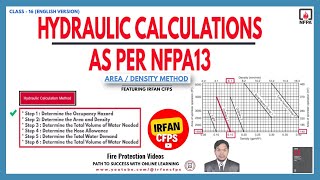
Hydraulic calculation 1: Hazen-Williams, fittings and elevation
Irfan CFPS
Standpipes, landing valves and hose reels
Irfan CFPS

Fire pumps: types, performance curves and selection
Irfan CFPS
Lesson frames belong to the creators named in the Credits below and are shown from YouTube.
What you will learn
Place a project in its code family (NFPA 13, 14, 20, 24 and 25, EN 12845 or a national code); choose wet, dry, preaction or deluge systems; classify hazards and read design densities; lay out sprinklers within spacing and coverage limits; select the remote area and calculate it node by node with Hazen-Williams, balancing branch lines and checking the demand against a water supply curve; design standpipes, hydrants and the fire water tank; select a fire pump against its NFPA 20 curve points and lay out the pump room with its pressure settings and fuel tank; size a clean agent system and list the signals sent to the fire alarm panel; and plan hydrostatic tests, acceptance tests, NFPA 25 maintenance and the design submittal.
- Explain what sprinklers, standpipes, hydrants and fire pumps do and how NFPA 13, 14, 20, 24 and 25 and EN 12845 divide the work
- Choose wet, dry, preaction or deluge systems and apply the design area adjustments that come with each
- Classify hazards, read design densities and work Q = K x sqrt(P) for any sprinkler
- Lay out sprinklers within the coverage, spacing, wall and obstruction limits
- Size the remote area and calculate it node by node with Hazen-Williams, balancing branch lines against a water supply curve
- Design Class I standpipes, run a hydrant flow test and size a fire water tank
- Select a fire pump against its NFPA 20 curve points, lay out the pump room and set the jockey and pump pressures
- Size a clean agent system, list the fire alarm signals, and plan hydrostatic tests, commissioning and NFPA 25 maintenance
The course project · about 18 hours
Fire fighting design for an office over a basement car park: design basis, layout, hydraulic calculation, tank, fire pump and commissioning
Design the water-based fire protection for a three-storey office building over a basement car park as the MEP consultant's fire fighting designer: fix the design basis and hazard classes, lay out and schedule the sprinklers, calculate the two governing remote areas by hand, size the fire water tank, select the fire pump and set its pressures, list the fire alarm signals and write the commissioning sheet. The sample pack shows each document for a building in Panama City, Panama, designed to NFPA 13, 14, 20 and 24.
Sample document pack, 6 documents, filled in for the scenario
- PlanFire fighting design basis: Mirador Office Building
- RegisterSprinkler layout check and area schedule
- ReportHydraulic calculation report: car park and level 2 office remote areas
- DatasheetFire water tank and fire pump set
- RegisterFire fighting signals for the fire alarm designer
- Commissioning procedureCommissioning sheet: sprinklers, standpipes and fire pumps
Read inside the course and download as a workbook. The project is optional practice, marked when you submit it; the certificate needs only the modules and the final assessment.
Course content
15 modules · 77 lessons · 14h 47m
In order, at whatever pace suits you. Each module ends with a practice task that builds on the last.
- 01Water-based fire protection and the codes behind it3 lessons37m
- 02Sprinkler system types: wet, dry, preaction and deluge7 lessons57m
- 03Sprinklers and the K-factor4 lessons1h 8m
- 04Hazard classification and design density4 lessons40m
- 05Sprinkler layout: spacing, walls and obstructions4 lessons1h 5m
- 06Design approach: pipe schedule, density/area and the remote area6 lessons1h 14m
- 07Hydraulic calculation 1: Hazen-Williams, fittings and elevation6 lessons1h 4m
- 08Hydraulic calculation 2: balancing, the demand point and the worksheet7 lessons1h 33m
Requirements
- Who it is for
- Intermediate. For mechanical and MEP engineers, draughtsmen and site engineers moving into fire fighting design. You should know basic fluid flow (flow, pressure, friction) and use a spreadsheet; no fire protection experience is needed.
- Software
- A spreadsheet (LibreOffice Calc is free) for the hydraulic calculator built in the course, and LibreCAD, AutoCAD or squared paper for the layouts. NFPA offers free read-only online access to its standards after a free account is made. What to download, and how
- Hardware
- None. Every exercise is done with a spreadsheet and a drawing tool or squared paper.
Software you need
What to download, where from, what it costs and how to install it. Every link goes to the maker's own site, never a mirror.
Nothing to install
A spreadsheet is enough for every hydraulic calculation, and the layouts can be drawn by hand or in a free tool such as LibreCAD. AutoCAD is useful but optional. NFPA offers free read-only access to its standards online after a free account is made.
Optional
Useful, not needed to finish the course.
- 01Free
LibreOffice
The Document Foundation
- Runs on
- Windows 10 or 11, macOS 11 or newer (Intel or Apple silicon), Linux
- Account
- None needed
- Size
- up to 1.5 GB of disk space on Windows
LibreOffice is free, open-source software under the Mozilla Public License 2.0, for any use including business. Calc is its spreadsheet.
Steps
- 1.Open the LibreOffice download page.
- 2.Check the page has picked your operating system, then select Download.
- 3.Run the installer (administrator rights are needed on Windows).
- 4.Start LibreOffice Calc for spreadsheet work.
- 5.Save as .xlsx if you need to share files with Excel users.
- Choose the latest main version unless your organisation asks for the older, more conservative release.
Official download pagelibreoffice.org - 02Free trial: 15 days
AutoCAD
Autodesk
- Runs on
- Windows 10 or 11 64-bit; AutoCAD for Mac on recent macOS versions
- Account
- A free Autodesk account
- Size
- about 10 GB of disk space for AutoCAD on Windows
The AutoCAD trial lasts 15 days in most regions (30 in a few), expires on its own and cannot be extended. Students and educators can get free one-year educational access through an Autodesk Education plan, renewable while they stay eligible; education licences are for learning only.
Steps
- 1.Open the AutoCAD free trial page on autodesk.com and select Download free trial.
- 2.Sign in to your Autodesk account, or create one.
- 3.Answer the short questions about how you will use AutoCAD.
- 4.Download the installer from your Autodesk account and run it.
- 5.Start AutoCAD and sign in with the same Autodesk account.
- If you are a student or teacher, use the Autodesk Education route instead: it lasts a year, not 15 days.
- Plan your practice before starting the trial, since it cannot be extended.
Official download pageautodesk.comAlternatives
- Autodesk Education plan: Free one-year access for verified students and educators, renewable while eligible.
- LibreCAD: Free open-source 2D CAD if you only need basic drafting practice.
Checked against each maker's own page on 27 September 2026. Trial lengths and editions change; the maker's page is the final word.
Fire Fighting Design: Sprinklers, Fire Pumps and Hydrants at a glance
Fire Fighting Design: Sprinklers, Fire Pumps and Hydrants is a free, self-paced online course from EDWartens for mechanical and MEP engineers, draughtsmen and site engineers at consultants and contractors in the Gulf and worldwide who design, submit or install sprinkler, standpipe and fire pump systems. It has 15 modules and 14h 47m of video lessons by Irfan CFPS, NSVCad, John Novak TR2FD and others, with written notes and worked problems, a practical project with a document pack and a 15-question final assessment (pass mark 60%). Learning is free with an account; an optional certificate with a public verification code is issued when you pass. Last updated 27 September 2026.
All course factsHide course facts
- Price
- ₹0, free for good. No trial, no card. Comparable classroom training of this length costs about ₹8,999.
- Who it is for
- Mechanical and MEP engineers, draughtsmen and site engineers at consultants and contractors in the Gulf and worldwide who design, submit or install sprinkler, standpipe and fire pump systems
- Format
- 15 self-paced modules, 14h 47m of video, written notes, a practice task per module and one final assessment.
- Level
- Intermediate. Intermediate. For mechanical and MEP engineers, draughtsmen and site engineers moving into fire fighting design. You should know basic fluid flow (flow, pressure, friction) and use a spreadsheet; no fire protection experience is needed.
- Brand
- Vendor-neutral
- Software
- A spreadsheet (LibreOffice Calc is free) for the hydraulic calculator built in the course, and LibreCAD, AutoCAD or squared paper for the layouts. NFPA offers free read-only online access to its standards after a free account is made.
- Hardware
- None. Every exercise is done with a spreadsheet and a drawing tool or squared paper.
- Certificate
- Optional EDWartens Certificate of Completion, verifiable by code. Not a vendor credential.
- Video lessons by
- Irfan CFPS, NSVCad, John Novak TR2FD, Project Fire, FPE Learning with Alam, TheHoseMonsterCompany, CalifDGS, MeyerFire, Flameguard Fire Protection Philippines, WAGNER Group GmbH, Renewable Fuels Association, Viking Group, Inc., FIRE PROTECTION GUY, GPSTC Productions, McWane Ductile, Konken, Leann, National Fire Protection Association, Louisiana State Fire Marshal, Jason Schroeder (independent creators, credited below)
- Language
- English
- Last updated
- 27 September 2026
A shareable EDWartens certificate
Finish every module and pass the final assessment, and the optional EDWartens certificate is yours. It carries a unique verification code on a public page anyone can check, so it stands up when a recruiter looks it up. See it below.
The course itself stays free whether or not you ever buy one.
Stuck? Ask a practising engineer
A free course usually means a comment section and hope. This one does not. Every module has an Ask-your-trainer panel that reaches the same engineers who teach our paid programme: people who commission panels for a living, not moderators.
Pairs well with
 PLC programming · FreeSiemens TIA PortalFrom zero electrical knowledge to a working, simulated S7-1200 program, for nothing.
 PLC programming · FreeSiemens TIA Portal in Three HoursThe first three hours of the Siemens TIA Portal course, cut to end on a win: what a PLC is, how it is wired, a project configured in TIA Portal, and your first ladder program running in simulation. Finish it in an evening or two, earn a certificate, and carry straight on into the full course.
 PLC programming · FreeTIA Portal: Build a MachineOne machine, start to finish. Take a bottle filling line from a written specification and an I/O list to a structured S7-1200 program with a fill station, a capper, a reject sorter and an operator screen with alarms, then test it against a written record and archive it for hand-over. The lessons are the reference; the machine is yours, and it is what you submit.
 Instrumentation · FreeInstrumentation for PLC EngineersThe half of the loop that is not code. Follow one measurement from the transmitter in the field, down the 4-20 mA loop, into the analog card, through NORM_X and SCALE_X into engineering units, out again to a valve, and back to the control room when the reading is wrong.
More free courses: Free BMS and building automation courses
Classroom course, Bangalore
PLC training in Bangalore
The Automation Engineer Program (AEP) is our classroom course in PLC programming and industrial automation, taught in person at our Electronic City centre.
Learner reviews
No reviews yet
Reviews here are written only by learners who have finished every module of Fire Fighting Design: Sprinklers, Fire Pumps and Hydrants, and they are published exactly as written. Finish the course and yours will be the first.
Common questions
Who is this fire fighting design course for?
It is for mechanical and MEP engineers, draughtsmen and site engineers at consultants and contractors who are moving into fire fighting design, and for HVAC and plumbing engineers widening into fire protection. You should know basic fluid flow and use a spreadsheet; no fire protection experience is needed.
Is the course free to learn?
Yes. Every module, the notes, the worked problems, the project and the final assessment are free, and the software it uses is free. The certificate is optional.
Which codes and standards does it follow?
NFPA 13 (2025 edition) for sprinklers, NFPA 14 (2024) for standpipes, NFPA 20 (2025) for fire pumps, NFPA 24 (2025) for underground mains and NFPA 25 (2026) for maintenance, with EN 12845 compared where it differs. The notes explain the rules in their own words and never reproduce the standards; NFPA offers free read-only access to its standards online after a free account is made.
Does it cover the rules in my country?
It teaches the method and the NFPA family that most national codes build on, and shows how to read whichever code your project adopts. The United States and many other countries adopt NFPA standards through their building and fire codes, and Europe designs sprinklers to EN 12845. In India, Part 4 of the National Building Code and the related IS standards apply, and in the Gulf each civil defence authority publishes its own code, such as the UAE Fire and Life Safety Code or SBC 801 in Saudi Arabia, and approves contractors and products. Local regulations and the authority always govern.
Can I design a real sprinkler system after this course?
You will be able to prepare a design pack that a senior engineer can review: layouts, a hydraulic calculation, a tank and pump selection and a commissioning sheet. Fire fighting systems are life safety systems, so a real design must be done or checked by a competent engineer under local regulations, and in many places only an approved designer or contractor may submit it.
Which software do I need?
A spreadsheet such as LibreOffice Calc for the hydraulic calculator you build in the course, and LibreCAD, AutoCAD or squared paper for the layouts. Commercial hydraulic software is not needed.
How long does the Fire Fighting Design course take?
About 23 hours of video, notes and practice at your own pace, of which about 15 hours is video. The optional office building project takes about 18 hours more.
What certificate does the Fire Fighting Design course give?
An EDWartens certificate of completion, issued when you finish the modules and pass the 15-question final at 60 percent, with a number anyone can verify on our site. The course covers much of the knowledge used in NFPA 13, 14 and 20 design and tested in exams such as NICET Water-Based Systems Layout, but it is not an NFPA certification (such as CFPS), a NICET level or a civil defence approval, and none of them is affiliated with EDWartens.
Is the Fire Fighting Design course free in India, and what does the certificate cost?
Yes. Learning costs ₹0 in India: every module, the written notes, the practice tasks and the final assessment, with no card and no trial period. The only paid item is the optional EDWartens Certificate of Completion, ₹559 including GST for this intermediate course, paid in rupees through Razorpay, and only if you want it after passing the final assessment.
What you walk away with
Your certificate for Fire Fighting Design: Sprinklers, Fire Pumps and Hydrants
Finish the course, pass the final, and this is the document with your name on it.

Verifiable by anyone
Adds to LinkedIn in one click
QR code on the certificate
Names what you can do
A permanent link
Earned, not attended
Learning is free. The certificate is optional.
Add it now and pay only when you have finished the course, or come back for it later. One-off, US$28.99, with a receipt.
Issued by EDWartens India (Wartens Automation Private Limited) as a Certificate of Completion for this self-paced course. It is not a vendor certification, a university award or a CPD-accredited activity, and it does not certify competence on live equipment. Delivered electronically; see the refund policy.
Credits
Who made the video lessons
The video lessons in this course were created by the people below, not by EDWartens. Every lesson streams from its creator's own YouTube channel; EDWartens neither hosts nor sells that footage, and the creators are not affiliated with EDWartens and do not endorse this course. What EDWartens wrote is the study plan, the notes, the practice tasks and the assessments.
- Irfan CFPSthe NFPA 13, 14, 20 and 25 lessons: system types, sprinklers, hazards and commodities, layout, pipe sizing and hangers, the eleven-step hydraulic calculation series, standpipes, hydrant flow tests, tank capacity, fire pump types, curves, sizing, pump room design, settings and diesel tanks, clean agents and submittals
- NSVCadthe NFPA 13 series on the K-factor, flow and pressure, density, the five-part design area series, CMSA and ESFR sprinklers, the step-by-step hydraulic calculation, the detailed worksheet and the hose stream allowance
- John Novak TR2FDthe overview of sprinklers, standpipes and fire pumps that opens the course
- Project Firethe Sprinkler Talk episode on obstruction rules
- FPE Learning with Alamthe comparison of standpipe system types
- TheHoseMonsterCompanyhow a standpipe flow test is performed
- CalifDGSthe lecture on underground fire service mains and water supply
- MeyerFirehow a fire pump works
- Flameguard Fire Protection Philippinesthe summary of NFPA 20 requirements for the pressure sensing line
- WAGNER Group GmbHhow inert gas extinguishing works
- Renewable Fuels Associationthe training module on fire fighting foam principles
- Viking Group, Inc.the activation of a high expansion foam deluge system
- FIRE PROTECTION GUYa valve tamper switch signalling the fire alarm panel
- GPSTC Productionsthe components of a wet sprinkler system, the main drain test and inspection
- McWane Ductilehow to conduct a hydrostatic test on ductile iron pipe
- Konken, Leannan electric fire pump test
- National Fire Protection Associationwhat NFPA 25 requires for sprinkler inspections
- Louisiana State Fire Marshalthe shop drawing review process
- Jason Schroederhow construction submittals are prepared and reviewed
If you are one of these creators and would like a lesson removed or credited differently, write to info@wartens.com.