Motor Full Load Current Chart at 415 V (kW and HP)

The short answer
The full-load current of a 3-phase motor is I = P / (√3 x V x pf x η), with P the rated output in watts. At 415 V, a typical 4-pole motor draws about 1.7 A at 0.75 kW (1 HP), 7.3 A at 3.7 kW (5 HP), 14 A at 7.5 kW (10 HP), 27 A at 15 kW (20 HP) and 127 A at 75 kW (100 HP). These are typical figures; the real current depends on the manufacturer, efficiency class and number of poles, so for setting an overload always use the current printed on the nameplate.
The formula
For a 3-phase motor:
I = (P x 1000) / (1.732 x V x pf x η)
- P is the rated output power in kW, as on the nameplate. (1 HP = 0.746 kW.)
- V is the line-to-line voltage, 415 V on most Indian LT supplies (newer IEC motors are often rated 400 V).
- pf is the power factor at full load, typically 0.72 for a very small motor rising to about 0.87 at 75 kW.
- η is the efficiency at full load, as a decimal. Because P is output power, you divide by efficiency to get the input power the supply has to deliver.
For a single-phase motor, drop the √3: I = (P x 1000) / (V x pf x η).
Typical full-load current chart at 415 V
Calculated with typical 4-pole IE2-class power factor and efficiency for each size. Real motors differ by a few percent either way, and 2-pole and 6-pole motors differ more.
| kW | HP | Typical pf | Typical efficiency | FLC at 415 V (A) | FLC at 400 V (A) |
|---|---|---|---|---|---|
| 0.37 | 0.5 | 0.72 | 70% | 1.0 | 1.1 |
| 0.75 | 1 | 0.76 | 79% | 1.7 | 1.8 |
| 1.1 | 1.5 | 0.78 | 81% | 2.4 | 2.5 |
| 1.5 | 2 | 0.80 | 83% | 3.1 | 3.3 |
| 2.2 | 3 | 0.81 | 84.5% | 4.5 | 4.6 |
| 3.7 | 5 | 0.82 | 86.5% | 7.3 | 7.5 |
| 5.5 | 7.5 | 0.83 | 87.5% | 10.5 | 10.9 |
| 7.5 | 10 | 0.84 | 89% | 14.0 | 14.5 |
| 11 | 15 | 0.85 | 90% | 20.0 | 20.8 |
| 15 | 20 | 0.86 | 91% | 26.7 | 27.7 |
| 18.5 | 25 | 0.86 | 91.5% | 32.7 | 33.9 |
| 22 | 30 | 0.86 | 92% | 38.7 | 40.1 |
| 30 | 40 | 0.86 | 93% | 52.2 | 54.1 |
| 37 | 50 | 0.87 | 93% | 63.6 | 66.0 |
| 45 | 60 | 0.87 | 93.5% | 77.0 | 79.8 |
| 55 | 75 | 0.87 | 94% | 93.6 | 97.1 |
| 75 | 100 | 0.87 | 94.5% | 126.9 | 131.7 |
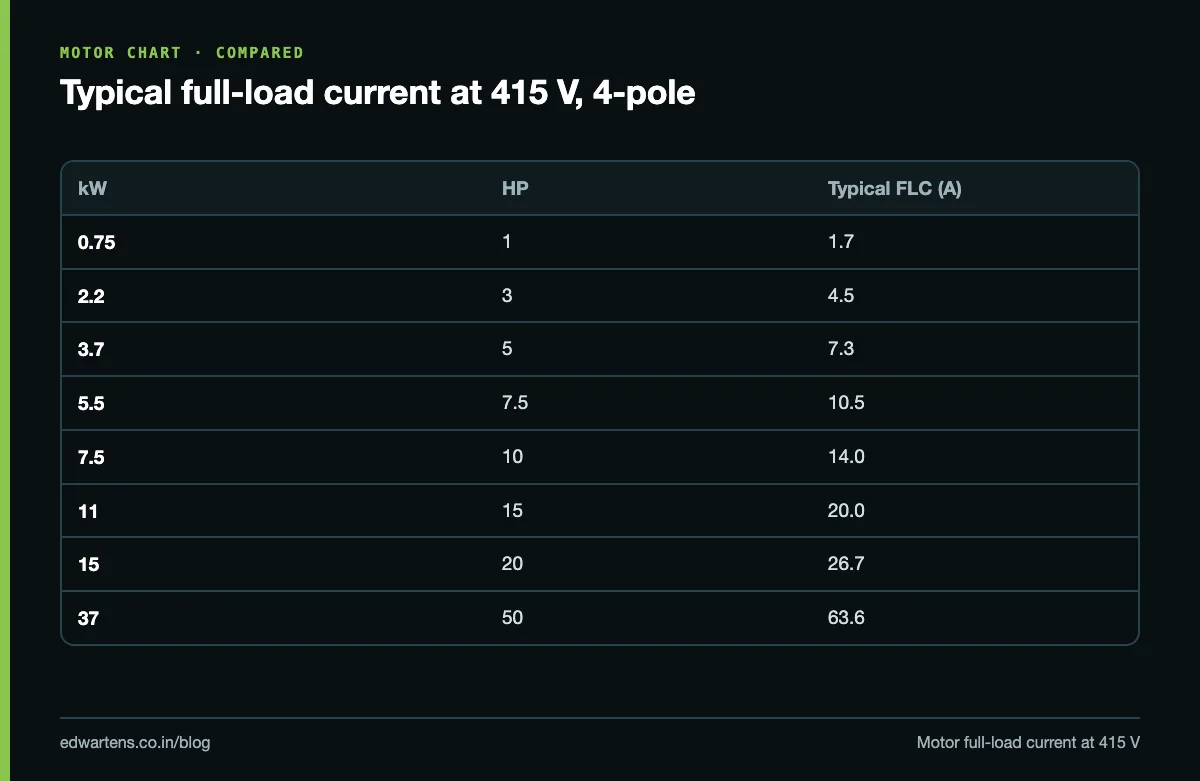
Different published charts give slightly different numbers for the same rating because they assume different power factors and efficiencies. That is normal. If two charts disagree by 5%, neither is wrong; they describe different motors.
The "2 A per kW" rule of thumb, and where it misleads
Electricians in India often say a 415 V motor draws about 2 A per kW. Compare it with the table:
- From about 2 kW to 7.5 kW it is close: 3.7 kW gives 7.4 A by the rule and 7.3 A by the table.
- Above about 11 kW it overstates, by up to about 18% at 75 kW (150 A by the rule, 127 A typical), because large motors are more efficient and have better power factor.
- Below 1 kW it understates, by about 25% at 0.37 kW (0.74 A by the rule, 1.0 A typical), because small motors have poor power factor and efficiency.
Use the rule to sanity-check a number in your head. Never use it to set an overload.
Worked example: a 7.5 kW motor
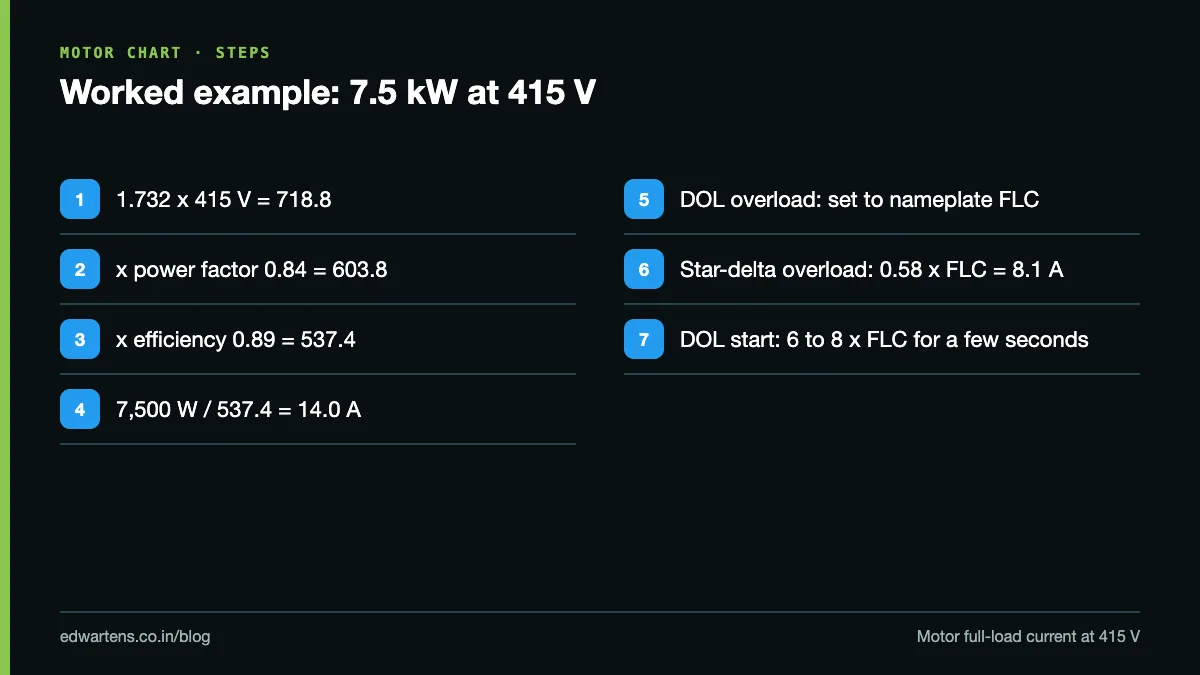
A 7.5 kW (10 HP), 4-pole motor at 415 V, with a nameplate power factor of 0.84 and efficiency of 89%.
- √3 x V = 1.732 x 415 = 718.8
- x pf: 718.8 x 0.84 = 603.8
- x η: 603.8 x 0.89 = 537.4
- I = 7,500 / 537.4 = 14.0 A
What that number decides:
- Overload relay (DOL starter): set it to the nameplate FLC, here about 14 A. Choose a relay whose adjustment range puts 14 A comfortably inside it, not at the very end.
- Overload relay (star-delta starter): the overload usually sits in the line to the motor windings, which carries phase current. Set it to FLC / √3, about 0.58 x 14 = 8.1 A. Setting 14 A there leaves the motor effectively unprotected.
- Starting current: a DOL start typically draws 6 to 8 times FLC for a few seconds, so roughly 85 to 110 A here. That is what the breaker or fuse must ride through without tripping, and what causes voltage dip on a weak supply.
- Cable: sized for at least the FLC after derating (grouping, ambient temperature, installation method), then checked for voltage drop at running and at starting current. Our cable sizing guide walks through it.
Why the nameplate wins
The table is for estimating: sizing a feeder before the motor is bought, checking a quotation, answering an interview question. Once the motor is on site, read the nameplate, because:
- Efficiency class changes the current. An IE3 motor is more efficient than an IE2 of the same rating and draws a little less.
- Poles change power factor. A 6-pole or 8-pole motor has a lower power factor than a 4-pole of the same kW, so it draws more current.
- Rated voltage matters. A motor rated 400 V running on 415 V, or 380 V, will not draw the 415 V table current.
- Manufacturers differ. Two 7.5 kW motors from different makers can differ by several percent.
- Rewound motors may no longer match anything in a catalogue.
The nameplate also gives the service factor (if any), the connection (star or delta at which voltage), the insulation class and the rated speed. The overload relay protects that particular motor, so its setting comes from that particular nameplate.
Starter choice by size
As a general pattern in Indian plants, DOL starting is common for small motors, up to around 7.5 kW, and star-delta, soft starters or VFDs are used above that to limit starting current. The real limit depends on the supply's strength, the electricity supplier's rules and the load, not on a fixed number. The comparison in DOL vs star-delta vs soft starter vs VFD explains how to choose, and how to select a contactor, overload relay and breaker takes the FLC from this page and turns it into part numbers.
On a VFD, the drive's own motor overload protection is set from the nameplate current in the motor parameters, which is one more reason to read the plate. See setting up a VFD for the first time.
Use the free calculator
The Motor and VFD Calculator needs no sign-up. Enter the rated power in kW or HP, the voltage, power factor and efficiency, and choose 3-phase or 1-phase and 50 Hz or 60 Hz. It returns the full-load current using the formula above, plus synchronous speed, slip from the nameplate speed, rated torque, the V/Hz ratio and the speed and voltage at a reduced drive frequency. Put in the nameplate pf and efficiency and you get the same 14.0 A as the worked example.
Common mistakes
- Using input kW as output kW. The nameplate kW is shaft output; divide by efficiency.
- Forgetting √3 on a 3-phase motor, which overstates current by 73%.
- Setting a star-delta overload to full FLC when it carries phase current.
- Treating the chart as the setting. It is an estimate; the nameplate is the setting.
- Mixing HP and kW. A "10" on an old motor may be HP; 10 HP is 7.5 kW, not 10 kW.
Learn it free
The free Industrial Motor Control course covers selecting contactors, overloads, fuses and breakers, wiring DOL and reversing starters, reduced-voltage starting and troubleshooting control circuits. Variable Frequency Drives covers setting motor nameplate parameters, wiring and controlling a drive from a PLC. If you need the basics of voltage, current and power first, start with Electrical Fundamentals for Technicians.
Frequently asked questions
Q: What is the full-load current of a 7.5 kW motor at 415 V?
A: About 14 A for a typical 4-pole motor with power factor 0.84 and efficiency 89%. Check the nameplate for the exact figure.
Q: How much current does a 1 HP 3-phase motor draw at 415 V?
A: About 1.7 A typically. 1 HP is 0.75 kW, and small motors have a lower power factor and efficiency, so the current is higher than the 2 A per kW rule suggests.
Q: What is the formula for 3-phase motor current?
A: I = (P x 1000) / (1.732 x V x pf x η), with P the output power in kW, V the line voltage, pf the power factor and η the efficiency as a decimal.
Q: Should I set the overload relay from a chart?
A: No. Set it from the full-load current on the motor nameplate. For a star-delta starter with the overload in the winding circuit, set it to about 0.58 times the nameplate FLC.
Q: Why does my motor chart differ from another chart?
A: Each chart assumes a power factor and efficiency. Different efficiency classes, pole numbers and manufacturers give different values, so a few percent difference between charts is normal.
Learn this, free
The courses that teach this
Every lesson, the written notes and the practice are free with an account. Only the certificate is optional and paid.