MCB vs MCCB vs RCCB vs ELCB vs RCBO: the differences

The short answer
An MCB and an MCCB protect cables against overload and short circuit; the MCB covers small final circuits up to about 63 A in Indian boards (the standard allows up to 125 A), the MCCB covers feeders and incomers from about 16 A to 1,600 A with adjustable settings. An RCCB protects people against earth leakage (30 mA) but gives no overcurrent protection, so it always needs an MCB or fuse with it. An RCBO is an MCB and an RCCB in one device for a single circuit, and "ELCB" is an old name: the voltage-operated ELCB is obsolete, and the current-operated one is what we now call an RCCB.
What each device protects against
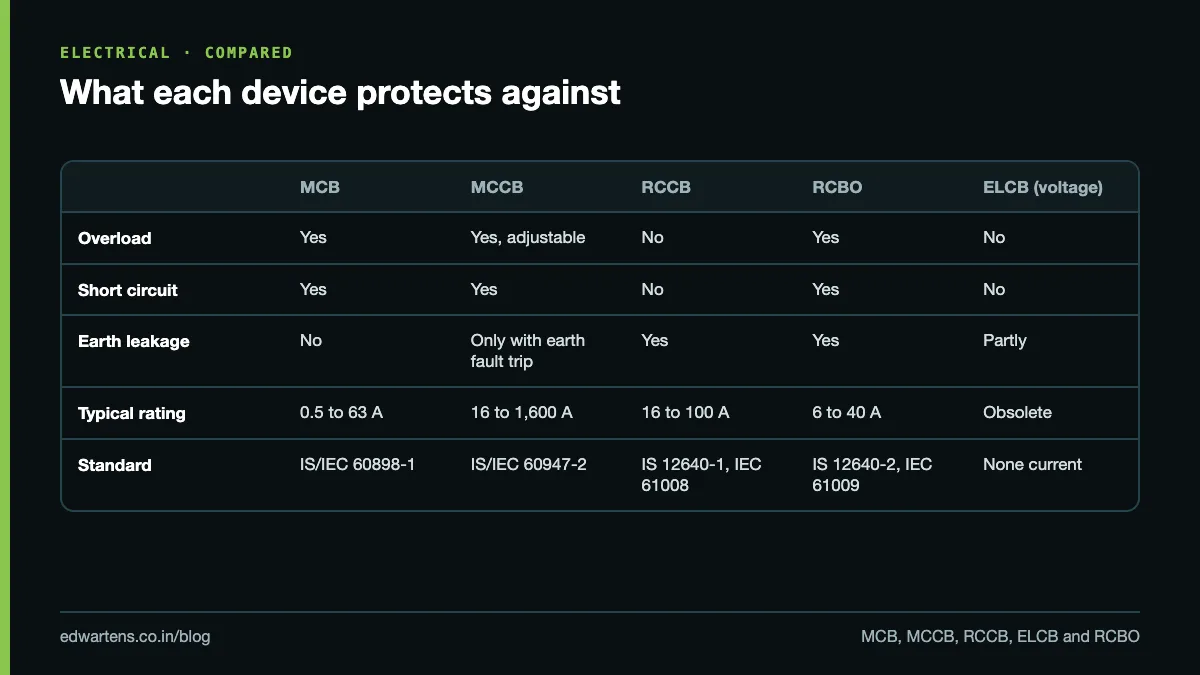
| Device | Overload | Short circuit | Earth leakage | Typical rating | Standard |
|---|---|---|---|---|---|
| MCB | Yes, thermal | Yes, magnetic | No | 0.5 to 63 A (to 125 A in the standard) | IS/IEC 60898-1 (IEC 60947-2 for industrial MCBs) |
| MCCB | Yes, often adjustable | Yes, often adjustable | Only with an earth fault release or add-on | About 16 to 1,600 A | IS/IEC 60947-2 |
| RCCB | No | No | Yes, 10/30/100/300 mA | 16 to 100 A common | IS 12640 (Part 1), IEC 61008-1 |
| RCBO | Yes | Yes | Yes | 6 to 40 A common (to 125 A in the standard) | IS 12640 (Part 2), IEC 61009-1 |
| ELCB (voltage type) | No | No | Only fault current that returns through its own earth wire | Obsolete | None current |
Overload is a modest overcurrent that slowly overheats a cable; short circuit is a fault current many times rated that must clear in milliseconds; earth leakage returns through earth, often through a person. A few tens of milliamps of leakage is far below any breaker's rating, so only a residual current device can see it.
MCB: miniature circuit breaker
An MCB has two trip mechanisms. A bimetal strip bends with heat and trips on overload; a magnetic coil trips instantly on short circuit. Under IEC 60898-1, at 1.13 times rated current (In) it must not trip within one hour, and at 1.45 times In it must trip within one hour (for ratings up to 63 A). That is why a 16 A MCB can carry 17 or 18 A for a long time: it is protecting the cable, not acting as a precise current limiter.
The breaking capacity (Icn) is the largest fault current it can safely interrupt. Standard values include 3 kA, 4.5 kA, 6 kA and 10 kA. In Indian homes and commercial boards close to the distribution transformer, choose 10 kA; never pick an MCB with a breaking capacity below the prospective fault current at that board.
B, C and D trip curves
The curve letter sets where the instant magnetic trip starts, as a multiple of In.
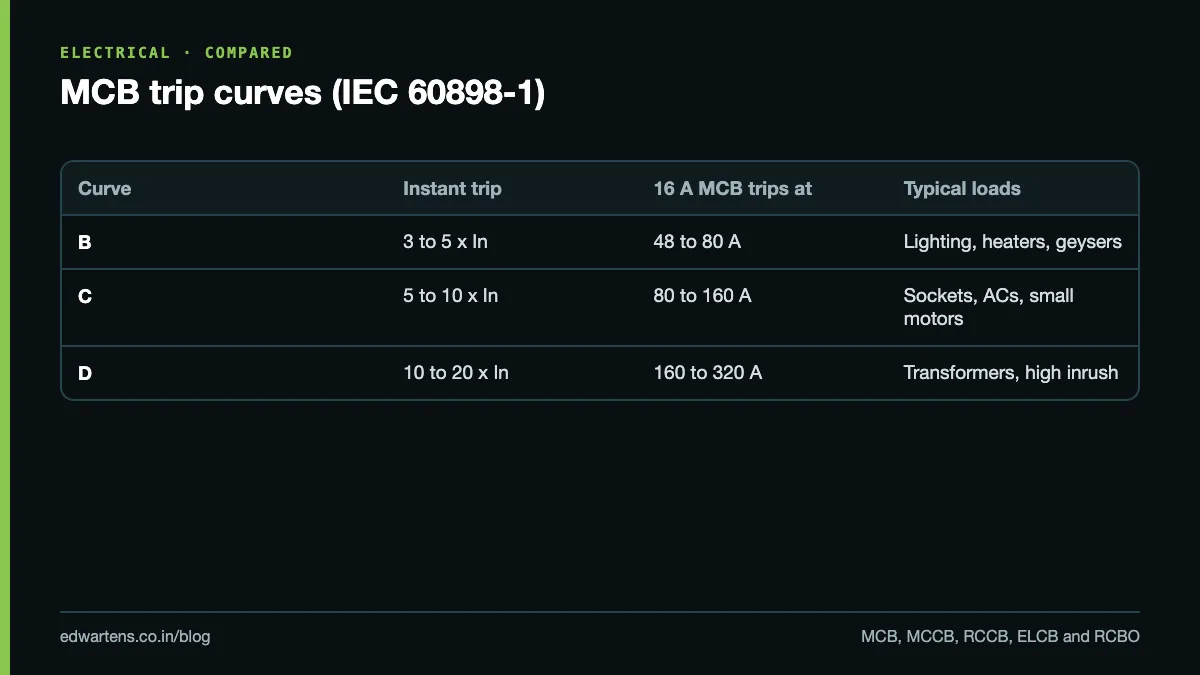
| Curve | Instant trip (IEC 60898-1) | Typical loads |
|---|---|---|
| B | 3 to 5 times In | Lighting, resistive heaters, geysers, long cable runs |
| C | 5 to 10 times In | Sockets, air conditioners, small motors, fluorescent and LED drivers, control transformers |
| D | 10 to 20 times In | Transformers, welding sets, motors with high starting current |
A B16 trips instantly somewhere between 48 A and 80 A; a C16 between 80 A and 160 A; a D16 between 160 A and 320 A. A D curve rides through inrush but needs a lower earth loop impedance to clear a far-end fault quickly, so pick the lowest curve that does not nuisance-trip.
MCCB: moulded case circuit breaker
An MCCB does an MCB's job at higher currents and fault levels. What matters in a panel:
- Ratings. Frame sizes run from about 16 A to 1,600 A in most ranges. Above that, an air circuit breaker (ACB) usually takes over, also under IEC 60947-2.
- Breaking capacity. Two figures: Icu, the ultimate breaking capacity, and Ics, the service breaking capacity it can interrupt and still remain in service, given as a percentage of Icu. Icu figures of 25 kA to over 100 kA are common, depending on frame and series.
- Adjustable settings. Thermal-magnetic releases usually let you set the overload pickup (Ir) to a fraction of In and sometimes the magnetic pickup. Electronic releases add long time, short time, instantaneous and earth fault settings (LSI or LSIG), which allow proper discrimination between incomer and outgoing feeders.
- Accessories. Shunt trip, undervoltage release, auxiliary contacts and motor operators.
RCCB: residual current circuit breaker
An RCCB passes the phase and neutral (or all three phases and neutral) through a core balance transformer. In a healthy circuit the currents cancel. If some current leaks to earth, the imbalance induces a signal and the device trips. It has no overload or short-circuit protection, so it must be backed by an MCB, MCCB or fuse of a rating the RCCB maker allows.
Sensitivity (IΔn):
| IΔn | Purpose |
|---|---|
| 10 mA | Special cases where the designer wants extra sensitivity, for example a single bathroom or lab circuit |
| 30 mA | Additional protection of people against electric shock; sockets, bathrooms, outdoor and portable equipment |
| 100 mA | Protection of a group of circuits where 30 mA would nuisance-trip; equipment protection |
| 300 mA | Fire protection and upstream (often time-delayed, type S) protection of a whole installation |
A 30 mA RCCB must trip at 30 mA and may hold below 15 mA (half of IΔn). For a general (non-delayed) device, the maximum break time at IΔn is 300 ms, and at 5 times IΔn it is 40 ms. Only 30 mA or less counts as protection for people; 100 and 300 mA devices protect installations against fire and equipment damage.
Type matters as much as sensitivity:
- Type AC detects sinusoidal AC leakage only.
- Type A also detects pulsating DC from electronic loads such as inverter ACs and washing machines; the sensible default for a modern home.
- Type F adds mixed-frequency leakage from single-phase VFD loads.
- Type B also detects smooth DC leakage, which three-phase VFDs, solar inverters and EV chargers can produce. Check what the equipment maker specifies.
ELCB: why the name is confusing
"ELCB" has meant two different devices.
- The voltage-operated ELCB measures the voltage between the equipment's metal body and a separate reference earth electrode. If the body rises above a threshold, it trips. It fails silently if the frame finds another path to earth (a water pipe, a parallel earth), and it cannot see a person touching a live conductor while standing on the ground, because that current never flows through the ELCB's earth wire. It is obsolete and should be replaced when found.
- The current-operated ELCB works on residual current, exactly like an RCCB. That is the device most Indian electricians and shops still call an ELCB.
If a shop offers you an "ELCB" with IΔn in mA and IS 12640 or IEC 61008 on the label, it is an RCCB.
RCBO: residual current breaker with overcurrent protection
An RCBO combines an MCB and an RCCB for one circuit: overload, short circuit and earth leakage, with a curve (B or C), a rated current and an IΔn on the label. Its advantage is selectivity: an earth fault on the geyser circuit trips only the geyser, not every circuit under a shared RCCB. It costs more per way, so Indian boards usually use one RCCB per group of MCBs and RCBOs only where that selectivity matters.
Where each one goes in an Indian DB or panel
Home or small office distribution board (single phase):
- Incomer: a double-pole MCB or isolator after the energy meter, for example 40 A or 63 A.
- RCCB: 2-pole, 30 mA type A covering sockets, bathrooms and outdoor circuits. Some boards split lighting and sockets across two RCCBs so one leak does not black out the house.
- Outgoing MCBs: B6 or B10 for lighting, C16 for power sockets and air conditioners, B16 or B20 for a geyser, each sized to its cable.
For a three-phase supply, use a 4-pole MCB or MCCB incomer and a 4-pole RCCB, and keep each circuit's neutral on the same RCCB as its phase.
Industrial control panel:
- Incomer: MCCB, or an ACB for large incomers (commonly from about 800 A upward), sized for the panel load and the fault level at the main switchboard.
- Motor feeders: a motor protection circuit breaker (MPCB) with contactor, or MCCB with contactor and overload relay, coordinated per IEC 60947-4-1. An MCB alone does not give motor overload protection, because it is set to protect the cable, not the motor's full-load current.
- Control circuit: a C-curve MCB on the control transformer secondary and on the 24 V DC power supply input, because both draw inrush.
- RCCB: 30 mA on the panel's service socket and lighting. Feeding VFDs from a 30 mA RCCB causes nuisance tripping from filter leakage; where earth leakage protection is required on a drive, use the type and sensitivity the drive maker specifies.
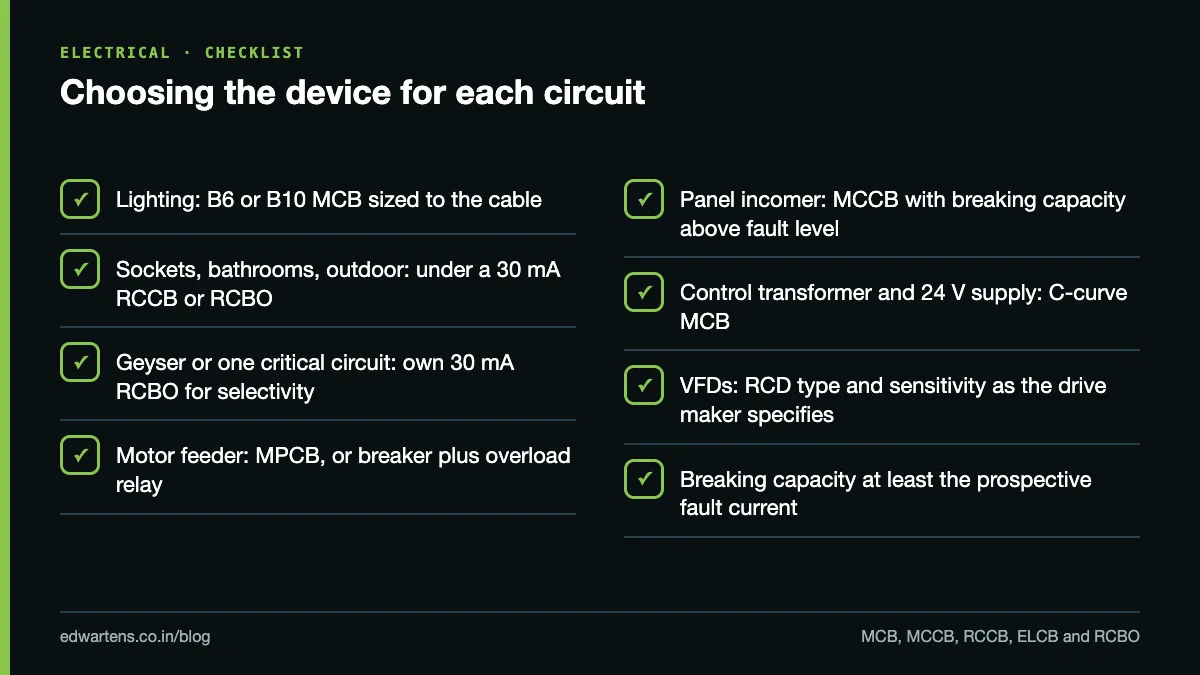
Three selection examples
A 2 kW geyser on 230 V. Current = 2,000 / 230 = 8.7 A, a purely resistive load. A B16 MCB on 2.5 sq mm copper cable is a common choice, with the circuit under a 30 mA RCCB or on its own 30 mA RCBO, since water and electricity meet.
A split air conditioner. Read the rated current and the recommended breaker from the nameplate or installation manual. The compressor's starting current makes a C curve the normal choice, and the manufacturer's breaker size takes priority over any rule of thumb.
A 7.5 kW, 415 V induction motor started DOL. Full-load current is about 14 to 15 A (check the nameplate), and starting current is typically 6 to 8 times that, around 85 to 120 A. A C16 MCB, whose instant trip can start at 80 A, may trip on starting. Use an MPCB set to the full-load current, or a breaker plus overload relay, as explained in selecting a contactor, overload relay and breaker. The 415 V motor full-load current chart lists the currents for other sizes, and the Motor and VFD Calculator works them out.
Common mistakes
- Using an RCCB as the only protection on a circuit. It has no overcurrent trip.
- Sharing one neutral between circuits on two different RCCBs, or taking a neutral from outside the RCCB. The imbalance trips it at random.
- Putting every circuit under one 30 mA RCCB. Normal leakage from many appliances adds up and causes nuisance trips; split the circuits across two RCCBs or use RCBOs.
Learn it free
Cable sizing, breaker selection, discrimination and DB design are taught in the free Electrical Design Engineering course. If you are starting from volts, amps and a multimeter, take Electrical Fundamentals for Technicians first; to build and test a panel that uses these devices, follow Electrical Control Panel Design, Building and Testing. All three are free with an account, with written notes and a final assessment.
Frequently asked questions
Q: What is the main difference between an MCB and an RCCB?
A: An MCB trips on overload and short circuit to protect cables. An RCCB trips on earth leakage, typically 30 mA, to protect people, and has no overcurrent protection, so the two are used together.
Q: Is an ELCB the same as an RCCB?
A: A current-operated ELCB is the same thing as an RCCB, and many people in India still use the old name. The voltage-operated ELCB is a different, obsolete device that misses many faults and should be replaced.
Q: Which MCB curve should I use for a motor?
A: For small motors a C curve may work, and a D curve for high-inrush loads, but an MCB does not give motor overload protection. Use a motor protection circuit breaker or a breaker with an overload relay set to the full-load current.
Q: Should a home use a 30 mA or 100 mA RCCB?
A: Use 30 mA for sockets, bathrooms and outdoor circuits, because only 30 mA or less protects people against shock. A 100 mA or 300 mA device protects against fire and equipment damage and is often used upstream or for lighting groups.
Q: When should I use an RCBO instead of an RCCB and MCBs?
A: Use an RCBO when one circuit's earth fault must not trip other circuits, for example a geyser, an outdoor socket or a server rack. It costs more per circuit, so most boards use RCBOs only where that selectivity matters.
Learn this, free
The courses that teach this
Every lesson, the written notes and the practice are free with an account. Only the certificate is optional and paid.