

Renewable energy · Free online course
Solar Farm O&M and QA/QC: Commissioning, IV Curves and Inspection
Learn to build, test and run a utility-scale solar plant: the power chain from module to grid, construction QA/QC (piling, trackers, modules, DC cabling), string commissioning to IEC 62446-1 (continuity, polarity, Voc and Isc, insulation resistance, I-V curves), inverters and MV stations, SCADA, performance ratio and availability, cleaning, vegetation, thermography and drones, fault finding, and DC arc, heat and height safety.
- 9 modules
- About 2.5 hours of lessons
- Beginner
- English
- ₹0, free
- Lab practice in your browser

₹0Free for good
Worth ₹1,999 by length and depth against classroom training. It has always been free; that is not a former price.
No card. Checkout takes a minute and gives you a receipt.
Certificate ₹959, optional. The course is free either way.
Overview
About Solar Farm O&M and QA/QC: Commissioning, IV Curves and Inspection
Learn to build, test and run a solar farm: QA/QC checks, IEC 62446-1 string tests, I-V curves, inverters, SCADA, inspection and safety.
Solar Farm O&M and QA/QC: Commissioning, IV Curves and Inspection is a free, self-paced online course from EDWartens for electrical and electronics graduates, solar installers and electricians, and O&M or QA/QC technicians moving onto utility-scale solar plants. It has 9 modules and takes about 2.5 hours of lessons and practice, plus about 2 hours of optional video, with written notes, a practice task per module, a practical project and a final assessment of 15 questions (pass mark 60%). Learning costs nothing and needs only a free account. The optional EDWartens Certificate of Completion, verifiable by code, is a one-off ₹959 inclusive of GST for learners in India; it is not a vendor credential. Updated 28 November 2026.
Who it is for: Electrical and electronics graduates, solar installers and electricians, and O&M or QA/QC technicians moving onto utility-scale solar plants
This course includes
- About 2.5 hours of lessons and practice, plus about 2 hours of optional video
- 9 modules with written notes and diagrams
- One final assessment: 15 questions, pass mark 60%
- Ask-an-engineer support from practising engineers
- Lifetime access, the course does not expire
- Optional verifiable certificate when you finish
- Step 1 of 3
Learn the 9 modules
About 2.5 hours of lessons and practice, plus about 2 hours of optional video, with written notes and a practice task per module, at your own pace.
- Step 2 of 3
Pass the final assessment
15 questions drawn from every module, pass mark 60%, 3 attempts.
- Step 3 of 3
Take the certificate, if you want it
Optional, paid once, only if you choose it. The course stays free either way.
See the certificate and its price
A look inside


From the lessons

A utility-scale PV plant: blocks, power flow and who does what
by HeatSpring

Construction QA/QC: piles, trackers, modules and DC cabling
by Terraconconsultants
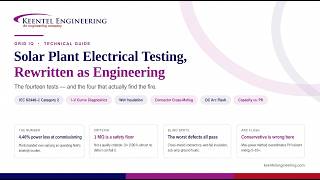
String testing and commissioning to IEC 62446-1
by Keentel Engineering
Inverters and the MV station
by SolarAcademy

Monitoring, SCADA, performance ratio and availability
by SCADA Support PH

Preventive maintenance, cleaning, vegetation, thermography and drones
by LIGHTHIEF INTERNATIONAL
Lesson frames belong to the creators named in the Credits and are shown from YouTube.
What you learn
What you will be able to do
By the end you will be able to:
- Trace power from a module to the grid and count strings and inverters
- Predict and judge string Voc, Isc, insulation resistance and I-V curves
- Calculate performance ratio and availability from a month of data
- Plan thermography and drone inspections and find common faults
- Isolate a plant safely and work around DC arcs and in heat
How it works
How this course works
Watch the lessons
Short video lessons, one module at a time, at your own pace.
Read the notes
Open the Reading tab for the written notes and diagrams of the module.
Practise in the 3D labOptional
Try the module in the free 3D lab, in your browser.
Check yourself
Answer the questions to see what stuck before you move on.
Final assessment
Pass the final once you have been through the modules.
Certificate, if you want oneOptional
Optional, with a page anyone can use to verify it.
Syllabus
Course content, module by module
In order, at whatever pace suits you. Each module ends with a practice task that builds on the last.
- Modules
- 9
- Optional videos
- 21
- Lessons and practice
- 2.5 hours
- Final questions
- 15
- 01
A utility-scale PV plant: blocks, power flow and who does what
2 optional videos · 10m - 02
Construction QA/QC: piles, trackers, modules and DC cabling
1 optional video · 2m - 03
String testing and commissioning to IEC 62446-1, with lab practice:
4 optional videos · 25m - 04
Inverters and the MV station
2 optional videos · 8m - 05
Monitoring, SCADA, performance ratio and availability
2 optional videos · 18m - 06
Preventive maintenance, cleaning, vegetation, thermography and drones
4 optional videos · 29m - 07
Fault finding and corrective maintenance
4 optional videos · 18m - 08
Safety: DC arcs, heat and working at height, with lab practice:
2 optional videos · 12m Final assessment · 15 questions, pass mark 60%
3D lab
Practise in the 3D lab
Test the strings, find the faulty one, energise in the safe order and name every isolation point, in the Solar and EV lab. The lab system is smaller than a utility plant; the order of the work is the same.
- Commission the system: the safe energising orderSolar and EV labOpen in the lab (opens in a new tab): Commission the system: the safe energising order
- Site survey: name every part and every isolation pointSolar and EV labOpen in the lab (opens in a new tab): Site survey: name every part and every isolation point
Optional. Skip it whenever you like: it never blocks your progress or your certificate.
Project
The course project
Optional practice that ends in the kind of job the course prepares you for, with the documents that go with it.
About 4 hours
Commissioning test sheet and monthly O&M report for a 50 MWp solar plant
Act as the commissioning engineer, then the O&M engineer, at Northfield Solar. Judge the string tests of one combiner box against predicted values. Read three I-V curves. Write the isolation steps to replace a string fuse. Then write the month's O&M report with PR, availability and a cleaning decision.
- 4documents in the pack
- 5steps to follow
- 5things to hand in
- 4 hof work, at your pace
Sample document pack, 4 documents, filled in for the scenario
- RegisterCommissioning test sheet, CB-02 (training example), Northfield Solar
- ProcedureIsolation sheet, inverter fan replacement (training example), Northfield Solar
- ReportMonthly O&M report format (training example), a 20 MWp plant
- RegisterInspection and test plan extract, DC cabling (training example), Northfield Solar
Read inside the course and download as a workbook. The project is optional practice, marked when you submit it; the certificate needs only the modules and the final assessment.
Tools
Software, hardware and lessons
Software
A spreadsheet (LibreOffice Calc is free) for the commissioning test sheet and the monthly O&M report. Nothing else is needed.
Hardware
None. Every task can be done on paper or in a spreadsheet. If you work on a plant, your own site's test sheets and procedures make the practice tasks better.
Who it is for
Beginner to intermediate. For electrical and electronics diploma and degree graduates, solar installers and electricians, and O&M or QA/QC technicians and engineers moving onto utility-scale plants. You should know basic DC and three-phase electricity and what a solar module and an inverter do; no utility-scale experience is needed.
Video lessons by
- HeatSpring
- EltonDP
- Terracon
- Keentel Engineering
- Metrel
- Transcat
- Fluke Corporation
- SolarAcademy
- SMA Solar Technology
- SCADA Support PH
- Clearspot
- LIGHTHIEF International
- Ecoppia
- Penn State Solar Center
- The Drone Life
- PADCON
- eFIXX
- Tyndale Company
- NT WorkSafe
Independent creators, credited in full under Credits.
Software you need
What to download, where from, what it costs and how to install it. Every link goes to the maker's own site, never a mirror.
Nothing to install
A spreadsheet is enough for the commissioning test sheet and the monthly O&M report. If you work on a plant, your own site test sheets make the practice better, but every task can be done on paper.
Optional
Useful, not needed to finish the course.
- 01Free
LibreOffice
The Document Foundation
- Runs on
- Windows 10 or 11, macOS 11 or newer (Intel or Apple silicon), Linux
- Account
- None needed
- Size
- up to 1.5 GB of disk space on Windows
LibreOffice is free, open-source software under the Mozilla Public License 2.0, for any use including business. Calc is its spreadsheet.
Steps
- 1.Open the LibreOffice download page.
- 2.Check the page has picked your operating system, then select Download.
- 3.Run the installer (administrator rights are needed on Windows).
- 4.Start LibreOffice Calc for spreadsheet work.
- 5.Save as .xlsx if you need to share files with Excel users.
- Choose the latest main version unless your organisation asks for the older, more conservative release.
Official download pagelibreoffice.org
Checked against each maker's own page on 27 September 2026. Trial lengths and editions change; the maker's page is the final word.
What you walk away with
Your certificate for Solar Farm O&M and QA/QC: Commissioning, IV Curves and Inspection
Finish the course, pass the final, and this is the document with your name on it.

Verifiable by anyone
Adds to LinkedIn in one click
QR code on the certificate
Names what you can do
A permanent link
Earned, not attended
Learning is free. The certificate is optional.
Add it now and pay only when you have finished the course, or come back for it later. One-off, US$26.49, with a receipt.
Issued by Wartens Ltd (England and Wales, company no. 15262249) through the EDWartens training portal, as a Certificate of Completion for this self-paced course. Sold in India by Wartens Automation Private Limited. It is not a vendor certification, a university award or a CPD-accredited activity, and it does not certify competence on live equipment. Delivered electronically; see the refund policy.
Practise what you learn in the free 3D lab
Technical work is judged on what you can do: wiring, commissioning, finding a fault. Doing a task yourself teaches more than watching it a second time, and a lab lets you try it safely before you meet real equipment. It does not replace working on real hardware.
- Practise safely, so a mistake costs nothing.
- The lab checks your work like a site test, so you know when it is right.
- Free, in your browser, with nothing to install.
Why learn with EDWartens
What you get with this course.
- Free from the first lesson to the final assessment.
- Practice in a free 3D lab in your browser, with nothing to install.
- Video lessons with written notes and a project.
- An optional certificate that anyone can verify online.
FAQ
Common questions
Who is this solar farm O&M and QA/QC course for?
It is for electrical and electronics diploma and degree graduates, solar installers and electricians, and O&M or QA/QC technicians who want to work on utility-scale plants. You should know basic DC and three-phase electricity and what a module and an inverter do. No utility-scale experience is needed.
Is the course free to learn?
Yes. Every module, the notes, the worked problems, the project and the final assessment are free. The only software you need is a free spreadsheet. The certificate is optional.
Does it cover IEC 62446-1 commissioning tests?
Yes. You learn the test order, continuity and polarity, how to predict Voc and Isc from irradiance and temperature, insulation resistance at 1500 V, I-V curve tracing and the commissioning record. It is a course on the method and does not replace the standard.
Is this a solar certification or an electrical qualification?
No. It is not a solar certification, and it does not replace site induction, electrical competence assessment or authorisation to work on live equipment. You get an EDWartens Certificate of Completion.
What certificate does the Solar Farm O&M and QA/QC course give?
An EDWartens Certificate of Completion, issued when you finish the modules and pass the 15-question final at 60 percent. It has a number anyone can verify on our site. It is not an official grade from any industry body.
How does it differ from your other solar courses?
Our PVsyst course covers plant design and loss modelling. The rooftop solar course covers small systems, string and cable sizing. The battery storage course covers storage. This course is about building checks, commissioning, operation and inspection of a large plant.
How long does the Solar Farm O&M and QA/QC course take?
The lessons and practice take about 2.5 hours. The video is optional: about 2 more hours if you watch all of it. The optional project takes about 4 hours more.
What is the project in the Solar Farm O&M and QA/QC course?
You judge the string tests of one combiner box against predicted values. You read three I-V curves and write the isolation steps for a string fuse. Then you work out PR and availability for a month. You write the O&M report with a cleaning decision.
Do I have to use the lab?
No. The lab is optional practice. You can skip it whenever you like, and it never blocks your progress, the final assessment or your certificate.
Is the lab free?
Yes. Every lab level for this course opens in your browser, free, with nothing to install.
Is the Solar Farm O&M and QA/QC course free in India, and what does the certificate cost?
Yes. Learning costs ₹0 in India: every module, the written notes, the practice tasks and the final assessment, with no card and no trial period. The only paid item is the optional EDWartens Certificate of Completion, ₹959 including GST for this beginner course, paid in rupees through Razorpay, and only if you want it after passing the final assessment.
What topics does the Solar Farm O&M and QA/QC course cover, module by module?
The Solar Farm O&M and QA/QC course has 9 modules. It opens with "A utility-scale PV plant: blocks, power flow and who does what", goes through "Construction QA/QC: piles, trackers, modules and DC cabling", "Inverters and the MV station", "Preventive maintenance, cleaning, vegetation, thermography and drones" and "Safety: DC arcs, heat and working at height" and ends with "Final Assessment". The full list with minutes is under "What you learn" on this page.
What can I do after the Solar Farm O&M and QA/QC course?
After the Solar Farm O&M and QA/QC course: Trace power from a module to the grid, and count the strings and inverters of a plant from its size and DC/AC ratio; Set out the hold points for piling, trackers, modules and DC cabling, and judge a pile load test; Run the IEC 62446-1 test order, and predict and judge string Voc, Isc and insulation resistance. These are the practical outcomes the course is written around, and the final assessment of 15 questions checks them.
What software and hardware do I need for the Solar Farm O&M and QA/QC course, and does it cost anything?
For the Solar Farm O&M and QA/QC course, software: A spreadsheet (LibreOffice Calc is free) for the commissioning test sheet and the monthly O&M report. Nothing else is needed. Hardware: none. Every task can be done on paper or in a spreadsheet. If you work on a plant, your own site's test sheets and procedures make the practice tasks better. The course itself is free.
Is the Solar Farm O&M and QA/QC course suitable for me, and what level is it?
Solar Farm O&M and QA/QC is rated beginner. Beginner to intermediate. For electrical and electronics diploma and degree graduates, solar installers and electricians, and O&M or QA/QC technicians and engineers moving onto utility-scale plants. You should know basic DC and three-phase electricity and what a solar module and an inverter do; no utility-scale experience is needed. It is written for electrical and electronics graduates, solar installers and electricians, and O&M or QA/QC technicians moving onto utility-scale solar plants, and takes about 2.5 hours of lessons and practice, plus about 2 hours of optional video, at your own pace.
Which jobs use the skills from the Solar Farm O&M and QA/QC course?
Skills from the Solar Farm O&M and QA/QC course (for example: trace power from a module to the grid, and count the strings and inverters of a plant from its size and DC/AC ratio) are used in solar O&M technician work. The course gives you practical evidence of the skill; it does not promise a job, and employers decide on experience and interview.
All course factsHide course facts
- Price
- ₹0, free for good. No trial, no card. Comparable classroom training of this length costs about ₹1,999.
- Who it is for
- Electrical and electronics graduates, solar installers and electricians, and O&M or QA/QC technicians moving onto utility-scale solar plants
- Format
- 9 self-paced modules, about 2.5 hours of lessons and practice, plus about 2 hours of optional video, written notes, a practice task per module and one final assessment.
- Level
- Beginner. Beginner to intermediate. For electrical and electronics diploma and degree graduates, solar installers and electricians, and O&M or QA/QC technicians and engineers moving onto utility-scale plants. You should know basic DC and three-phase electricity and what a solar module and an inverter do; no utility-scale experience is needed.
- Brand
- Vendor-neutral
- Software
- A spreadsheet (LibreOffice Calc is free) for the commissioning test sheet and the monthly O&M report. Nothing else is needed.
- Hardware
- None. Every task can be done on paper or in a spreadsheet. If you work on a plant, your own site's test sheets and procedures make the practice tasks better.
- Certificate
- Optional EDWartens Certificate of Completion, ₹959 inclusive of GST for learners in India, verifiable by code. Not a vendor credential.
- Video lessons by
- HeatSpring, EltonDP, Terracon, Keentel Engineering, Metrel, Transcat, Fluke Corporation, SolarAcademy, SMA Solar Technology, SCADA Support PH, Clearspot, LIGHTHIEF International, Ecoppia, Penn State Solar Center, The Drone Life, PADCON, eFIXX, Tyndale Company, NT WorkSafe (independent creators, credited below)
- Language
- English
- Last updated
- 28 November 2026
Pairs well with
 PLC programming · FreeSiemens TIA Portal
 PLC programming · FreeSiemens TIA Portal in Three Hours
 PLC programming · FreeTIA Portal: Build a Machine
 Instrumentation · FreeInstrumentation for PLC Engineers
More free courses: Free solar and renewable energy courses
Classroom course, Bangalore
PLC training in Bangalore
The Automation Engineer Program (AEP) is our classroom course in PLC programming and industrial automation, taught in person at our Electronic City centre.
Credits
Who made the video lessons
The video lessons in this course were created by the people below, not by EDWartens. Every lesson streams from its creator's own YouTube channel; EDWartens neither hosts nor sells that footage, and the creators are not affiliated with EDWartens and do not endorse this course. What EDWartens wrote is the study plan, the notes, the practice tasks and the assessments.
- HeatSpringhow electricity flows through a utility-scale solar site
- EltonDPhow a solar farm is constructed from start to finish
- Terraconpile load testing on a solar site
- Keentel Engineeringthe electrical tests used to commission a utility solar plant
- Metreltesting a 1500 V PV installation to IEC 62446
- Transcatan insulation test on a PV array
- Fluke CorporationI-V curve tracing, I-V curve deviations and locating ground faults
- SolarAcademystring inverters against central inverters in utility plants
- GoodWe Solar Academya medium voltage transformer station for a solar farm
- SCADA Support PHSCADA systems for PV power plants
- Clearspotspecific yield against performance ratio
- LIGHTHIEF Internationala short guide to solar farm operations and maintenance
- Ecoppiasoiling analysis and measurement
- Penn State Solar Centerinfrared thermography of a PV system
- The Drone Lifehow drone solar inspections work
- PADCONpotential induced degradation and how it can be reversed
- eFIXXassembling MC4 solar connectors and testing crimp strength
- Tyndale CompanyDC arc flash against AC arc flash
- NT WorkSafeworking safely in the heat
If you are one of these creators and would like a lesson removed or credited differently, write to info@edwartens.co.in.