Control Panel Wiring Simulator: Wire a DOL Starter Online
Why a wiring simulator helps
Control panel wiring is one of the first skills a junior electrical or automation engineer is asked to show, and one of the hardest to practise. Panels are expensive, the lab kit is shared, and nobody likes a student making the first mistake on live 415 V. A control panel wiring simulator lets you make that mistake safely.
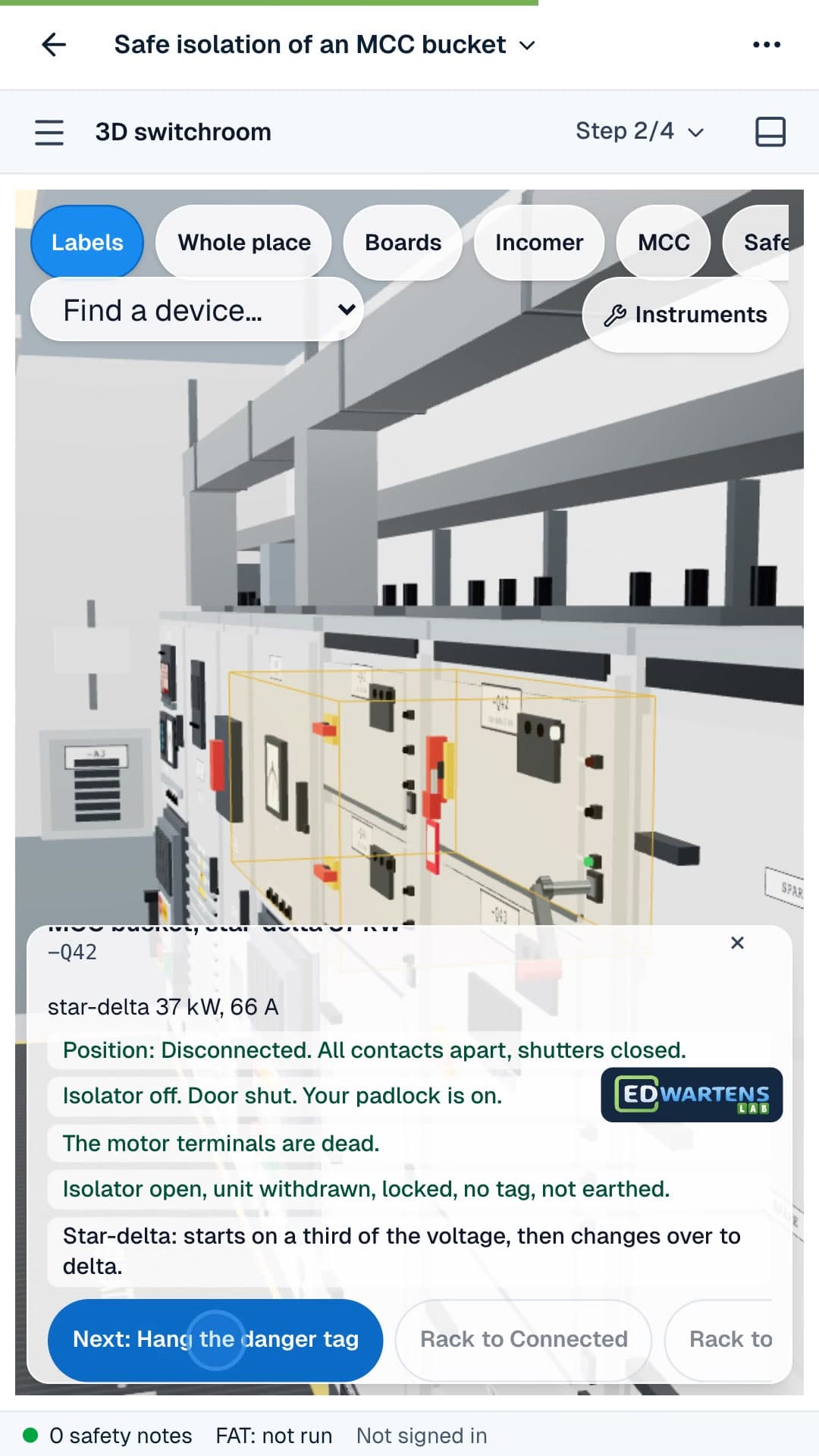
The clip above is from the Panel Lab in the EDWartens Lab. The job is a transfer pump starter on a 415 V, 3 phase, 50 Hz supply with a 24 V DC control circuit, the kind of direct on line starter you meet in many Indian pump houses and small plants.
What the job asks you to do
You begin with isolation, as you would on site. Switch off, apply your lock and tag, and then prove dead. The lab gives you a virtual multimeter, and you test each terminal of the incoming isolator, phase to phase, phase to neutral and phase to earth, before it lets you move on.
Next you wire. You drag from one terminal to another, or tap one terminal and then the other on a phone, and the lab draws the conductor. You follow a wiring schedule that lists which terminal goes to which. A tooltip tells you the wire number and how many conductors are on that terminal, so you can see a doubled-up lug before it becomes a loose connection.
Power back on, then operate
When all the wires are in, you remove your lock, power the panel and use the closed cabinet as an operator would. Press START and the motor runs in the 3D view. The STOP button and the emergency stop are there too, and the panel must be wired correctly for the lamps to come alive.
The factory acceptance test
The last step is a factory acceptance test, or FAT. The lab powers up your panel with your wiring and runs a set of checks, including forcing an output once to prove the emergency stop works. You get a result for each check, and you can run the test again after you fix a fault. This is the habit that separates a panel builder from someone who only connects wires.
Who should try it
Diploma and ITI electrical students, B.E. and B.Tech students from electrical and instrumentation branches, freshers heading to a panel shop, and technicians moving from maintenance to panel work. If you want to compare what you did with real practice, the Bangalore classroom has wired PLC panels, but the first pass is easy to do from home.
Open the lab
Choose the Panel Lab, take your time over the lock out and prove dead steps, and try the FAT twice. Open the free EDWartens Lab and start the panel job.
It runs in your browser and is free to start. This is practice, not a substitute for site safety rules or your employer's permit system.
If you want to learn this alongside PLCs, SCADA and drives in a classroom, see our industrial automation course in Bangalore.
Learn this, free
The courses that teach this
Every lesson, the written notes and the practice are free with an account. Only the certificate is optional and paid.