

Six Sigma Black Belt vs Green Belt: What Changes

The short answer
Six Sigma Black Belt vs Green Belt comes down to scope and statistics. A Green Belt works part time on a small project inside one process and uses the core DMAIC toolkit: process maps, basic charts, simple tests, Gage R&R and capability. A Black Belt leads larger, cross-functional projects and goes deeper: sample size and power, non-normal data, ANOVA, multiple regression, designed experiments, Lean flow and coaching Green Belts. Both use DMAIC; the Black Belt has more tools and more responsibility for the result.
Facts about the exam bodies were checked on their own sites in November 2026. This guide describes what each level teaches. It does not state exam rules, which differ by body and change; read the current pages before you book anything.
The difference in one table
Question | Green Belt | Black Belt |
|---|---|---|
Project size | One process, one team | Cross-functional, tied to a business goal |
Time on projects | Part of the week | Often most of the week |
Data | Mostly normal, one factor at a time | Non-normal data, many factors together |
Tests | One-sample and two-sample t, chi-square | Power, ANOVA with post-hoc, regression, logistic regression |
Experiments | Rarely | Full and fractional factorial designs |
Lean | Waste hunt, 5S | Value stream, flow, pull, kanban sizing |
People | Member of the team | Leads the team, coaches Green Belts |
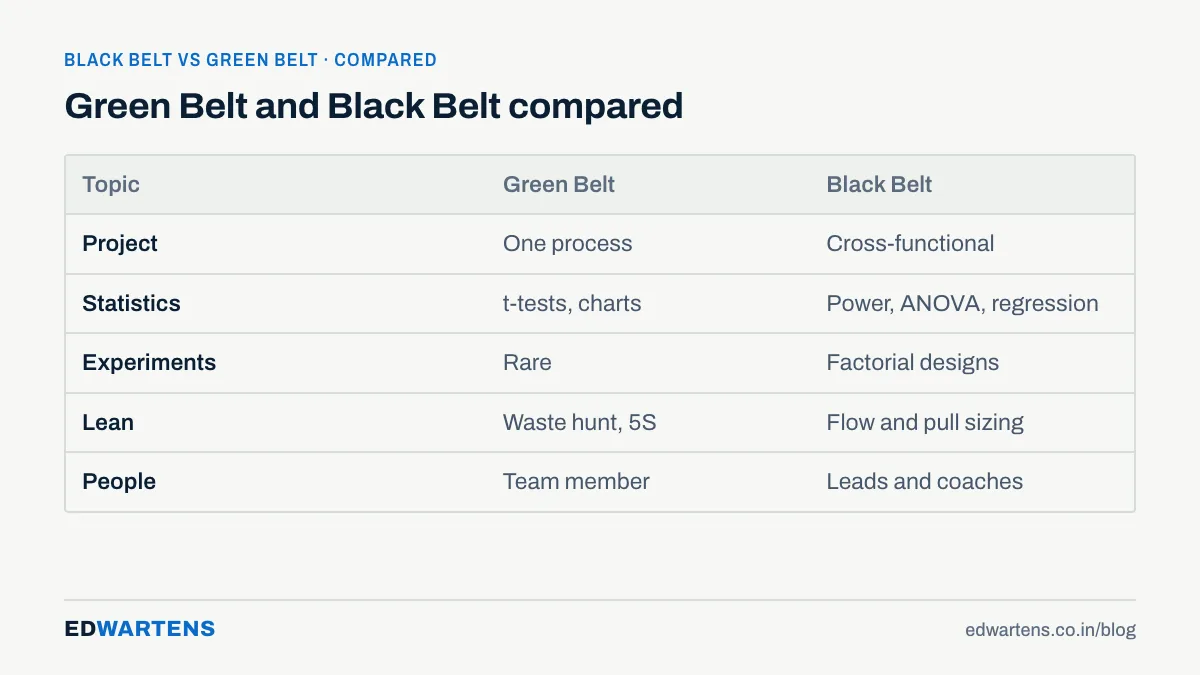
The names come from a colour ladder borrowed from martial arts. There is no single owner of the words. Professional bodies such as ASQ and IASSC publish their own outlines for Green Belt and Black Belt exams, and many companies run in-house belts with their own rules. Two people who both say "Black Belt" may have studied different syllabi, so always ask which body of knowledge was used.
Where the real jump is: sample size and power
The clearest difference is a question a Green Belt rarely asks: how many measurements do I need before I can trust a "no difference" result?
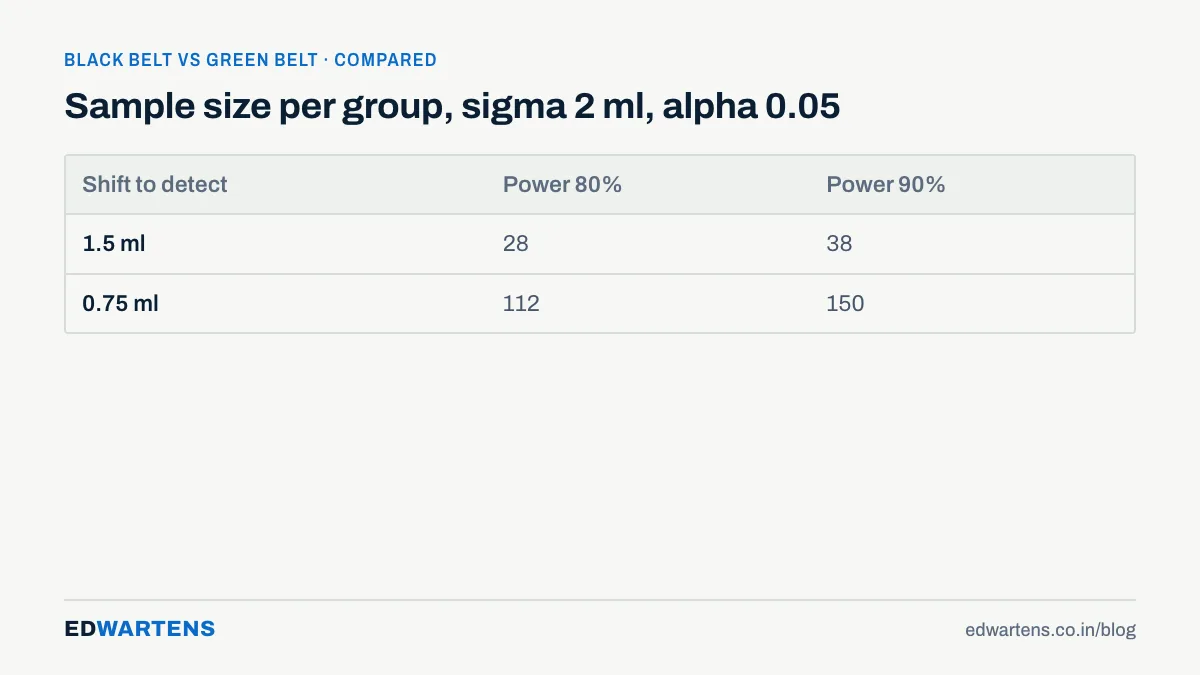
Here is a worked example. A line fills bottles, and the standard deviation of fill volume is 2 ml. You want to detect a shift of 1.5 ml between two fillers with a two-sided test at alpha 0.05. Use the normal approximation for the number per group:
n = 2 x (z for alpha + z for power)^2 x sigma^2 / delta^2
- For alpha 0.05 two-sided, z is 1.96.
- For power 80%, z is 0.8416. So n = 2 x (1.96 + 0.8416)^2 x 2^2 / 1.5^2 = 27.9, which rounds up to 28 per group.
- For power 90%, z is 1.2816. So n = 2 x (3.2416)^2 x 4 / 2.25 = 37.4, which rounds up to 38 per group.
- If the shift you care about is only 0.75 ml, the 80% figure becomes 111.6 (112) and the 90% figure 149.4 (150).
Halving the shift you want to detect multiplies the sample by four. That one fact explains why Black Belt projects plan data collection before touching a tool. The normal approximation slightly understates the need for a t-test, so add a unit or two in practice. The figures above were computed in node and can be repeated in a spreadsheet.
Why ANOVA is a Black Belt tool
A Green Belt compares two things with a t-test. When there are three machines, running three t-tests is a trap, because each test carries a 5% false alarm risk. Together the chance of at least one false alarm is 1 - 0.95^3 = 14.3%.
Worked example. Six fill weights from each of three machines, in grams:
- Machine A: 24.1, 24.8, 23.9, 24.5, 25.0, 24.3 (mean 24.433)
- Machine B: 25.2, 25.9, 25.4, 26.1, 25.0, 25.6 (mean 25.533)
- Machine C: 24.6, 25.1, 24.4, 25.3, 24.9, 25.5 (mean 24.967)
The grand mean is 24.978. The between-machine sum of squares is 3.631 and the within-machine sum of squares is 2.620. With 2 and 15 degrees of freedom, the mean squares are 1.8156 and 0.17467, so F = 10.39 and p = 0.0015. The machines do differ.
ANOVA says only that at least one mean differs. To find which, a Black Belt runs post-hoc comparisons at a corrected level. With three comparisons, the Bonferroni level is 0.05 / 3 = 0.0167. The pooled standard deviation is 0.418 on 15 degrees of freedom, so the standard error of a difference is 0.241 and the critical t at the corrected level is 2.69. A difference must exceed 0.65 g to count. The results:
Pair | Difference | Result at 0.0167 |
|---|---|---|
A and B | 1.10 | Different |
B and C | 0.57 | Not shown to differ |
A and C | 0.53 | Not shown to differ |
Only machine B stands apart from A. Reading this correctly is a skill the Green Belt syllabus rarely reaches.
What else a Black Belt adds
- Non-normal data. Cycle times and defect counts are often skewed. A Black Belt tests normality, tries a transformation or switches to a rank-based test.
- Regression. Multiple regression finds which of several inputs drives the output, and checks for inputs that move together.
- Designed experiments. Instead of changing one setting at a time, you change several together in a planned pattern and read the effects from far fewer runs.
- Lean flow. Value stream maps, takt time, work in progress and kanban sizing, using the arithmetic of queues.
- Change and coaching. Leading a team, running workshops and handing a process to its owner with a control plan.
Which should you study first
If DMAIC and basic statistics are new to you, start with Green Belt. The Black Belt material assumes you can already draw a process map, read a control chart and run a simple t-test. If you have used those for a year, go straight to the Black Belt course topics above. Our post on where Six Sigma helps manufacturing engineers shows what a first project looks like, and OEE calculated properly is a good source of project ideas.
Free software for the practice
Every worked problem above can be done in a spreadsheet such as Excel or LibreOffice Calc. JASP is a free, open-source statistics program from the University of Amsterdam. It gives full ANOVA and regression output. Minitab is common in industry and offers a free trial on its own site; read its current terms there.
Learn it free on EDWartens
The Lean Six Sigma Black Belt course covers the Black Belt body of knowledge in 12 study modules and a final. Topics include project selection, charters, data collection, normality and transformations. They go on to hypothesis tests with power, ANOVA, regression and factorial experiments. The course also covers Lean flow, control plans, change leadership and a full DMAIC case. It is a free course with a verifiable certificate of completion, issued after the modules and a final assessment. Anyone can check a certificate on the verification page.
It prepares you for ASQ and IASSC style exams but does not award a Black Belt credential. Those bodies set their own exams and award their own credentials. EDWartens is not affiliated with ASQ, IASSC or Minitab. If you are new to the toolkit, take the Green Belt training for manufacturing first.
Q: What is the main difference between a Six Sigma Green Belt and Black Belt?
A: A Green Belt applies the core DMAIC tools to a small project part time. A Black Belt leads larger cross-functional projects and uses deeper statistics such as power, ANOVA, regression and designed experiments, and coaches Green Belts.
Q: Do I need a Green Belt before a Black Belt?
A: Not by rule in general, but the Black Belt material assumes Green Belt skills. Some exam bodies add their own experience or project conditions, so check the current page of the body you plan to use.
Q: Is Lean Six Sigma Black Belt the same as Six Sigma Black Belt?
A: Lean Six Sigma adds Lean flow tools to the Six Sigma statistics. Some syllabi emphasise one side, so compare the topic lists rather than the names.
Q: How many samples does a Black Belt need to compare two means?
A: It depends on the spread, the shift worth detecting and the power wanted. For a spread of 2, a shift of 1.5, alpha 0.05 and 80% power, about 28 per group by the normal approximation.
Q: Can I learn Black Belt topics for free?
A: Yes. You can study the topics and practise in free software at no cost. Exam fees, if you choose an ASQ or IASSC style exam, are paid to that body.
Q: Is the EDWartens certificate a Black Belt certification?
A: No. It is a verifiable certificate of completion for the course. It is not a credential from ASQ, IASSC or any other body.
For a classroom route that puts topics like this next to PLC programming, see industrial automation course in Bangalore.
Learn this, free
The courses that teach this
Every lesson, the written notes and the practice are free with an account. Only the certificate is optional and paid.


