India's Data Centre Boom: Electrical and BMS Jobs in 2026

The short answer
India's top seven data-centre markets reached 1,789 MW of operational capacity across 147 data centres in H1 2026, with 3,860 MW more in the pipeline to 2030, according to Cushman & Wakefield's update of 23 September 2026. Mumbai leads with 890 MW live; Bengaluru has 162 MW live and 100 MW coming. Every megawatt needs medium-voltage switchgear, UPS, generators, chillers and a building management system, so the build-out is a steady source of work for electrical, BMS, HVAC and controls engineers.
What Cushman & Wakefield reported
The headline numbers from the 23 September 2026 report:
- 178 MW added in H1 2026 across the top seven markets.
- 1,789 MW operational, in 147 data centres run by 33 operators.
- 3,860 MW pipeline to 2030: 509 MW under construction and 3,351 MW in planning.
- About US$29.9 billion of investment needed for that pipeline.
- Colocation vacancy of 14.9%.
City by city
| City | Operational (MW) | Upcoming (MW) |
|---|---|---|
| Mumbai | 890 | 1,726 |
| Chennai | 214 | 368 |
| Delhi NCR | 183 | 387 |
| Bengaluru | 162 | 100 |
| Hyderabad | 151 | 710 |
| Pune | 133 | 258 |
| Kolkata | 22 | 84 |
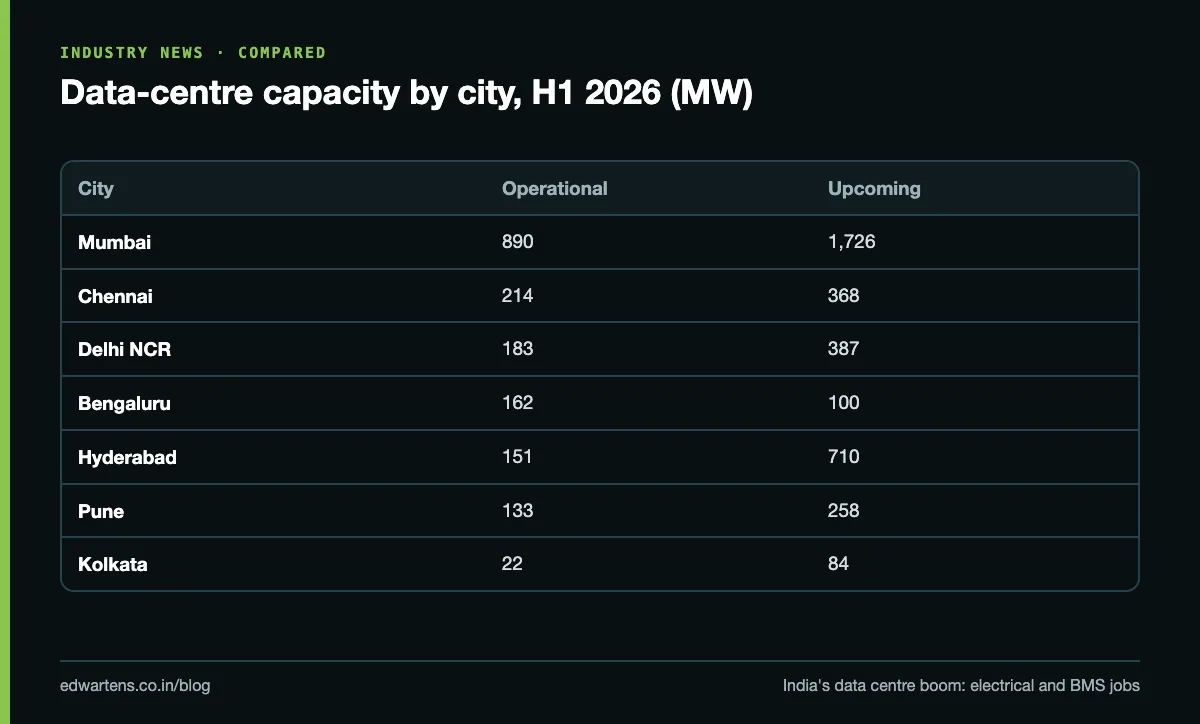
Three things stand out. Mumbai is half the country's live capacity and will stay the largest market. Hyderabad has the biggest pipeline relative to its size, with 710 MW coming on top of 151 MW live, so it is where much of the next construction and commissioning work will be. Bengaluru is a mature market with a smaller pipeline; its jobs lean towards operations and maintenance of existing sites rather than new builds.
The trend is also visible from the automation vendors. Rockwell Automation's CEO named semiconductor, data centre and warehouse automation as growth drivers when the company reported third-quarter FY26 sales of US$2,313 million, up 8%, and raised its FY26 organic growth guidance to 7.5% to 9.5% (Rockwell Automation, 4 August 2026).
Why megawatts mean engineering jobs
Data-centre capacity is quoted in megawatts of IT load: the power the servers draw. To deliver and cool that power reliably, around the clock, a site needs an electrical and mechanical plant far larger than a typical commercial building. A simplified power path looks like this:
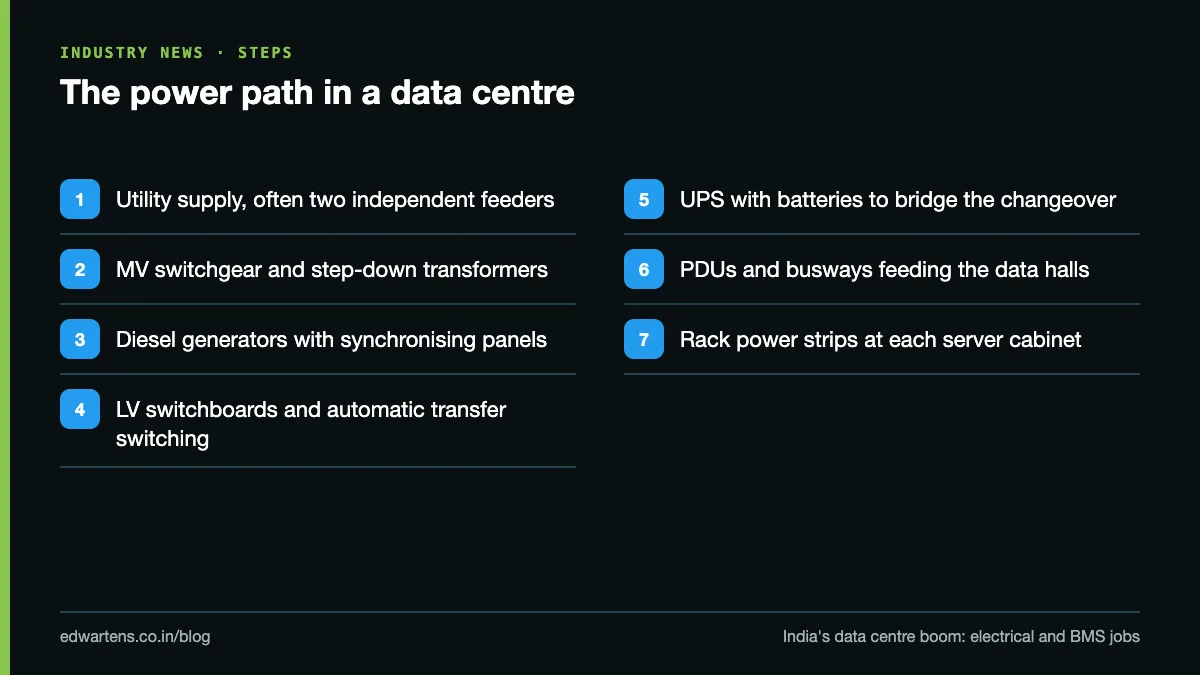
- Utility supply at high or medium voltage, often from two independent feeders.
- MV switchgear and transformers stepping down to low voltage.
- Diesel generators that start automatically on mains failure, with synchronising panels.
- LV switchboards and automatic transfer switching between mains and generator.
- UPS systems with batteries that bridge the seconds before generators take load.
- Power distribution units (PDUs) and busways feeding the halls.
- Rack power strips at each server cabinet.
Redundancy is designed in at every step (two power paths, spare UPS modules, spare generators), and every piece of it is monitored. That is where automation comes in.
The cooling side
Every watt the servers draw becomes heat. Chillers, cooling towers, computer-room air handlers, pumps, and increasingly liquid cooling for dense AI racks, all run under controls that hold temperature and humidity within limits while using as little energy as possible.
The monitoring layer
The building management system (BMS) controls and monitors the mechanical plant. An electrical power monitoring system (EPMS) watches the power path. DCIM (data centre infrastructure management) software sits on top, showing capacity, power and cooling per rack. Under the hood these run on the same building blocks as industrial automation: PLCs or DDC controllers, Modbus, BACnet and SNMP, SCADA-style graphics and alarm management.
The roles a data centre needs
| Role | What you do | Background that fits |
|---|---|---|
| Critical power or electrical engineer | Design, commission and operate MV/LV, UPS, generators and ATS | Electrical engineering, protection, switchgear |
| Power system study engineer | Load flow, short circuit, protection coordination, arc flash | Electrical, ETAP or similar tools |
| BMS engineer | Program and commission controls for chillers, AHUs and CRAHs | Instrumentation, PLC or DDC, BACnet |
| EPMS and SCADA engineer | Meter integration, power monitoring screens, alarm handling | SCADA, Modbus, PLC |
| HVAC or mechanical engineer | Heat load, chilled-water and airflow design, operations | Mechanical, HVAC design |
| Facility operations engineer | Run the site on shifts, switching, maintenance, incident response | Electrical or mechanical diploma or degree |
| Commissioning engineer | Integrated systems testing: pull the mains and prove it all works | Any of the above, with field experience |
Notice how much of this table an automation or electrical engineer already half-knows. A PLC programmer who understands Modbus and alarm handling is most of the way to an EPMS role. An electrical engineer who has run an ETAP load flow and short-circuit study can do the same studies for a data-centre single-line diagram. For the building-controls side, see our posts on BMS for automation engineers and BMS engineer careers in India.
What to learn, and in what order
- Electrical fundamentals for critical power. Single-line diagrams, breaker selection and discrimination, earthing, UPS topologies, generator and ATS operation. If breaker types are hazy, start with MCB vs MCCB vs RCCB vs ELCB vs RCBO.
- Power system studies. Load flow, short circuit and protection coordination in a tool such as ETAP.
- HVAC basics. Heat load, chilled-water systems and air distribution, enough to understand what the BMS is controlling.
- BMS and protocols. BACnet, Modbus, sequences of operation for chillers and air handlers, alarm priorities.
- Data-centre specifics. Redundancy levels, integrated systems testing, DCIM, and working under change-control rules where one mistake can drop a hall.
Where to aim by city
- Mumbai: the largest number of live sites, so the most operations and maintenance roles.
- Hyderabad and Chennai: large pipelines, so construction and commissioning roles with contractors and integrators.
- Bengaluru and Pune: steady operations work, plus engineering and design offices of equipment makers and consultancies.
We have not quoted salaries here because the report does not cover them. For general automation pay data, see our salary guide or try the free salary estimator.
Learn it free
Five free courses cover the roles above:
- Data Centre Electrical and Critical Power: the power path, UPS, generators, ATS and redundancy.
- Data Centre Cooling, BMS and DCIM: cooling plant, controls and the monitoring layer.
- Building Management Systems (BMS): BACnet, DDC controllers and sequences of operation.
- HVAC Design: Heat Load, Ducts and Chilled Water: the mechanical side the BMS controls.
- ETAP Power System Analysis: load flow, short circuit and protection studies.
All are free with an account, self-paced, with written notes, practice tasks and a 15-question final assessment. The optional EDWartens Certificate of Completion is ours, not an equipment maker's credential. Browse everything at /free-courses.
Frequently asked questions
Q: How much data-centre capacity does India have in 2026?
A: 1,789 MW of operational capacity across 147 data centres in the top seven markets at the end of H1 2026, according to Cushman & Wakefield.
Q: How much new data-centre capacity is coming to India by 2030?
A: 3,860 MW: 509 MW under construction and 3,351 MW in planning, needing about US$29.9 billion of investment.
Q: Which Indian city has the most data-centre capacity?
A: Mumbai, with 890 MW operational and 1,726 MW upcoming. Chennai (214 MW) and Delhi NCR (183 MW) follow.
Q: How big is Bengaluru's data-centre market?
A: 162 MW operational and 100 MW upcoming as of H1 2026, a mature market with a smaller pipeline than Mumbai or Hyderabad.
Q: Can a PLC or SCADA engineer move into data centres?
A: Yes. EPMS, BMS and DCIM work uses PLCs or DDC controllers, Modbus, BACnet, SCADA graphics and alarm handling, so the core skills transfer. Add electrical critical-power and HVAC basics.
Q: What skills does a data-centre electrical engineer need?
A: Single-line diagrams, MV and LV switchgear, UPS and generator systems, automatic transfer switching, protection coordination and power system studies, plus the discipline of working under change control.
Learn this, free
The courses that teach this
Every lesson, the written notes and the practice are free with an account. Only the certificate is optional and paid.