

STAAD Pro Tutorial for Steel Structures: Eight Steps

The short answer
A STAAD.Pro tutorial for steel structures follows one loop. Set units, build the geometry, and assign steel sections and supports. Apply loads and combinations, then run the analysis. Add the design parameters, run the code check, and check the result by hand. Do the hand check first for one member, because it tells you whether the model is believable before you trust any utilisation ratio. This guide walks the loop for a steel shed, with every hand number worked out.
Bentley and AISC pages were read on 1 November 2026 (November 2026). Menu names change between releases, so use this as a map and follow your own version's help.
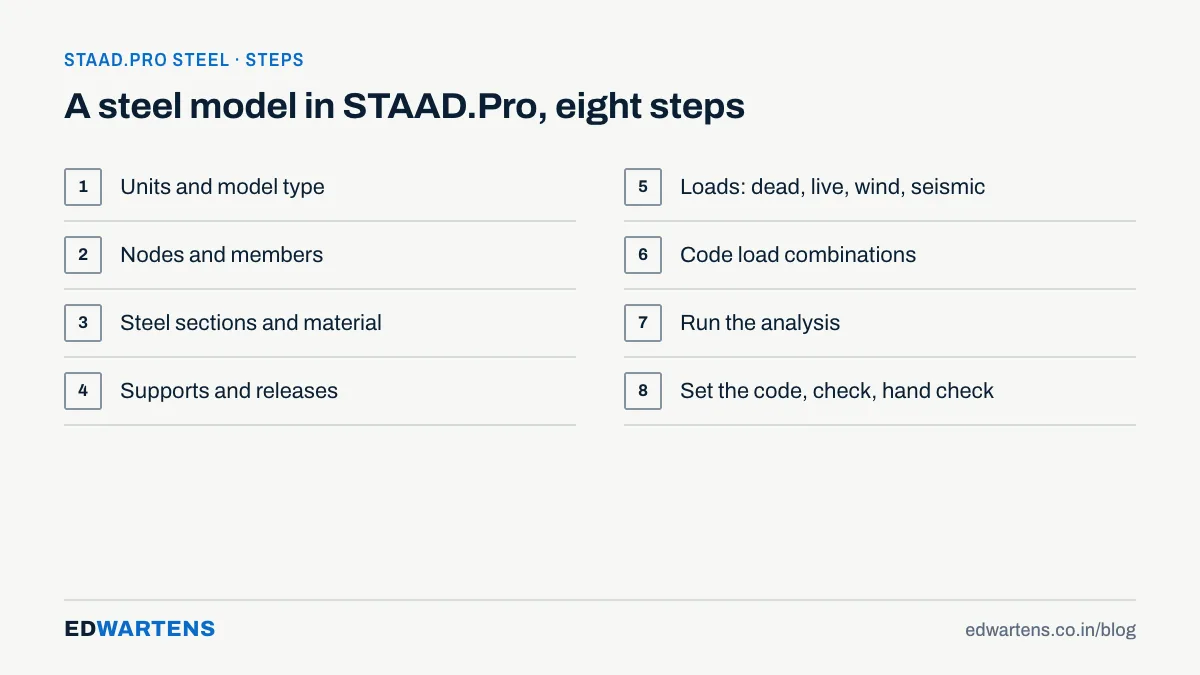
The steel workflow in eight steps
Every steel model in STAAD.Pro, from a portal frame to a multi-storey building, uses the same sequence. Bentley's STAAD page describes steel, concrete and timber design, structure wizards, and an editor that works as a command file. The command file is worth learning, because it shows exactly what the model contains.
Step | What you do | What to check |
|---|---|---|
1. Units and type | Choose metres and kilonewtons, space frame or plane frame | Units on every input |
2. Geometry | Add nodes and members, or use a structure wizard | Node numbers and lengths |
3. Properties | Assign steel sections and material | Section names and orientation |
4. Supports and releases | Pin, fix or release ends | Is the model stable |
5. Loads | Dead, live, wind, and seismic cases | Direction and area of each load |
6. Combinations | Apply the code load combinations | Which case governs |
7. Analysis | Run linear or P-delta analysis | Errors and warnings |
8. Design | Set the code and run the code check | Ratios below 1.0, hand check |
Learn the command names that matter. The command file starts with the model type and a UNIT line, then lists JOINT COORDINATES and MEMBER INCIDENCES. MEMBER PROPERTY assigns sections, SUPPORTS fixes the base, and LOAD blocks define each case. PERFORM ANALYSIS runs the solver. Design commands then set a CODE and use CHECK CODE and SELECT. Which code names your release offers is shown in its own help.
Pick one code family
Steel design needs a code. The worked examples here use ASCE 7 loads with AISC 360, in LRFD form. Eurocode 3 with EN 1990 and EN 1991 is the other common family, and the steps are the same. Choose one family per job and write it on your calculation. AISC says on its Current Standards page that its current standards are free to download as PDFs, so you do not need a pirated copy. ANSI/AISC 360-22 is the edition AISC's pages list, and a newer edition has been in review, so check which one your release implements.
India's regional alternative is IS 800 for steel with IS 875 for loads. The method does not change. Only the factors and section tables do.
A hand check you should run first
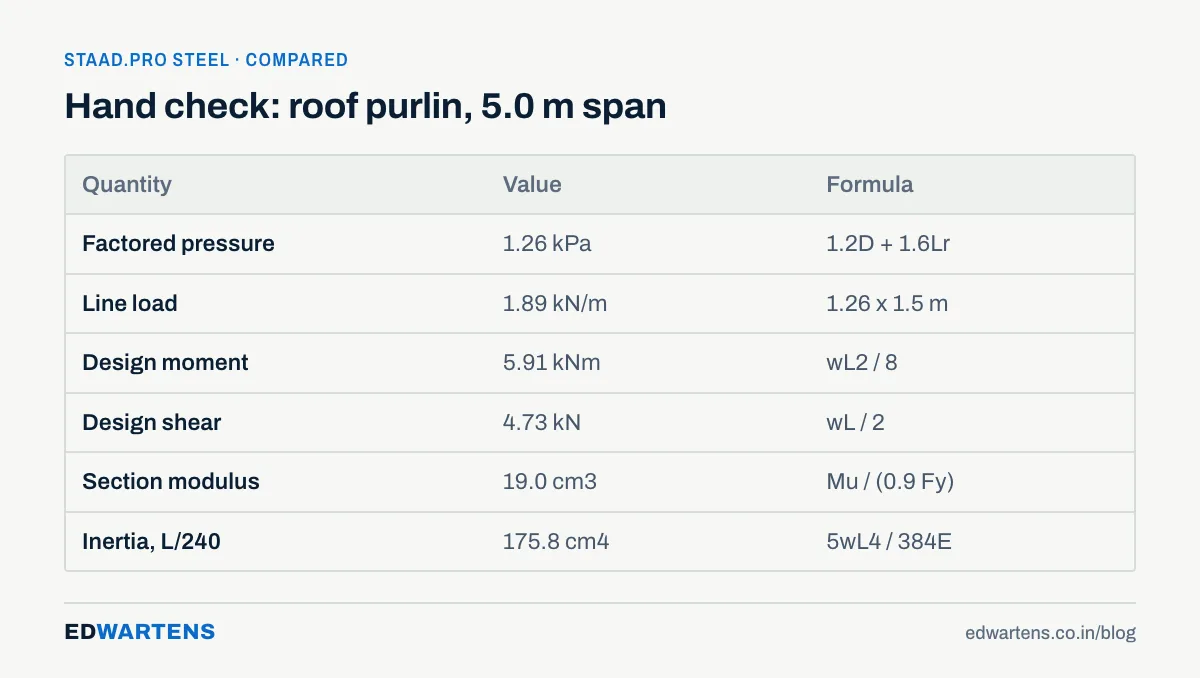
Here is a worked example of the check to run on one member before you trust the model. A roof purlin is simply supported over 5.0 m. Purlins are spaced 1.5 m apart. The roof dead load is 0.25 kPa and the roof live load is 0.60 kPa. Steel yield strength is 345 MPa, and the resistance factor for bending is 0.9. Every number was computed in a script.
- The factored pressure is 1.2 x 0.25 + 1.6 x 0.60 = 0.30 + 0.96 = 1.26 kPa.
- The line load on one purlin is 1.26 x 1.5 = 1.89 kN/m.
- The design moment is Mu = wL squared over 8 = 1.89 x 25 / 8 = 5.91 kNm.
- The design shear is Vu = wL / 2 = 1.89 x 5.0 / 2 = 4.73 kN.
- The plastic section needed is Z = Mu / (0.9 x 345) = 5.91 x 10^6 / 310.5 = 19,022 mm3, which is 19.0 cm3.
- For deflection, the service live line load is 0.60 x 1.5 = 0.90 kN/m. With a limit of L/240 = 20.8 mm and E = 200,000 MPa, the inertia needed is I = 5wL^4 / (384 E x limit) = 175.8 cm4.
If STAAD.Pro reports a purlin moment far from 5.91 kNm, find out why before you read a single ratio. A wrong tributary width, a missing load or a bad support is usually the cause.
Quantity | Hand value | Formula |
|---|---|---|
Factored pressure | 1.26 kPa | 1.2D + 1.6Lr |
Line load | 1.89 kN/m | 1.26 x 1.5 m |
Design moment | 5.91 kNm | wL squared / 8 |
Design shear | 4.73 kN | wL / 2 |
Required section modulus | 19.0 cm3 | Mu / (0.9 x Fy) |
Required inertia | 175.8 cm4 | Deflection limit L/240 |
The load combination, the deflection limit and the resistance factor all come from the code and the project specification. The limit L/240 is an example. A real project states its own.
Read the output the right way
After analysis, look at three things in this order. First the support reactions: their sum must equal the applied load. Take a frame with a 20 m span and frames 5 m apart. The roof line load is 1.26 x 5 = 6.3 kN/m. The total is 126 kN, and each side takes 63 kN. Second, the bending moment and shear diagrams, which should have the shape you expect from statics. Third, the code-check ratios, which tell you how close each member is to its limit.
A utilisation ratio is only as good as the model behind it. If the member is unbraced in reality but braced in the model, a ratio of 0.5 is meaningless. Set effective lengths and bracing for the real structure, and look at which load combination governs.
Software access without cracked copies
Bentley offers a free trial request for STAAD.Pro. Its page describes a free, limited-time, fully functional trial licence, with eligibility confirmed by Bentley. The same page sends students and educators to Bentley Education. Bentley's STAAD page says students and educators get free access for academic use and lists Windows 10 or 11, 64-bit, with 8 GB or more of memory helping complex models.
Never download a cracked copy. It is illegal, and nobody can stand behind a result from software you cannot trust.
Where the free course fits
The free STAAD.Pro: Structural Analysis and Design course teaches this loop in thirteen study modules and a final assessment, about 13 hours of video, with hand checks beside each result. It covers frames and trusses, loads, wind and seismic, steel code checks, and a calculation report. It is not a Bentley certification, and EDWartens is not affiliated with Bentley.
It is a free course with a verifiable certificate of completion, and anyone can check a certificate on our verification page. Start with the STAAD.Pro course if you want the workflow in order.
Responsibility and limits
A model is not a design. A qualified structural engineer, working under local regulations, is responsible for any real structure, and software output must be checked by hand. A tutorial like this teaches the workflow and the habit of checking. It does not let you sign off a building.
More reading
Choosing which software to learn first? Our comparison of EPLAN, AutoCAD Electrical and SOLIDWORKS Electrical asks the same questions. What is free, what do employers use, and what transfers? And for practising without spending anything, see free PLC software you can practise with at home.
To learn this with an instructor in a classroom, see classroom PLC training in Bangalore.
Frequently asked questions
Q: How do I start a STAAD.Pro tutorial for steel structures?
A: Set units and build the geometry with nodes and members or a structure wizard. Assign steel sections and supports, apply loads and combinations, and run the analysis. Then set the design code and run the code check.
Q: What should I check before trusting STAAD.Pro results?
A: Check that the support reactions sum to the applied load, that the bending moment diagram has the shape statics predicts, and that one member matches a hand calculation. Only then read the code-check ratios.
Q: Which steel code should I use in STAAD.Pro?
A: Use the code your project requires. This guide uses ASCE 7 loads with AISC 360 in LRFD form. Eurocode 3 and IS 800 follow the same steps with different factors.
Q: Is STAAD.Pro free for students?
A: Bentley says students and educators can get free access for academic use through Bentley Education. Bentley also offers a free trial on request, with eligibility confirmed by a Bentley representative.
Q: Can STAAD.Pro design a real building on its own?
A: No. Software output must be checked by hand, and a qualified structural engineer under local regulations is responsible for a real design.
Q: Is there a free STAAD.Pro course with a certificate?
A: Yes. The EDWartens STAAD.Pro course is a free course with a verifiable certificate of completion. It is not a Bentley certification.
Learn this, free
The courses that teach this
Every lesson, the written notes and the practice are free with an account. Only the certificate is optional and paid.


