

QA/QC Engineer Qualifications: What Civil Sites Expect

The short answer
QA/QC engineer qualifications for civil work usually start with a degree or diploma in civil or construction engineering. On top of that, employers look for site experience and working knowledge of the test methods for concrete, steel and soil. They also want the habit of keeping records that stand up to an audit. There is no single licence for the role. Several optional technician credentials and your own sample documents show that you can do the job.
Facts about the ACI and ASTM pages were read on 1 November 2026 (November 2026). This post makes no promise of a job or a pay level, and test acceptance limits always come from the project specification.
What the role actually involves
On a civil site, quality assurance (QA) is the system. It holds the quality plan, the inspection and test plans, the method statements and the document control that stop mistakes before they happen. Quality control (QC) is the checking: the slump test, the cube sample, the field density test and the inspection of reinforcement before a pour. A civil QA/QC engineer does both, usually on the contractor's side, sometimes for the consultant or client.
The daily work is practical. You check that the rebar matches the drawing and that formwork is clean and braced. You check that the delivery ticket matches the approved mix. You make sure each test result is recorded and compared with the specification. When something fails, you raise a non-conformance report and follow it to closure.
The qualification layers
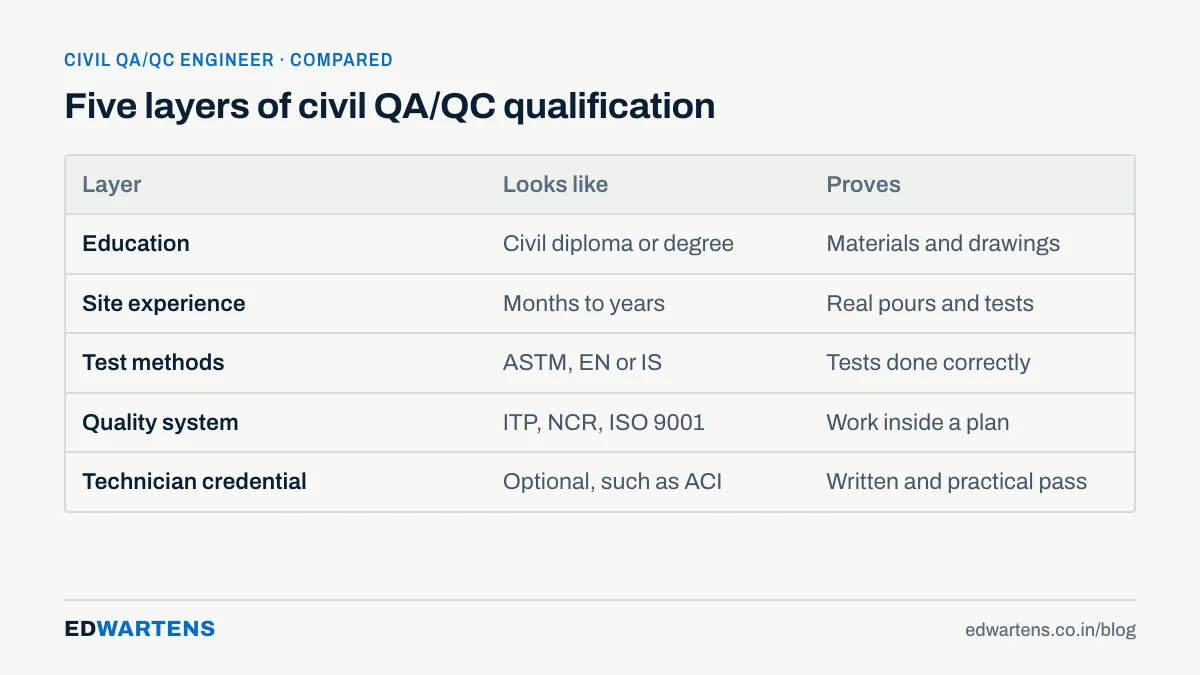
Think of qualifications as layers rather than a single certificate. The table shows what each layer proves.
Layer | What it usually looks like | What it proves |
|---|---|---|
Education | Diploma or degree in civil or construction engineering | You understand materials, structures and drawings |
Site experience | Months to years as a site or quality engineer | You have seen real pours, tests and failures |
Test-method knowledge | Working knowledge of ASTM, EN or IS methods | You can run or witness the tests correctly |
Quality system knowledge | ITPs, method statements, NCRs, ISO 9001 awareness | You can work inside a quality plan |
Technician credentials | Optional, such as an ACI field testing grade | You passed a written and performance check |
None of these layers is a licence to practise. A degree does not replace site experience, and a technician credential does not replace a degree. Employers combine them differently, so read each job advertisement for what it actually asks.
Technician credentials worth knowing
Several bodies certify people to perform specific tests. ACI describes its Concrete Field Testing Technician, Grade I programme as covering basic field tests on freshly mixed concrete: sampling, temperature, slump, density, air content, and making and curing specimens. It has a written and a performance examination. Check the page for the current list of methods and the rules for renewal.
A technician credential is separate from the role of QA/QC engineer. It proves you can perform a set of tests correctly. Many sites value having at least one holder on the team, and it can make a CV stand out when it matches the work you apply for.
Test methods by family
Test methods come in families. The ASTM family is common internationally. C143 covers slump, C31 covers making and curing specimens, C39 covers cylinder strength, and D1556 covers field density by the sand cone. EN and BS EN methods serve Europe. The ASTM C39 page shows the scope and a note that strength depends on how specimens are made and cured. The ASTM D1556 page describes the sand cone method for in-place density.
In India the regional alternative is the IS family. IS 516 covers strength of concrete, IS 1199 covers fresh concrete sampling and slump, and IS 2720 covers soil tests, with a part for sand replacement. Always name the method and edition your project specification cites, because editions change.
Worked example 1: a cube result
Here is a worked example of the arithmetic you do every week. A 150 mm concrete cube fails at a load of 702 kN. The area is 150 x 150 = 22,500 mm2. The strength is 702,000 N / 22,500 mm2 = 31.2 MPa. Indian sites usually test cubes, while many other countries use cylinders, so know which one the specification names and do not mix the two without a stated conversion.
Worked example 2: does this set of results pass?
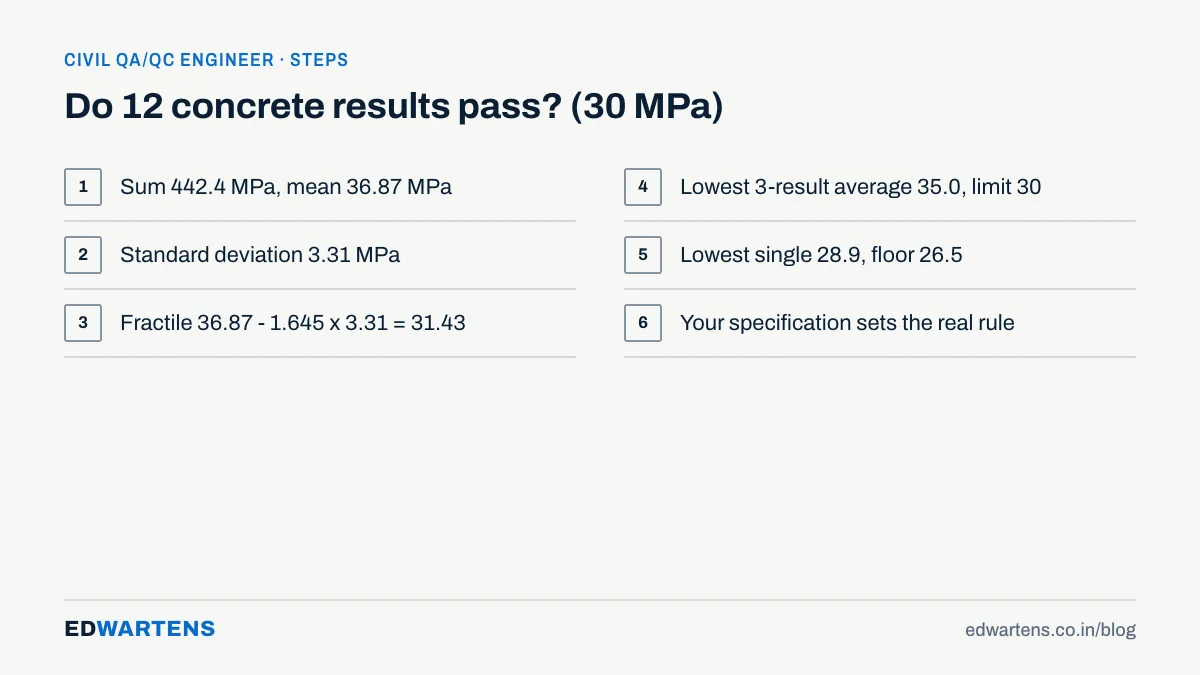
A concrete grade is specified with a characteristic cylinder strength of 30 MPa. Twelve consecutive 28-day results in MPa are 36.5, 38.2, 35.1, 40.3, 33.8, 37.9, 39.4, 28.9, 36.7, 41.2, 35.8 and 38.6. The numbers were computed in a script.
- The sum is 442.4, so the mean is 442.4 / 12 = 36.87 MPa.
- The sample standard deviation is 3.31 MPa, a coefficient of variation of 9.0 percent.
- A one-sided 5 percent fractile gives 36.87 - 1.645 x 3.31 = 31.43 MPa, above 30.
- The lowest average of three consecutive results is 35.0 MPa, above 30.
- The lowest single result is 28.9 MPa. A floor of 30 - 3.5 = 26.5 MPa is not breached.
These two criteria are examples common in ACI-based specifications. Your own project specification sets the rule, so use its wording, not this one. If a result fails, you do not argue with the number. You record it, inform the engineer, and follow the procedure for investigation.
Check | Value | Example limit |
|---|---|---|
Mean of 12 | 36.87 MPa | Informative |
Standard deviation | 3.31 MPa | Informative |
Lowest 3-result average | 35.0 MPa | At least 30 MPa |
Lowest single result | 28.9 MPa | At least 26.5 MPa |
The documents that prove you can do the job
Interviewers often ask about documents because they show how you think. Learn what an inspection and test plan is, with its hold, witness and review points. Learn what a method statement says for a concrete pour and how a material submittal is approved. Learn how a request for inspection is raised. Learn how a non-conformance report records root cause and corrective action.
A short portfolio helps more than a long list of tools. Draft a one-page inspection and test plan for a slab pour, a sample non-conformance report, and a results sheet like the one above. Write them for a fictional project so you share no confidential data.
Where the free course fits
The free Civil QA/QC Engineer: Concrete, Steel and Earthworks course works through one hospital project. It covers the quality plan, inspection and test plans, concrete from mix to cube result, reinforcement, formwork, steel erection, earthworks, compaction, blockwork, waterproofing, and non-conformance reports. It has twelve study modules and a final assessment, with about 8.4 hours of video.
It is a free course with a verifiable certificate of completion, and anyone can check a certificate on our verification page. It is not a testing technician certification, and it does not give you a professional licence. Start with the civil QA/QC course if you want the site workflow in order.
Related reading
If you are weighing what free certificates are worth, read our post on whether free certificates are worth anything in India. For a view of another site-based engineering career path, see the electrical design engineer career roadmap.
To learn this with an instructor in a classroom, see classroom PLC training in Bangalore.
Frequently asked questions
Q: What qualifications do you need to be a civil QA/QC engineer?
A: Usually a diploma or degree in civil or construction engineering, plus site experience, knowledge of test methods and quality documents, and optional technician credentials. There is no single licence for the role.
Q: Do I need a certificate to work as a QA/QC engineer?
A: Not always. Some employers ask for a technician credential, such as an ACI field testing grade, or for a quality system course. Many hire on a civil degree and proven site experience.
Q: What is the difference between QA and QC in construction?
A: QA is the system of plans and procedures that prevents defects. QC is the inspection and testing that finds them. A civil QA/QC engineer usually does both.
Q: Which test standards should a civil QA/QC engineer know?
A: Know the family your project cites. ASTM is common internationally, EN and BS EN serve Europe, and IS is the regional alternative in India. The specification names the method and the acceptance limit.
Q: Can I learn civil QA/QC for free?
A: Yes. You can follow a free course, practise the arithmetic in a spreadsheet and draft sample documents. A free certificate shows study; real tests and records show skill.
Q: Is there a free civil QA/QC course with a certificate?
A: Yes. EDWartens Civil QA/QC Engineer is a free course with a verifiable certificate of completion. It is not a testing technician certification or a licence.
Learn this, free
The courses that teach this
Every lesson, the written notes and the practice are free with an account. Only the certificate is optional and paid.


