

NATS Apprenticeship: Who Can Apply, Stipend and Steps

The short answer
The NATS apprenticeship is the National Apprenticeship Training Scheme of the Government of India (not the UK air traffic body of the same initials). It places graduates, diploma holders and vocational certificate holders with employers for six months to one year of on-the-job training under the Apprentices Act, 1961. The apprentice is paid a stipend, and the government reimburses half of it to employers who claim reimbursement. At the end the apprentice gets a Certificate of Proficiency, which the portal says can be registered at employment exchanges as valid employment experience. The portal also says plainly that there is no guarantee of employment afterwards.
Read on the official NATS portal, its student manual and the AICTE internship portal on 23 November 2026. We could not find stipend rates on any official page we could open, so this post gives no rupee rates. Third-party pages quote conflicting numbers, so confirm the rate in your own offer and on the portal.
What the NATS apprenticeship is and who runs it
NATS runs under the Apprentices Act, 1961 (amended in 1973). The portal describes it as one of the flagship programmes of the Government of India for skilling youth, offering on-the-job training to graduates, diploma holders and vocational certificate holders. The Board of Apprenticeship Training (BOAT) regional offices, for the north, south, east and west regions, run it and hold apprenticeship fairs. Registered establishments have training managers and training modules, and selected apprentices train at the place of work. The student side of the portal is called NATS 2.0, and its support email, shown on the portal, is natssupport@aicte-india.org.
Who can join
Category | Who it covers, per the portal | Notes |
|---|---|---|
Graduate apprentice | Degree holders, with 126 subject fields listed for graduates and diploma holders | Pass-outs register as a "general student" |
Technician (diploma) apprentice | Diploma holders | Same registration route |
Technician (vocational) apprentice | Vocational certificate holders | The portal lists this category too |
Sandwich or AEDP student | Students still pursuing a diploma or degree | They use a separate manual on the footer of the portal |
The student page says the scheme is for recent graduates and diploma holders making the move from study to work. The exact limit on how long after passing you can apply is not stated on the pages we read, so check the current student manual or the helpline. A portal FAQ adds that NATS deals only with graduates and diplomas in engineering or technology, and not with M.E. or M.Tech holders.
How the stipend works, in words
The portal gives no rate table, so here is how it works rather than a number.
Question | What the official pages say |
|---|---|
Who pays? | The establishment pays the apprentice the stipend during training |
What does the government do? | It reimburses 50 percent of the stipend to the employer, for establishments that opt for reimbursement |
What decides the amount? | The portal says the stipend is aligned to the minimum rates in the Act for each category: graduate, technician diploma, technician vocational |
How does the government share reach the apprentice? | Through DBT, which needs e-KYC and an APAAR ID |
Can employers skip reimbursement? | Yes. The establishment manual describes full, partial or no reimbursement |
Here is a worked example of the arithmetic. If a rule or an offer sets the monthly stipend at 100 units, the government share is 50 units and the employer's net cost is 50 units. The numbers in any particular year come from the Act's schedule and the current notices, so check the rate on the portal and in your offer letter before you decide.
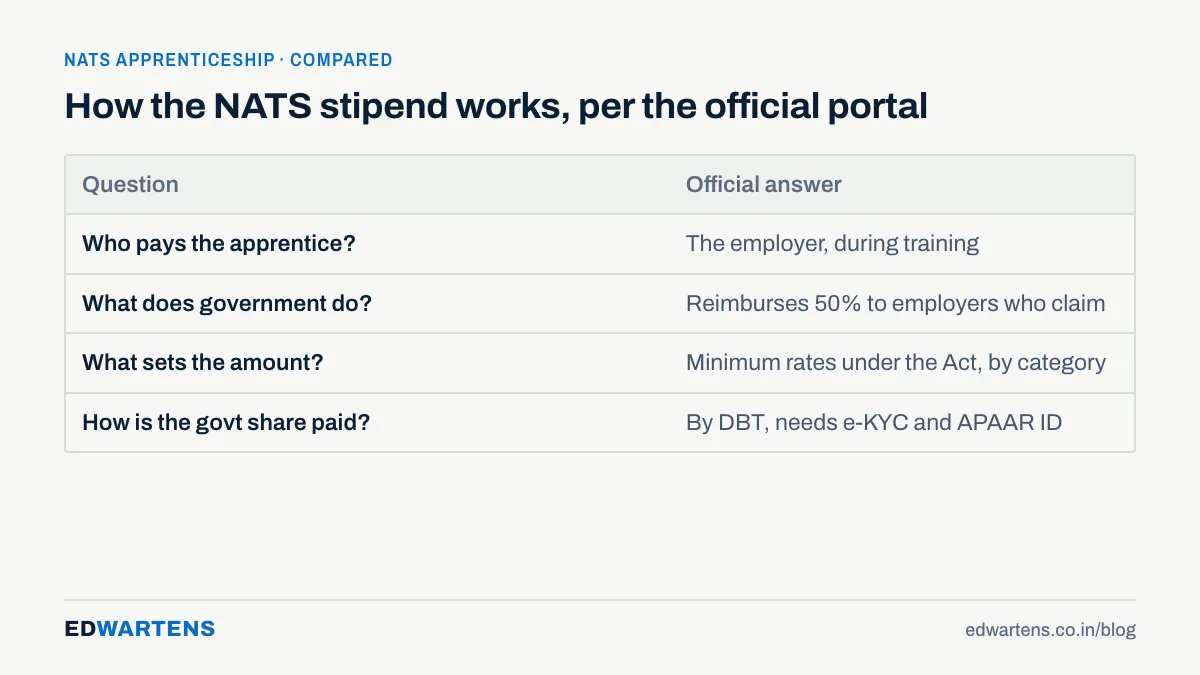
Two portal notices matter for payment. Ministry of Education instructions made e-KYC on the portal mandatory for receiving the government share by DBT, and APAAR ID mandatory for registering and for obtaining an apprenticeship. Do both before you apply.
Duration, the certificate and what it does not promise
Training lasts from six months to one year. The Certificate of Proficiency is issued by the Government of India, and the portal says it can be registered at employment exchanges as valid employment experience. That is useful on a resume where "0 to 2 years" appears. It is not a job offer. The portal states there is no guarantee of employment after training, so treat an apprenticeship as paid experience and a way to be seen, not as a placement.
How to apply, step by step
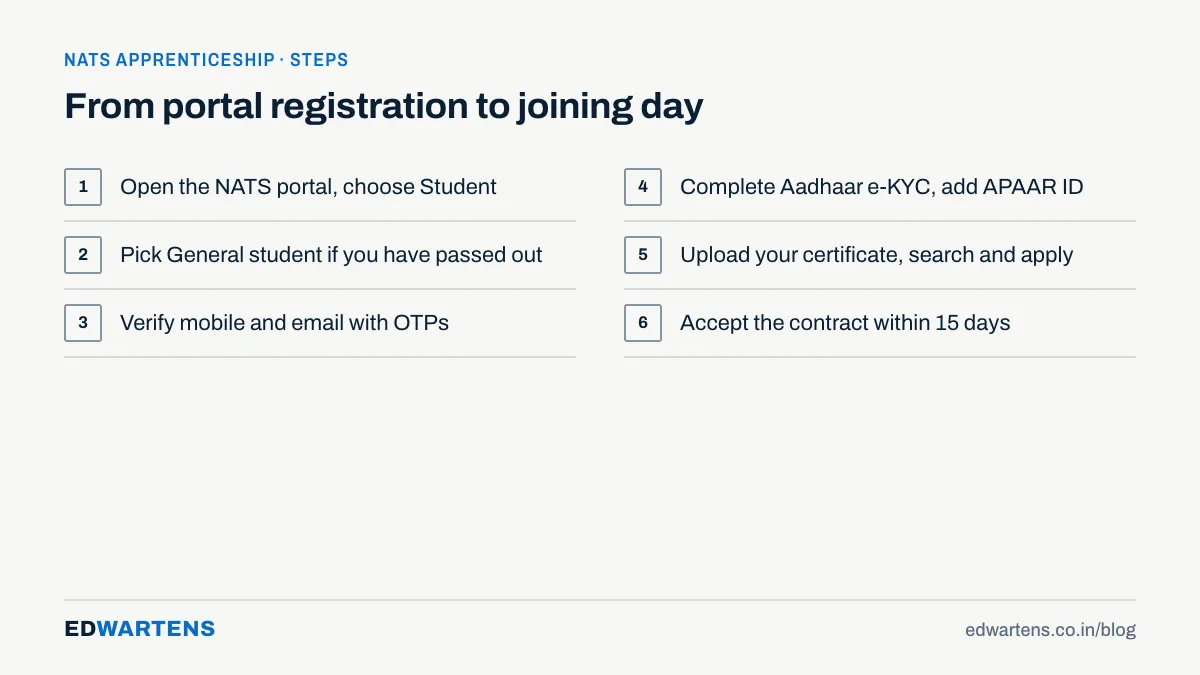
The NATS student manual describes the registration. Keep these ready: a valid email address, a mobile number, your Aadhaar number for e-KYC, your qualifying degree or provisional certificate as a PDF under 1 MB, and your APAAR ID.
- Open the NATS portal and choose Student.
- Pick the General student tab if you have passed out, or Sandwich or AEDP if you are still studying.
- Start Student Registration, and verify your mobile and email with OTPs.
- Complete Aadhaar e-KYC, then fill in your education details and upload the certificate.
- Search the advertisements from establishments and apply to those that match.
- If selected, accept the contract on the portal. The portal FAQ says a contract not accepted within 15 days is auto-rejected.
The portal lists the BOAT regional offices for the north, south, east and west and a support email. Do not pay anyone to register or to get a slot. The portal's own pages do not describe any fee for students.
Apprenticeship, internship or simulation
NATS apprenticeship | AICTE internship portal | EDWartens job simulation | |
|---|---|---|---|
What it is | Paid on-the-job training with an employer | Internships listed by organisations | A simulated working day for practice |
Cost to the student | Nothing listed on the portal | Free to students at every step | Included with the paid programmes |
Result | Certificate of Proficiency | Completion certificate | Practice and a work pack, not work experience |
The AICTE internship portal says registration, applying, shortlisting and the completion certificate cost students nothing, and that anyone asking for money to apply through it is a scam to report to internship@aicte-india.org. A job simulation on our job simulations page is practice. It does not count as work experience or a placement, and it should never be compared to an apprenticeship.
Is this apprenticeship offer genuine?
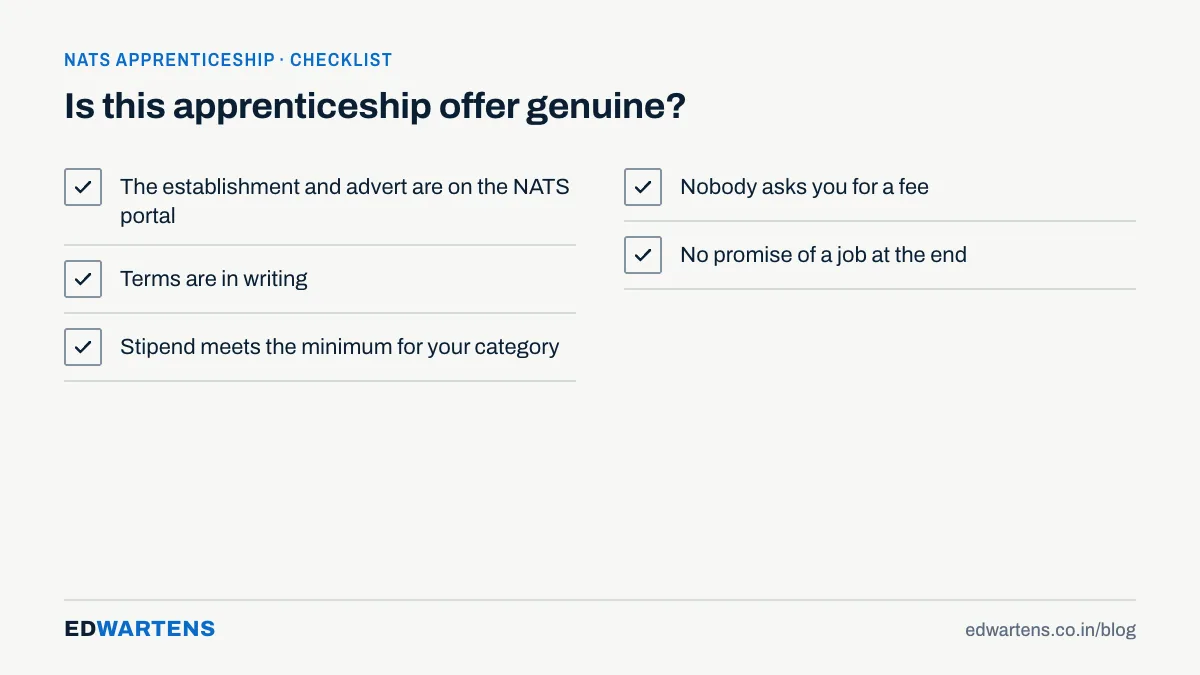
Check that the establishment is registered on the portal and the advertisement is there, that the terms are in writing, that the stipend is at least what the Act requires for your category, and that nobody asks you for a fee. Our guide to verifying placement claims uses the same habit of asking for written proof.
Prepare with free skill courses
Selection interviews for electrical and maintenance apprenticeships test basics and fault-finding. Our free PLC and Electrical Troubleshooting for Maintenance Teams course (about 15.5 hours) teaches a symptom-to-cause method, safe isolation, meter work and reading drawings. Pair it with Electrical Fundamentals for Technicians, Industrial Motor Control and Siemens TIA Portal in Three Hours. The hubs are electrical design and panels and maintenance and condition monitoring. For resumes and routes, see our guides on PLC training for electricians and ITI holders, the diploma route after 12th, the fresher guide to an automation career and ATS resumes for freshers.
An apprenticeship is a separate route through an employer. If you want a taught automation programme instead, the EPGDIA is four weeks of live online classes in Siemens and Delta PLC, HMI and SCADA for graduates and diploma holders. It is not part of NATS.
Watch: technician tips to fix faults faster
The video above is Work Smarter Not Harder- Technician Tips to Fix it Faster by Greg Roche Automation, embedded with thanks. EDWartens is not affiliated with the creator. It runs about 11 minutes and gives practical technician tips for finding faults, and it is a lesson in our free troubleshooting course.
Learn it free on EDWartens
Start the troubleshooting course with the fault-finding method module. It is a free course with a verifiable certificate of completion, and anyone can check a certificate on the verification page. It is an EDWartens certificate and not part of any apprenticeship scheme. You can practise in the free 3D lab at lab.edwartens.com.
Sources (all read 23 November 2026)
- NATS, About us: the scheme, the 50 percent reimbursement, the Certificate of Proficiency, no guarantee of employment.
- NATS portal: student registration, e-KYC and APAAR ID notices.
- NATS students page: duration and subject fields.
- AICTE internship portal: free to students.
Q: What is the NATS stipend for engineering graduates in 2026?
A: The official pages we could open show no rate. The portal says stipend is aligned to the minimum rates under the Apprentices Act for each category. Check the portal and your offer letter for the current figure.
Q: Can B.Tech graduates apply for apprenticeship under NATS?
A: Yes. The portal says graduates and diploma holders in engineering and technology can apply as apprentices after registering. The limit on how long after passing is not stated on the pages we read, so check it.
Q: How do I register on the NATS portal?
A: Choose Student, pick the General tab if you have passed out, register with OTP-verified email and mobile, complete Aadhaar e-KYC, add your education details and APAAR ID, and then apply to advertisements.
Q: Is NATS apprenticeship paid, and does the government pay it?
A: Yes, it is paid. The establishment pays the stipend and the government reimburses 50 percent to employers who claim reimbursement. Some establishments choose not to claim it.
Q: Does an apprenticeship guarantee a job?
A: No. The portal says there is no guarantee of employment after completion. The Certificate of Proficiency counts as employment experience, which can help your applications.
Q: What is the difference between an apprenticeship and an internship?
A: An apprenticeship under NATS is a paid, longer on-the-job training with a contract and a government certificate. An internship is usually shorter and varies by organisation. Check the stipend and terms in each offer.
If you are a fresher or a diploma holder wondering where to start, see our PLC course for freshers and diploma holders.
Learn this, free
The courses that teach this
Every lesson, the written notes and the practice are free with an account. Only the certificate is optional and paid.


