PLC Training for Electricians and ITI Holders

The short answer
PLC training for electricians builds on skills you already use every day: wiring, motor starters, reading drawings and working safely. The ITI Electrician syllabus covers relay control panels and AC/DC drives, but PLC programming is not in it (DGT Electrician CTS version 3.0, revised August 2025), so that is the gap to fill. On Indeed India, electricians average about ₹17,750 a month (August 2026) while PLC programmers average about ₹28,740 a month (May 2026). The realistic route is step by step: panel wiring, then PLC maintenance, service and commissioning work, then programming, learning in the evenings with free courses and a small PLC.
What you already know that matters
Many electricians and ITI holders think PLC work is only for engineers. It is not. A large part of an automation technician's day is electrical work you already do well.
- Wiring. Terminating, ferruling, dressing cables and following a wire number from one end of a panel to the other.
- Motor starters. DOL, star-delta, forward-reverse, overload settings. A PLC replaces the relay logic, not the contactors and motors.
- Reading drawings. If you can follow a control circuit drawing, you can learn to follow a PLC I/O drawing. It is the same idea with a PLC card in the middle.
- Safety. Isolation, proving dead, earthing, lockout. Companies trust a technician who works safely more than one who knows more software.
- Fault finding with a meter. Most PLC faults on site turn out to be a sensor, a loose wire, a blown fuse or a tripped overload. You find those with a multimeter, not a laptop.
The official ITI Electrician curriculum confirms this base. The DGT Electrician syllabus (CTS version 3.0, NSQF level 4, two years) includes control panel wiring, relay logic, and speed control of motors with AC and DC drives. It does not include PLC programming. If you hold Electronics Mechanic or Instrument Mechanic, you bring other strengths: electronics fault finding, or transmitters and 4 to 20 mA loops, which are exactly what automation plants need.
What PLC training for electricians adds
PLC training does four new things for an electrician:
- Ladder logic. You already know relay logic, so ladder logic will feel familiar. A normally open contact in the program behaves like the one in your control circuit.
- Inputs and outputs. How sensors (PNP, NPN), push buttons and limit switches connect to a PLC input card, and how outputs drive contactors, solenoids and lamps.
- Going online with a laptop. Connecting to a PLC, watching the program run live, seeing which input is on, and reading the fault messages. This is the most valuable maintenance skill, and it does not require writing big programs.
- Drives and HMIs. Starting a VFD from the PLC, setting speed, and using an HMI screen to find alarms.
If you are looking for a PLC course after ITI, start with what is closest to your trade. The free Industrial Motor Control course revises starters and relay logic in the same way PLC courses describe them. Then move to a small PLC: the free Siemens LOGO! and S7-200 SMART course is a good first PLC course for electricians because these small controllers are common in Indian machines. After that, the free Variable Frequency Drives course covers wiring, parameters and control from a PLC. If your basics in theory are weak, Electrical Fundamentals for Technicians is there first. All of these are free to study in full, including the final test. A certificate after passing is optional and costs ₹459 to ₹959, GST included, depending on the course level.
The realistic job ladder from electrician to programmer
Nobody goes from ITI straight to senior PLC programmer, and anyone who promises that is not being honest with you. Here is the ladder most technicians actually climb.
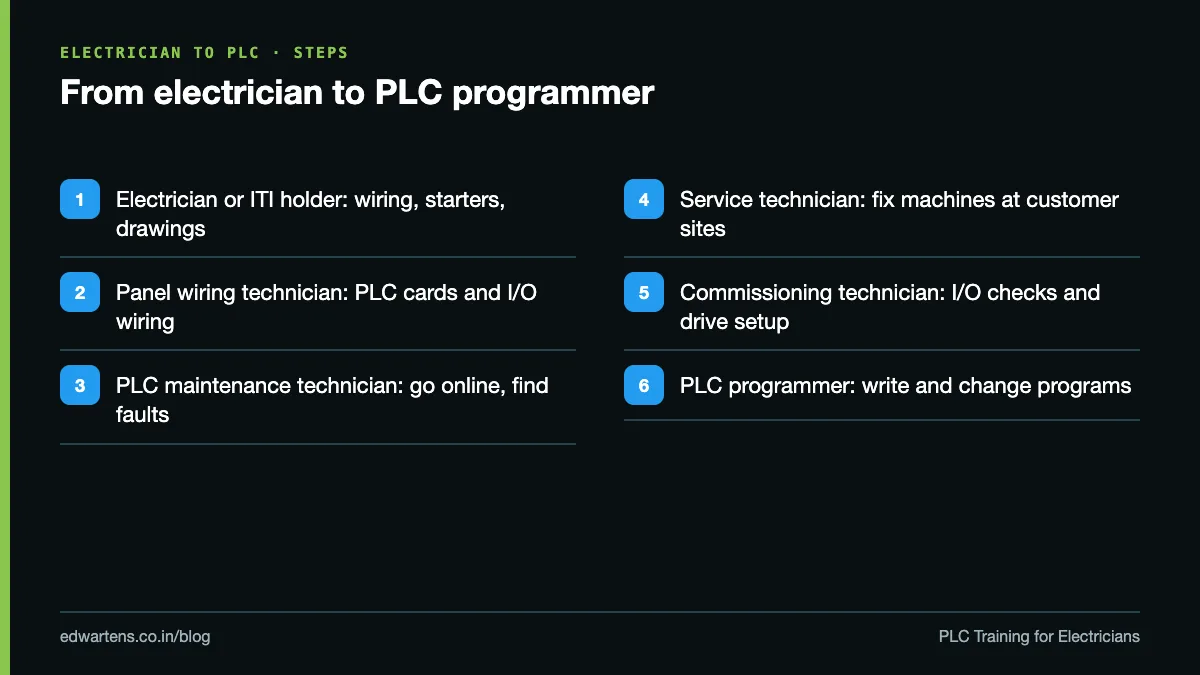
- Panel wiring technician. Wiring control panels at a panel builder from drawings. You learn PLC cards, terminals, I/O wiring and testing. This is often the easiest first step for an electrician.
- PLC maintenance technician. In a factory, keeping machines running. You go online to the PLC to see which input is missing, change a sensor, reset a drive fault. You rarely change the program.
- Service technician. With a machine builder or system integrator, travelling to customer sites to fix and maintain their machines.
- Commissioning technician. Starting up new machines and panels: I/O checks, loop checks, drive setup, working beside the programmer.
- PLC programmer. Writing and changing programs. Technicians who reach this step usually got there by doing small program changes under supervision at steps 2 to 4.
Each step takes time. Two years at one step is common, and that is fine. The experience is what makes the next employer trust you.
Pay at each step
These figures come from Indeed India, which averages salaries from job posts and user reports. Sample sizes are small for some roles, so read them as rough guides. Indeed has no separate "panel wiring technician" page, so the electrical technician figure is the closest match.
| Step | Closest Indeed title | Average a month | Typical range a month | Data |
|---|---|---|---|---|
| Electrician | Electrician | ₹17,750 | ₹8,086 to ₹40,739 | 618 salaries, Aug 2026 |
| Panel wiring | Electrical technician | ₹18,152 | ₹11,305 to ₹29,144 | 206 salaries, June 2026 |
| PLC maintenance | Maintenance technician | ₹19,326 | ₹11,664 to ₹32,020 | 111 salaries, Feb 2026 |
| Service | Service technician | ₹20,475 | ₹12,244 to ₹34,237 | 111 salaries, Feb 2026 |
| Instrumentation | Instrument technician | ₹25,397 | ₹13,970 to ₹46,170 | 42 salaries, May 2026 |
| Programming | PLC programmer | ₹28,740 | ₹16,633 to ₹49,660 | 40 salaries, May 2026 |
| Commissioning | Commissioning engineer | ₹34,206 | ₹14,843 to ₹78,828 | 18 salaries, Feb 2026 |
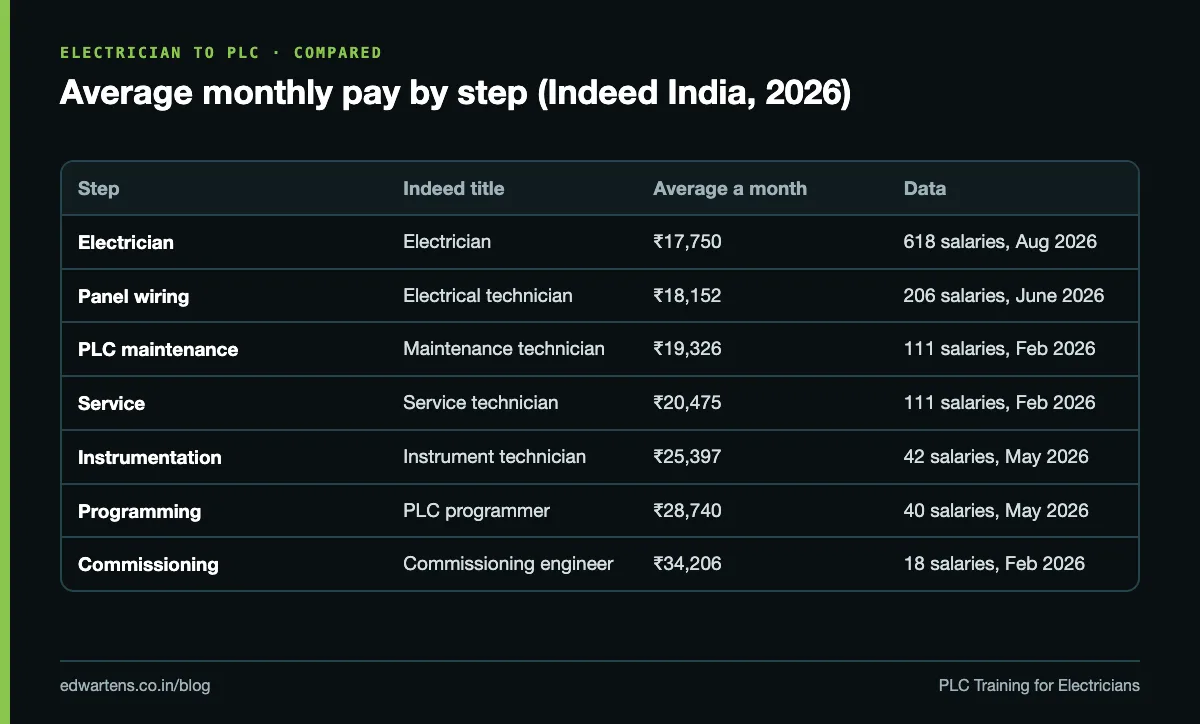
Two honest points. First, on these averages the jump from electrician to the middle steps is modest, about ₹1,500 to ₹3,000 a month. The bigger jump comes at commissioning and programming, after experience. Second, location matters. Indeed shows electrical technicians in Bangalore at about ₹20,049 a month and PLC programmers in Bangalore at about ₹30,669 a month, a little above the national average, and industrial belts such as Hosur and Sriperumbudur are also above average for technicians.
Government routes for ITI holders: ATS, NSTI and CITS
ITI holders have government routes that degree holders often do not. Here is what we could verify.
| Route | What it is | Key facts | Where to check |
|---|---|---|---|
| Apprenticeship (ATS) | On-the-job training in a company under the Apprentices Act, 1961 | Minimum stipend for an ITI certificate holder is ₹7,000 a month under the 2019 rules, plus 10% in year two and 15% more in year three | apprenticeshipindia.gov.in |
| NSTI short courses (AVTS) | Short skill-upgrade courses at National Skill Training Institutes | Typically 1 to 2 weeks; NSTI Chennai charges private candidates ₹1,500 per week | Your nearest NSTI website |
| CITS | One-year Craft Instructor Training at NSTIs | For NTC, NAC, diploma or degree holders; admission by all-India entrance test | dgt.gov.in |
Apprenticeship. An apprenticeship at a plant or panel builder is one of the best ways to get near PLCs, because you are inside a working company. The ₹7,000 minimum comes from the Apprenticeship (Amendment) Rules, 2019. In May 2025 the Central Apprenticeship Council recommended a 36% increase, which would move the range from ₹5,000 to ₹9,000 up to ₹6,800 to ₹12,300 a month (IASGyan summary). Check the current rate on the apprenticeship portal before you join, because companies are only bound by the notified minimum.
NSTI short courses. National Skill Training Institutes run short courses that suit electricians. NSTI Hyderabad lists PLC Programming, Automation with Micro PLC (Siemens LOGO), Electro Pneumatics and PLC Applications, and AC and DC Motor Controls, with no training fee for ongoing ITI trainees. NSTI Bengaluru lists Electrical Maintenance and Drives, Mechatronics, and Pneumatics and Hydraulics. Fees, dates and seats change every year, so read the current training calendar on the institute's own website.
CITS. If you enjoy explaining things, the Craft Instructor Training Scheme lets ITI holders train as ITI instructors. It is a one-year course at NSTIs with an all-India entrance test.
How to learn while you are working
Most readers of this post already have a job and a family to support. Quitting to study full-time is not realistic for many of you, and you do not need to.
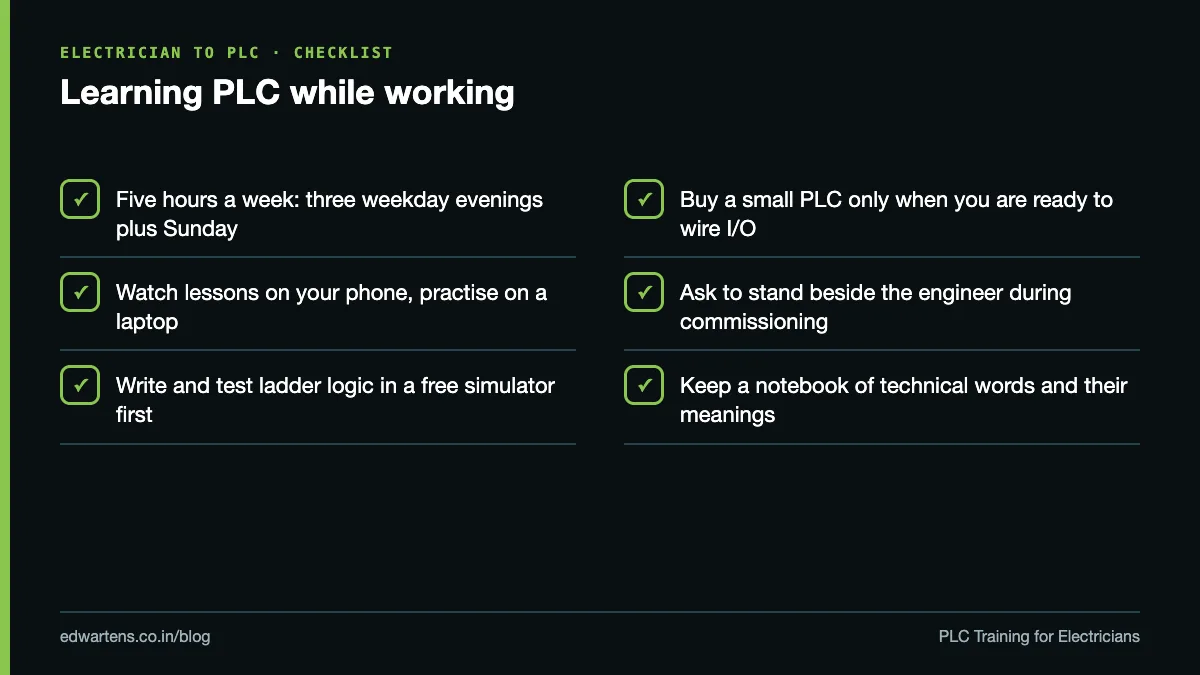
- Five hours a week is enough to start. One hour on three weekday evenings and two hours on Sunday. In three months you can finish motor control revision and a first PLC course.
- Use your phone for video, a laptop for practice. Watch lessons on the bus or in breaks. Do the practice tasks on a laptop or a shared computer when you can.
- Practise on simulation first. Free software and simulators let you write and test ladder logic without buying anything. Our guide to free PLC software to practise at home lists the options.
- Buy hardware only when you are ready. A small PLC such as a Siemens LOGO! or a Delta DVP, or the free OpenPLC software on an Arduino, is enough to practise wiring inputs and outputs. Check current dealer prices before buying, and never practise on mains voltage at home without proper protection.
- Ask at work. Tell your supervisor you are learning PLCs and ask to stand next to the engineer the next time a machine is commissioned or a program is changed. For many technicians this is the first real look at a live PLC.
If you can only attend classes on weekends, our post on weekend and evening PLC batches explains what is realistic.
About English and language
Many electricians worry that PLC work needs fluent English. It needs less than you think. Software menus, fault messages and drawings use a small set of technical words: input, output, contact, coil, timer, counter, fault, reset. Once you know about a hundred of these, you can work.
Be aware that the EDWartens free courses are in English. The notes are written in short, simple sentences, but they are still English. We have not verified a complete free PLC course in Hindi or another Indian language that we can recommend, so we do not name one here. Two things that help: turn on subtitles on the video lessons, and keep a notebook of new words with their meaning in your own language. Ask questions in whatever language you are comfortable with. Nobody good at this job will think less of you for it.
When a classroom programme makes sense
Free courses and evening practice can take you to panel wiring and maintenance roles. If you want to move faster towards commissioning and programming and can spend time in Bangalore, a full classroom programme with real panels helps. The EDWartens Automation Engineer Program in Electronic City accepts ITI holders alongside diploma and degree holders and admission is based on aptitude. It covers 20 PLC brands plus drives, HMI and SCADA on hands-on panels, and candidates receive an experience certificate from Wartens. There is a written job guarantee with conditions in the Placement Policy. Fees are discussed after counselling, with EMI options. You can compare it with other options on our PLC training in Bangalore page.
If you are coming from 12th or a diploma rather than ITI, read PLC training after 12th or diploma, and if you are worried about not having a degree, read how to start a PLC career without a degree.
Read next: government PLC training institutes in India for low-cost NSTI short courses, and PLC programmer salary in India.
Frequently asked questions
Q: Can an ITI electrician learn PLC programming?
A: Yes. Electricians already understand relay logic, starters and drawings, which is the base of ladder logic. Most start by learning to go online to a PLC and find faults, then move to small program changes, then full programming over a few years.
Q: Is PLC included in the ITI Electrician course?
A: Not in the current DGT Electrician syllabus (CTS version 3.0, revised August 2025). It covers control panel wiring, relay logic and AC/DC drives, but PLC programming has to be learned separately.
Q: How much does a PLC technician earn compared with an electrician?
A: On Indeed India, electricians average about ₹17,750 a month (August 2026), maintenance technicians about ₹19,326 (February 2026) and PLC programmers about ₹28,740 (May 2026). The larger jump usually comes with commissioning and programming experience.
Q: Do I need good English for PLC jobs?
A: You need a working vocabulary of technical words, not fluent English. Fault messages and software menus use a small set of words you can learn with a notebook and practice.
Q: Are there government PLC courses for ITI holders?
A: Yes. NSTIs run short courses; NSTI Hyderabad lists PLC Programming and Automation with Micro PLC (Siemens LOGO), with no training fee for ongoing ITI trainees. Check your nearest NSTI website for current dates and fees.
Q: Can I learn PLC while working full-time?
A: Yes. About five hours a week on free courses and a simulator is enough to start, and standing beside engineers during commissioning at your own workplace teaches a lot of the rest.
Next step
Start this week with the free Industrial Motor Control course, then the free Siemens LOGO! and S7-200 SMART course. They cost nothing to study. If you want advice on your next step, or want to know whether the classroom programme suits you, talk to us through our contact page.
Learn this, free
The courses that teach this
Every lesson, the written notes and the practice are free with an account. Only the certificate is optional and paid.