

EV Charging Jobs in India: Skills and Free Courses

The short answer
EV charging jobs in India are real but still early. Under PM E-DRIVE, 6,562 public charging points had been sanctioned and none installed as of 22 July 2026, according to a ministry reply reported by electrive, so the scheme itself has not yet produced a hiring wave. A policy brief projects public charging jobs could grow from about 21,000 in FY2025 to 650,000 by FY2047. That is a projection, not hiring. The skills worth building now are electrical safety, earthing and protection, AC and DC charger basics (Type 2 and CCS2), communication with OCPP, and fault-finding. Electrical, electronics and mechatronics graduates, diploma holders and ITI electricians can all start free.
Scheme numbers were read on 23 November 2026 from electrive (5 August 2026), a Lok Sabha reply of 17 March 2026 and a January 2026 policy brief. They change, so recheck before you rely on them. We state no pay figures.
EV charging jobs in India: the scheme picture in November 2026
Item | Reported figure | Source and date |
|---|---|---|
Public charging points approved under PM E-DRIVE | 6,562, including 1,571 in Karnataka | electrive, 5 August 2026 |
Installed as of 22 July 2026 | None, per the Heavy Industries Minister | electrive, 5 August 2026 |
Scheme budget | 10,900 crore rupees, April 2024 to March 2028, with 2,000 crore for public charging | electrive, 5 August 2026 |
High-speed chargers on national highways | 2,000 planned. No locations finalised or sanctioned as of 12 March 2026 | Lok Sabha reply, 17 March 2026 |
What does this mean for jobs? Scheme-funded chargers are not yet in the ground, so the near-term work depends on other buyers: private charging operators, vehicle makers, fleets and housing societies. The sources above do not count those. The longer-term picture is more hopeful. The Climate Policy Initiative brief of January 2026 says public charging jobs could expand at a 17 percent compound annual growth rate from roughly 21,000 in FY2025 to 650,000 in FY2047, across charger manufacturing, utilities, installation and operations and maintenance. It identifies 105 new job categories in charging infrastructure and says 43 percent of internal combustion technical skills have minimal overlap with EV needs. Read these as scenarios.
How a charger works
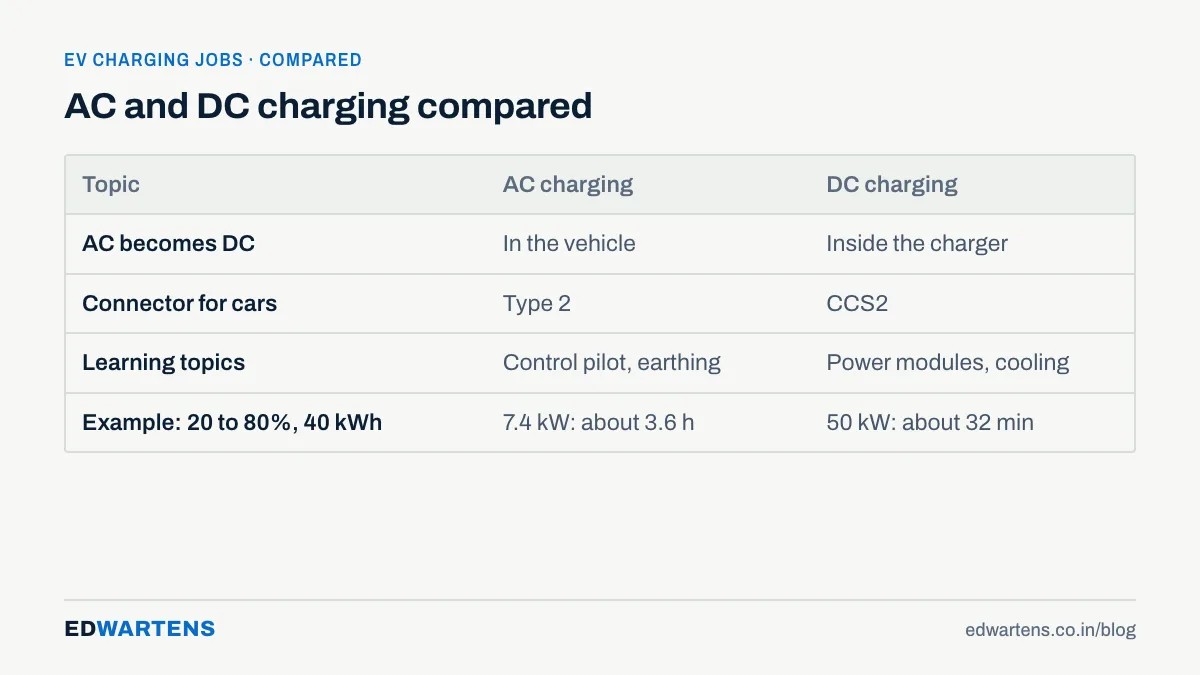
Topic | AC charging | DC charging |
|---|---|---|
Where AC becomes DC | In the vehicle's on-board charger | Inside the charger |
Connector for cars | Type 2 | CCS2 (combined charging system) |
Main learning topics | Control pilot, earthing, protection | Power modules, cooling, communication |
The ministry's reply lists the charging standards under PM E-DRIVE: Light EV DC (IS 17017-2-6) and Light EV AC and DC combo (IS 17017-2-7) for e-2W and e-3W, and CCS-II (IS 17017-2-3) for e-4W, e-buses and e-trucks.
A worked example: how long does a charge take
Take a battery you want to charge from 20 to 80 percent, which on a 40 kWh pack is 24 kWh. A 7.4 kW AC charger draws about 7,400 / 230 = 32 A on a single-phase supply. Assume 90 percent of the power reaches the battery, which is 6.66 kW. The time is 24 / 6.66 = 3.6 hours. A 50 kW DC charger at the same 90 percent gives 45 kW, so 24 / 45 = 0.53 hours, about 32 minutes. Real charging tapers as the battery fills, and the values here are assumptions, so use manufacturer data for real work. The point of the example is the habit: check the current as well as the time, because the supply and the cable must carry it.
Jobs in charging
Role | What the work involves | Skills that help |
|---|---|---|
Installation technician | Fitting chargers, cables and protection | Wiring, earthing, safe isolation |
Commissioning engineer | Testing before power, then a test charge | Insulation and earth tests, communication checks |
Operations and maintenance | Fault-finding on live sites | Meter work, logs, remote monitoring |
Design and utility interface | Load and supply planning | Cable sizing, fault levels, protection |
Software and network | Connecting chargers to a back end with OCPP | Networking, protocols, data |
If you are an ITI electrician, our guide to PLC training for electricians shows an adjacent path. For storage-related jobs see our post on battery plant jobs in Bengaluru.
Skills to build now
Electrical safety comes first. Learn safe isolation, earthing and bonding, and how protective devices differ. Our posts on earthing and bonding, MCB, MCCB, RCCB, ELCB and RCBO and selecting a contactor, overload relay and breaker cover the basics. Then learn the charger itself: AC and DC, the control pilot, the connector types and OCPP. Our related wave post on PM Surya Ghar jobs shows how rooftop solar and charging meet on a limited supply.
Before you pay for a course
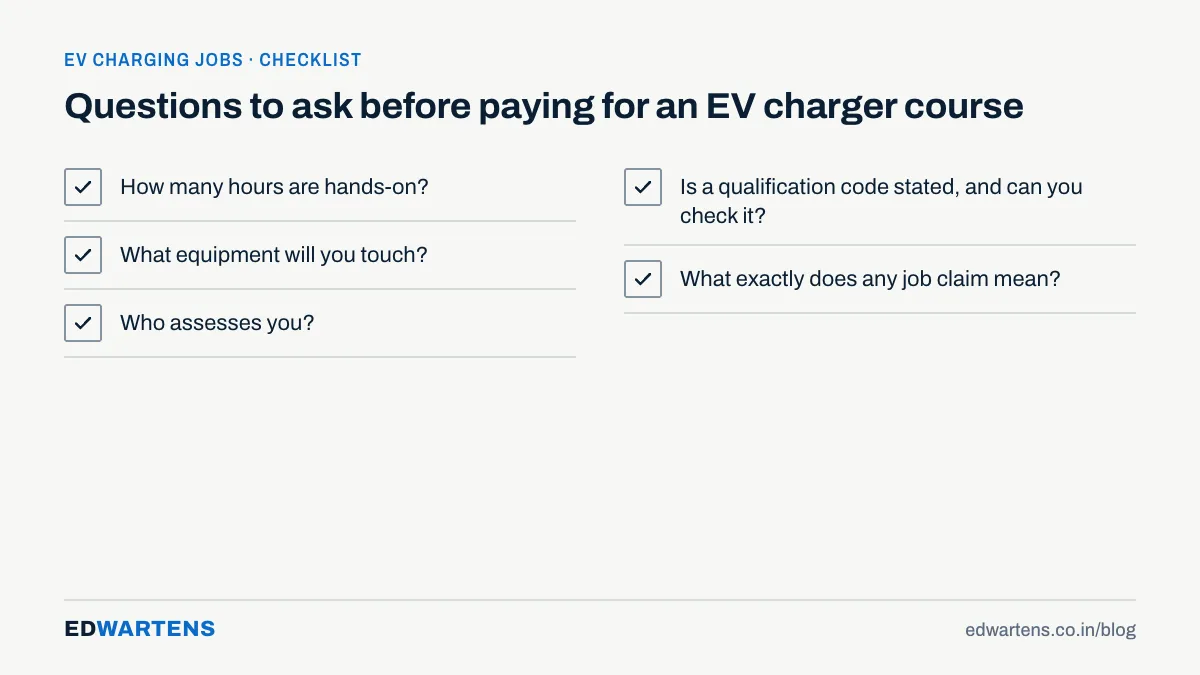
Ask how many hours are hands-on, what equipment you will touch, who assesses you, whether any qualification code is stated and whether it can be checked, and what exactly any job claim means. A course that cannot say what you will do with your hands is a theory course, which may still be fine if it is priced that way.
A four-week free plan
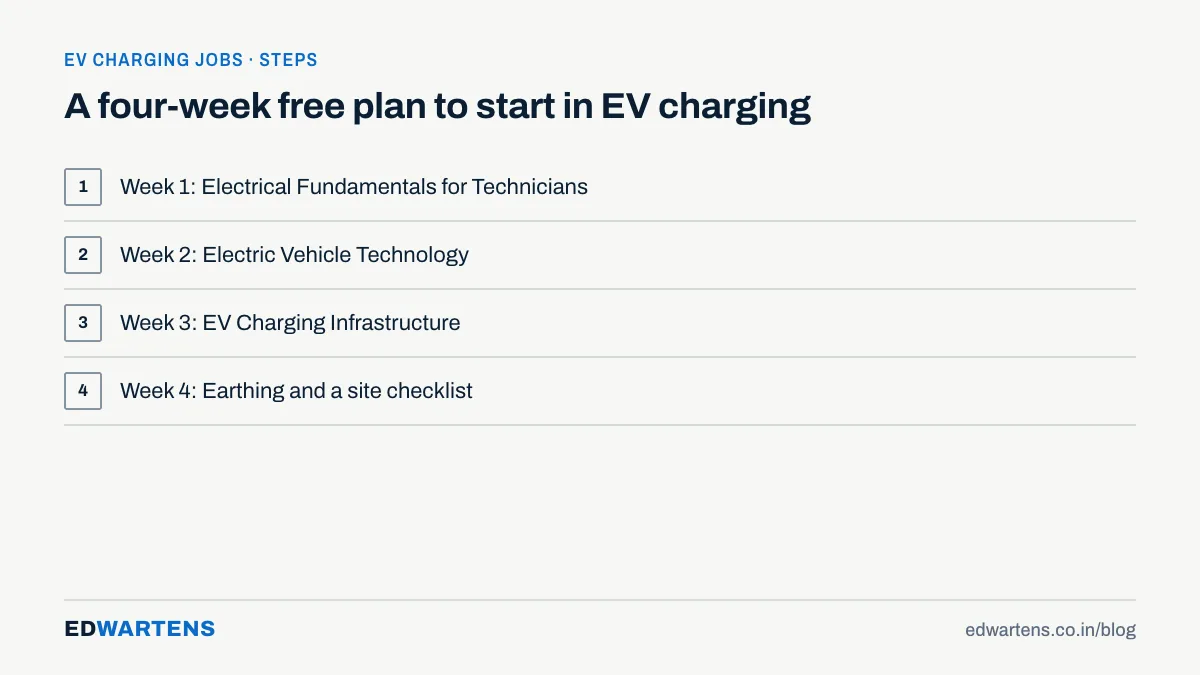
- Week 1: Electrical Fundamentals for Technicians for safe isolation, the multimeter and earthing.
- Week 2: Electric Vehicle Technology Fundamentals for the vehicle and battery.
- Week 3: EV Charging Infrastructure for AC, DC, CCS2 and OCPP.
- Week 4: Earthing and Lightning Protection Design and a one-page checklist for a charger site.
For storage, add Battery Energy Storage Systems. As a learning outline only, not a site procedure, a first-day commissioning order is: check the drawings, test earthing, check insulation, energise, test communication and finish with a test charge. Always follow the site's own safety rules and a qualified supervisor.
Practise in the lab and a simulation
The free 3D lab at lab.edwartens.com lets you practise wiring and testing without hardware. On our job simulations page, the Solar PV and EV Charging Engineer simulation has you size a rooftop array, test it before energising and fit EV chargers on a limited supply. It is included with the paid programmes and is practice, not work experience. A step-by-step version is in our post on commissioning a solar and EV charger setup in a simulator.
Watch: charging and swapping infrastructure
The video above is Lecture 5: Charging and SwappingInfrastructure by NPTEL-NOC IITM, embedded with thanks. EDWartens is not affiliated with the creator. It runs about 19 minutes and covers the picture of charging and swapping infrastructure, and it is the first lesson of our free EV charging course.
Learn it free on EDWartens
The EV Charging Infrastructure course takes about 10.5 hours over four weeks. It explains AC and DC charging and where conversion happens, what is inside each charger, Type 2 and CCS2, the control pilot, OCPP, public charging stations, battery swapping and the economics of a charging business. It is built on NPTEL lectures from IIT Madras and IIT Roorkee. It is a free course with a verifiable certificate of completion, and anyone can check a certificate on the verification page. It is an EDWartens certificate, not a government or vendor qualification. The hubs are electric vehicles, solar and energy storage and power systems. Start the EV charging course after you finish week 1.
Sources (all read 23 November 2026)
- electrive, "India approves chargers, awaits deployment", 5 August 2026: sanctioned and installed counts, budget.
- Ministry of Heavy Industries, Lok Sabha Unstarred Question 4080, answered 17 March 2026: highway chargers and the charging standards.
- Climate Policy Initiative, Outlook of Future Mobility Jobs Market in India, January 2026: the jobs projection.
Q: How do I start a career in EV charging in India?
A: Build electrical safety, earthing and protection skills first, then learn AC and DC chargers, CCS2 and OCPP. Free courses cover this, and a small project, such as a site checklist, shows your learning.
Q: What does an EV charging station technician do?
A: They install and connect chargers, check earthing and insulation, test communication and a charge, and later find and fix faults. Safe isolation and meter skills are the base.
Q: Which courses are good for EV charger installation?
A: Look for hands-on hours, a stated qualification code you can check, and equipment practice. Free courses give theory and design checks, and you must add supervised practical work on real equipment.
Q: Is there demand for electrical engineers in EV charging?
A: Demand is projected to grow, but scheme-funded chargers had not yet been installed as of 22 July 2026. Private operators and fleets also build charging, so look at both when you plan.
Q: What is CCS2 and which standard do Indian chargers follow?
A: CCS2 is a combined connector for AC and DC charging of cars. The ministry names IS 17017-2-3 (CCS-II) for e-4W, e-buses and e-trucks, and IS 17017-2-6 and IS 17017-2-7 for light EVs.
Q: Is PM E-DRIVE creating charging jobs now?
A: Not at scale yet on the figures we read. Public charging points were sanctioned, but none had been installed by 22 July 2026. Watch for installation figures in later ministry replies.
If you are a fresher or a diploma holder wondering where to start, see our PLC course for freshers and diploma holders.
Learn this, free
The courses that teach this
Every lesson, the written notes and the practice are free with an account. Only the certificate is optional and paid.


