PLC Course Duration and Fees in India: 2026 Details

The short answer
A PLC course in India usually takes 1 to 2 months for a short certificate, 2 to 4 months for a combined PLC SCADA course, and 6 to 12 months for a long programme with drives, HMI and placement. Government institutes publish their fees and are the cheapest: CTTC Bhubaneswar charges ₹8,000 for a one-month PLC course, NIELIT Calicut charged ₹4,500 including GST for a four-week online PLC and SCADA course (details), and a one-year post diploma in automation at CTTC costs ₹54,000. Private institutes typically quote from about ₹15,000 for a short course to above ₹1 lakh for long, placement-linked programmes, and rarely publish fees. Eligibility is usually a diploma, BE/BTech or BSc in electrical, electronics, instrumentation or mechanical, with ITI accepted for many technician courses.
PLC course details: eligibility
Most PLC courses in India accept:
- Diploma in electrical, electronics, instrumentation, mechatronics or mechanical engineering.
- BE/BTech in EEE, ECE, E&I, mechanical, mechatronics, and in many cases computer science.
- BSc in physics or electronics, for some private and university certificate courses.
- ITI electrician, fitter or electronics mechanic, for technician-level and NSTI short courses.
Government courses are stricter on paper. CTTC Bhubaneswar's one-month PLC and SCADA courses are listed for diploma or degree holders in electrical or electronics engineering, and ASAP Kerala's industrial automation course is for BTech students and graduates in ECE, EEE, E&I, mechanical, mechatronics, CSE and AEI. If you are coming from 12th standard with no diploma, read our note on PLC training after 12th or diploma before paying for anything.
PLC course duration by format
The honest answer to "how long is a PLC course" is: long enough to give you hardware hours, and no longer. Here is how the main formats compare.
| Format | Typical duration | Published example | Who it suits |
|---|---|---|---|
| Government short course (NSTI) | 1 to 2 weeks | NSTI Chennai, S7-1200 with HMI and SCADA: 2 weeks | Working technicians, upskilling |
| Short PLC certificate | 1 to 2 months | CTTC PLC: 1 month; NIELIT online: 35 hours | Students testing the field |
| PLC SCADA combined | 2 to 4 months | ASAP Kerala Industrial Automation: 300 hours | Freshers aiming for a first job |
| Long programme (PLC, SCADA, HMI, drives, projects) | 6 to 12 months | CTTC Process Designer, Automation: 600 hours | Freshers and career changers who want placement |
| Government post diploma | 1 year | CTTC post diploma: 1,560 hours | Diploma holders wanting a formal credential |
| OEM course (Siemens, Rockwell) | 3 to 5 days | Rockwell Studio 5000 Level 1: 5 days | Engineers already on the job |
Hours matter more than months. ASAP Kerala's course is defined as 300 hours; CTTC's six-month automation courses are 600 hours and its one-year post diploma is 1,560 hours. An institute that cannot tell you the hours, and how many of them are on hardware, is selling a duration, not a course. For how long the skill itself takes, see how long it takes to learn PLC programming.
PLC course duration and fees: published government examples
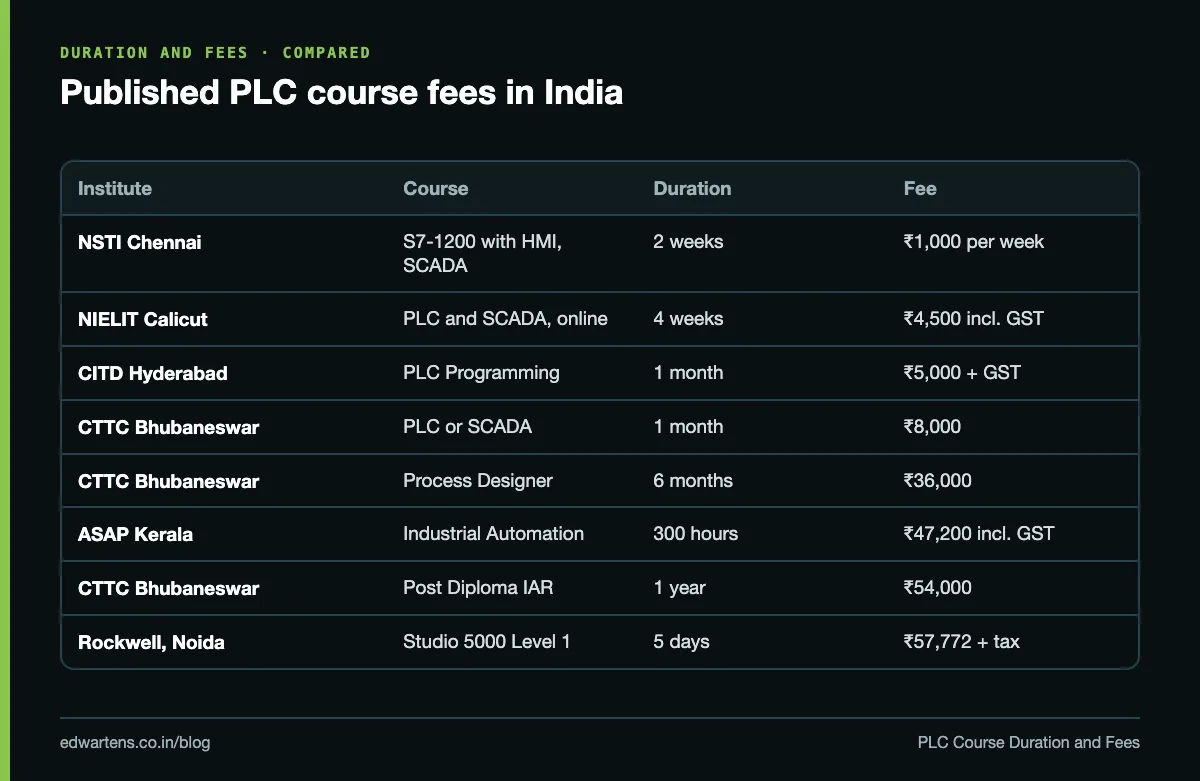
Government institutes are the only ones in India that publish complete fee tables, which makes them the best benchmark. These are the 2025-26 and 2026 figures from each institute's own document.
| Institute | Course | Duration | Fee |
|---|---|---|---|
| NSTI Chennai | PLC Programming using Siemens S7 1200 with HMI and SCADA | 2 weeks | ₹1,000 per week (private candidate) + ₹100 registration |
| NIELIT Calicut | Industrial Automation with PLC and SCADA (online) | 4 weeks, 35 hours | ₹4,500 incl. GST |
| MSME Technology Centre (CITD) Hyderabad | PLC Programming | 1 month, 3 hours a day | Reported ₹5,000 + GST; confirm with CITD |
| CTTC Bhubaneswar | PLC / SCADA | 1 month each | ₹8,000 each + ₹1,000 registration |
| CTTC Bhubaneswar | Process Designer: Automation | 6 months, 600 hours | ₹36,000 |
| ASAP Kerala | Industrial Automation | 300 hours | ₹47,200 incl. GST |
| CTTC Bhubaneswar | Post Diploma in Industrial Automation and Robotics | 1 year, 1,560 hours | ₹54,000 |
| Rockwell Automation, Noida | Studio 5000 Logix Designer Level 1 | 5 days | ₹57,772 + tax |
CTTC also adds an assessment fee (₹500 plus ₹300 other fees for courses over a month, ₹800 plus ₹300 for a year or more), and SC/ST candidates pay no course fee on NSQF-aligned courses. These details are why reading the actual brochure matters.
PLC SCADA course fees at private institutes
Private institutes rarely publish fees, and quotes vary with batch, brand count and negotiation. From public listings we reviewed in October 2026, short PLC or PLC with HMI courses of one to three months are commonly quoted between about ₹13,000 and ₹45,000. Combined PLC SCADA courses with more brands and lab time cost more, and long programmes with placement terms often run into six figures. Our earlier breakdown of PLC training fees in Bangalore puts numbers on each tier for one city.
PLC course fees in Chennai, Pune, Hyderabad and Coimbatore
City matters less than format. A one-month course costs roughly the same in Chennai, Pune, Hyderabad or Coimbatore; what changes is living cost and the employers near you. Hyderabad has CITD, an MSME Technology Centre whose 2025-26 brochure was reported at ₹5,000 plus GST for a one-month PLC course; we could not open the brochure ourselves, so confirm the fee with CITD. Chennai has the NSTI Chennai short courses at ₹1,000 a week. Pune and Coimbatore have no single published government PLC benchmark we could verify, so compare private quotes there against the CTTC and NIELIT figures above. Kerala has ASAP Kerala at ₹47,200 for 300 hours.
How to check a private fee properly:
- Ask for the fee in writing, including GST. A quote "plus GST" is 18% higher.
- Ask for total hardware hours and the number of students per kit.
- Ask what is refundable, and when.
- Ask for two former students you can call.
What a fair PLC SCADA course syllabus contains
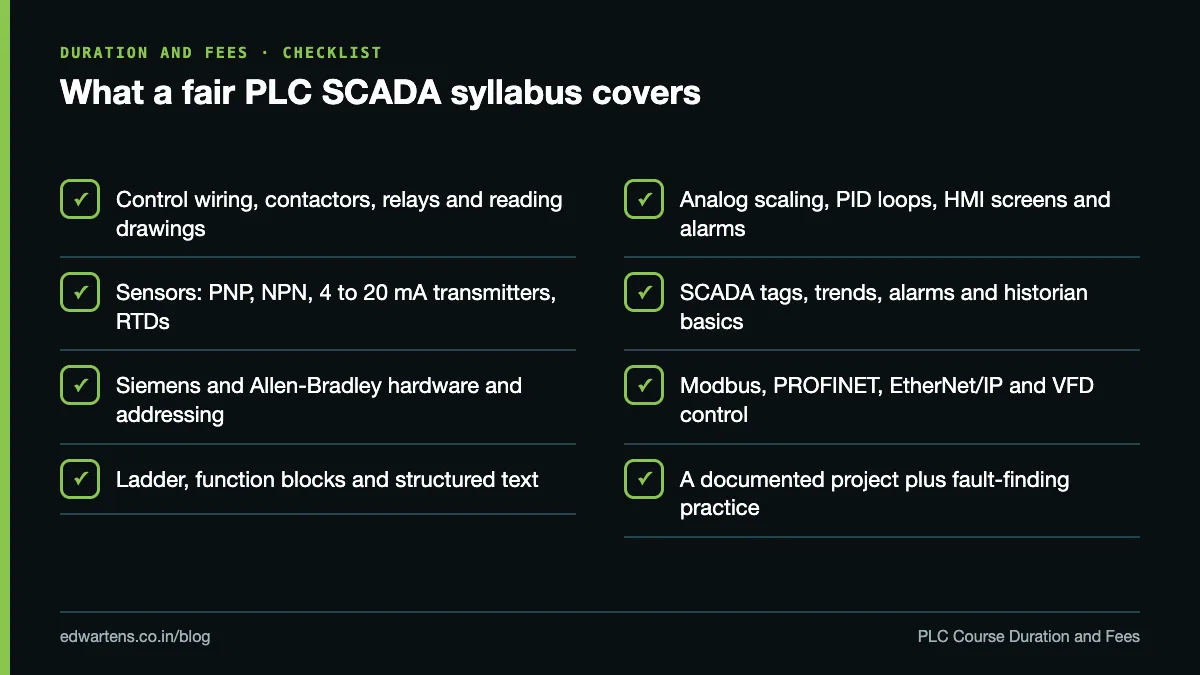
Whatever the duration, a PLC SCADA course that prepares you for a job should cover the following. Anything missing is a gap you will pay for later in interviews.
- Electrical basics: contactors, relays, MCBs, control wiring, reading drawings
- Sensors and field devices: PNP and NPN, 4 to 20 mA transmitters, RTDs
- PLC hardware and addressing on at least Siemens and Allen-Bradley
- Ladder logic, timers, counters, comparison and math, then function blocks and structured text
- Analog scaling and PID loops
- HMI screens, alarms and recipes
- SCADA: tags, trends, alarms, historian basics, one platform such as WinCC or FactoryTalk
- Communication: Modbus, PROFINET, EtherNet/IP
- VFDs: wiring, parameters and network control
- A full project with documentation, plus troubleshooting on faults you did not create
A week-by-week version is in our PLC syllabus guide.
What pushes the fee up (and whether it is worth it)
| Cost driver | Why it costs more | Worth paying for? |
|---|---|---|
| More PLC brands | More licences and hardware | Yes, up to about four to six well-taught brands |
| Hardware hours | Real panels wear out and need trainers | Yes, this is the main thing you are buying |
| SCADA and DCS licences | Runtime and development licences are costly | Yes, if you actually build a project on them |
| Placement terms | Staff to run employer drives | Only if written, with refund conditions |
| Brand names on the certificate | Licensing and marketing | Rarely, unless the employer can verify it |
| Air-conditioned classrooms and video | Overheads | No |
Hidden costs nobody quotes
- GST at 18% if the quote is exclusive.
- Registration and assessment fees (CTTC charges ₹1,000 registration plus assessment fees on longer courses).
- Hostel and food: CTTC lists dormitory beds at ₹1,700 a month; private rooms in a metro cost several times that.
- Travel to the institute or to interviews in an industrial belt.
- Laptop: TIA Portal and Studio 5000 need a reasonably powerful Windows machine.
- Certificate reissue or verification charges at some institutes.
EMI and loans
Many private institutes offer EMI through finance partners. The government-backed route is the Skill Loan Scheme run through Indian Banks' Association member banks: Canara Bank's scheme page lists need-based loans from ₹5,000 to ₹7,50,000 for NSQF-aligned courses, with no collateral or third-party guarantee, and repayment of up to three years for loans up to ₹50,000. Ask the institute whether the course is NSQF-aligned before you apply.
EDWartens' Automation Engineer Program in Electronic City, Bangalore runs 3 to 12 months in assessment-gated phases and covers 20 PLC brands plus SCADA, HMI and drives. Its fee is agreed per candidate after counselling and is not published; EMI is available in 3, 6, 9 or 12 instalments through partner institutions (details on the fees page). The job guarantee refunds 100% of the fee if you complete every phase and are not placed, subject to the Placement Policy; conditions apply. If you are deciding where to study in Bangalore, start with our page on PLC training in Bangalore.
Read next: government PLC training institutes in India for every published government fee, and PLC programmer salary in India for what the course is likely to pay back.
Frequently asked questions
Q: What is the PLC course duration in India?
A: A short certificate takes 1 to 2 months, a PLC SCADA course 2 to 4 months, and a long programme with placement 6 to 12 months. NSTI short courses run 1 to 2 weeks and OEM courses 3 to 5 days.
Q: What are PLC course fees in India?
A: Published government fees run from ₹4,500 (NIELIT, four weeks online) and ₹8,000 (CTTC, one month) up to ₹54,000 for CTTC's one-year post diploma. Private institutes commonly quote ₹13,000 to ₹45,000 for short courses and more for long ones.
Q: What is the PLC SCADA course fee and duration?
A: A combined PLC SCADA course usually takes 2 to 4 months. NSTI Chennai's two-week Siemens S7-1200 with HMI and SCADA course costs ₹2,000 plus registration for a private candidate, while private courses cost much more.
Q: Who is eligible for a PLC course?
A: Diploma, BE/BTech and BSc holders in electrical, electronics, instrumentation, mechanical or mechatronics, and ITI holders for technician courses. Some government courses restrict entry to electrical and electronics streams.
Q: Can I pay PLC course fees in EMI?
A: Yes. Many institutes offer EMI through finance partners, and the Skill Loan Scheme offers collateral-free loans from ₹5,000 for NSQF-aligned courses through member banks.
Q: Is a free PLC course enough to get a job?
A: It is enough to learn the logic and decide whether you like the work. Most employers also test wiring and troubleshooting, so plan for hands-on hardware time before interviews.
Start without spending
Before you compare fees, do one course that costs nothing: Allen-Bradley Studio 5000 or Siemens TIA Portal, with every module, note and assessment at ₹0 and an optional certificate after you pass. When you know what you want from paid training, book a counselling call through the contact page.
Learn this, free
The courses that teach this
Every lesson, the written notes and the practice are free with an account. Only the certificate is optional and paid.