PLC Course for Electrical Engineers: The EEE Route

The short answer
A PLC course for electrical engineers should not reteach what a BE/BTech EEE or diploma electrical already covers. You already know machines, power electronics, control theory and protection. What is missing for an automation job is narrower: PLC programming in one major platform, VFD setup, 4 to 20 mA instrumentation, reading and producing panel drawings, a little SCADA/HMI, and the habit of commissioning safely. That gap takes about 12 weeks of steady evening study using free courses, and the entry pay is close to core electrical jobs (PayScale puts an entry-level electrical engineer at about ₹3.07 LPA, June 2026), with the difference showing after two to four years for people who can commission a machine on their own.
What your EEE degree already gives you
Most EEE graduates underrate how much of their syllabus an automation engineer uses every week. The problem is not the theory. It is that the theory was taught without a contactor, a drive or a PLC in front of you, so it does not show up on a resume in a form a hiring manager recognises.
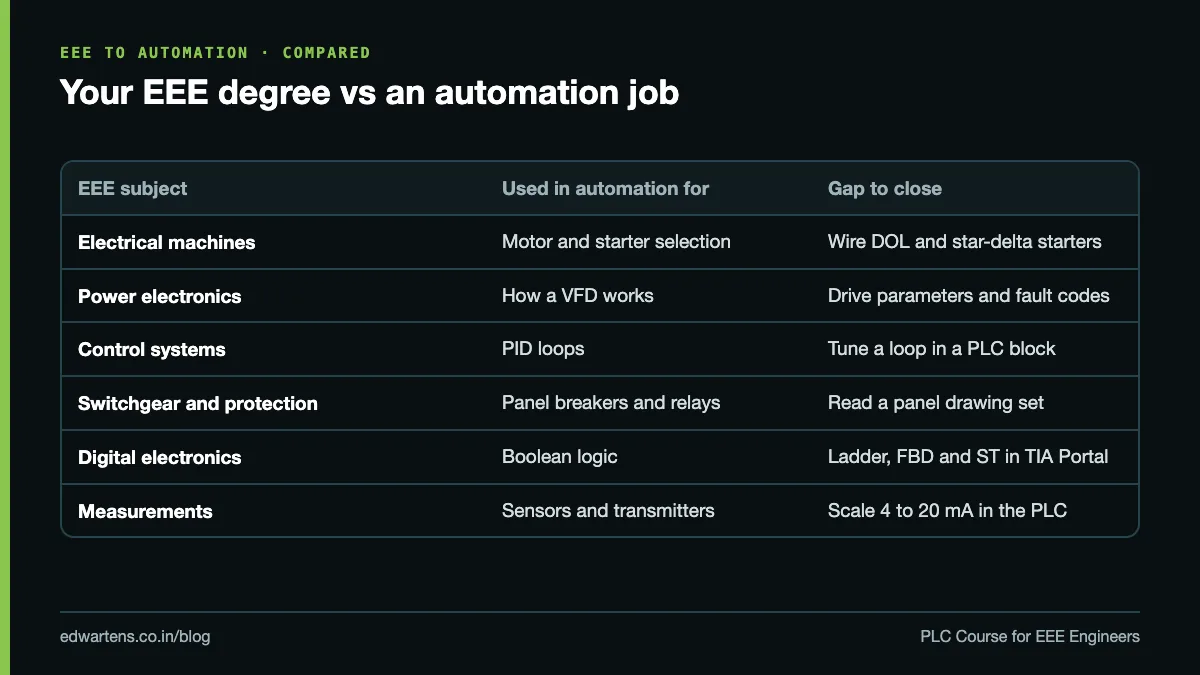
| EEE subject you passed | Where it shows up in an automation job | What is usually missing |
|---|---|---|
| Electrical machines | Motor selection, starting method, nameplate data entered into a VFD | Wiring a real DOL or star-delta starter and setting an overload |
| Power electronics | How a VFD rectifies, builds a DC bus and switches IGBTs | Parameter setup, fault codes, PLC control of the drive |
| Control systems | PID loops for pressure, flow, temperature and level | Tuning a loop in a PLC block, not on paper |
| Switchgear and protection | Breaker, MCCB and relay selection in a panel | Reading a panel drawing set and a bill of materials |
| Digital electronics | Boolean logic, the basis of ladder logic | Ladder, function block and structured text in a real tool |
| Measurements and instrumentation | Sensors, transmitters, signal conditioning | Scaling 4 to 20 mA into engineering units inside the PLC |
So the job is not to start again. It is to convert six subjects you already passed into six things you can show.
The gap between an EEE degree and an automation job
Interviewers for PLC and commissioning roles in India tend to test the same short list. Be ready for each of these:
- PLC programming in one platform. Siemens TIA Portal is the safest first choice in Indian plants, with Allen-Bradley Studio 5000 second. Learn one deeply before touching a second.
- Drives. Setting motor data, ramps, control source and fault reset on a VFD, then running it from the PLC.
- Instrumentation. Transmitters, RTDs, thermocouples, loop wiring and analog scaling.
- Panel design. Reading and drawing schematics in AutoCAD Electrical or EPLAN, terminal plans, cable schedules.
- SCADA and HMI. One HMI screen with alarms and a trend is enough at entry level.
- Commissioning habits. I/O checks, loop checks, lockout, and writing down what you changed.
Notice what is not on the list: robotics, AI, five PLC brands, or a certificate collection. Those can come later. A fresher who can wire a starter, program a sequence in TIA Portal, run a drive from it and scale an analog input is already ahead of most applicants.
A 12-week plan using free courses
This plan assumes 8 to 10 hours a week alongside final year or a first job. Every course linked here is free to study in full, including the final assessment. The only optional cost is a certificate after you pass (₹459, ₹559 or ₹959 depending on the course level, GST included).
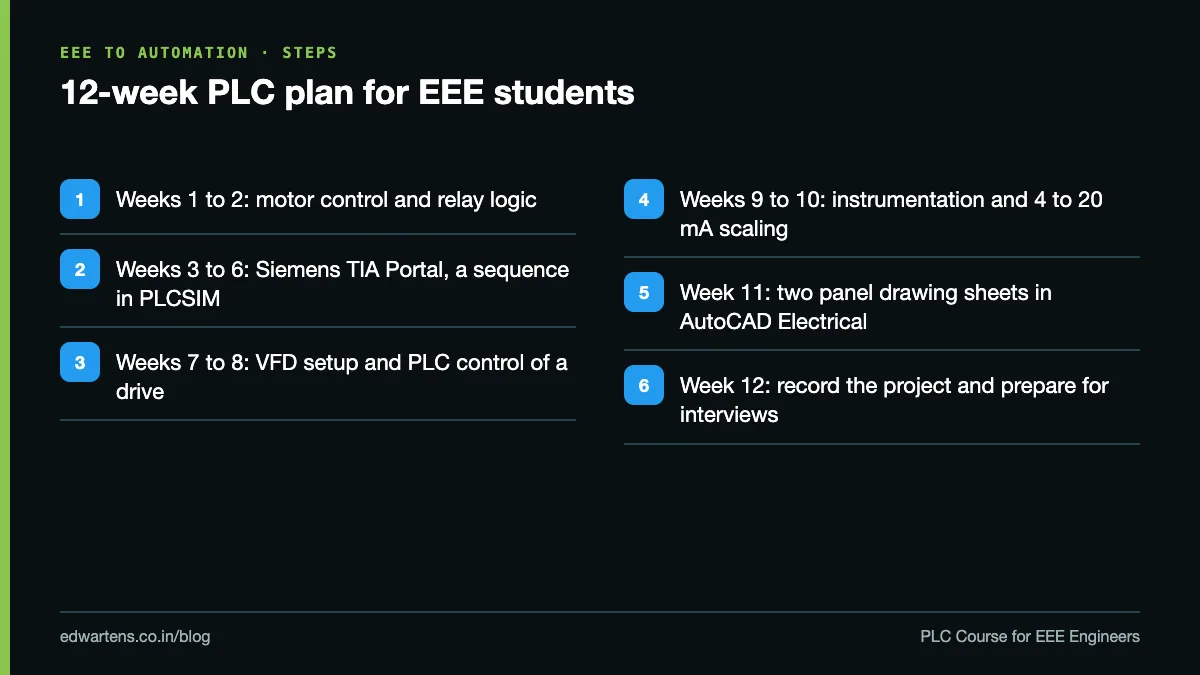
| Weeks | Focus | Free course | What to have at the end |
|---|---|---|---|
| 1 to 2 | Motor control and relay logic | Industrial Motor Control | DOL, reversing and star-delta circuits drawn and explained |
| 3 to 6 | PLC programming | Siemens TIA Portal | A conveyor or tank sequence running in PLCSIM |
| 7 to 8 | Drives | Variable Frequency Drives | A VFD parameter sheet and PLC start, stop and speed logic |
| 9 to 10 | Instrumentation | Instrumentation for PLC Engineers | A scaled 4 to 20 mA input with high and low alarms |
| 11 | Panel drawings | AutoCAD Electrical for Control Design | Two drawing sheets for your own small project |
| 12 | Portfolio and interview prep | Revise and record | A 3 minute screen recording of the project working |
If you are still in college, you can spread the same plan over two semesters: motor control and TIA Portal in the semester before final year, drives, instrumentation and drawings in the final year, with your final-year project built around a PLC instead of a microcontroller. If you prefer EPLAN to AutoCAD Electrical, swap in the free EPLAN Electric P8 course; Indian panel builders use both.
You do not need hardware for weeks 1 to 10. PLCSIM and Factory I/O cover most of it, as our guide to learning PLC programming without hardware shows. What simulation cannot teach is wiring, earthing and the smell of a burnt control transformer. That is the honest case for hands-on training later.
PLC course for electrical engineers: roles and pay
Here is what the main entry routes pay, from the salary sites that publish sample sizes and dates. All of these are self-reported or taken from job posts, so treat them as rough ranges, not offers.
| Role | Source and date | Average | Typical range | Sample |
|---|---|---|---|---|
| Electrical engineer, all levels | PayScale, June 2026 | ₹5.14 LPA | ₹2.17 to ₹10 LPA base | 551 profiles |
| Electrical engineer, entry level | PayScale, June 2026 | ₹3.07 LPA | not published | part of 551 |
| Electrical engineer, 1 to 4 years | PayScale, June 2026 | ₹4.02 LPA | not published | part of 551 |
| PLC programmer | Indeed India, May 2026 | ₹28,740 a month | ₹16,633 to ₹49,660 a month | 40 salaries |
| Automation engineer | Indeed India, Sept 2026 | ₹6.09 LPA | ₹2.81 to ₹13.18 LPA | 95 salaries |
| Field service engineer | PayScale, May 2026 | ₹4.28 LPA | ₹1.94 to ₹10 LPA base | 94 profiles |
| Field service engineer, entry level | PayScale, May 2026 | ₹2.40 LPA | not published | part of 94 |
Two cautions. First, "automation engineer" on salary sites mixes industrial roles with software test automation, which pulls the average up. Second, Indeed shows Bangalore PLC programmers slightly above the national figure, at about ₹30,669 a month in the same May 2026 data. The city pays a little more, not dramatically more. For a fuller breakdown by experience, read our automation engineer salary guide.
What the numbers say, plainly: an EEE fresher in a private core electrical job and an EEE fresher in a PLC or commissioning job start in roughly the same ₹2.5 to ₹4 LPA band. The gap opens later. Commissioning and service engineers who travel, solve faults alone and handle a second PLC brand move up faster, and they have a clearer route to roles abroad. Core maintenance jobs are steadier and travel less. Neither is wrong; pick on the life you want, not on a fresher number.
GATE and PSU jobs compared honestly
Many EEE students hold off on skills because they plan to write GATE. That is reasonable if you go in with real numbers.
- In GATE 2025, 67,701 candidates appeared for the Electrical Engineering paper, out of 83,355 registered (Careers360).
- NTPC's Engineering Executive Trainee recruitment through GATE 2025, open 11 to 25 February 2026, had 515 posts in total, of which 165 were electrical (Engineers Academy summary of the NTPC advertisement). The E1 scale is ₹40,000 to ₹1,40,000 basic, plus DA, HRA or housing, PRP and other benefits.
Other PSUs and state utilities add more posts, so 165 is not the whole market. Still, the ratio tells you something: PSU jobs pay well and are secure, and very few people get them in any one year. Our advice to EEE students is simple. If you are scoring in the top few percent in mock tests, give GATE a serious attempt. Either way, do the 12-week plan alongside it. It costs you nothing, it uses the same machines and control systems syllabus, and it gives you a job route if the GATE score is not enough. Two or three years of GATE attempts with no practical skill leaves a resume gap with nothing to show for it, and that is harder to explain in a private-sector interview.
When classroom training makes sense
Free courses get you through programming, drives and instrumentation theory. They do not give you real panels, real faults or someone checking your wiring. That matters most if:
- You learn better with a timetable and a trainer than alone in the evenings.
- You have finished the free courses and want hands-on time on several PLC brands, HMIs, drives and SCADA before interviews.
- You want an experience certificate rather than only a course certificate.
If that is you and Bangalore is practical, look at a classroom programme. EDWartens runs the Automation Engineer Program in Electronic City, covering 20 PLC brands plus SCADA, HMI and drives on hands-on panels, in assessment-gated phases of 3 to 12 months. Candidates join as junior engineers and receive an experience certificate from Wartens. Admission is by aptitude, and BE/BTech, BSc, diploma and ITI candidates are all welcome. There is a written job guarantee with a full fee refund if you complete every phase and are not placed, with conditions in the Placement Policy. Fees are agreed after counselling, not published. If you are comparing options across the city, our page on PLC training in Bangalore lists what to check.
If you are not near Bangalore, or money is tight, the free plan above is enough to get interviews.
Also useful: our guide to how to become an automation engineer in India, and if you are still choosing between paths after graduation, best courses after BTech.
Read next: PLC programmer salary in India and PLC internships for freshers.
Frequently asked questions
Q: Is a PLC course useful for EEE students, or is it only for mechanical and instrumentation students?
A: It is very useful for EEE students. You already understand machines, drives and protection, which most automation trainees from other branches have to learn from scratch. You mainly need to add PLC programming, VFD setup, analog scaling and panel drawings.
Q: Which PLC should an electrical engineer learn first in India?
A: Siemens with TIA Portal is the safest first choice, with Allen-Bradley Studio 5000 second. Learn one well, including timers, counters, analog scaling and a full sequence, before starting a second brand.
Q: Can I learn PLC programming in my final year without buying hardware?
A: Yes. PLCSIM and Factory I/O cover programming, sequencing and HMI practice. You will still need hands-on wiring practice later, through a lab, internship or classroom programme, because simulation does not teach wiring or fault finding on live panels.
Q: Do automation jobs pay more than core electrical jobs for EEE freshers?
A: Not at the start. Salary sites put both in roughly the ₹2.5 to ₹4 LPA band for freshers. Commissioning and service engineers often pull ahead after two to four years, especially those who travel and can handle more than one PLC brand.
Q: Should I prepare for GATE or do a PLC course?
A: You can do both. In GATE 2025, 67,701 candidates sat the EE paper, while NTPC's GATE-based intake in early 2026 had 165 electrical posts. Prepare seriously if your mock scores are strong, and do a free PLC course alongside it so you have a job route either way.
Q: Is the certificate from a free PLC course enough to get hired?
A: Rarely on its own. What gets interviews is a small project you can show: a working sequence, a drive controlled from the PLC, a scaled analog input and two drawing sheets. The certificate helps when it backs up that project.
Next step
Start with the free Industrial Motor Control course this week, then move into Siemens TIA Portal. Both are free to study in full. If you want help deciding between GATE, a core job and automation, or want to know whether the classroom programme suits you, book a counselling call through our contact page.
Learn this, free
The courses that teach this
Every lesson, the written notes and the practice are free with an account. Only the certificate is optional and paid.