PLC Internship for Freshers in India, Honestly Mapped

The short answer
Genuine PLC internships for freshers in India are scarce, and the job sites make them look more common than they are. On 5 October 2026 a "PLC" search on Internshala returned 52 internships, but only 2 were actual PLC or automation roles (₹3,000 to ₹10,000 a month in Delhi, ₹10,000 a month in Gurgaon). Naukri listed 16 "PLC internship" results (5 in Bangalore, 4 in Pune), and 15 of them were shown as unpaid. The routes that actually work are in-plant training through your college, an apprenticeship under NATS (minimum stipend ₹12,300 a month for graduates and ₹10,900 for diploma holders since 1 April 2026), and a direct email to a small system integrator with a project you have already built.
What the listings actually show (October 2026)
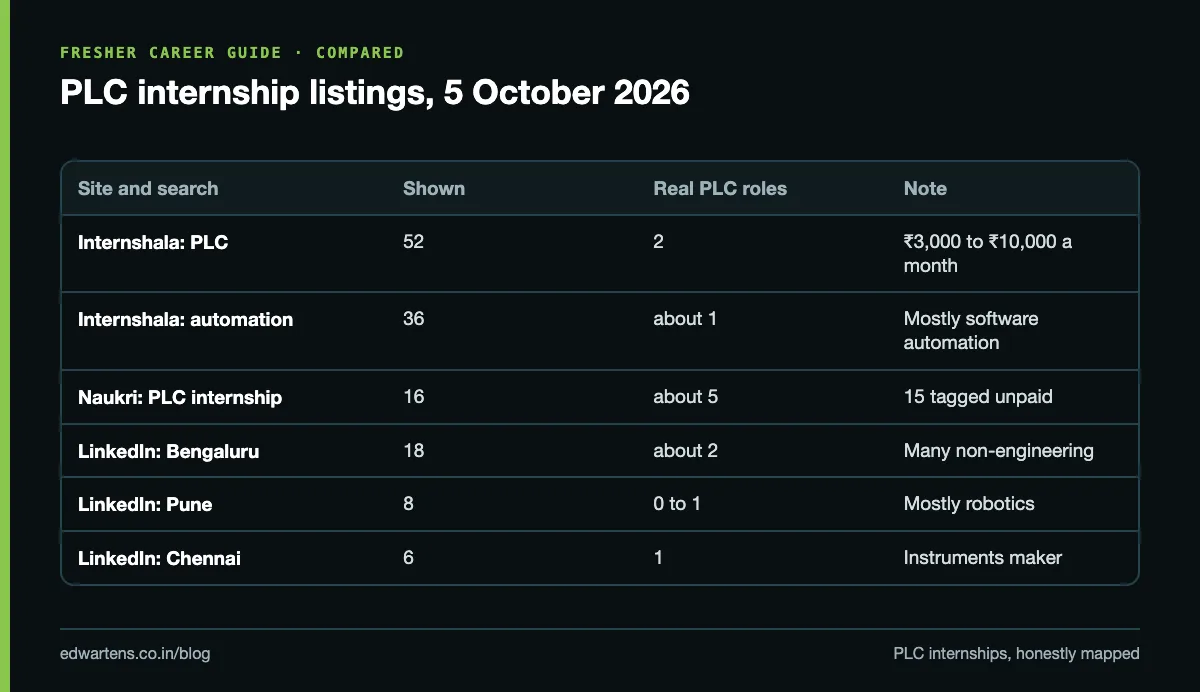
We searched the three sites freshers use most on 5 October 2026. Counts change daily, so treat these as a snapshot, not a census.
| Site and search | Results shown | Genuinely PLC or controls | Notes |
|---|---|---|---|
| Internshala, keyword "PLC" | 52 | 2 | Delhi hybrid ₹3,000 to ₹10,000 a month for 3 months; Gurgaon hybrid ₹10,000 a month for 6 months |
| Internshala, "automation" category | 36 | about 1 | Mostly software, marketing and AI "automation" |
| Naukri, "PLC internship" | 16 | about 5 | Bangalore 5, Pune 4, Kochi 1, Mumbai 1; 15 tagged unpaid |
| LinkedIn, "PLC intern", Bangalore | 18 | about 2 | Rest were finance, legal, software and general trainee roles |
| LinkedIn, "PLC intern", Pune | 8 | 0 to 1 | Mostly robotics and ROS internships |
| LinkedIn, "PLC intern", Chennai | 6 | 1 | An electrical engineering internship at an instruments maker |
Two lessons from this. First, the word "automation" on internship sites now usually means software test automation or no-code tools. AmbitionBox's "Automation Engineer Intern" pay page, for example, lists Python, SQL and Selenium as the top skills, so its ₹4.5 to ₹5 lakh figures say nothing about PLC work. Second, most real PLC openings for freshers are not labelled "internship" at all. They are called trainee, graduate apprentice, diploma trainee or junior engineer, and they are filled through colleges, NATS and word of mouth.
The five kinds of PLC internship in India
1. In-plant training during BE or diploma
This is the one most students already have access to. AICTE's internship policy counts 14 to 20 credits of internship and project work towards a BTech, at 40 to 45 hours per credit, which works out to about 600 to 700 hours over the degree (450 to 500 hours for a diploma). The blocks fall in the summer vacations after the 2nd, 4th and 6th semesters and in the final semester, typically 3 to 6 weeks each. Plant maintenance departments in pharma, food, cement and automotive plants take students for these blocks, often without a stipend. Ask your training and placement officer which plants your college has letters with, and ask for the maintenance or instrumentation department specifically, not "production".
2. Apprenticeships under NATS
The National Apprenticeship Training Scheme is the most reliable paid route, and it is underused by students who only look on Internshala. Revised minimum stipends from 1 April 2026 are ₹12,300 a month for graduate apprentices, ₹10,900 for diploma (technician) apprentices and ₹9,600 for vocational apprentices, and the government reimburses part of the stipend to the employer. Apprenticeships usually run for a year. You register on the NATS portal and apply to establishments listed there; large manufacturers post their graduate and diploma apprentice openings there and on LinkedIn (Volvo Group had a graduate apprentice trainee opening in Bangalore in our October search).
3. Paid internships at system integrators
Small and mid-sized integrators who build panels and program machines are where you learn fastest. They rarely advertise. When they do take an intern, the work is panel wiring, I/O checking, drawing updates, simple logic changes and going to site with a senior engineer. Stipends vary widely and many offer a junior engineer role at the end if you are useful. The way in is a direct approach, covered below.
4. OEM and multinational internships
Siemens, ABB, Rockwell, Schneider and other OEMs run structured internship and graduate programmes, mostly for students from campus drives. Many of the internships they list are software, testing or R&D roles rather than plant-floor PLC work, so read the description before you get excited by the logo. In our October search, a Siemens Gamesa Bangalore internship was software development and testing, not PLC programming.
5. Virtual internships, and why most are worthless
A "virtual PLC internship" with a fee, recorded videos and a certificate at the end is a course, not an internship. Nobody supervised your work, nobody signed a daily diary, and no plant or company is accountable for what you did. An employer reading "virtual internship" on a fresher's CV will ask what you built and who checked it. If the honest answer is "I watched videos", the line does more harm than good. If you want structured learning without a fee, a free course does the same job openly: the Siemens TIA Portal course costs nothing to complete.
How to apply when nobody is advertising
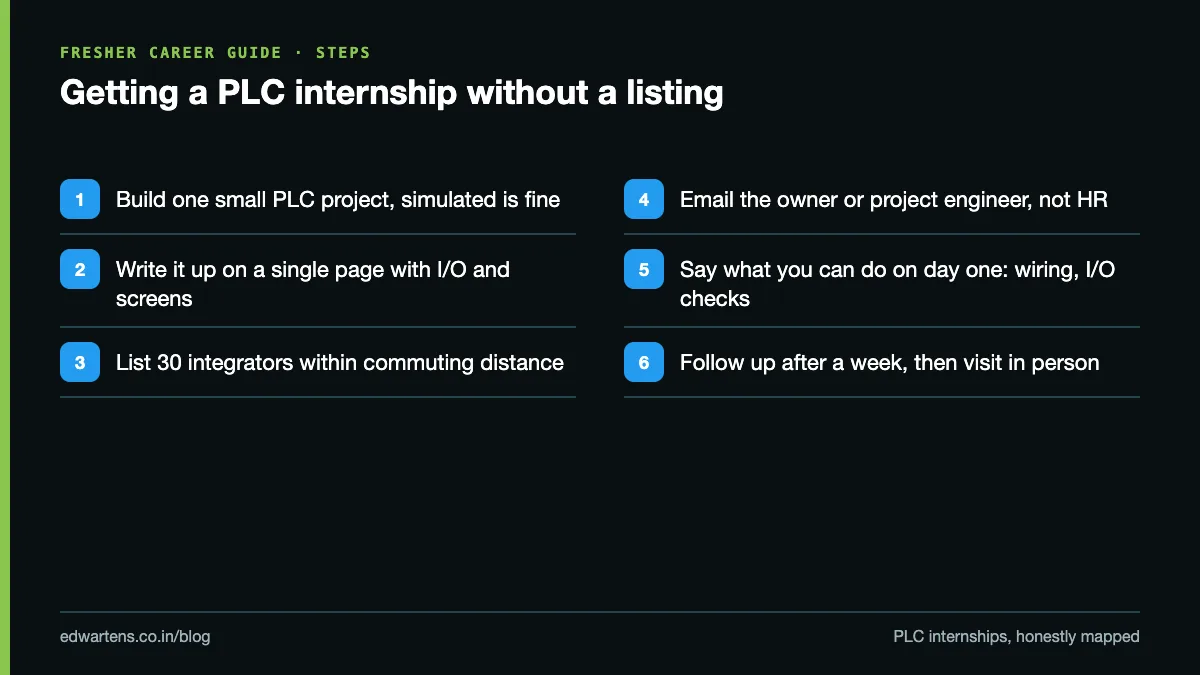
The fresher who gets the integrator internship is almost always the one who walks in with something already built. Here is the sequence that works.
- Build one small project first. A conveyor sorter, a tank fill and drain, or a traffic light with an HMI. Simulated is fine. The Factory I/O virtual commissioning course gives you scenes to program. See portfolio projects that get interviews for ideas that are not toys.
- Write it up on one page. Problem, I/O list, a screenshot of the logic, a screenshot of the HMI, and two lines on what went wrong and how you fixed it.
- Make a list of 30 integrators within commuting distance. Use Google Maps searches for "control panel manufacturer" and "PLC programming services" around your area, and IndiaMART supplier pages.
- Email the owner or the project engineer, not HR. Four lines: who you are, what you built (attach the one-pager), what you can do on day one (wiring, I/O checks, drawings), and when you can start.
- Follow up once after a week, then visit. Small firms answer the person standing at the gate more often than the email.
- Keep your CV to one page and put the project above your marks. Our ATS resume guide for freshers covers the format.
What to do during the internship
Most interns waste the first two weeks waiting to be given PLC work. You will not be handed the program on day one. Do this instead:
- Keep a daily diary. AICTE's guidelines expect a daily log signed by your supervisor, and it becomes the backbone of your report.
- Learn the drawings. Ask for the electrical drawings of one machine and trace every input from the field device to the PLC terminal.
- Watch faults being fixed. Note the fault, what the engineer checked first, and what the cause was. Ten of these are worth more than any certificate.
- Ask to go online with the program (read only) and follow one sequence step by step.
- Collect evidence you are allowed to keep: your own notes and sketches, not the company's code or drawings. Ask before you photograph anything.
How to write a PLC internship report
People search for "PLC internship report pdf" hoping to download one. Do not. AICTE lists originality as the first evaluation criterion, and examiners recognise copied reports. Use this structure and fill it from your own diary.
| Section | What goes in it | Rough length |
|---|---|---|
| Certificate and declaration | Company certificate, your declaration, signatures of supervisor, TPO and faculty mentor | 2 pages |
| Company profile | What the company makes or does, your department, the equipment you worked around | 1 to 2 pages |
| Introduction to PLCs | Only what you used: the PLC family, I/O, scan cycle, the software | 2 to 3 pages |
| The system you studied | One machine or process: block diagram, I/O list, sequence of operation | 4 to 6 pages |
| Work done, week by week | Drawn from your diary: tasks, faults seen, what you learned | 4 to 6 pages |
| Problem and solution | One real fault or improvement, with cause and fix | 2 pages |
| Conclusion and references | What you can now do, and the manuals you used | 1 to 2 pages |
AICTE's evaluation criteria for the report are originality, an adequate and purposeful write-up, organisation and drawings, the variety of learning, and how you related practice to theory. You will usually present it as a seminar or viva, so write only what you can explain.
Red flags before you pay or sign
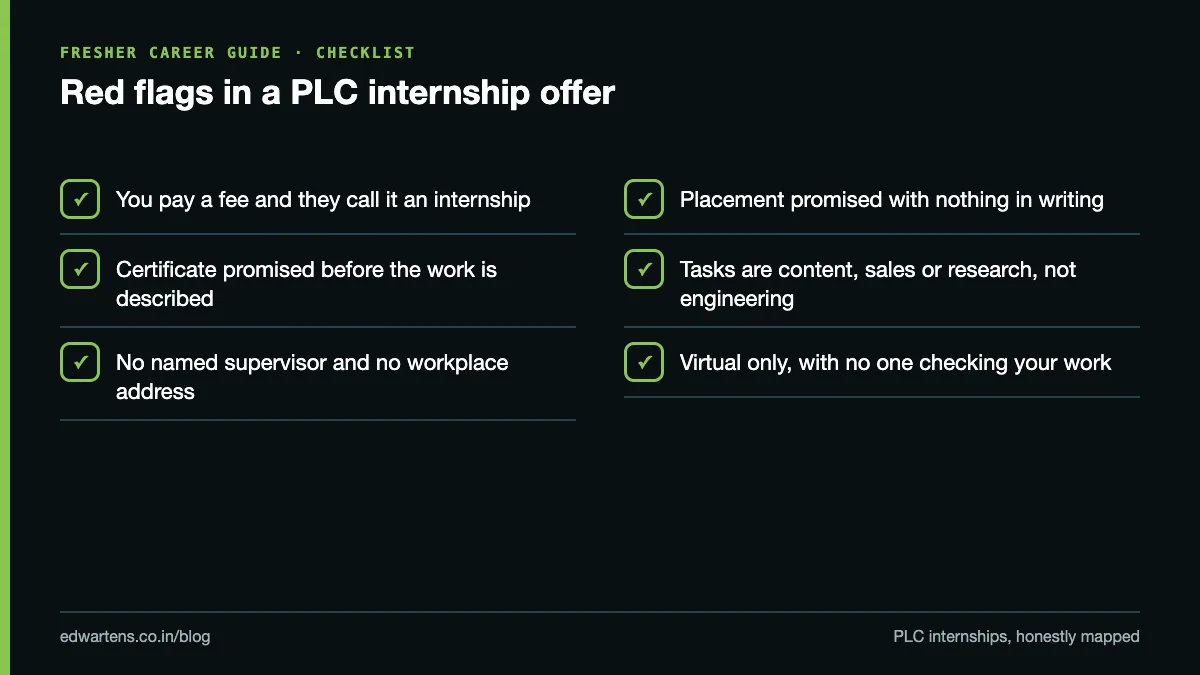
- You pay a fee and they call it an internship. Then it is training. Judge it as training.
- The certificate is promised before the work is described. A real internship describes the work first.
- No named supervisor and no workplace address.
- "100% placement" with nothing in writing. See what a job guarantee contract should say.
- Every task is "research" or "content". Internshala listings tagged PLC included content writing and sales roles in October 2026.
Bangalore: where PLC internships actually are
Bangalore's automation work is spread across industrial belts, and an intern's commute matters because plant shifts start early. Our guide to Bangalore's industrial corridors covers each belt in detail. In short:
- Electronic City and Bommasandra. Pharma, electronics and precision engineering. Biocon's headquarters is on Hosur Road in Electronic City and its Biocon Park campus is on the Bommasandra to Jigani Link Road. Rockwell Automation opened an integrated campus in Electronic City, though that site is a capability centre, so roles there lean towards engineering and software rather than plant floor work.
- Peenya. The densest cluster of small machine builders, panel makers and integrators in the city, which is why it is the best place to cold email. ABB runs a motion manufacturing campus in Peenya and announced new motor facilities there.
- Whitefield. Mostly R&D and IT parks. Good for software-side automation roles, poor for plant-floor internships.
Five of Naukri's 16 PLC internship listings in October 2026 were in Bangalore, more than any other city.
Where EDWartens fits, honestly
EDWartens does not run a free internship. Our Automation Engineer Program is a paid classroom training programme in Electronic City, where candidates work as junior engineers on hands-on panels and receive an experience certificate from Wartens at the end. It covers 20 PLC brands plus SCADA, HMI and drives, runs 3 to 12 months in assessment-gated phases, and fees are agreed per candidate after counselling. If you are comparing options for PLC training in Bangalore, treat it as training with work experience built in, not as an internship, and compare it on those terms.
Read next: PLC jobs for freshers in India for the job search after your internship, and PLC programmer salary in India.
Frequently asked questions
Q: Are there free PLC internships online?
A: Real online PLC internships are rare, because PLC work needs hardware and supervision. Most "free online PLC internships" are courses with a certificate. A free course is useful, but list it as a course on your CV, not as an internship.
Q: What stipend should I expect for a PLC internship?
A: In our October 2026 search, the two genuine PLC listings on Internshala paid ₹3,000 to ₹10,000 a month, and most Naukri listings were unpaid. NATS apprenticeships pay a legal minimum of ₹12,300 a month for graduates and ₹10,900 for diploma holders from 1 April 2026.
Q: How long is a PLC internship?
A: College in-plant training blocks are usually 3 to 6 weeks. Paid internships listed online ran 3 to 6 months. NATS apprenticeships usually run for one year.
Q: Where can I find a PLC internship in Pune or Chennai?
A: Pune had 4 of Naukri's 16 PLC internship listings and Chennai's LinkedIn search showed 1 genuine controls internship in October 2026. In both cities, the better route is NATS plus direct emails to integrators in the industrial belts around Chakan and Bhosari (Pune) or Ambattur and Sriperumbudur (Chennai).
Q: Can I download a PLC internship report PDF?
A: You can find them, but submitting one is a bad idea. AICTE evaluates reports on originality first, and your viva will expose a copied report. Use the section structure above and fill it from your own daily diary.
Q: Is a paid PLC internship worth it?
A: Only if you judge it as training: what hardware you will use, how many hours, who supervises you, and what you will have built at the end. If the main product is a certificate, it is not worth paying for.
Next step
Build your first project before you apply anywhere: the Siemens TIA Portal course is free to complete, with an optional certificate only if you want one. If you want to talk through whether a training programme or an apprenticeship suits you better, book a free counselling call and we will give you a straight answer.
Learn this, free
The courses that teach this
Every lesson, the written notes and the practice are free with an account. Only the certificate is optional and paid.