

PM Surya Ghar Jobs: Skills Engineers Need for Rooftop Solar

The short answer
PM Surya Ghar jobs exist in two layers. The official training is a 7-day course, with 2 days on the job, aimed at ITI and NSTI trained electricians and similar trades who will install rooftop solar. Above that sit engineering roles in survey, design, commissioning and maintenance, where a diploma or B.Tech electrical graduate adds sizing, protection, earthing and testing. The scheme is large, but a headline job count is an expectation, not a hiring list. Build skills you can show, and ask any employer the questions in the checklist below.
Scheme figures were read on the dates given below from the All India Radio, pv magazine India and NIMI pages. Reported figures change quickly and sources differ, so treat every number here as "reported on that date". We state no subsidy amounts, because we could not open the official scheme page.
PM Surya Ghar jobs: where the scheme stands, with dates
PM Surya Ghar: Muft Bijli Yojana launched on 13 February 2024 with an outlay of 75,021 crore rupees, according to pv magazine India. The sources we read give different counts, so here they are side by side.
Reported figure | Source and date |
|---|---|
More than 65 lakh rooftop installations crossed | All India Radio, 4 November 2026, quoting the Union Minister |
More than one lakh installations every six days | All India Radio, 4 November 2026 |
50,99,781 systems and 17,855.3 MW added | pv magazine India, 8 October 2026 (the same article's headline says 60 lakh) |
Over 2.5 lakh people trained against a target pool of 3 lakh | pv magazine India, 8 October 2026 |
17 lakh direct and indirect jobs "expected" | pv magazine India, 8 October 2026 |
Notice the gap between the headline and the body of the pv magazine piece. Counts depend on the date and on the definition (applications, sanctioned or commissioned), so quote one figure with its date and the word "reported". The 17 lakh figure is an expectation of what the scheme may create. It is not a count of people hired.
The jobs on a rooftop project
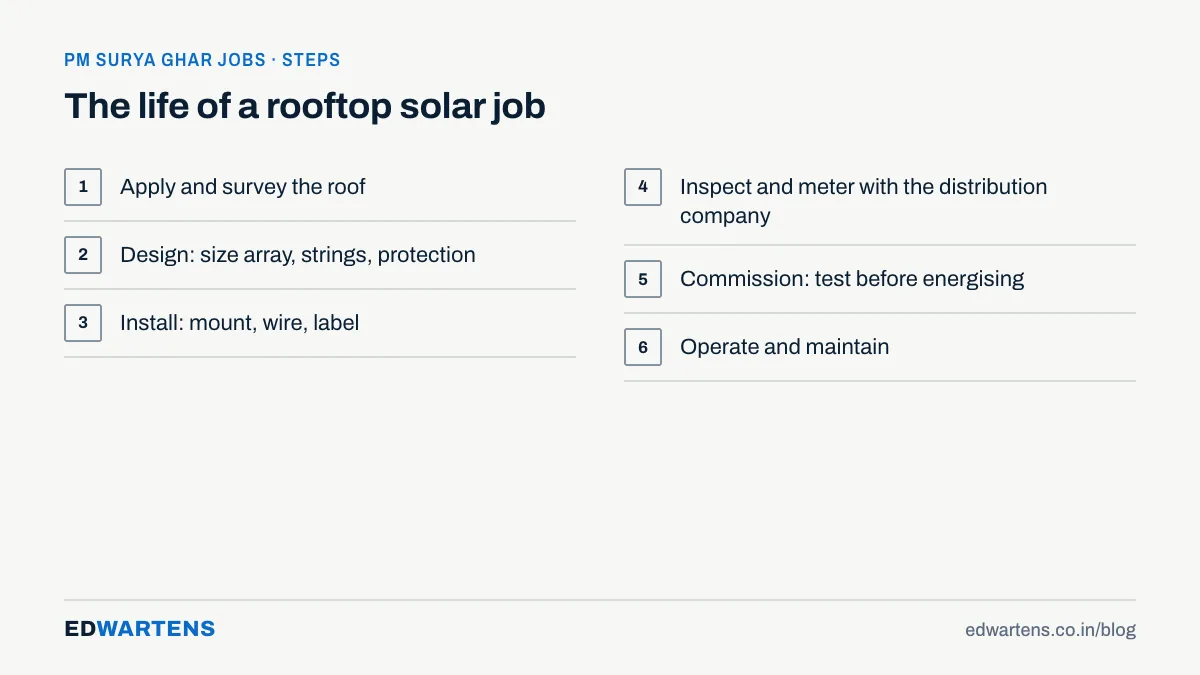
A rooftop job passes through stages, and each stage is a different job. This is a simplified sequence.
- Apply and survey. Visit the roof, measure shading and structure, read the electricity bills.
- Design. Size the array, choose strings, cables and protection.
- Install. Mount, wire and label, working safely at height.
- Inspect and meter. Approval and meter arrangements with the electricity distribution company.
- Commission. Test before energising and record the results.
- Operate and maintain. Monitor output, clean, find faults.
Our post on what PVsyst models in solar plant design shows the design side,.
The official training route
The National Instructional Media Institute (NIMI) page on PM Surya Ghar skilling describes the plan. Individuals trained as electrician, wireman, solar technician or similar trades under CTS or CITS, either passed out or in the final year at ITIs or NSTIs, are targeted for 7 days of training including 2 days of on-the-job training. The scheme anticipates opportunities for approximately 1,00,000 solar PV technicians. The Directorate General of Training under the skills ministry is the nodal agency, NIMI is the training partner, ITIs and NSTIs are the centres, and the vendor provides the two days of on-the-job training.
If you are an ITI electrician, our guide to PLC training for electricians and ITI holders shows how to add controls skills to the same trade. The NIMI page is the place to check current batches.
What an engineer adds beyond the 7-day course
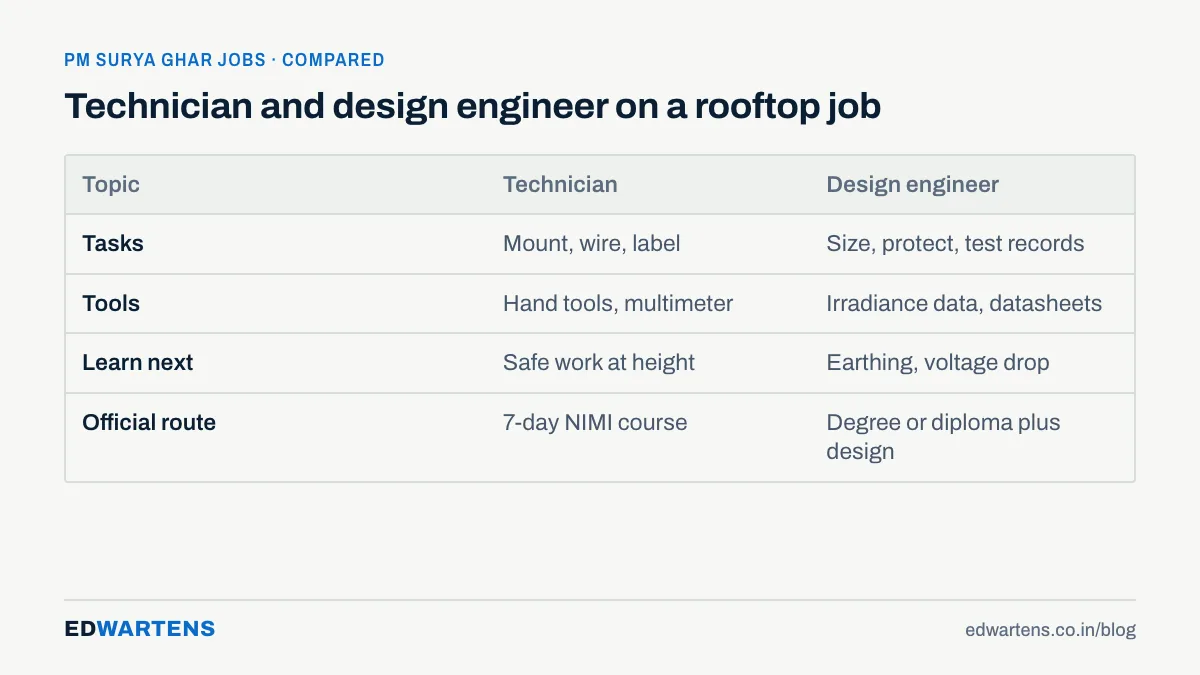
Topic | Technician (official 7-day course) | Design or commissioning engineer |
|---|---|---|
Main tasks | Mounting, wiring, labelling, basic tests | Sizing, string layout, protection, earthing, test records |
Tools | Hand tools, multimeter, safety gear | Irradiance data, datasheets, design software, test instruments |
What to learn next | Safe work at height, reading a layout | Voltage drop, fault levels, earthing and lightning protection, IEC 62446 style testing |
Here is a worked example of the first design step. A home uses 360 kWh a month, which is 12 kWh a day. Assume 5 peak sun hours and system losses of 20 percent, so the system delivers 80 percent of its rating. The array size is 12 / (5 x 0.8) = 3 kWp. With 540 W modules, 3,000 / 540 = 5.6, so you would use 6 modules, or 3.24 kWp. These are example inputs. The free Rooftop Solar PV Design and Installation course teaches you to read your own irradiance data from PVGIS and size from a year of bills instead of assuming.
The honest caution
Training numbers are not job numbers. An opinion piece in pv magazine India dated 16 October 2026, by the CEO of AXITEC Energy India, says the next bottleneck may be skilled manpower. It says certification does not always translate into field readiness for commissioning, fault diagnosis and long-term maintenance, and it points to delays, inconsistent workmanship and weak after-sales service as early signs of stress. Read it as one industry view. It still tells you what employers value: people who can test and fix, not only install. Work can also be seasonal and tied to project timing, so ask about the pipeline before you move cities.
A four-week free plan
- Week 1: read irradiance and temperature data for your town from PVGIS and compute peak sun hours.
- Week 2: size an array from one real electricity bill, then choose a string layout.
- Week 3: learn earthing and lightning protection basics, using our earthing and bonding guide for the wiring side.
- Week 4: write a commissioning checklist and a one-page design summary.
For storage and plant-scale design, add Battery Energy Storage Systems, PVsyst Solar Power Plant Design and Earthing and Lightning Protection Design. On our job simulations page, the Solar PV and EV Charging Engineer simulation has you size a rooftop array, test it before energising and fit EV chargers on a limited supply. It is included with the paid programmes, and it is practice, not work experience. A demo is on sim.edwartens.com with no sign-in. Our guide to commissioning a solar and EV charger setup in a simulator shows the free 3D lab version, and the wave post on EV charging careers is the next step.
Questions to ask before you accept a solar job
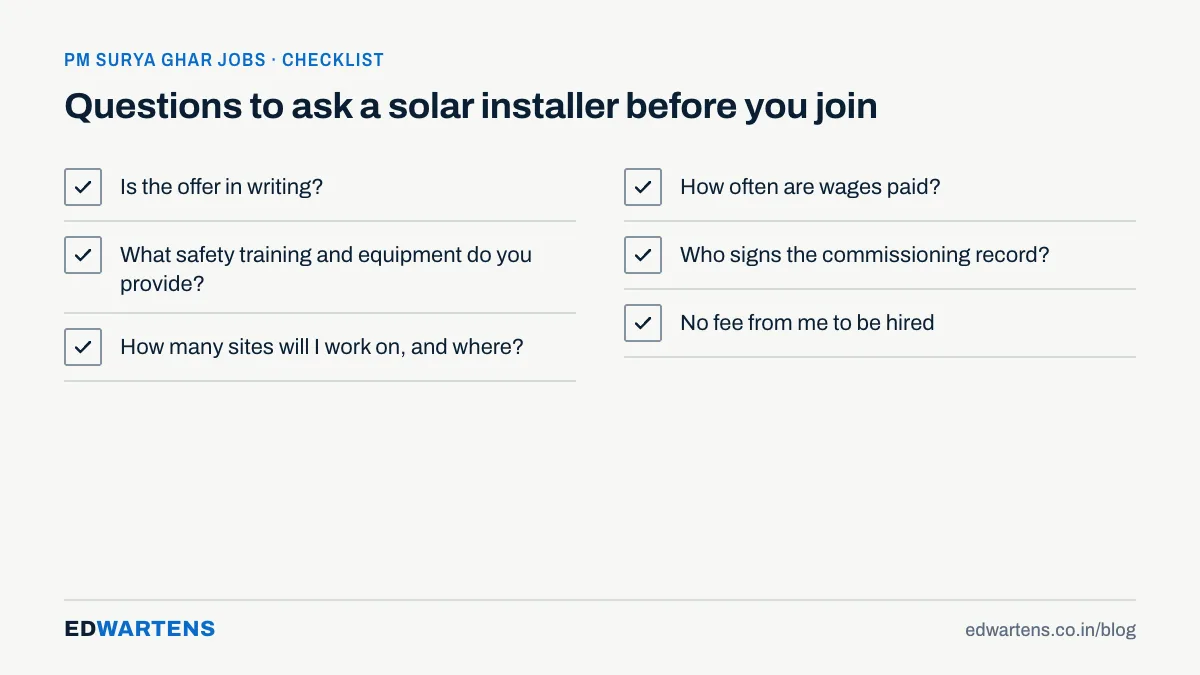
Ask for the offer in writing, the safety training and equipment you will get, how many sites you will work and how often wages are paid. Ask who signs the commissioning record. If an offer asks you to pay to be hired, walk away.
Watch: PVGIS irradiance data
The video above is Accessing Irradiance & Temperature Data from PVGIS by UNICEF Solar Hub, embedded with thanks. EDWartens is not affiliated with the creator. It runs about 8 minutes and shows how to read irradiance and temperature data from PVGIS, the first step in sizing any array and the first lesson of our free rooftop solar course.
Learn it free on EDWartens
The Rooftop Solar PV Design and Installation course takes about 18 hours over six weeks. It covers irradiance, panels and inverters, sizing from a bill, site survey and shading, string and cable sizing, protection, earthing, batteries, net metering and PM Surya Ghar, safe installation, testing and payback. The hubs are solar and energy storage and electric vehicles. It is a free course with a verifiable certificate of completion, and anyone can check a certificate on the verification page. It is not a government or NSDC certificate. You can practise in the free 3D lab at lab.edwartens.com, and our electrical design engineer roadmap shows where solar fits in a design career. Start the rooftop solar course with your own electricity bill.
Sources (all read 23 November 2026)
- NIMI, PM Surya Ghar skilling: 7-day training with 2 days on the job, target trades, roles and the 1,00,000 technician target.
- All India Radio, 4 November 2026: 65 lakh installations.
- pv magazine India, 8 October 2026: capacity, training and expected jobs.
- pv magazine India opinion, 16 October 2026: the skills bottleneck view.
Q: Does PM Surya Ghar create jobs for engineers?
A: It creates demand for survey, design, installation, commissioning and maintenance work. The 17 lakh jobs figure in pv magazine India is an expectation, so ask employers for specifics rather than rely on the headline.
Q: How can I get trained as a rooftop solar installer in India?
A: The NIMI page describes a 7-day course with 2 days on the job for ITI and NSTI trained electricians and similar trades. Check NIMI and your nearest ITI or NSTI for current batches.
Q: Is there a PM Surya Ghar training course for diploma and ITI students?
A: The official course targets people trained or in their final year under CTS or CITS at ITIs and NSTIs. Diploma holders can also take free design courses, which add sizing and testing skills.
Q: What does a solar PV design engineer do on a rooftop project?
A: They size the array from the load and site data, lay out strings, choose cables and protection, plan earthing, and write the test and commissioning records.
Q: Can an electrical engineer fresher work in rooftop solar?
A: Yes. Roles in design, commissioning and maintenance suit electrical freshers. Employers value people who can test and diagnose faults, so build a sizing example and a commissioning checklist.
Q: Is a rooftop solar certificate enough to get a job?
A: No certificate guarantees a job. A trade certificate or course certificate helps when paired with skills you can show, such as a sized design and test records, and with a safe working record.
If you want classroom training with placement support, where the conditions apply and are published, see our PLC training in Bangalore with a written job guarantee.
Learn this, free
The courses that teach this
Every lesson, the written notes and the practice are free with an account. Only the certificate is optional and paid.


