

AI Skills for Engineers in India: Branch by Branch

The short answer
The AI skills for engineers in India that matter most are not coding. They are knowing which tasks an AI assistant can draft, writing a prompt another engineer could audit, and checking every number the answer gives you by hand. A mechanical engineer uses AI for drawing notes and reports, a civil engineer for quantity checks and site reports, and an electrical engineer for load lists and specification comparisons. None of them should accept a sizing number, a code clause or a unit conversion without checking it against the source. Learn that discipline first, then add Excel and a little Python.
Facts about AICTE, NASSCOM and the Indian AI mission were read on 23 November 2026 from the sources listed at the end. The worked numbers below were computed by hand for this post.
AI skills for engineers in India: what changed
The All India Council for Technical Education (AICTE) chairperson TG Sitharam said in a PTI interview on 6 June 2025 that AI will be integrated into all branches of technical education, with a committee reviewing the model curricula. A March 2026 backgrounder from the Press Information Bureau, citing NASSCOM, says India had an AI talent pool of 600,000 to 650,000 in 2024 and needs over 1.25 million AI professionals by 2027. Digit.in's write-up of LinkedIn's 2026 Skills on the Rise report lists querying, LLMOps and workflow automation among the fast-rising engineering skills in India. Read all of these as direction, not a promise of jobs. The practical meaning for a core-branch engineer is smaller and more useful: the people you work with will use AI for first drafts, and you will be expected to check them.
The tasks, branch by branch
Use three labels for every task. Draft means AI can write a first version. Check by hand means you must verify the result against a source. Never delegate means the decision stays with a qualified engineer.
Branch | Draft with AI | Check by hand | Never delegate |
|---|---|---|---|
Mechanical | Drawing notes, supplier emails, maintenance log summaries, FEA report wording | Unit conversions, GD&T callouts, material properties | Safety factors, pressure vessel or lifting design |
Civil | Site diary text, RFI wording, schedule narrative, BOQ layout | Quantities, rates, code clauses | Structural adequacy, geotechnical judgement |
Electrical | Load list formatting, specification comparison, test report text | Cable and breaker sizing, voltage drop, settings notes | Protection settings, earthing design sign-off |
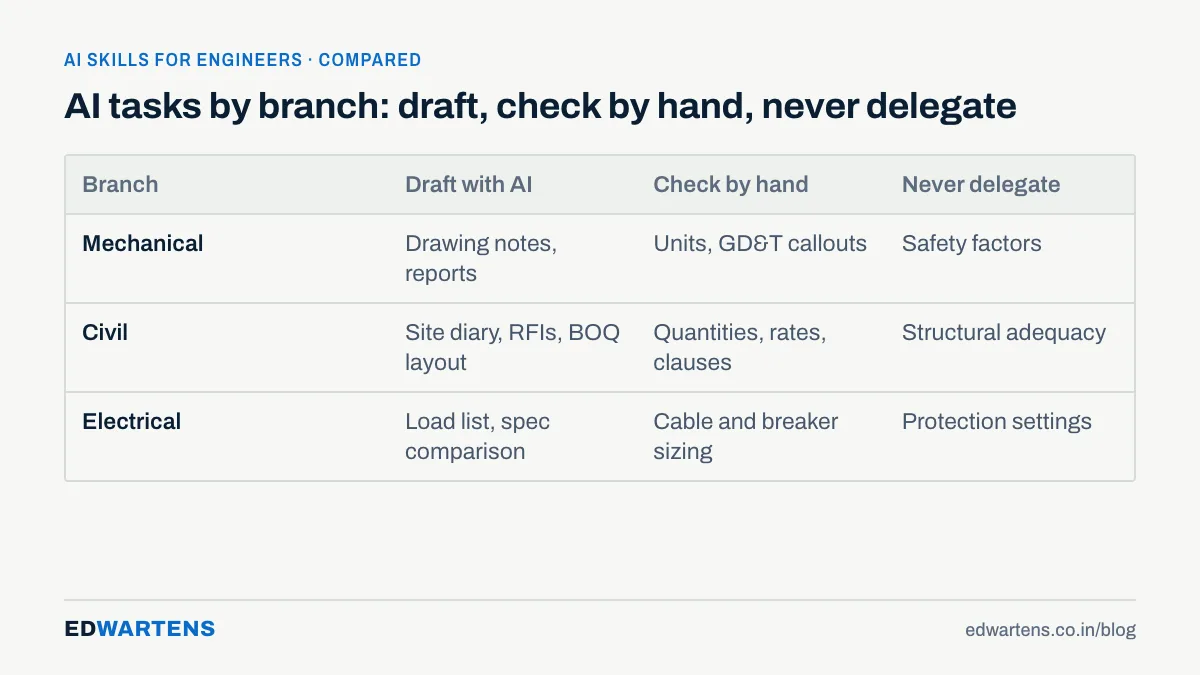
Five tasks per branch is a good first target. For mechanical: drawing notes, a GD&T review list, an FEA summary, a maintenance log digest and a supplier email. For civil: a BOQ layout, a quantity cross-check, a site report, an RFI and a schedule narrative. For electrical: a load list, a cable schedule check, a relay settings note, a specification comparison and a test report. Each one has a version that saves time and a version that causes damage, and the only difference is the check.
Three worked checks you can repeat
Each of these takes two minutes and catches the sort of mistake AI makes with numbers.
Branch | Question to the assistant | Hand check | Result |
|---|---|---|---|
Mechanical | Power of a shaft carrying 50 N m at 1,440 rpm | Omega = 1,440 x 2 x pi / 60 = 150.8 rad/s; P = 50 x 150.8 | 7.54 kW |
Civil | Concrete in a 6 m x 4 m slab, 150 mm thick | 6 x 4 x 0.15 | 3.6 cubic metres |
Electrical | Full load current of a 15 kW motor at 415 V, power factor 0.85, efficiency 0.9 | 15,000 / (1.732 x 415 x 0.85 x 0.9) | 27.3 A |
Suppose an assistant tells you the motor draws 18 A. The hand check shows the answer is wrong by a third, and a breaker or cable chosen from 18 A would be undersized. Compare against a published chart too: our post on motor full load current at 415 V lists typical values. The point is not that AI cannot do arithmetic. It sometimes does, and sometimes does not, and it never tells you which.
How to write a prompt another engineer can audit
A prompt is a specification. Good ones carry four parts: the context (project, units, standard), the data (pasted values, not "the usual"), the format (a table with units in the header) and the check (ask for the formula and the assumptions, so you can rerun them). Our free Prompt Engineering for Engineers course teaches this by writing prompts for FAT reports, procedures, I/O lists and fault guides, and testing each prompt with a set of cases whose answers you already know. The wider background is in our post on GenAI and LLMs in manufacturing.
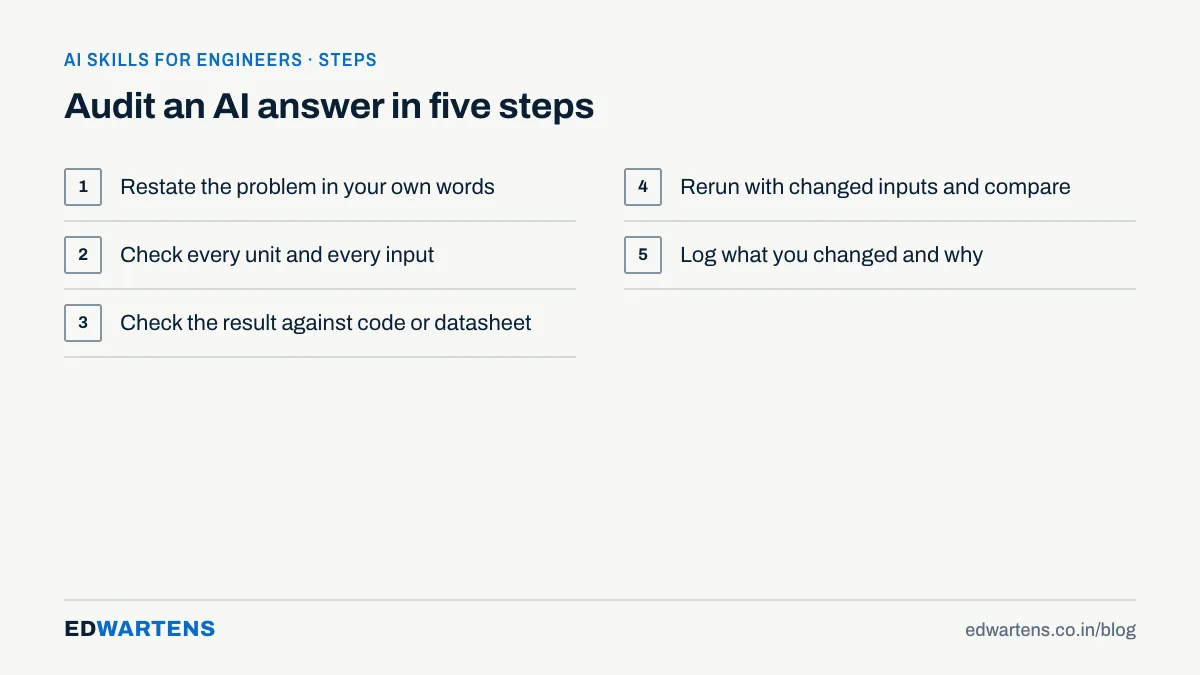
Before you paste anything into a chatbot
Client names, unreleased drawings, tender prices and personal data should not go into a public assistant. Many employers and clients forbid it, and the rules on personal data are strict: see our DPDP Act compliance checklist. Use made-up or rounded values when you only want a method, and use your employer's approved tool for real data.
Data skills to add next
AI answers are only as useful as the data you give them. The cheapest upgrade is Excel: tables, lookups and tolerance checks. See our wave post on Excel for engineers and its twelve formulas. After Excel, learn enough Python to automate repeated calculations, which our guide to Python for automation engineers introduces, and see AI copilots in PLC programming for a branch where this is already happening.
A free first route, and when a paid programme makes sense
Start free. Take AI Essentials for Work (about 6.5 hours) to learn what assistants can and cannot do, then Prompt Engineering for Engineers (about 13 hours). Electrical and MEP designers can add AI for Electrical and MEP Design Engineers (about 18 hours), and plant engineers can add AI for Industrial Automation (about 12 hours). The hubs are AI and machine learning and AI for professionals, and the paths are AI foundations and applied AI engineer.
If you later want depth, the Artificial Intelligence Program (AIP) is an online, self-paced course with recorded lessons. It starts from Python and runs through machine learning, deep learning, computer vision, industrial AI and generative AI, with graded projects. It is an option for people who want a structured route, and the free courses above come first.
Watch: large language models in 16 minutes
The video above is Introduction to large language models by Google Cloud Tech, embedded with thanks. EDWartens is not affiliated with the creator. It runs about 16 minutes and explains what a large language model is and how prompting works, and it is a lesson in our free AI for Electrical and MEP Design Engineers course.
Learn it free on EDWartens
Every course above is free to learn. It is a free course with a verifiable certificate of completion, and anyone can check a certificate on the verification page. The certificate is optional and is an EDWartens certificate, not a university or government credential. You can also try the free 3D lab at lab.edwartens.com. Our post on free AI courses with a certificate in India compares the wider market, and top AI skills in demand shows the job-side picture.
Sources (all read 23 November 2026)
- Digit.in, "Top 10 engineering skills in India 2026: LinkedIn Skills on the Rise" (updated 24 February 2026): a skills signal that lists querying, LLMOps and workflow automation among the rising skills.
- PIB backgrounder, "AI in Education: Building India's Talent Pipeline" (3 March 2026): the NASSCOM figures quoted above and the IndiaAI Mission, launched in March 2024.
- Careers360 news, PTI interview with the AICTE chairperson (6 June 2025): AI to be integrated into all branches of technical education.
Q: Can mechanical, civil or electrical engineers learn AI without coding?
A: Yes. Using assistants well is mostly about writing clear prompts, giving the right data and checking the output. Coding helps later, for automating repeated calculations, but it is not the first step.
Q: Will AI replace civil or mechanical engineers?
A: We found no source that says so, and the AICTE statement is about adding AI to the curriculum. Routine drafting will change. Responsibility for a design stays with a qualified engineer.
Q: Which AI course is best for non-CS engineering students in India?
A: Start with a beginner course that does not need coding, such as AI Essentials for Work, then a prompt engineering course aimed at engineers. Choose by whether the lessons practise checking answers.
Q: Is ChatGPT allowed for engineering design calculations?
A: Policy depends on your employer and client. Even where it is allowed, treat every number as unchecked until you have verified it against a formula, a datasheet or the code, and do not paste confidential data.
Q: Do I need Python to use AI in engineering?
A: No. Python helps you automate repeated calculations and read files, which is useful after you can use an assistant safely. Excel and clear prompts come first for most branch tasks.
Q: Is a free AI certificate valid for jobs?
A: A free course certificate shows you finished a course. It is not an exam credential, so pair it with a small project that shows a prompt, a checked answer and what you corrected.
Learn this, free
The courses that teach this
Every lesson, the written notes and the practice are free with an account. Only the certificate is optional and paid.


