

What Qualifications Do You Need to Be a Quantity Surveyor?

The short answer
To be a quantity surveyor you usually need a degree in quantity surveying, construction or civil engineering, then two or more years of supervised site and office work. Chartered status, where you want it, comes after that through the RICS Assessment of Professional Competence. Many Indian surveyors start as civil engineers and learn measurement on the job. The first skill an employer checks is whether you can take quantities off a drawing and defend the answer.
Facts about RICS and the US labour data were checked on the official pages on 1 November 2026 (November 2026). Nothing here is a promise of a job or a pay level.
What a quantity surveyor actually does
A quantity surveyor, or QS, controls the cost of a building project from the first sketch to the final payment. Early on the QS gives the client a cost plan. During design the QS measures quantities from the drawings and writes a bill of quantities. During tender the QS compares the contractors' prices. During construction the QS values the work done each month and prices every change.
Every one of those jobs rests on measurement. A surveyor who cannot turn a drawing into a trustworthy quantity cannot price anything. That is why the question about qualifications is really a question about two things: the paper that gets you in the door, and the skill that keeps you there.
The routes in, compared
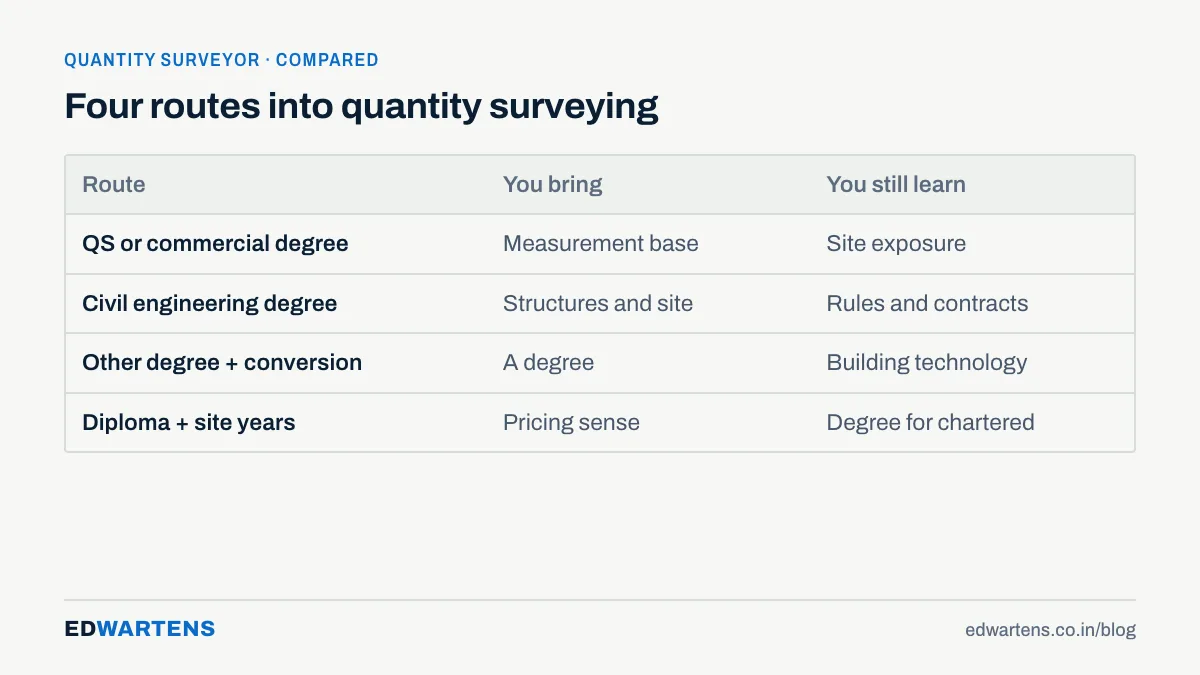
There is no single licence in most countries. Employers and clients look at a mix of degree, experience and professional membership. The table sets out the common routes and what each one gives you.
Route | What you need | What you get | Typical gap to fill |
|---|---|---|---|
Accredited degree in QS or commercial management | A university place | The shortest path to the RICS APC | Site exposure |
Civil or construction engineering degree | A B.E. or B.Tech in civil | Strong structural and site knowledge | Measurement rules and contracts |
Any other degree plus a conversion course | A postgraduate conversion | A route into the same APC | Technical building knowledge |
Diploma or site experience | Years on site as an estimator or engineer | Practical pricing sense | A degree if you want chartered status |
For the chartered route, RICS explains the Assessment of Professional Competence. With an RICS accredited degree and under ten years of experience you follow structured training. With up to five years of experience that training lasts 24 months, and with five to ten years it lasts 12 months. The formal assessment then takes six to twelve months, and you have six years from enrolment to finish.
The final assessment has written submissions, a case study of 3,000 words on a project no older than 24 months, and a 60-minute interview. RICS offers 22 sector pathways, and a quantity surveyor picks the Quantity Surveying and Construction pathway.
Is a civil engineering degree enough in India
A civil engineering degree is the most common starting point in India, and it is a good one. You already understand concrete, steel, masonry and drawings. What most graduates lack is measurement discipline. That means knowing what counts as a separate item, how to deduct an opening, and how to check a number by a second route.
RICS membership is optional in India for most jobs. Many contractors and consultancies hire on a civil degree plus demonstrated estimating skill. RICS matters more if you plan to work for international consultants, in the Gulf, or in the United Kingdom. In that case plan for the accredited degree or conversion route and check the current rules on the RICS site before you commit.
The skill employers test first: measurement
Whatever your qualification, an interviewer will usually hand you a drawing and ask for a quantity. Here is a worked example of the kind of question you should be able to answer in a few minutes. All numbers below were computed in a script and the inputs are shown.
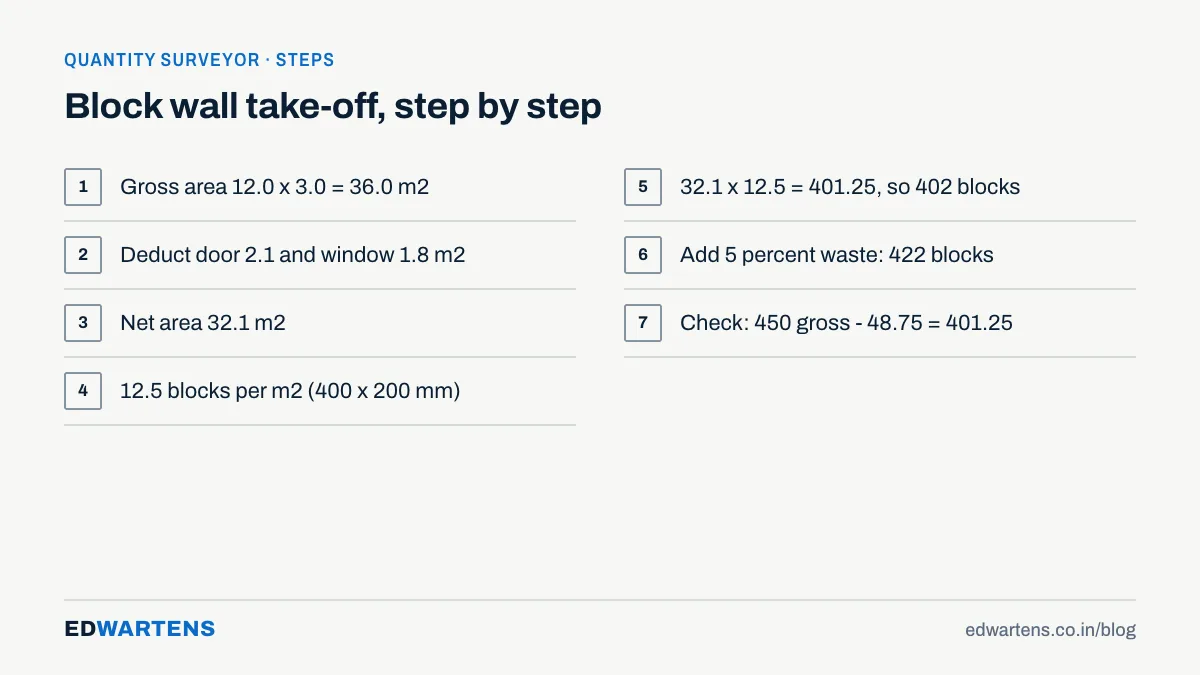
Worked example: a blockwork wall. A wall is 12.0 m long and 3.0 m high. It has one door of 1.0 m by 2.1 m and one window of 1.5 m by 1.2 m. The blocks are 400 mm by 200 mm on the face, which includes the mortar joint.
- Gross area is 12.0 x 3.0 = 36.0 m2.
- Door area is 1.0 x 2.1 = 2.1 m2, and window area is 1.5 x 1.2 = 1.8 m2.
- Net area is 36.0 - 2.1 - 1.8 = 32.1 m2.
- Blocks per square metre is 1 / (0.4 x 0.2) = 12.5.
- Blocks needed is 32.1 x 12.5 = 401.25, which rounds up to 402.
- With 5 percent allowed for breakage and cutting, the order is 421.3, so 422 blocks.
Now check it by a second route, which is the habit that separates a careful surveyor from a fast one. Count the gross blocks as 36.0 x 12.5 = 450. Deduct the openings as (2.1 + 1.8) x 12.5 = 48.75 blocks. The answer is 450 - 48.75 = 401.25, the same as before. Two routes agree, so the take-off can be trusted.
Step | Quantity | Unit |
|---|---|---|
Gross wall area | 36.0 | m2 |
Openings deducted | 3.9 | m2 |
Net wall area | 32.1 | m2 |
Blocks before waste | 402 | no. |
Blocks with 5 percent waste | 422 | no. |
The waste allowance of 5 percent is an assumption for this example. A real project takes it from the specification, the contractor's own records or the estimating rules in use. Measurement rules also differ by family, so the rule for deducting small openings depends on the standard you work to.
Measurement standards you will be asked about
Employers often ask which measurement rules you know. The main families are the RICS New Rules of Measurement, known as NRM, which is the standard for building work in the United Kingdom and widely used internationally. The RICS NRM page lists NRM1 for cost estimating and cost planning, NRM2 for detailed measurement of building works, and NRM3 for maintenance.
In the Gulf, contracts often use POMI, the Principles of Measurement International. For civil engineering works such as roads, drainage and earthworks, CESMM4 is the usual rule set. In India the regional alternative is IS 1200, the method of measurement of building and civil engineering works. Learn the family your target employers use rather than all four at once.
A realistic learning plan
Qualifications take years, but the measurement skill you can start in weeks. A sensible plan has three parts. First, learn the stages of a project and what the surveyor produces at each. Second, practise take-off on real drawings until your two routes agree. Third, learn to build a priced bill and a simple valuation.
The free Quantity Surveying and Building Estimation course follows that order. It has twelve study modules and a final assessment, about 14 hours of video, and it works one two-storey clinic from substructure to final account. Prices in it use cost units, not money, so the method carries to any country.
What the course does not give you
The quantity surveying course teaches you to measure and price, and it gives you a project to show an interviewer. It is a free course with a verifiable certificate of completion, and anyone can check a certificate on our verification page. It is not a degree, it is not RICS membership, and it does not make you a chartered surveyor.
If you want to see how a free certificate is judged by employers, read our honest take on whether free certificates are worth anything in India. The same logic applies here: the certificate matters less than the work you can show behind it.
How to show the skill on a CV
Put a small, checkable piece of work on your CV rather than a list of tools. A take-off sheet with a second-route check is ideal. Write the quantity, the method, the standard you followed and the check. A recruiter who opens it can see in one minute that you measure carefully.
If you are a civil graduate, describe the site tasks that touched cost, such as ordering or checking a subcontractor's claim. For a wider view of building an engineering career in India, our electrical design career roadmap shows the same pattern of skill, software and proof.
What the US labour data says about estimators
The US Bureau of Labor Statistics describes cost estimators as typically needing a bachelor's degree, with construction estimators usually studying construction or engineering. It also says some construction employers prefer work experience, and some estimators qualify through experience alone. Most learn estimating techniques and software on the job. That matches the picture above: a degree helps, experience counts, and practical skill closes the gap.
If you would rather practise this on PLC training panels with an instructor, see our PLC course in Bangalore for the syllabus and duration.
Frequently asked questions
Q: What qualifications do you need to be a quantity surveyor?
A: Most people hold a degree in quantity surveying, construction or civil engineering, then train for two or more years under supervision. For chartered status through RICS you complete the Assessment of Professional Competence. Some estimators qualify through long experience alone.
Q: Do I need RICS membership to work as a quantity surveyor in India?
A: Usually not. Many Indian employers hire on a civil degree and proven estimating skill. RICS membership matters more for international consultancies and for work in the Gulf or the United Kingdom.
Q: Can a civil engineer become a quantity surveyor?
A: Yes. A civil degree gives you the technical base. You then learn measurement rules, bills of quantities, rate build-up and contract valuations, and you practise take-off until your results check by a second route.
Q: How long does the RICS APC take?
A: With an accredited degree and under ten years of experience, structured training lasts 12 or 24 months depending on your experience. The formal assessment then takes six to twelve months, and you have six years from enrolment to finish.
Q: Which measurement standard should I learn first?
A: Learn the one your target employers use. NRM is common for building work in the United Kingdom, POMI in the Gulf, CESMM4 for civil works, and IS 1200 in India. The measurement habits carry across all of them.
Q: Is there a free course to start quantity surveying?
A: Yes. The EDWartens Quantity Surveying and Building Estimation course is a free course with a verifiable certificate of completion. It is not a degree or a chartered qualification.
Learn this, free
The courses that teach this
Every lesson, the written notes and the practice are free with an account. Only the certificate is optional and paid.


