

GATE RA Paper 2027: Robotics and Automation Explained

The short answer
The GATE RA paper is the new Robotics and Automation (RA) test that IIT Madras introduced in GATE 2027. It has 65 questions for 100 marks in three hours: 15 marks of General Aptitude, a common Part A of 60 marks (engineering mathematics, basics of mechatronics and principles of robotics and automation) and a Part B of 25 marks, where you choose Electrical (B1) or Mechanical (B2) inside the exam. The exams run on 6, 7, 13, 14, 20 and 21 February 2027, and registration for GATE 2027 has closed. Qualifying in GATE does not assure a PSU job.
Checked on the GATE 2027 website, the GATE 2027 Information Brochure and the IIT Madras press release on 23 November 2026. The brochure says its dates are liable to change and its paper pairs are tentative. Read the official pages before you act on anything here.
What the GATE RA paper is and why it exists
IIT Madras is the organising institute for GATE 2027, which has 30 test papers. In its press release of 20 July 2026, IIT Madras said a new paper on Robotics and Automation is introduced from GATE 2027, and that the Textile Engineering and Fibre Science (TF) paper becomes a sectional paper inside Engineering Sciences (XE). The same release says the syllabus was revised for the papers after five years.
RA is a mixed paper. Part A is common to everyone, and Part B lets an electrical or a mechanical background show. That design suits the subject: a robot cell needs motors, sensors and control from the electrical side, and links, gears and machine design from the mechanical side. If you are weighing branch choices, our post on moving from mechanical engineering to automation covers the same split from the job side.
The exam structure in one table
Section | Questions | Marks | What it holds |
|---|---|---|---|
General Aptitude (GA) | 10 | 15 | Language and analytical skills |
Part A, common | 39 | 60 | 18 one-mark and 21 two-mark questions |
Part B1 (Electrical) or B2 (Mechanical) | 16 | 25 | 7 one-mark and 9 two-mark questions, chosen in the exam |
Total | 65 | 100 | Three hours |
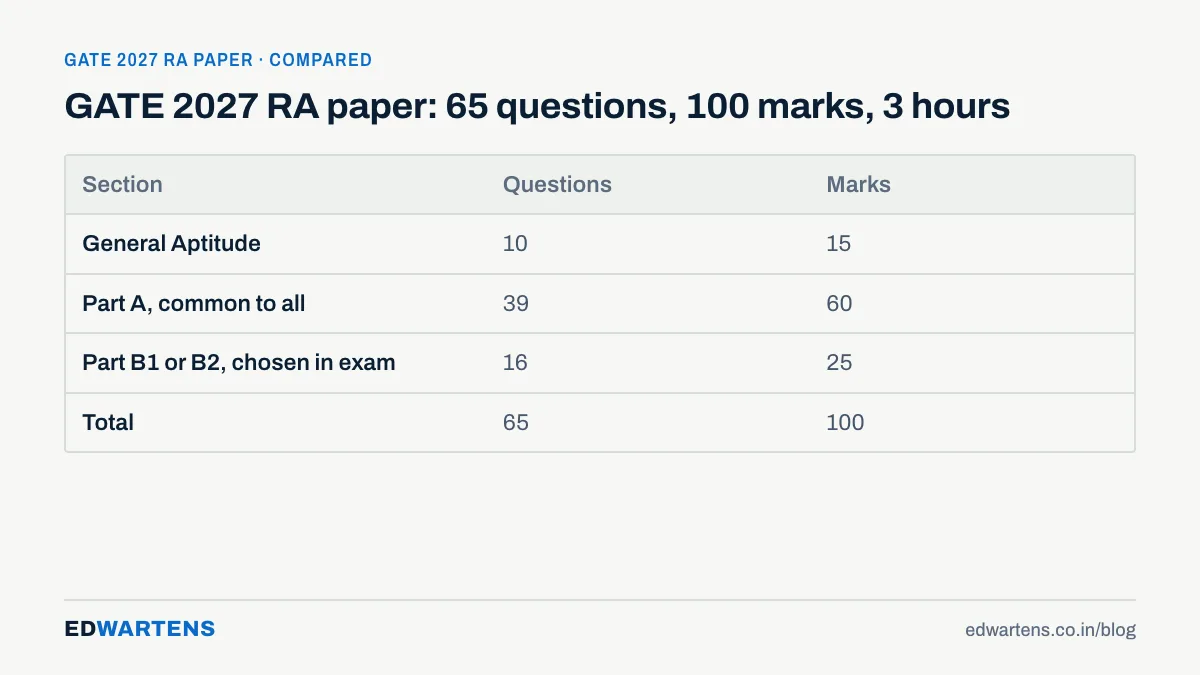
The brochure lists three question types: multiple choice (one correct option), multiple select (one or more correct) and numerical answer type. A wrong multiple-choice answer costs marks, and the other two types do not. The brochure also says there is no partial marking, and that section-wise scores are not given for RA.
Here is a worked example of the negative marking. A one-mark multiple-choice question loses one third of a mark for a wrong answer, and a two-mark one loses two thirds. Suppose a candidate answers 30 one-mark multiple-choice questions, gets 24 right and 6 wrong. The score is 24 minus 6 x 1/3, which is 22 marks, not 24. Guessing only pays when you can remove at least one option with reasons.
The syllabus in plain English
The brochure lists the topics below. The third column is our own reading of where each block shows up in a plant. It is not an official mapping.
Block | Topics the brochure names | Where it shows up |
|---|---|---|
A.1 Engineering mathematics | Linear algebra, calculus, differential equations, probability, numerical methods | Every model and every tuning calculation |
A.2 Basics of mechatronics | Network theorems, digital circuits, sensors, actuators, engineering mechanics, Python, data structures | Reading a sensor, choosing a motor, writing a script |
A.3 Principles of robotics and automation | Serial and parallel manipulators, rotation matrices, forward kinematics, end-effectors, accuracy and repeatability, PLCs in manufacturing, automated storage, CNC, multi-axis positioning | A palletising cell, a pick-and-place station |
B1 Electrical | Analog circuits and embedded systems, signals and systems, control systems | Drive and loop tuning |
B2 Mechanical | Mechanics of materials, kinematics and dynamics, machine design, CAD and CAM | Gripper and arm design |
Two things stand out. First, Part A is wide: circuits, mechanics, Python and robot kinematics sit in one section, so a pure electrical or pure mechanical student must learn the other side. Second, PLCs appear by name, under computer integrated manufacturing in A.3. B1.3 lists P, PI and PID controllers, with Routh-Hurwitz, Nyquist, Bode plots and root loci.
Who can write it, and which pairs are allowed
The brochure says a candidate in the third or a higher year of an eligible undergraduate degree, or one who has already completed it, can appear. A candidate may take one or two papers, and two-paper combinations must come from a table the brochure marks as tentative and subject to change.
Your first paper | Is RA allowed as the second paper? |
|---|---|
EE, ME, IN, EC, CS or DA | Yes, per the brochure's tentative table |
RA itself | The second paper can be EE, ME, DA, CS, EC or IN |
So an electrical or mechanical student can pair RA with their own branch paper. The score stays valid for three years from the day results are announced. If you are choosing between RA and a branch paper only, our guide to the best courses after B.Tech lists other routes that do not depend on one exam.
PSU jobs: what is known and what is not
Section 5.3.2 of the brochure lists public sector undertakings that have used GATE scores in recruitment in past years, for example NTPC, Power Grid, BHEL, IOCL, ONGC and GAIL. It also says plainly that GATE qualification does not assure a PSU job, because it depends on the recruitment procedure of each PSU.
None of the official pages we read says that any PSU will accept the RA paper. So do not plan a PSU career around RA yet. When a PSU publishes its recruitment notice, check which paper codes it lists. If RA is not there, it is not accepted for that notice. RA fits better as a route to M.Tech and research places in robotics and automation, and as a second paper that shows applied breadth.
Applied practice that helps, and what does not
GATE questions are theory and calculation. Free applied courses cannot replace past-paper practice, and none of ours is GATE preparation. What they do is make the A.3 and B1.3 topics concrete, so that terms like PID, PLC scan and robot frames mean something you have seen run.
RA topic | Free applied course on EDWartens | What it adds |
|---|---|---|
P, PI, PID controllers (B1.3) | Tuning a loop and watching windup | |
PLCs in manufacturing (A.3) | A first ladder program running in simulation | |
Robot frames and motion (A.3) | Tool and user frames, TP programs | |
Transfer functions, root locus, Bode (B1.3) | Plotting what the theory describes |
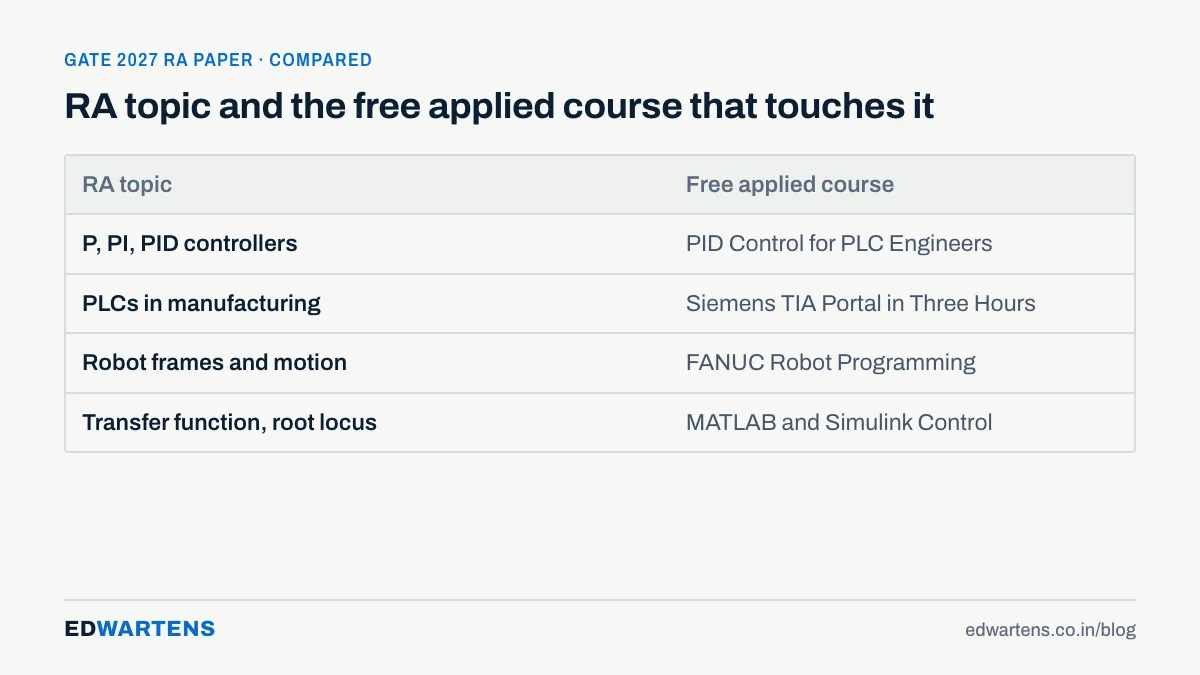
The official site has a Mock Test Links page, which is the right place for exam-style practice. For the robotics side of the job market, see our guide to industrial robotics training and the robot installation figures for India.
Dates to put in your calendar
Event | Date shown on the official site |
|---|---|
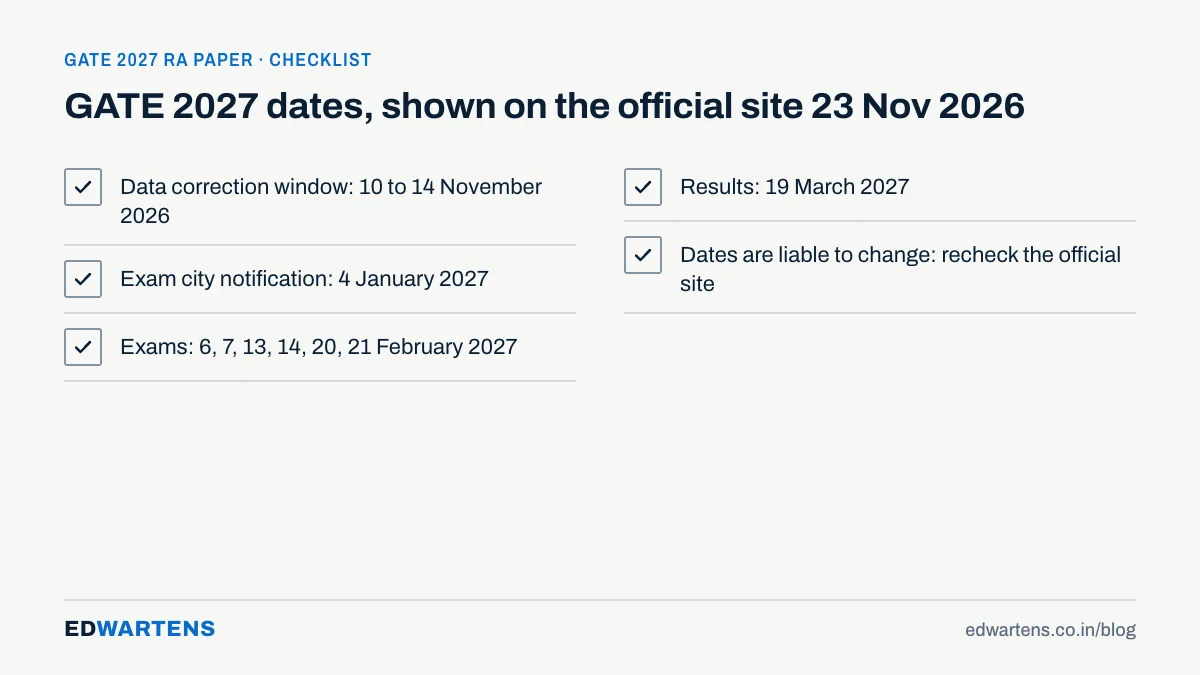
Application data correction window | 10 to 14 November 2026 |
Exam city notification | 4 January 2027 |
Admit card download | To be announced |
Examinations | 6, 7, 13, 14, 20 and 21 February 2027, two sessions a day |
Results | 19 March 2027 |
The official site shows new application registration as closed. We found no announced dates for GATE 2028, so any date you see for it elsewhere is a guess.
Watch: what PID control is
The video above is What Is PID Control? | Understanding PID Control, Part 1 by MATLAB, embedded with thanks. EDWartens is not affiliated with the creator. It runs about 12 minutes and explains what the proportional, integral and derivative terms do, which is the core of the P, PI and PID line in section B1.3.
Learn it free on EDWartens
If you want to see automation running while you study, start with the PID Control for PLC Engineers course. It is about 13 hours over four weeks and covers what P, I and D each do, tuning by hand and by rule, anti-windup and filtering. It is a free course with a verifiable certificate of completion, and anyone can check a certificate on the verification page. The robot and PLC hubs are at free robotics courses and free PLC courses, and the free 3D lab at lab.edwartens.com lets you practise without hardware.
If you are a graduate or diploma holder who wants a structured, instructor-led route into PLC, HMI and SCADA work, the live online EPGDIA teaches Siemens and Delta PLC, HMI and SCADA over four weeks. It is an industrial automation programme and is not a GATE course.
Sources (all read 23 November 2026)
- GATE 2027 Information Brochure, IIT Madras: pattern, marking, RA paper structure, syllabus, eligibility, paper combinations, score validity and the PSU statement.
- GATE 2027 official website: dates, registration status and notices.
- IIT Madras press release, 20 July 2026: the new RA paper and the syllabus revision.
Q: What is the GATE RA paper?
A: It is the Robotics and Automation test introduced in GATE 2027 by IIT Madras. It has 65 questions for 100 marks, with General Aptitude, a common Part A and a Part B where you pick Electrical or Mechanical.
Q: Who is eligible to write GATE RA?
A: The brochure allows candidates in the third or a higher year of an eligible undergraduate degree, and those who have completed one. Check Table 2 of the current brochure for your exact degree before relying on this.
Q: Can I take RA along with Electrical or Mechanical?
A: The brochure's tentative table allows EE and ME as a pair with RA, in either order, along with IN, EC, CS and DA. You can appear for one or two papers only, so confirm the table on the official site.
Q: Will PSUs recruit through GATE RA?
A: We found no official statement that they will. The brochure says GATE does not assure a PSU job and each PSU sets its own recruitment procedure, so read each PSU's own notice for the accepted paper codes.
Q: Is the RA paper harder than ME or EE?
A: There is no official data to say, and the paper is new, so there are no past RA papers to compare. Part A mixes circuits, mechanics, Python and robotics, so cover the side that is not your branch first.
Q: Did the syllabus change for other GATE 2027 papers?
A: Yes. The brochure says the syllabus of the GATE 2027 papers has been revised, TF moved into the XE sectional paper, and the paper codes of the XE, XH and XL sectional papers changed.
If you want the PLC side of a robot cell taught in a classroom, our page on robotics training in Bangalore explains what is covered there and what is left to the free robot programming courses.
Learn this, free
The courses that teach this
Every lesson, the written notes and the practice are free with an account. Only the certificate is optional and paid.


