PLC Training in India 2026: Formats, Cities and Costs

The short answer
PLC training in India comes in four formats: government institutes (NSTI, MSME tool rooms such as CTTC, NIELIT), OEM courses from Siemens and Rockwell, private institutes, and free online courses. Government courses are the cheapest classroom option: an NSTI short course costs a private candidate ₹1,000 a week, and CTTC Bhubaneswar charges ₹8,000 for a one-month PLC course in 2025-26. OEM courses are short and expensive: Rockwell's five-day Studio 5000 Level 1 course is listed at ₹57,772 plus tax in its 2026 India calendar. Private institutes sit in between and vary the most, so judge them on hardware hours, brands and written placement terms rather than on the brochure. If you have never written a rung of ladder logic, start with a free course before you pay anyone.
The four kinds of PLC training in India
Most people searching for "PLC training in India" are comparing things that are not really comparable. A one-week OEM course for a maintenance engineer and a six-month programme for a fresher solve different problems. Here is what each format is actually for.
1. Government institutes
These are the best-value classroom courses in the country, and most students never hear about them.
- NSTI (National Skill Training Institutes) under the Directorate General of Training run short courses of one to four weeks for working technicians and private candidates. NSTI Chennai's 2026-27 calendar includes a one-week "PLC Programming using Siemens S7 400/1200/1500" course and a two-week "PLC Programming using Siemens S7 1200 with HMI and SCADA" course. Private candidates pay ₹1,000 per week plus a ₹100 registration fee.
- MSME Technology Centres and tool rooms (CTTC Bhubaneswar, CITD Hyderabad and others) run one-month PLC and SCADA courses for diploma and degree students, and longer programmes. CTTC's 2025-26 programme lists PLC (1 month, ₹8,000), SCADA (1 month, ₹8,000), a six-month "Process Designer: Automation" course at ₹36,000 and a one-year Post Diploma in Industrial Automation and Robotics at ₹54,000.
- NIELIT runs short online and classroom automation courses. NIELIT Calicut's four-week online "Industrial Automation with PLC and SCADA" was priced at ₹4,500 including GST for its May 2025 batch.
- State skill missions such as ASAP Kerala run longer industry-partnered courses. ASAP's 300-hour offline Industrial Automation course lists a fee of ₹47,200 including GST.
The catch: batches fill fast, schedules are fixed, there is usually one brand (often Siemens), and there is no placement support worth the name. They are excellent for learning, weak for getting hired.
2. OEM training (Siemens SITRAIN, Rockwell)
Siemens runs SITRAIN in India and Rockwell runs an India customer training calendar. These courses are written by the manufacturer, use current hardware and are what companies send their own engineers to. They are short and priced for employers. Rockwell's 2026 India calendar lists Studio 5000 Logix Designer Level 1 (CCP299) at ₹57,772 per delegate for five days, excluding tax, at its Noida venue, and Level 3 Project Development at ₹46,200 for four days. Siemens SITRAIN India shows a classroom fee only when a batch is scheduled (on 5 October 2026 its core TIA Portal courses had no dates listed), and sells a one-year SITRAIN access e-learning subscription for ₹21,500, so ask SITRAIN for the current classroom fee before you plan around it. Our Siemens PLC training in India guide covers every Siemens route by budget.
If you are searching for Allen Bradley PLC training in India, the Rockwell calendar is the official route, and it is aimed at people already working on ControlLogix plants. For a fresher, paying ₹58,000 plus GST for five days is rarely the right first step.
3. Private institutes
Private institutes are where most students in India actually train. Duration runs from a few weeks to a year, fees from about ₹15,000 to well over ₹1 lakh, and quality ranges from excellent to useless. The good ones give you hours on real panels, several brands and honest placement terms. The weak ones give you a simulator, a certificate and a WhatsApp group. Section five below is a scorecard for telling them apart.
4. Free online courses
You can learn the fundamentals of ladder logic, timers, counters, analog scaling and HMI work for nothing. EDWartens runs free courses where every module, the notes, the practice tasks and the final assessment cost ₹0; the only paid item is an optional certificate after you pass (₹459 beginner, ₹559 intermediate, ₹959 advanced, including GST). Good starting points are Siemens TIA Portal and Allen-Bradley Studio 5000. For a comparison of every free option, see free PLC training online in 2026.
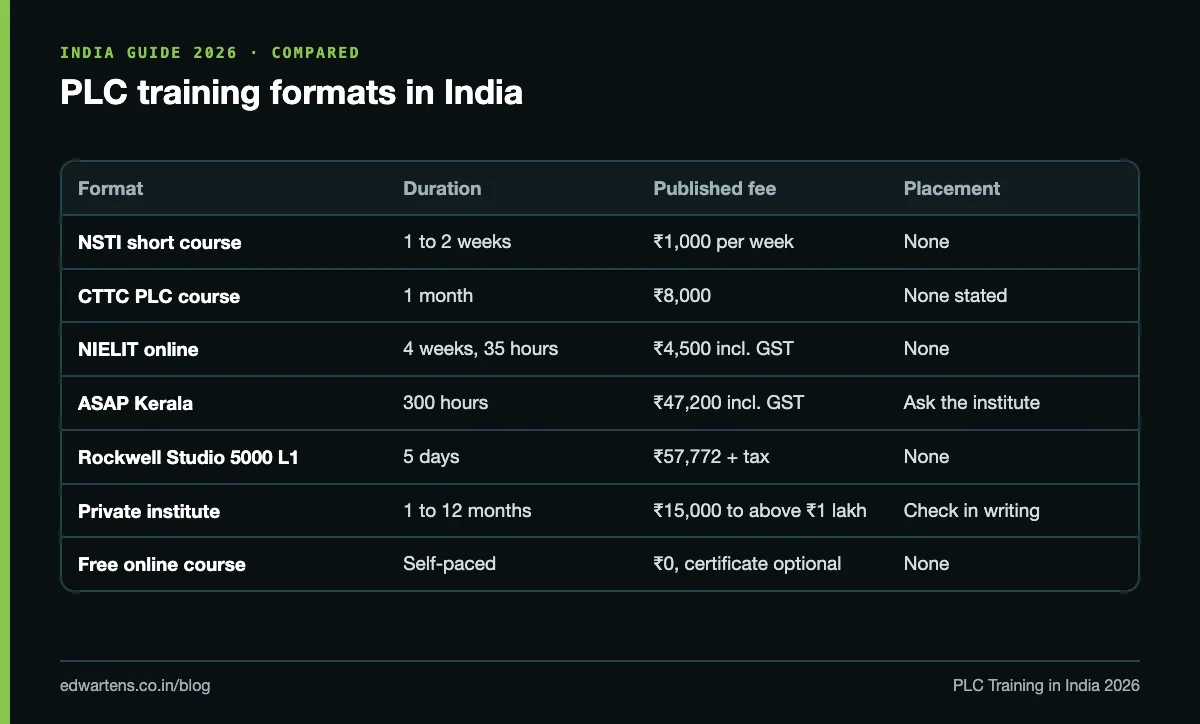
PLC training in India by format: duration and cost
| Format | Example | Duration | Fee (published) | Placement help |
|---|---|---|---|---|
| NSTI short course | Siemens S7-1200 with HMI and SCADA, NSTI Chennai | 2 weeks | ₹1,000 per week + ₹100 registration | None |
| MSME tool room, short | PLC course, CTTC Bhubaneswar 2025-26 | 1 month | ₹8,000 + ₹1,000 registration | None stated |
| MSME tool room, long | Post Diploma in Industrial Automation and Robotics, CTTC | 1 year (1,560 hours) | ₹54,000 | Ask the institute |
| NIELIT online | Industrial Automation with PLC and SCADA, NIELIT Calicut | 4 weeks (35 hours) | ₹4,500 incl. GST | None |
| State skill mission | Industrial Automation, ASAP Kerala | 300 hours | ₹47,200 incl. GST | Ask the institute |
| OEM (Rockwell) | Studio 5000 Level 1, CCP299, Noida | 5 days | ₹57,772 + tax | None |
| Private institute | Varies | 1 to 12 months | about ₹15,000 to above ₹1 lakh | Varies, check in writing |
| Free online | EDWartens free courses | Self-paced | ₹0 (certificate optional) | None |
Fees are as published by each institute in its 2025-26 or 2026 schedule. They change every year, so confirm on the institute's own site before you travel.
Where PLC jobs and training cluster in India
Training is only half the decision. The other half is where the jobs are, because the first job usually comes through a local network: an internship, a panel builder, a system integrator who knows your trainer. These are the clusters that matter.
| Cluster | Main industries | What they hire PLC people for |
|---|---|---|
| Bangalore (Peenya, Bommasandra, Electronic City, Hosur Road) | Machine builders, electronics, aerospace, special-purpose machines, OEM offices | Programming, commissioning, application engineering |
| Pune and Chakan | Automobile and auto components, machine tools, process equipment | Line automation, maintenance, robot cells |
| Chennai and Sriperumbudur | Automobiles, electronics assembly, EV and component plants | Maintenance, line commissioning, SCADA |
| Hyderabad | Pharma, bulk drugs, defence and aerospace | Validated automation, DCS and SCADA |
| Coimbatore | Pumps, motors, textiles machinery, foundries | Panel building, small PLC and drive work |
| Ahmedabad and Vadodara | Chemicals, pharma, power equipment, engineering | Process control, DCS, instrumentation |
| Delhi NCR (Noida, Gurgaon, Manesar) | Automobiles, two-wheelers, electronics, integrators | Maintenance, system integration |
| Kerala (Kochi and around) | Refining, ports, food processing, chemicals | Process instrumentation, maintenance |
A useful rule: process-heavy regions (Gujarat, Hyderabad pharma, Kochi refining) reward instrumentation and DCS skills on top of PLC. Discrete manufacturing regions (Pune, Chennai, NCR) reward fast troubleshooting on Siemens, Rockwell and Mitsubishi lines. Bangalore has both, plus a large number of machine builders and integrators who need programmers rather than only maintenance staff. We compared three cities in more detail in Bangalore vs Chennai vs Pune for PLC training.
What it pays when you get there
Pay at entry level is modest everywhere. AmbitionBox's self-reported data for PLC Automation Engineers in India (seen October 2026) runs from about ₹1.8 lakh to ₹7 lakh a year across one to seven years of experience, with Bangalore's band (about ₹2 lakh to ₹8.3 lakh) slightly above Pune and Chennai. Self-reported figures skew towards people who choose to post them, so treat them as a direction, not a promise. Our automation engineer salary guide breaks it down by role.
How to choose: a scorecard
Score any course out of 10 on each line below. A course scoring under 50 out of 80 is not worth a large fee, whatever the brochure says.
- Hardware hours. How many hours will you personally spend wiring and programming a real PLC, not watching one? Ask for the number.
- Brands. Siemens and Allen-Bradley at minimum. Mitsubishi, Delta, Omron or Schneider add value in specific regions.
- Beyond the PLC. HMI, SCADA, VFDs, sensors and field wiring. Employers hire for the whole panel.
- Trainer background. Has the trainer commissioned a plant in the last five years?
- Batch size per kit. Two students per trainer kit is good. Eight is a lecture.
- Placement terms in writing. "Assistance" means very little. Ask for the written policy and the refund conditions.
- Verifiable certificate. Can an employer check it online?
- Total cost. Fee, GST, registration, hostel, travel and software, added up.
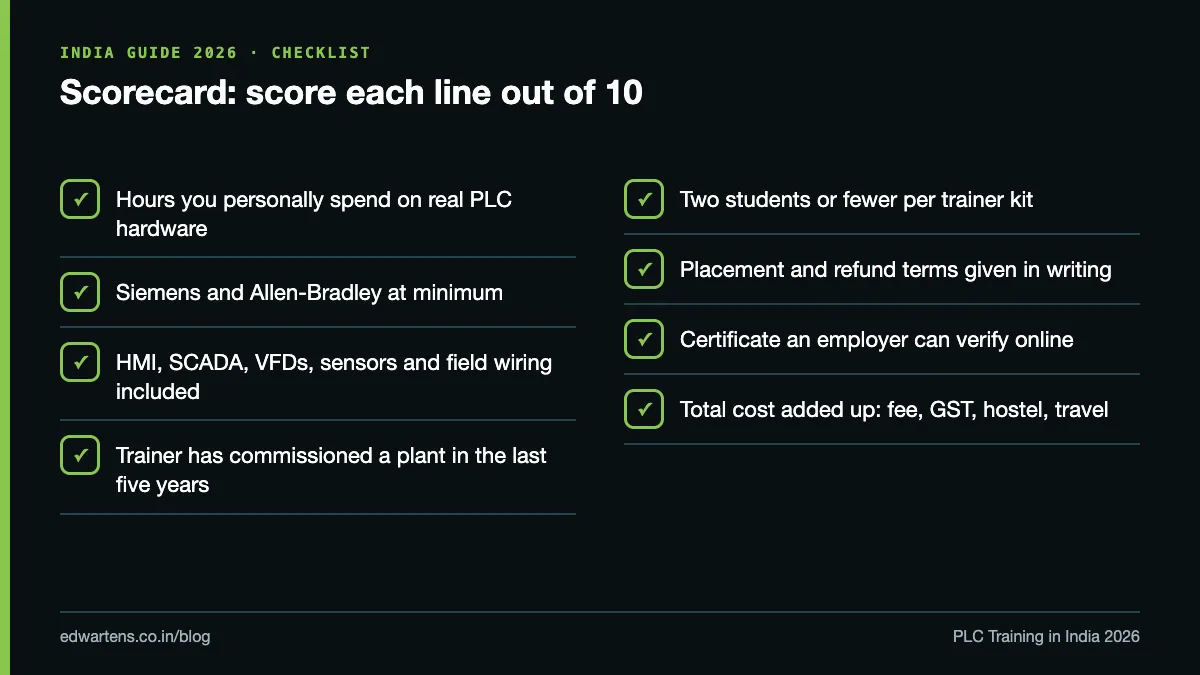
Government courses score high on cost and trainer credibility, low on placement. OEM courses score high on hardware and certificate, very low on cost for an individual. Private institutes can score anywhere, which is exactly why you need the scorecard. If you are comparing institutes in one city, our institute checklist goes deeper.
Why Bangalore is a strong place to train
Bangalore is not the only place to learn PLCs, and it is not the cheapest place to live. But three things make it a strong choice for someone who wants a programming or commissioning job rather than a maintenance role.
First, density of employers that write code. Machine builders, special-purpose machine makers, automation integrators and the India offices of large OEMs are concentrated around Peenya, Bommasandra, Electronic City and Whitefield. Second, the industry mix is broad: electronics, aerospace, pharma packaging, warehousing and data centres all need controls people, so you are not tied to one sector's hiring cycle. Third, short travel distances to Hosur and Tumkur industrial belts widen the range of interviews you can attend in a week.
If Bangalore suits you, our page on PLC training in Bangalore covers the local options in detail. EDWartens runs the Automation Engineer Program from Electronic City: 20 PLC brands plus SCADA, HMI and drives on hands-on panels, run in assessment-gated phases over 3 to 12 months. Fees are agreed per candidate after counselling and are not published. The written job guarantee (100% fee refund if you complete every phase and are not placed) is subject to the Placement Policy; conditions apply.
What is not worth paying for
- A course that is only a simulator. Simulators are fine for practice and are free. You pay for hardware time.
- "International certification" with no verification link. If an employer cannot check it, it adds nothing to your CV.
- A five-day OEM course as your first course. It assumes you already know the basics. Learn those free first.
- Twelve brands in four weeks. You will learn none of them properly. Two brands done well beats twelve done badly.
Read next: PLC course duration and fees in India, government PLC training institutes and which PLC certifications count.
Frequently asked questions
Q: Which is the best PLC training in India for a fresher?
A: The best option depends on budget and location, but for most freshers it is a free online course first, then a classroom course with real hardware hours, at least Siemens and Allen-Bradley, and written placement terms. Government short courses are excellent value for the basics.
Q: How much does PLC training cost in India?
A: Published 2025-26 fees run from ₹4,500 (NIELIT, four weeks online) and ₹8,000 (CTTC, one month) to ₹47,200 (ASAP Kerala, 300 hours) and ₹57,772 plus tax (Rockwell, five days). Private institutes range from about ₹15,000 to above ₹1 lakh.
Q: Is there government PLC SCADA training in India?
A: Yes. NSTIs run one to two week Siemens PLC, HMI and SCADA courses at ₹1,000 a week for private candidates, and MSME tool rooms such as CTTC run one-month PLC and SCADA courses for diploma and degree students.
Q: Where can I get Allen Bradley PLC training in India?
A: Rockwell Automation runs official courses from its Noida training venue, with Studio 5000 Level 1 listed at ₹57,772 plus tax for five days in 2026. Free Studio 5000 courses and private institutes are the usual route for freshers.
Q: Which city is best for PLC training in India?
A: Choose the city where you want your first job. Bangalore suits programming and commissioning roles, Pune and Chennai suit automobile lines, and Gujarat and Hyderabad reward process and DCS skills.
Q: Can I learn PLC online and still get a job?
A: You can learn the logic online, but most employers will test you on wiring and troubleshooting real hardware, so plan for some hands-on time before interviews.
Where to start
Do one free course end to end before you pay for anything: Siemens TIA Portal takes most people a few weeks and costs ₹0. If you then want hands-on training with a job route, talk to our counsellors through the contact page and bring your scorecard.
Learn this, free
The courses that teach this
Every lesson, the written notes and the practice are free with an account. Only the certificate is optional and paid.